Principal Data Analyst full preview

32 Data Analyst Resume Examples

EchoCV

Written by The Echocv Team

Updated: 4/24/20238 min read

See all resume examples in this guide, or generate your own resume example with your personalized prompt

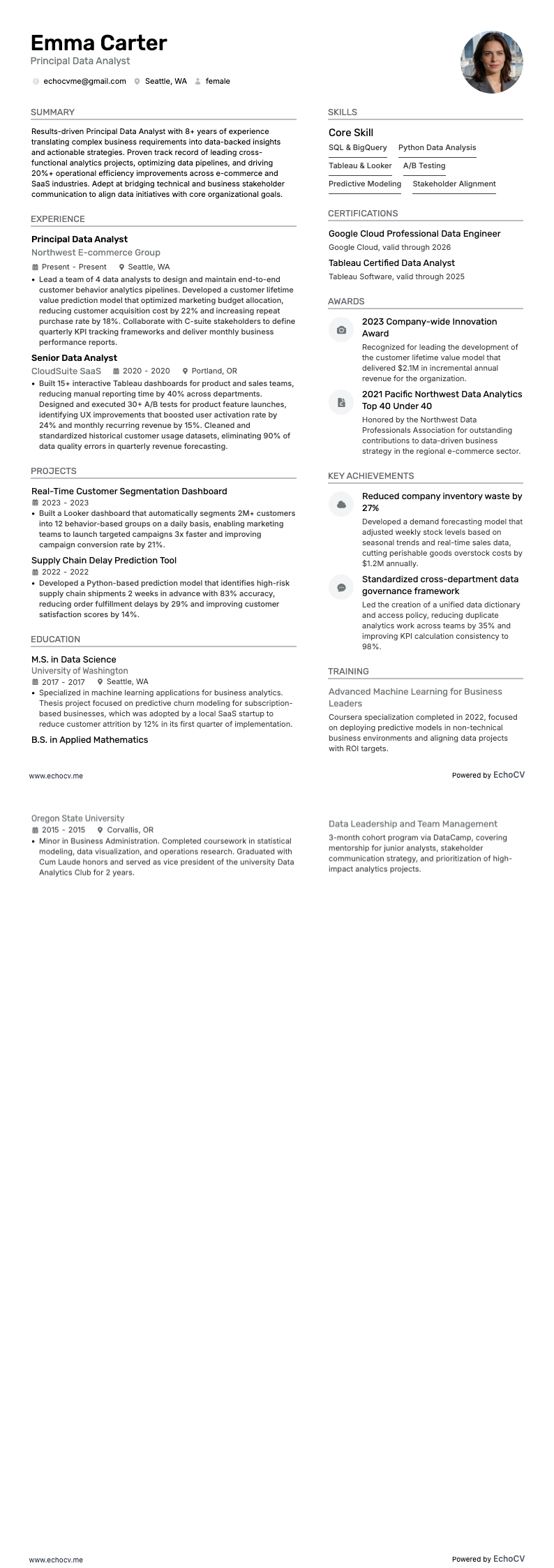
Principal Data Analyst example resume

Principal Data Analyst

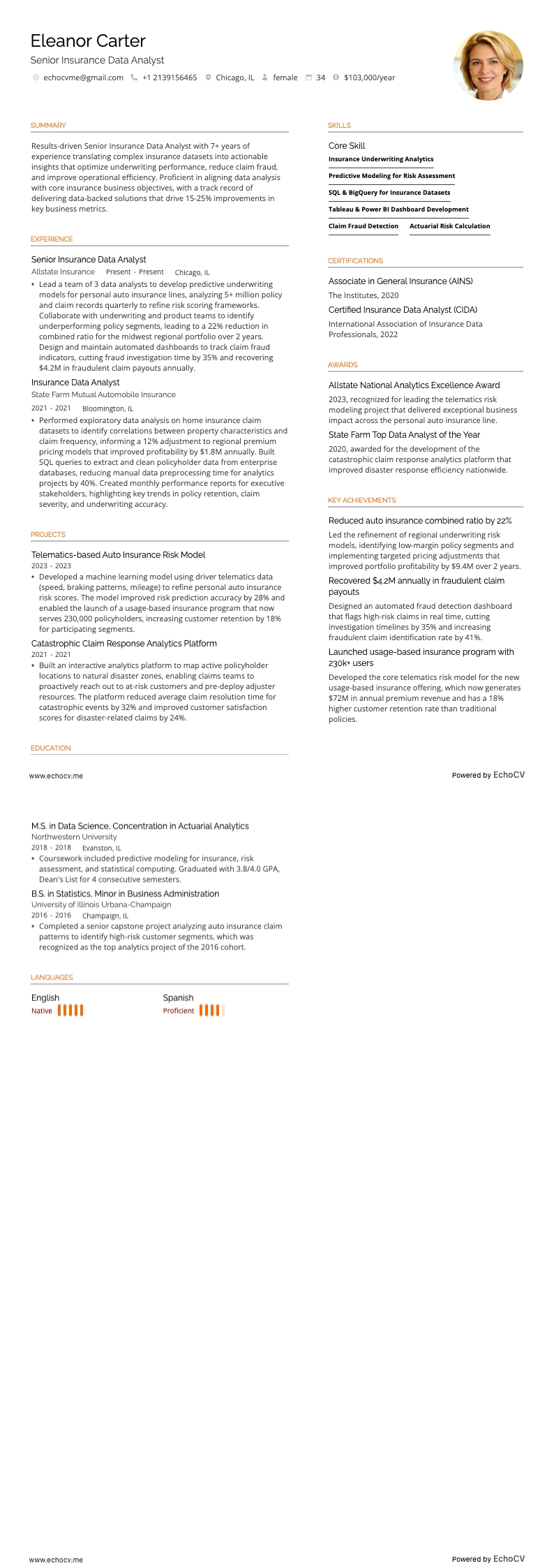
Senior Insurance Data Analyst example resume

Senior Insurance Data Analyst

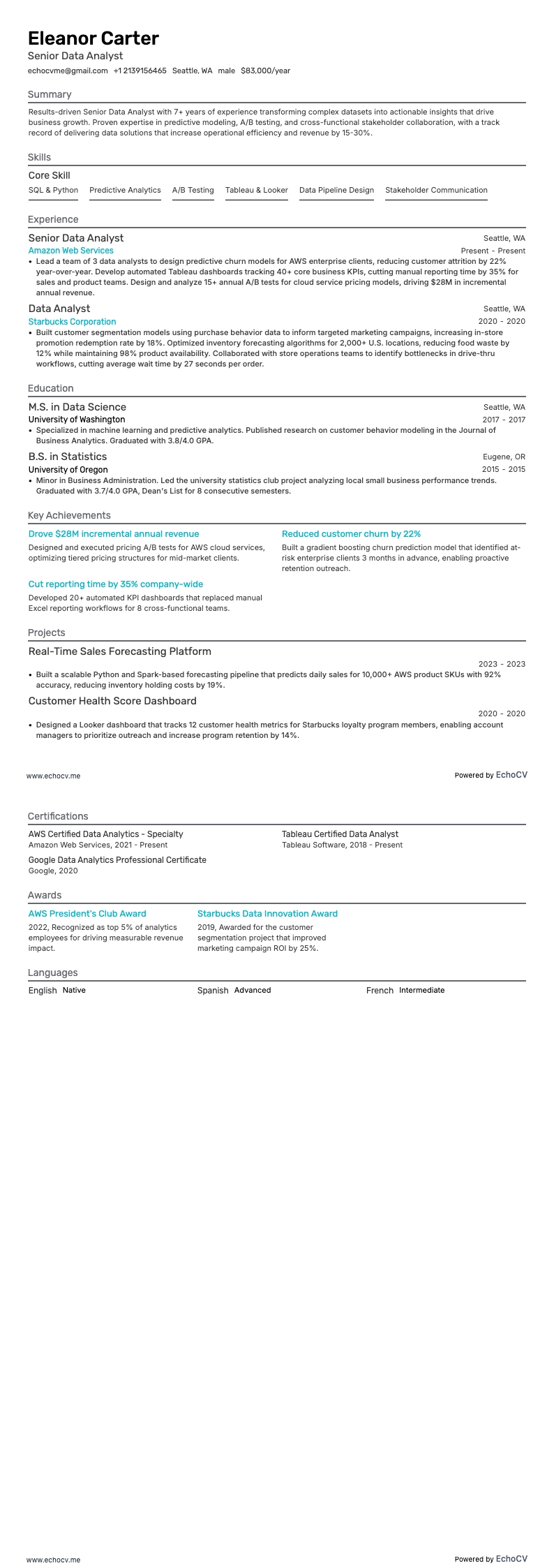
Senior Data Analyst example resume

Senior Data Analyst

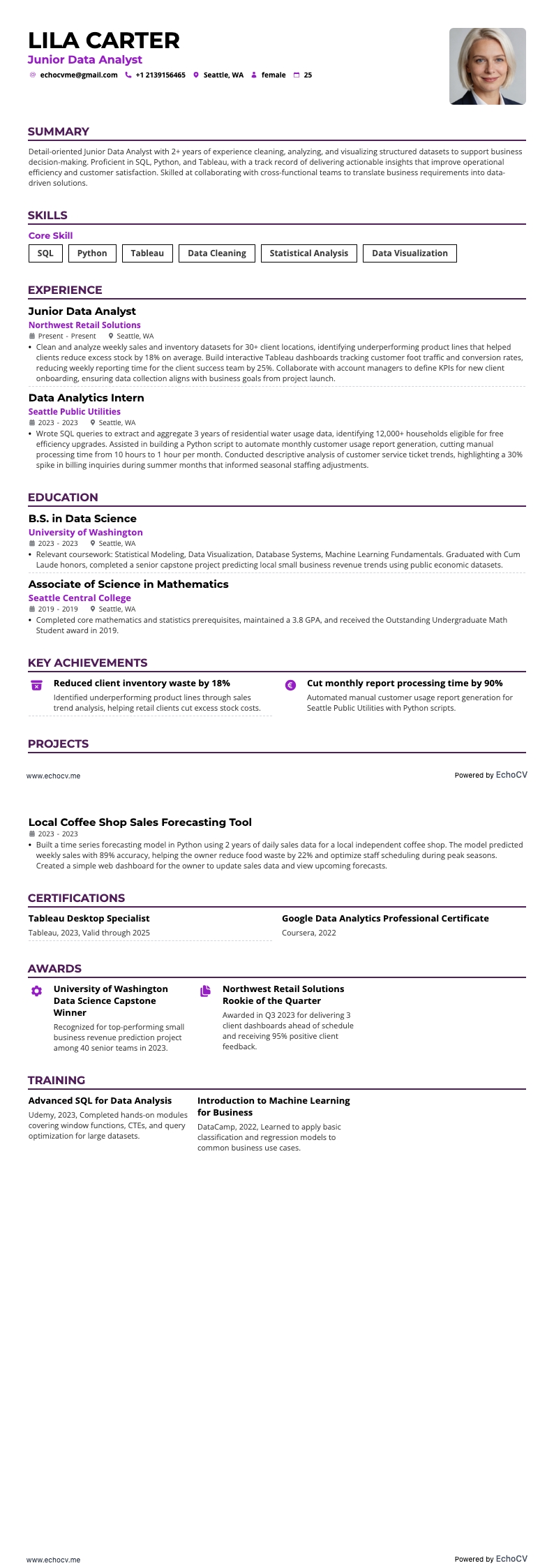
Junior Data Analyst example resume

Junior Data Analyst

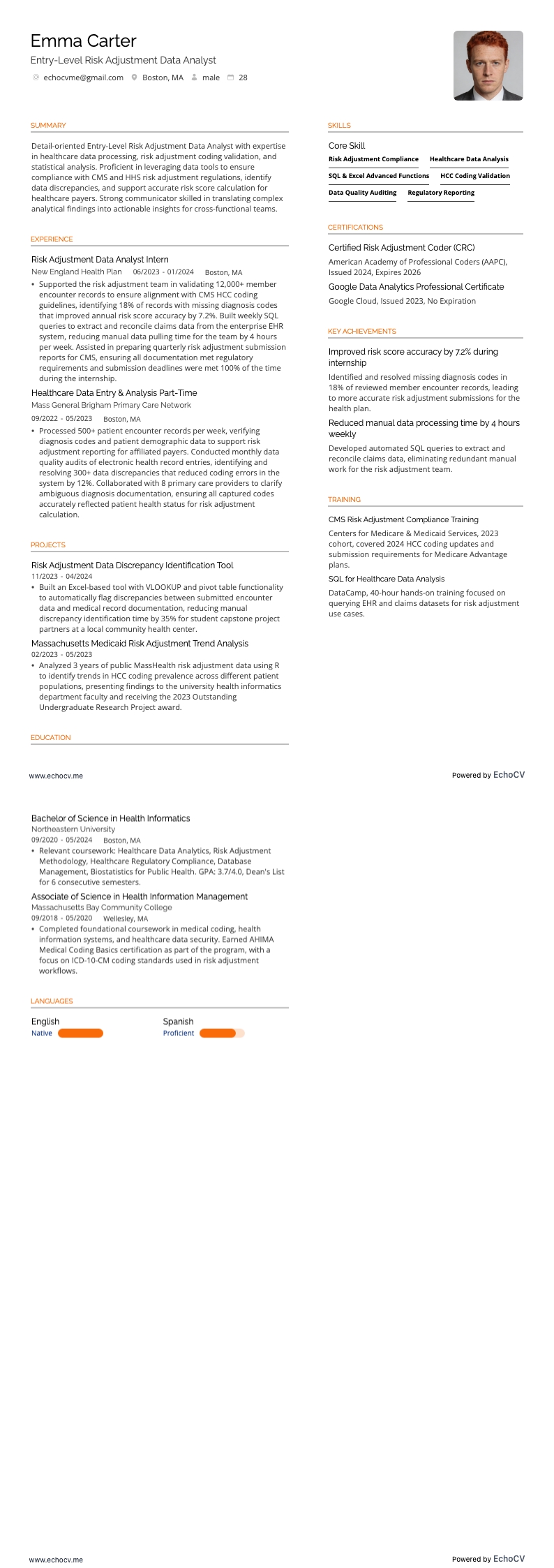
Entry-Level Risk Adjustment Data Analyst example resume

Entry-Level Risk Adjustment Data Analyst

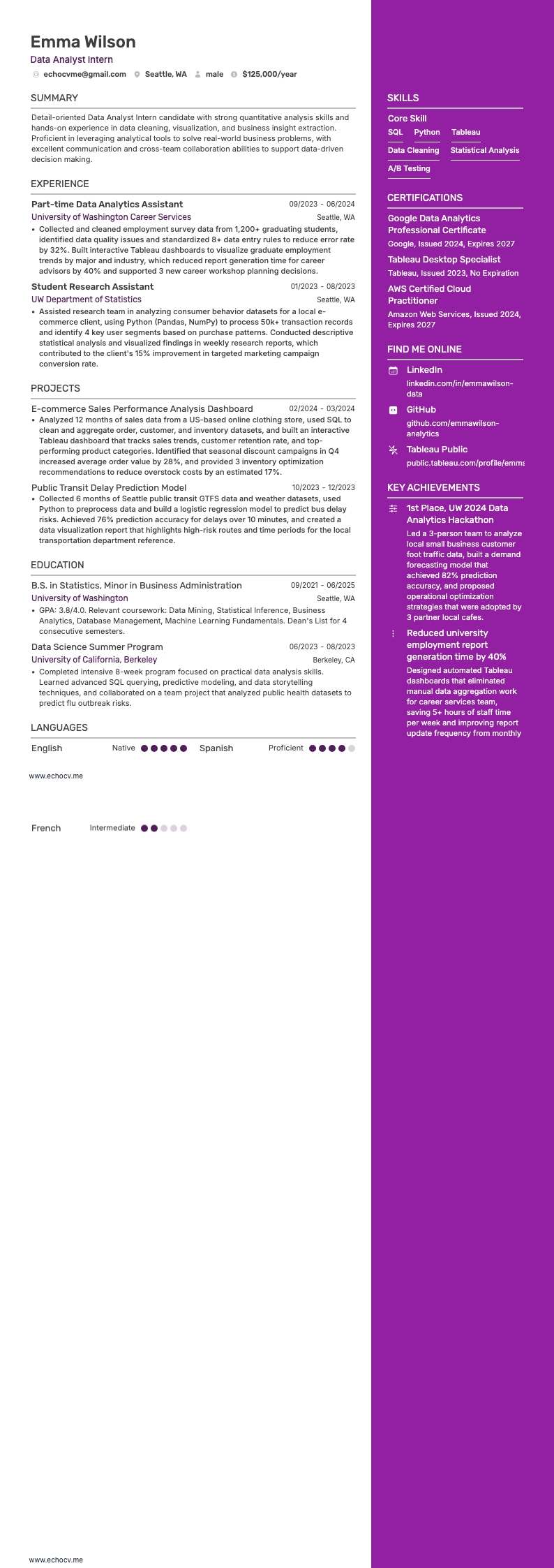
Data Analyst Intern example resume

Data Analyst Intern

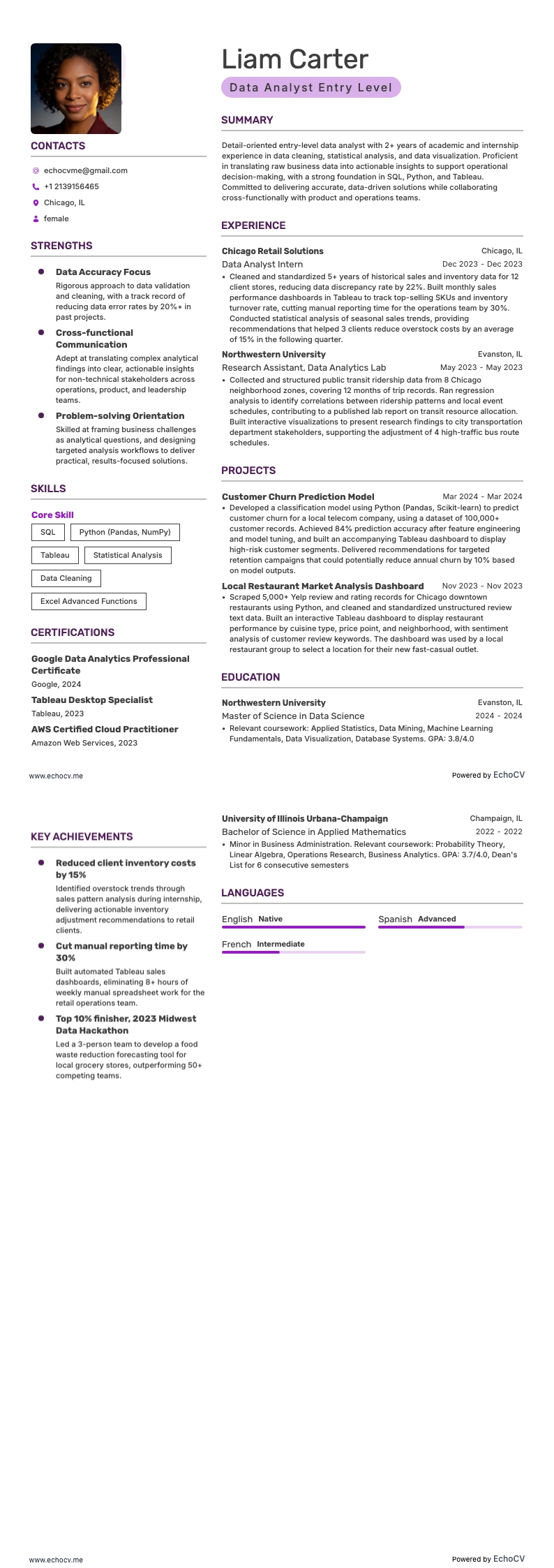
Data Analyst Entry Level example resume

Data Analyst Entry Level

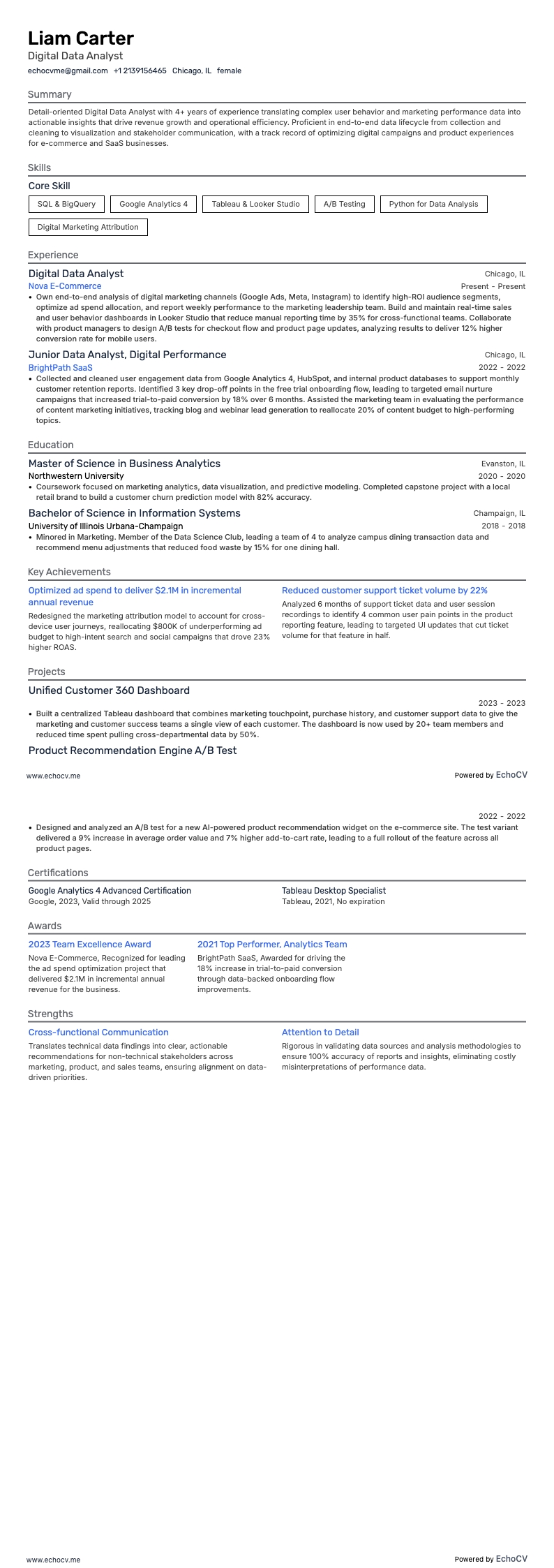
Digital Data Analyst example resume

Digital Data Analyst

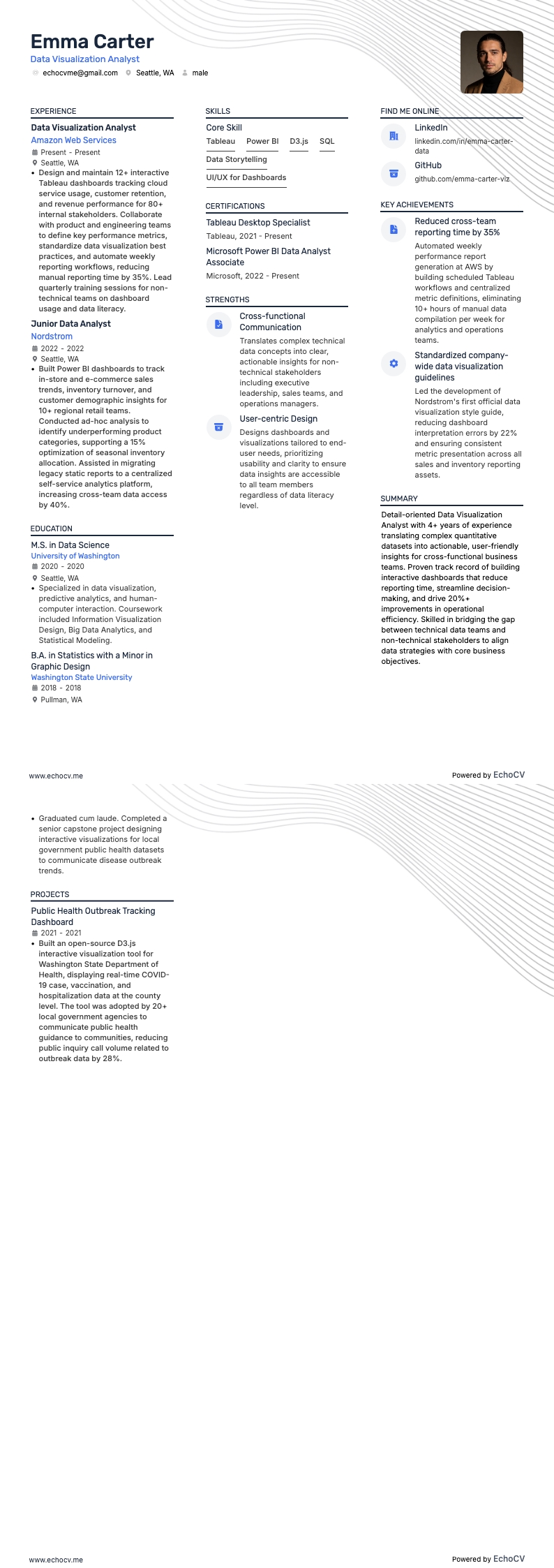
Data Visualization Analyst example resume

Data Visualization Analyst

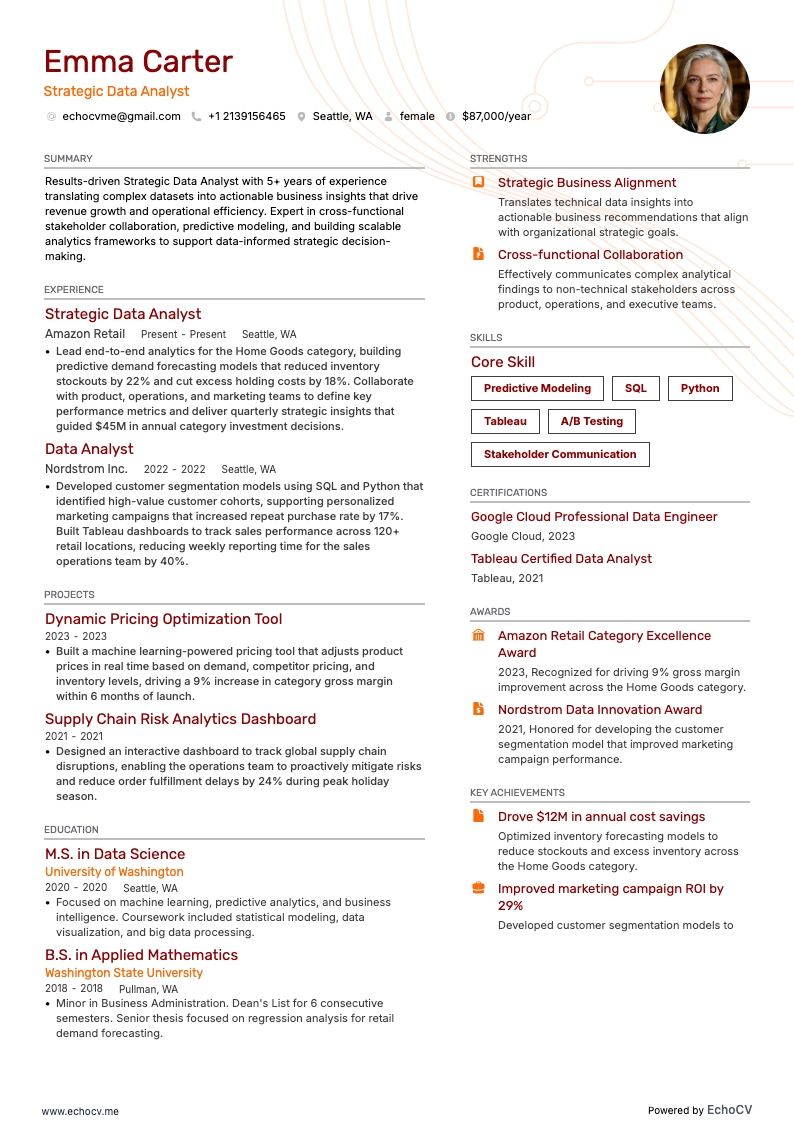
Strategic Data Analyst example resume

Strategic Data Analyst

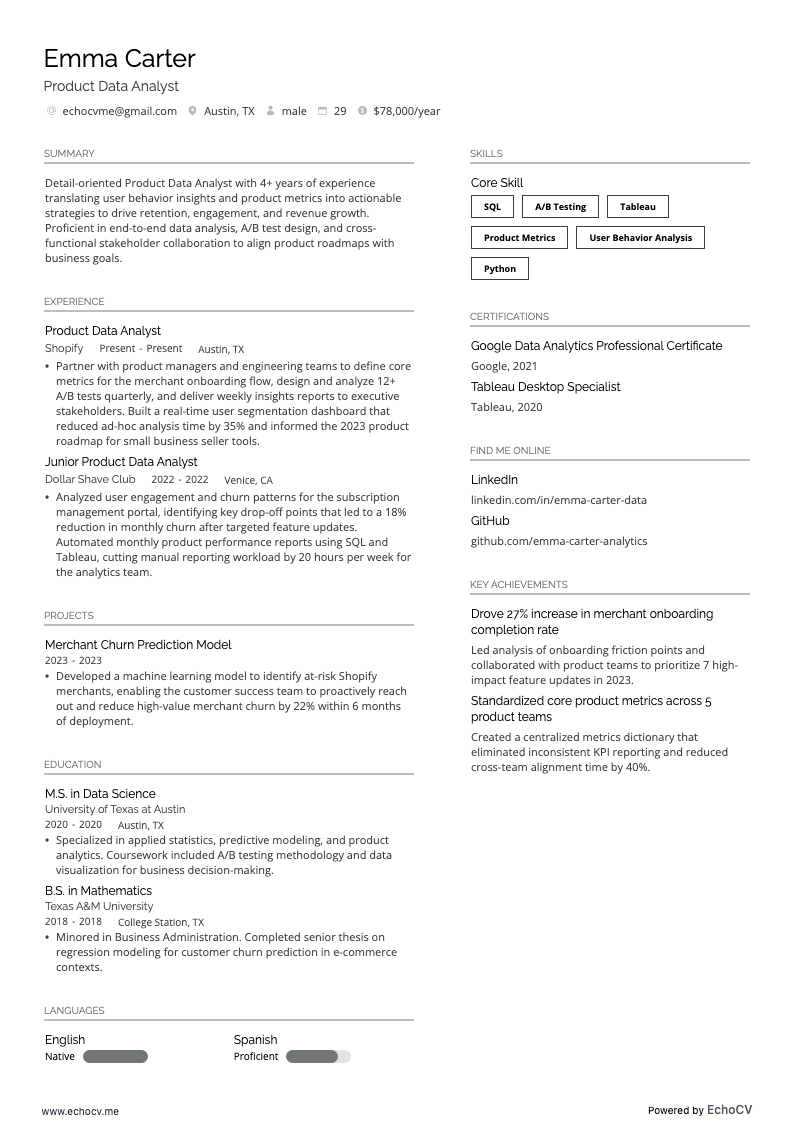
Product Data Analyst example resume

Product Data Analyst

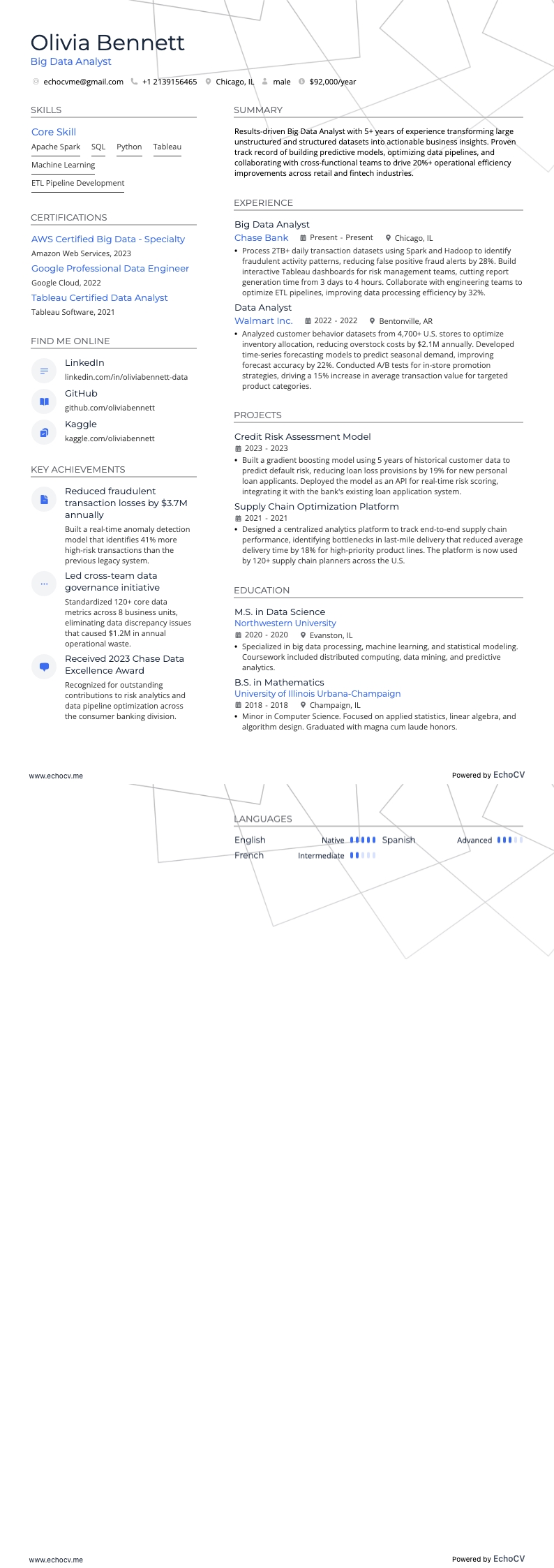
Big Data Analyst example resume

Big Data Analyst

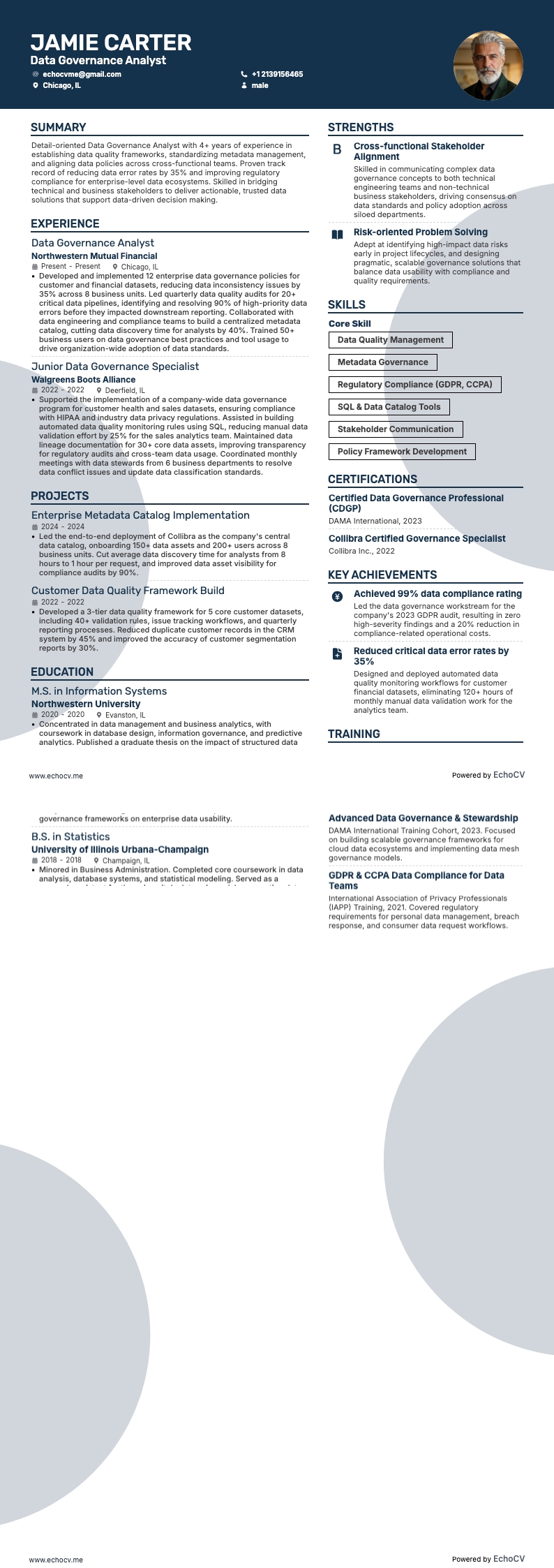
Data Governance Analyst example resume

Data Governance Analyst

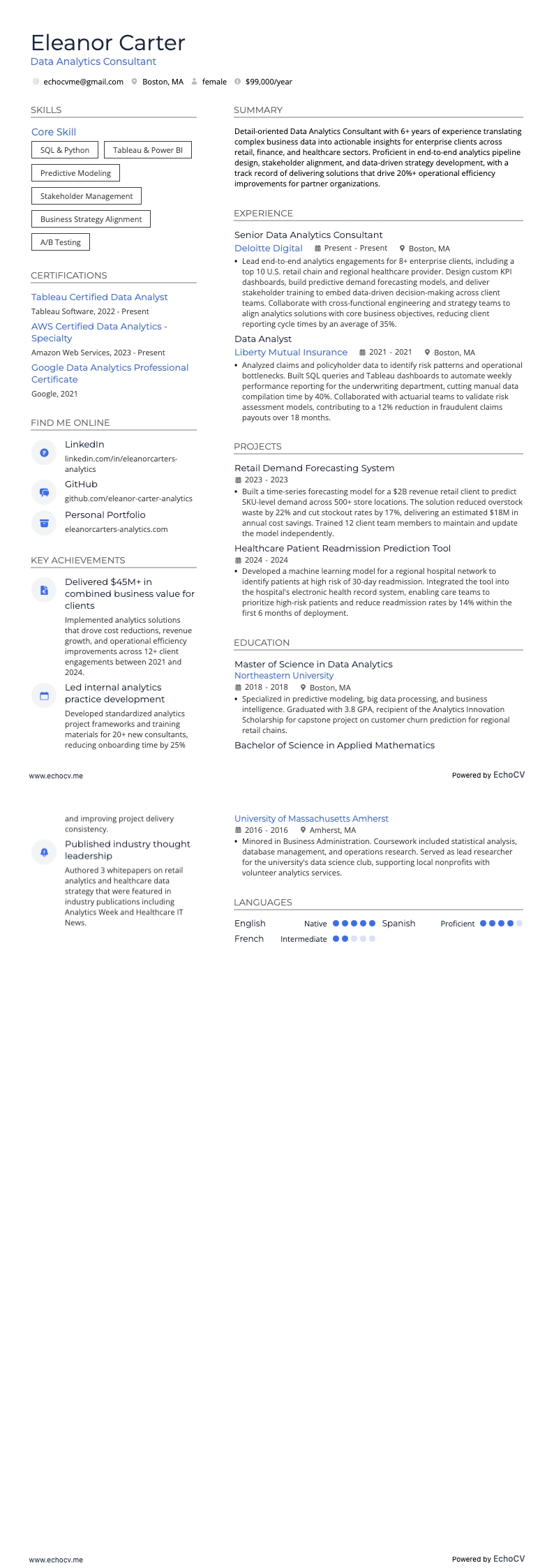
Data Analytics Consultant example resume

Data Analytics Consultant

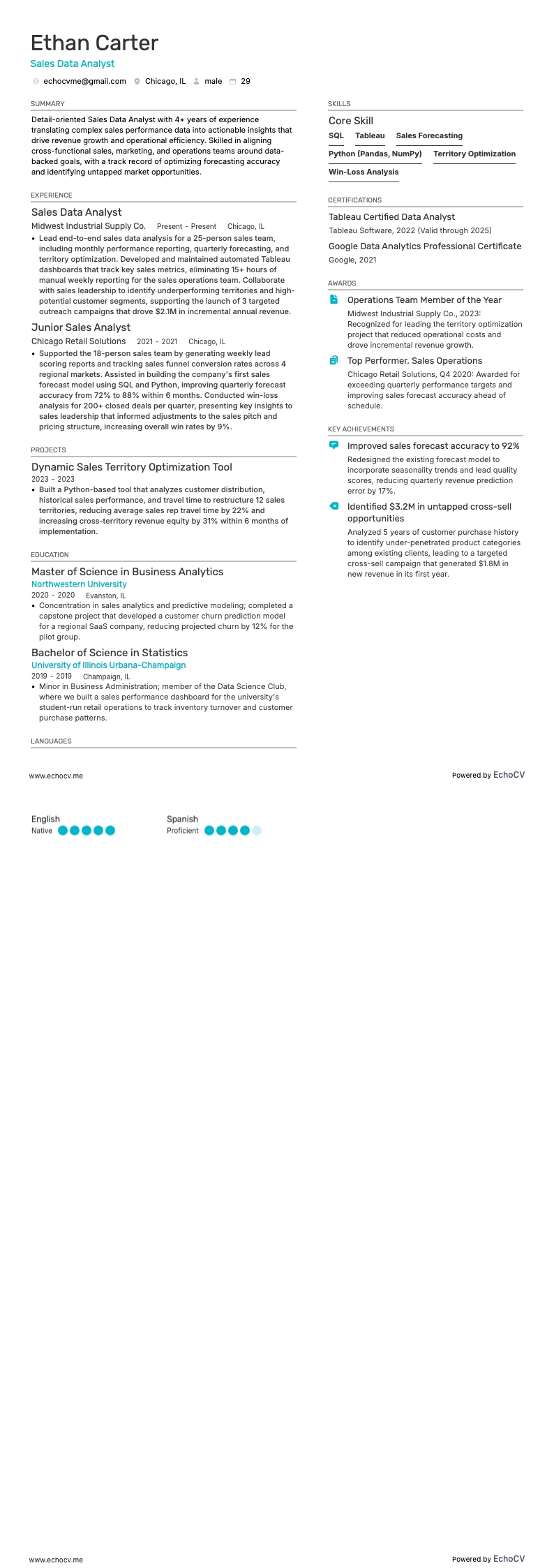
Sales Data Analyst example resume

Sales Data Analyst

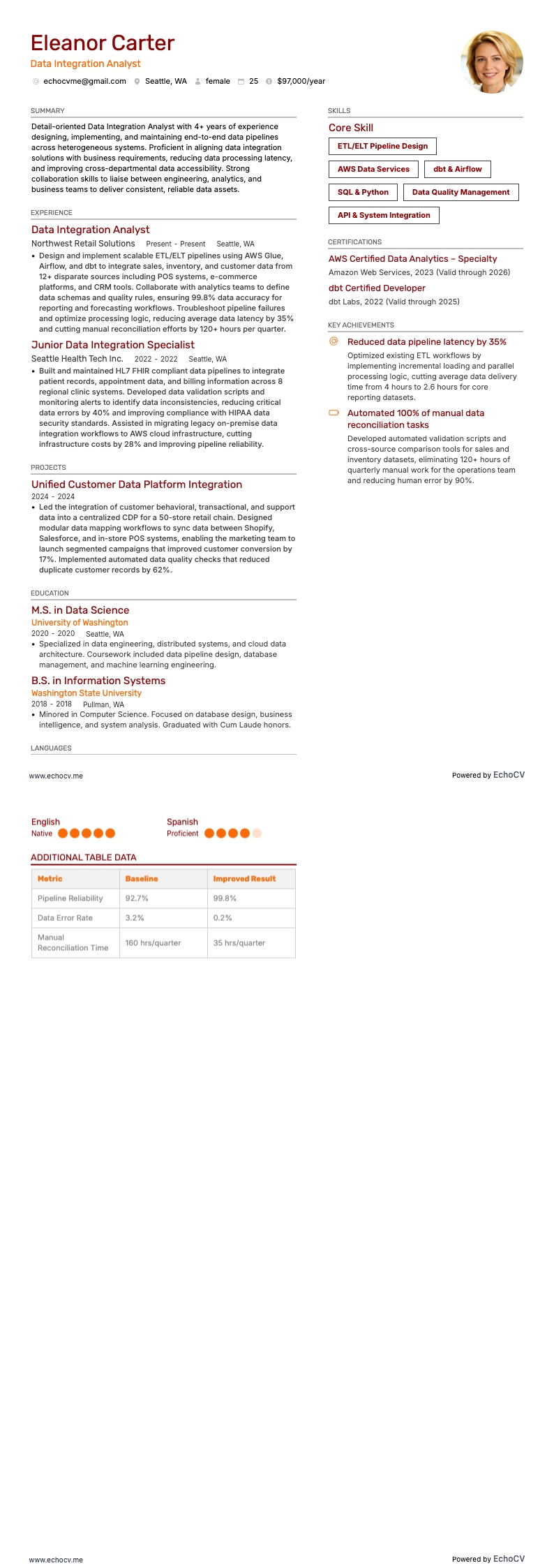
Data Integration Analyst example resume

Data Integration Analyst

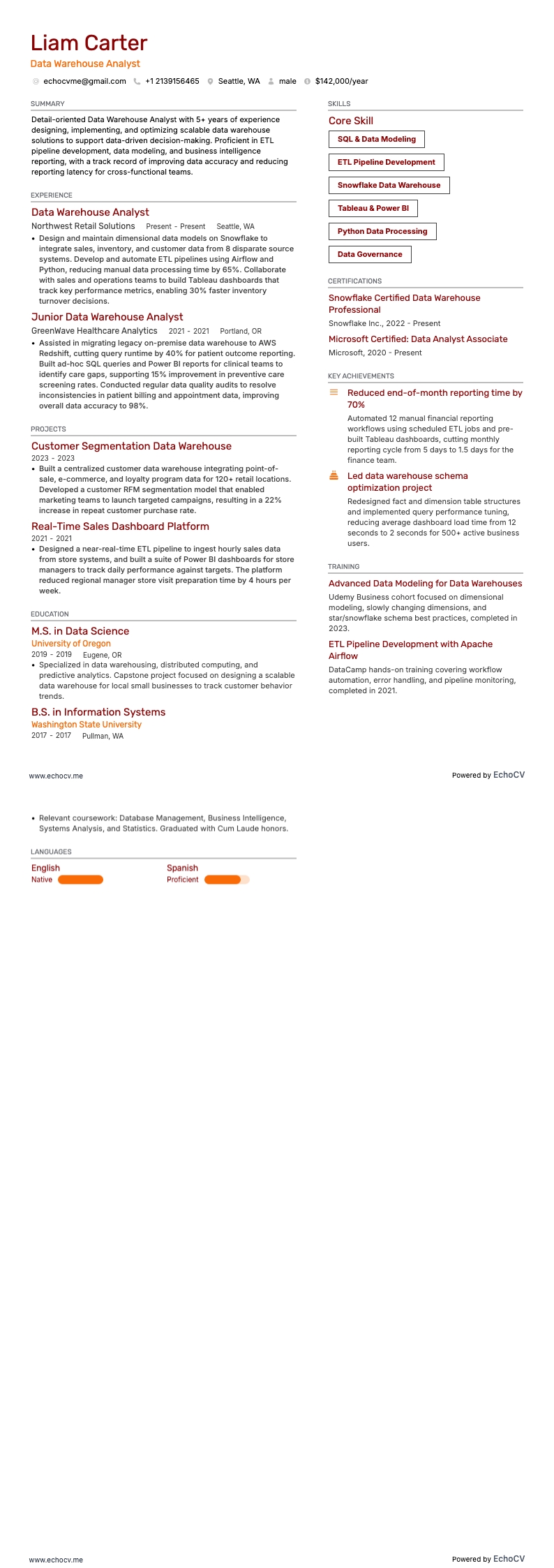
Data Warehouse Analyst example resume

Data Warehouse Analyst

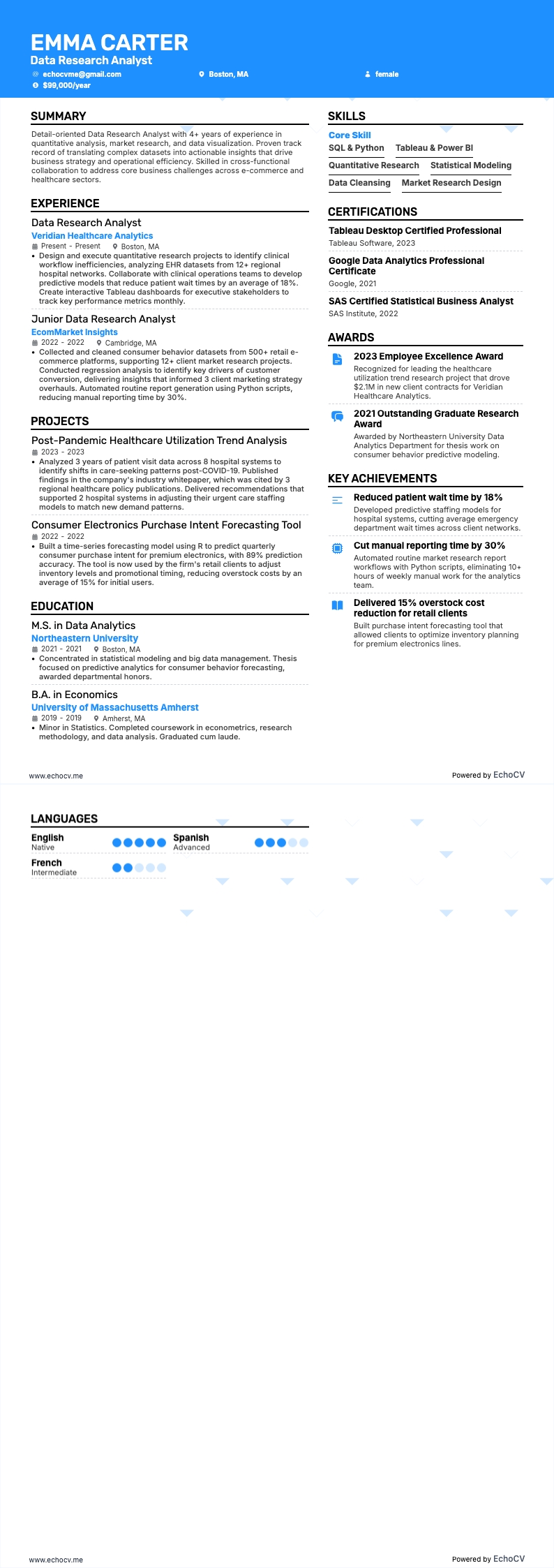
Data Research Analyst example resume

Data Research Analyst

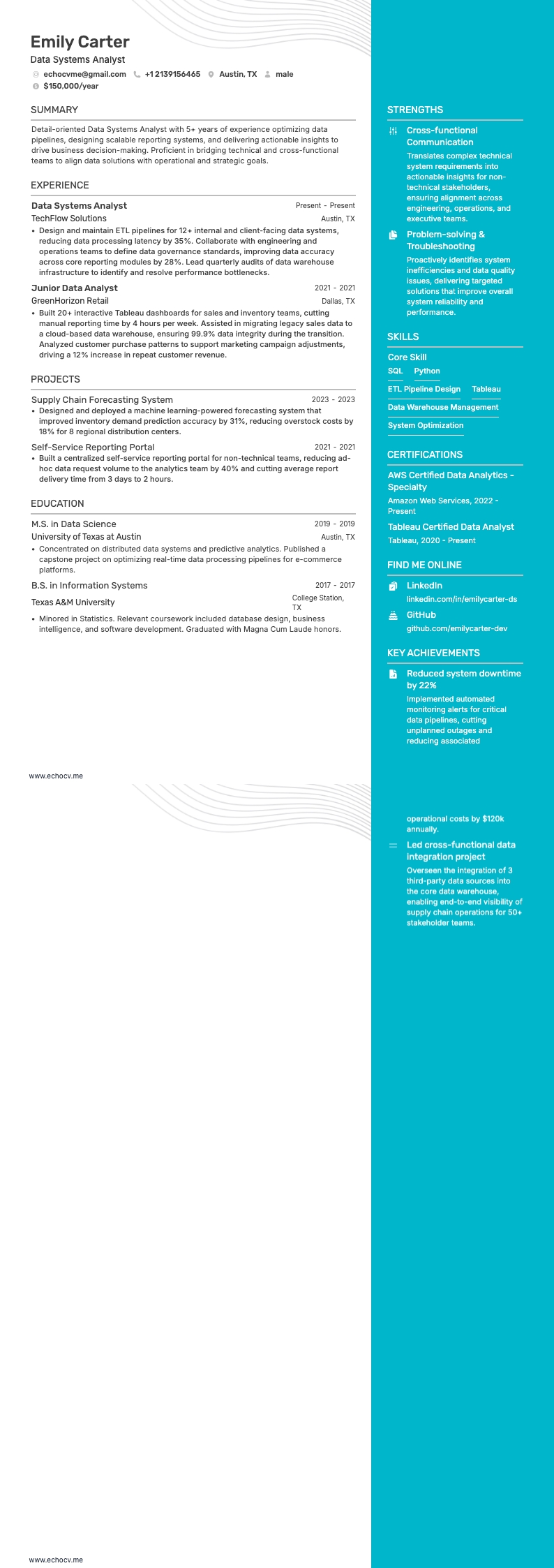
Data Systems Analyst example resume

Data Systems Analyst

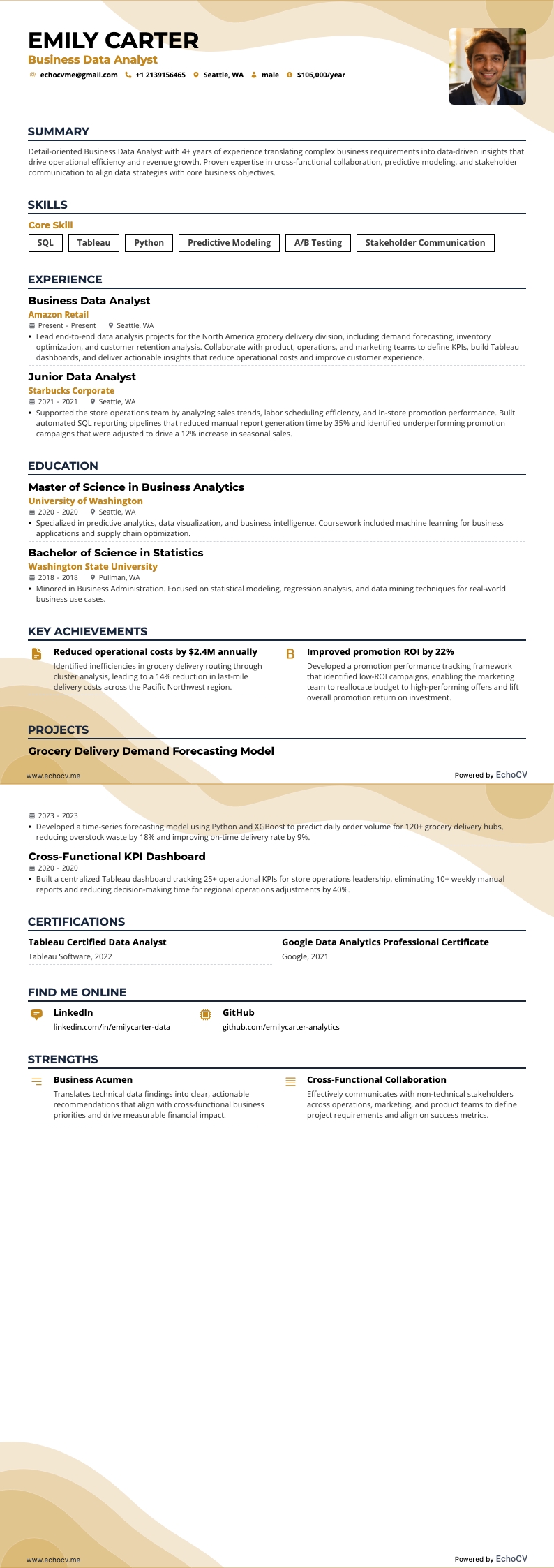
Business Data Analyst example resume

Business Data Analyst

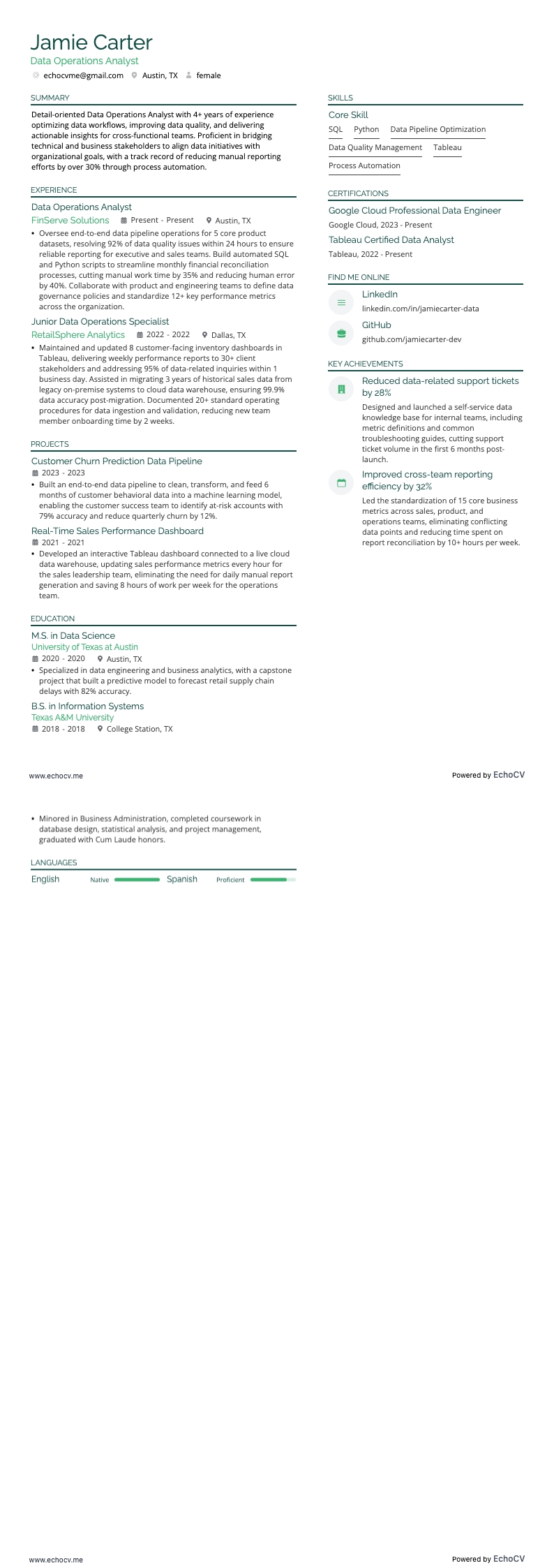
Data Operations Analyst example resume

Data Operations Analyst

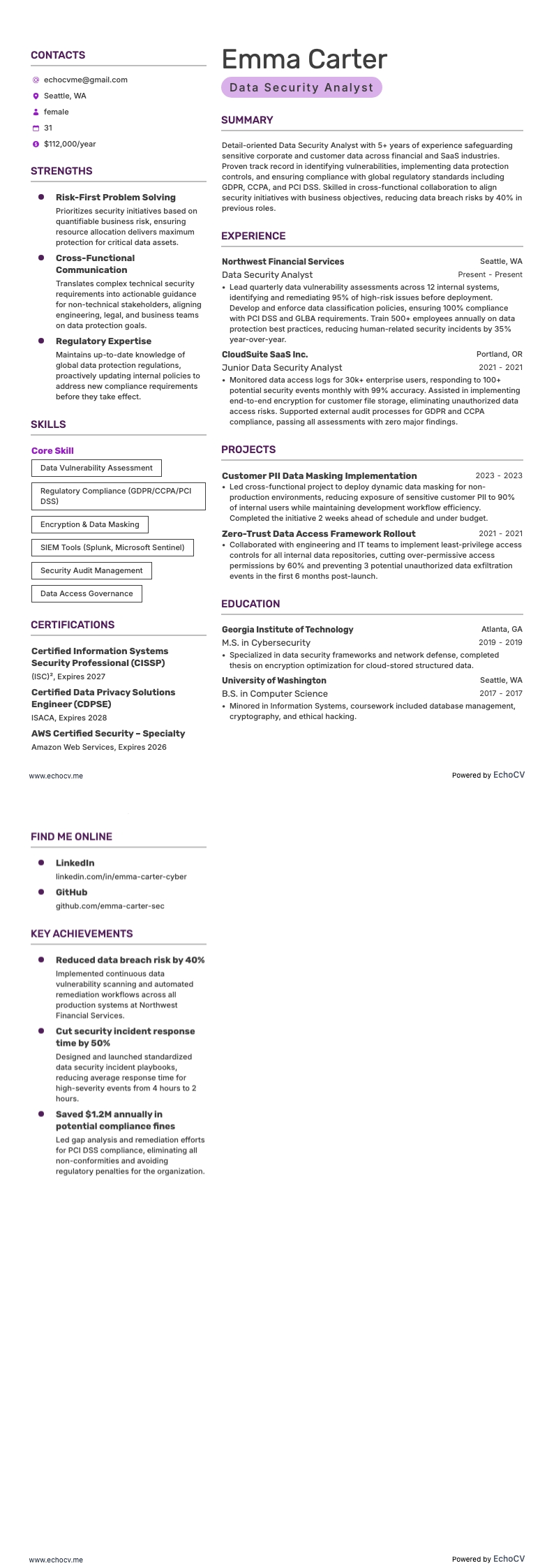
Data Security Analyst example resume

Data Security Analyst

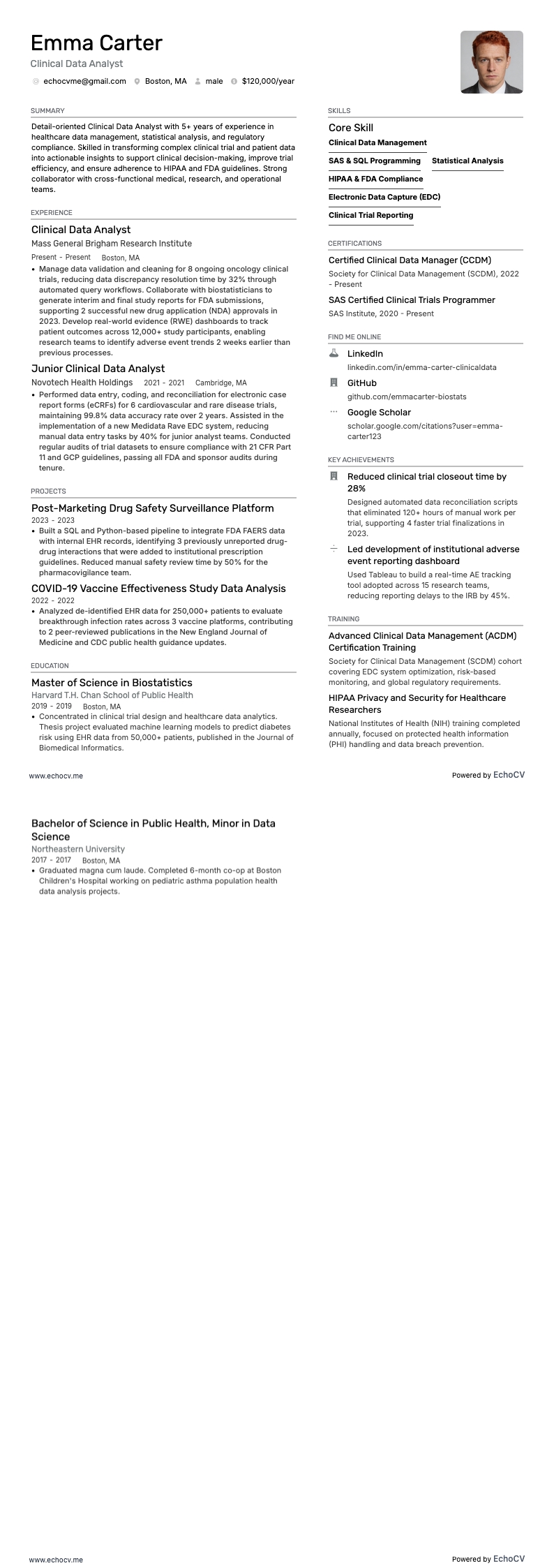
Clinical Data Analyst example resume

Clinical Data Analyst

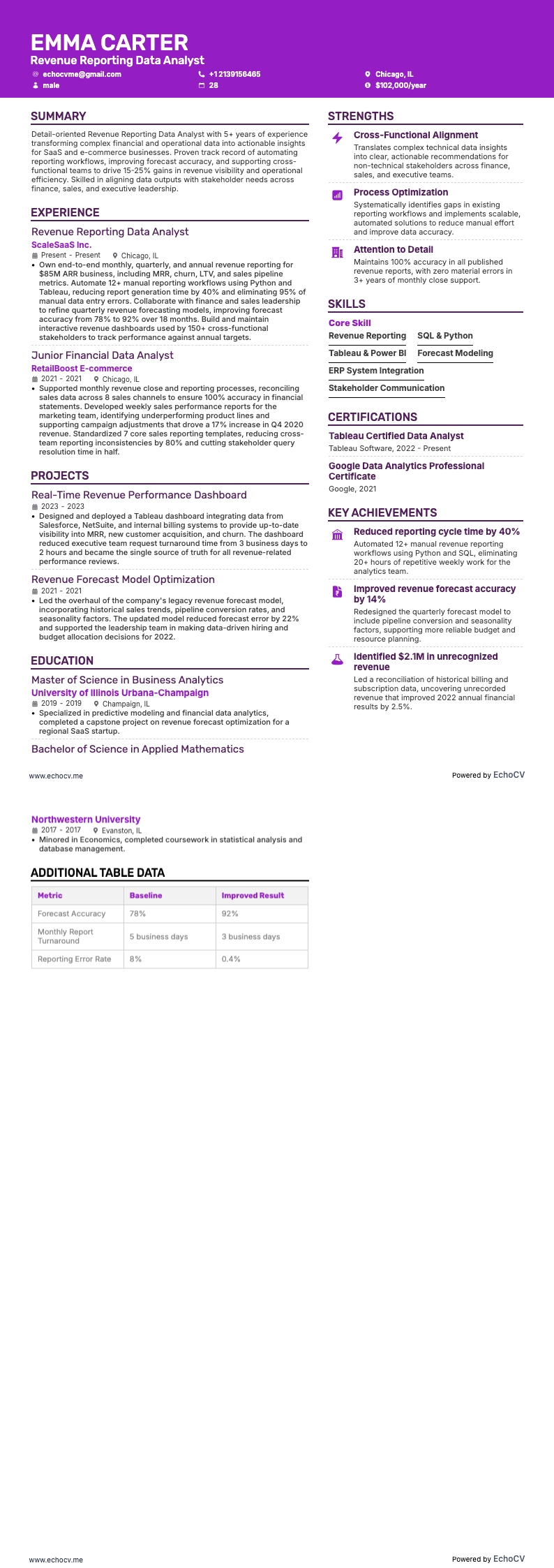
Revenue Reporting Data Analyst example resume

Revenue Reporting Data Analyst

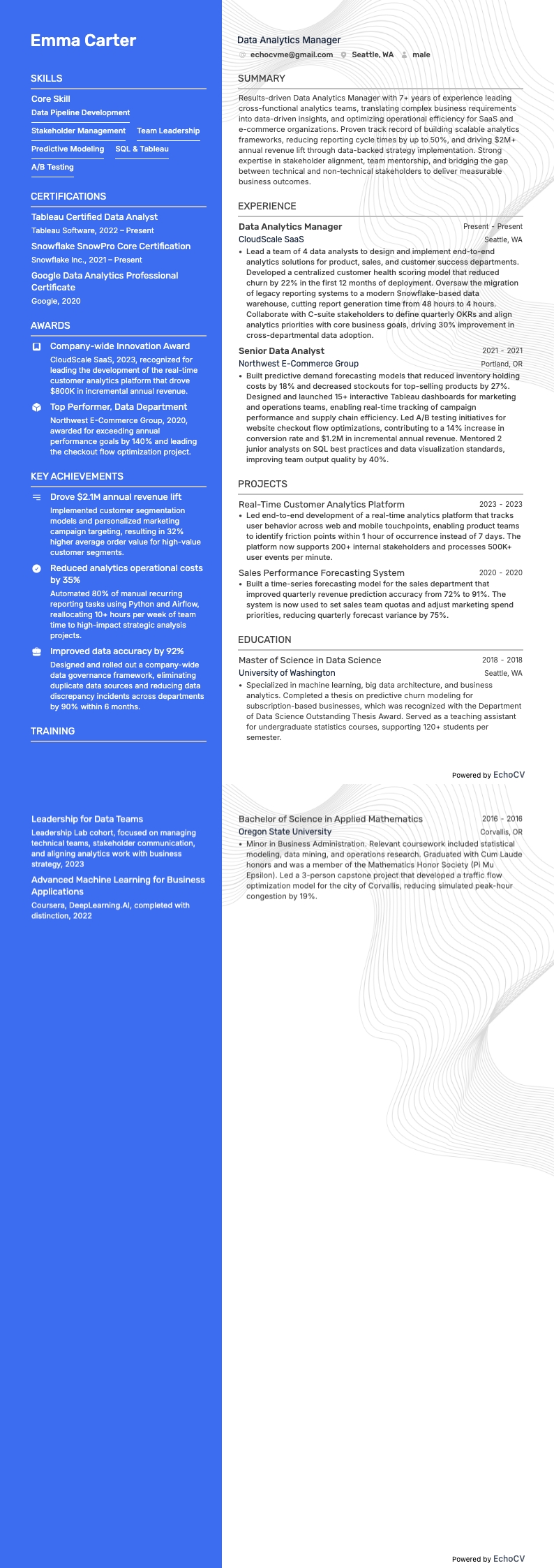
Data Analytics Manager example resume

Data Analytics Manager

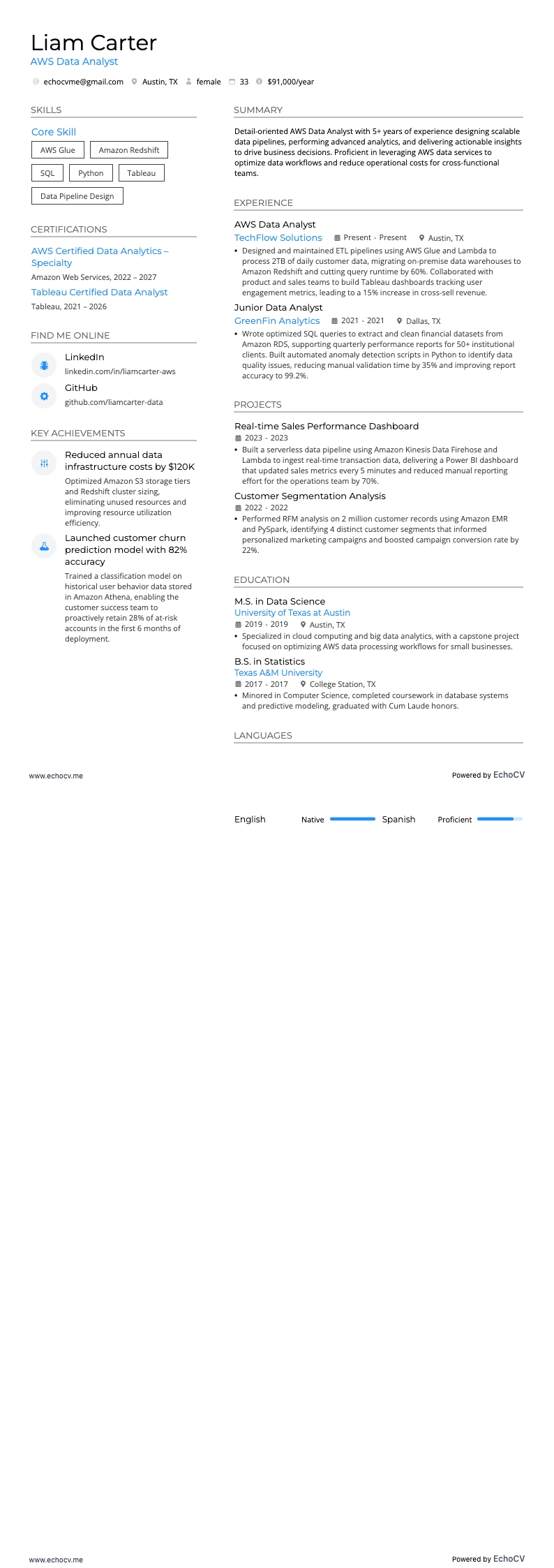
AWS Data Analyst example resume

AWS Data Analyst

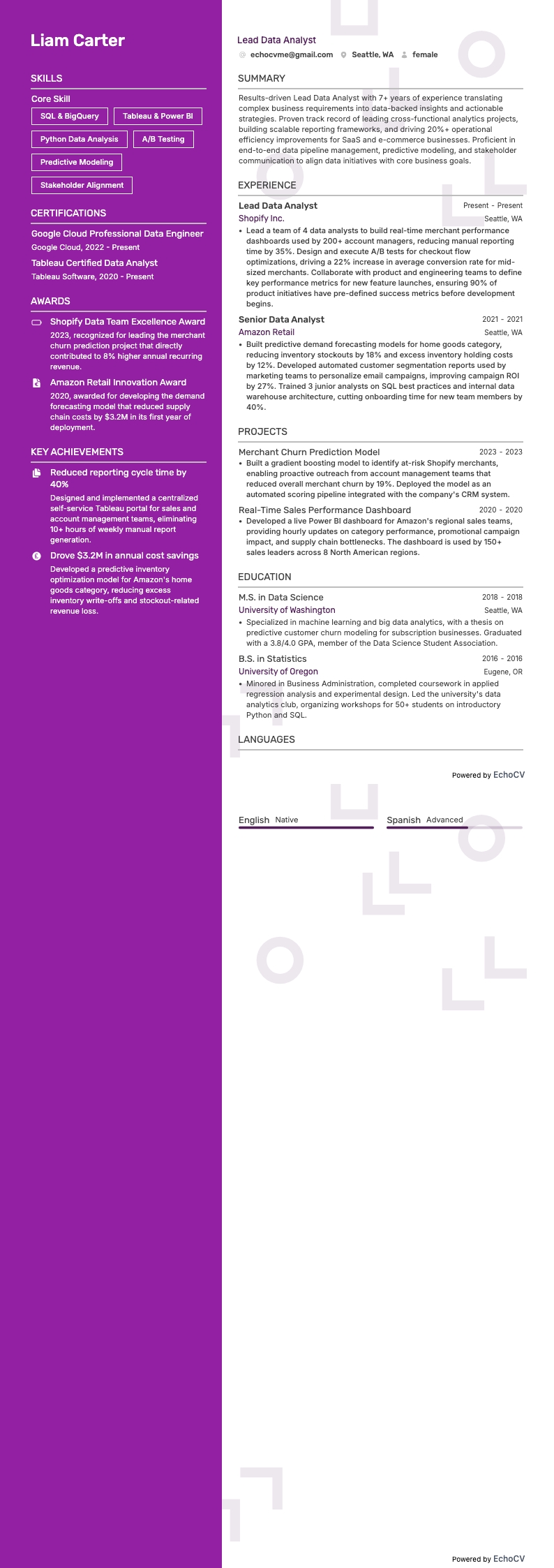
Lead Data Analyst example resume

Lead Data Analyst

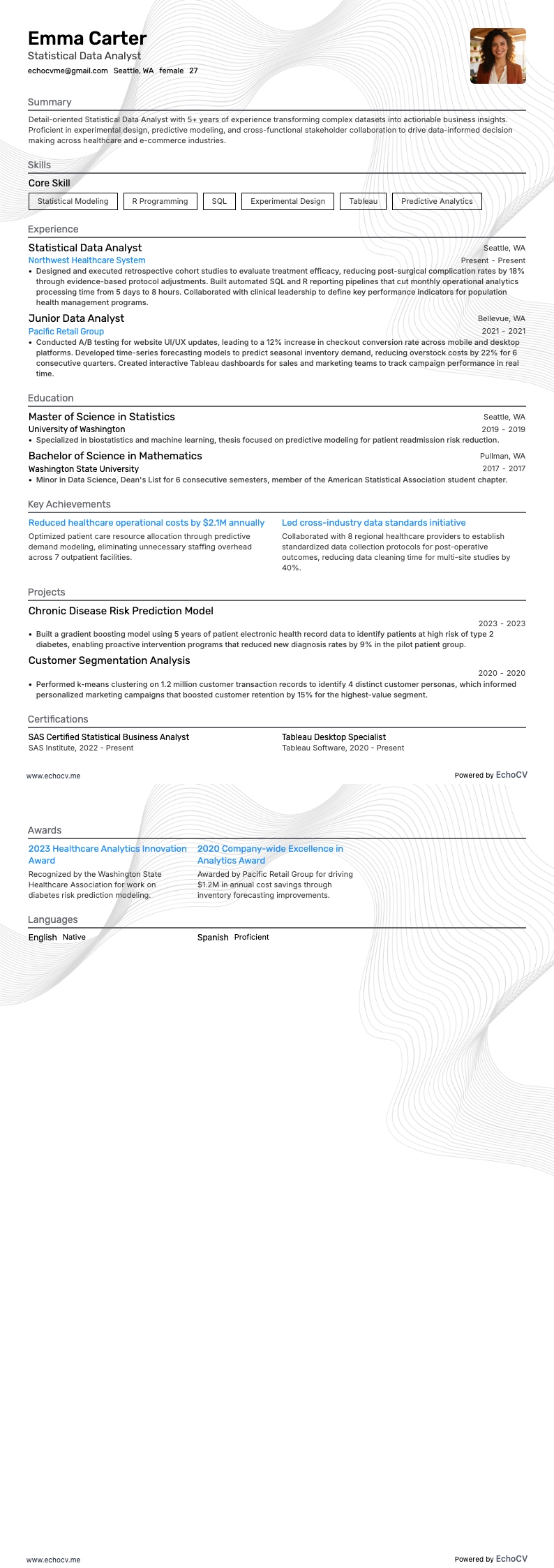
Statistical Data Analyst example resume

Statistical Data Analyst

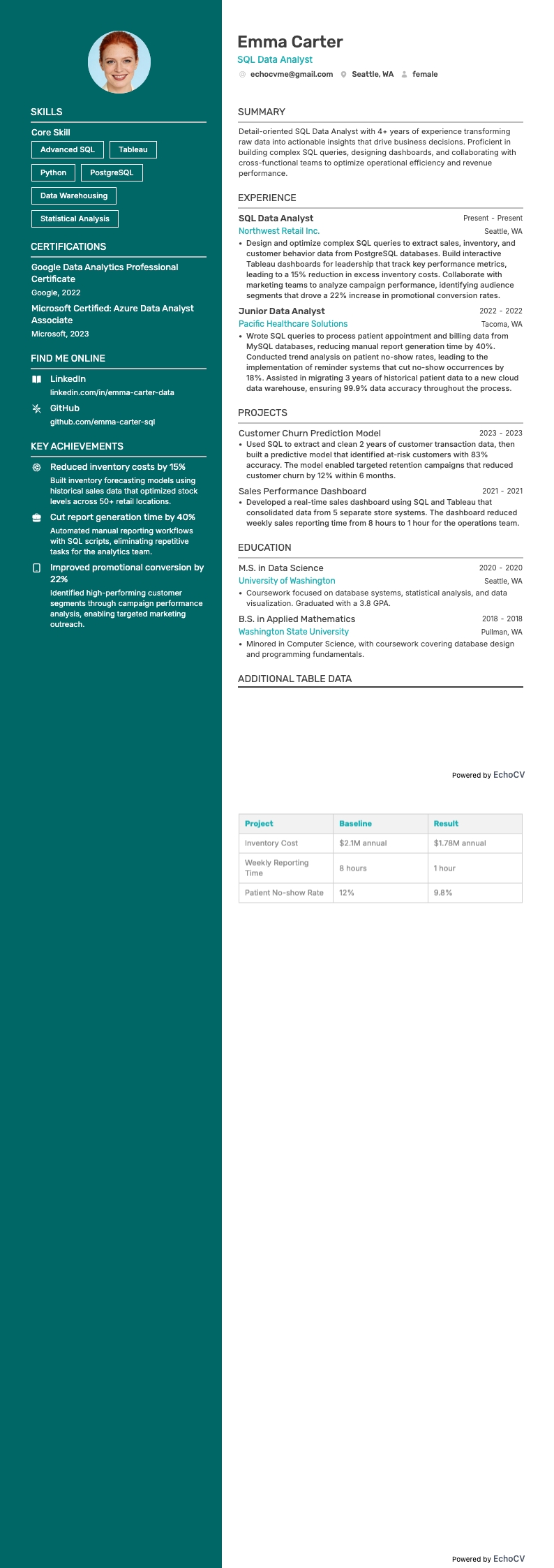
SQL Data Analyst example resume

SQL Data Analyst

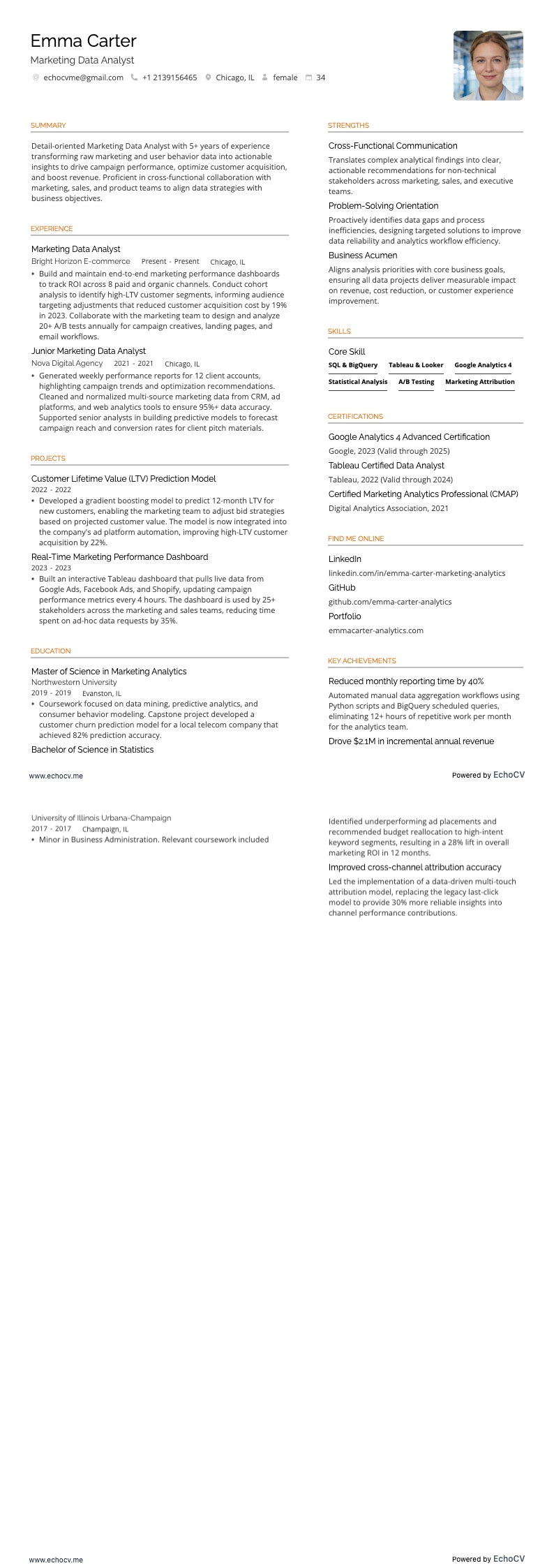
Marketing Data Analyst example resume

Marketing Data Analyst

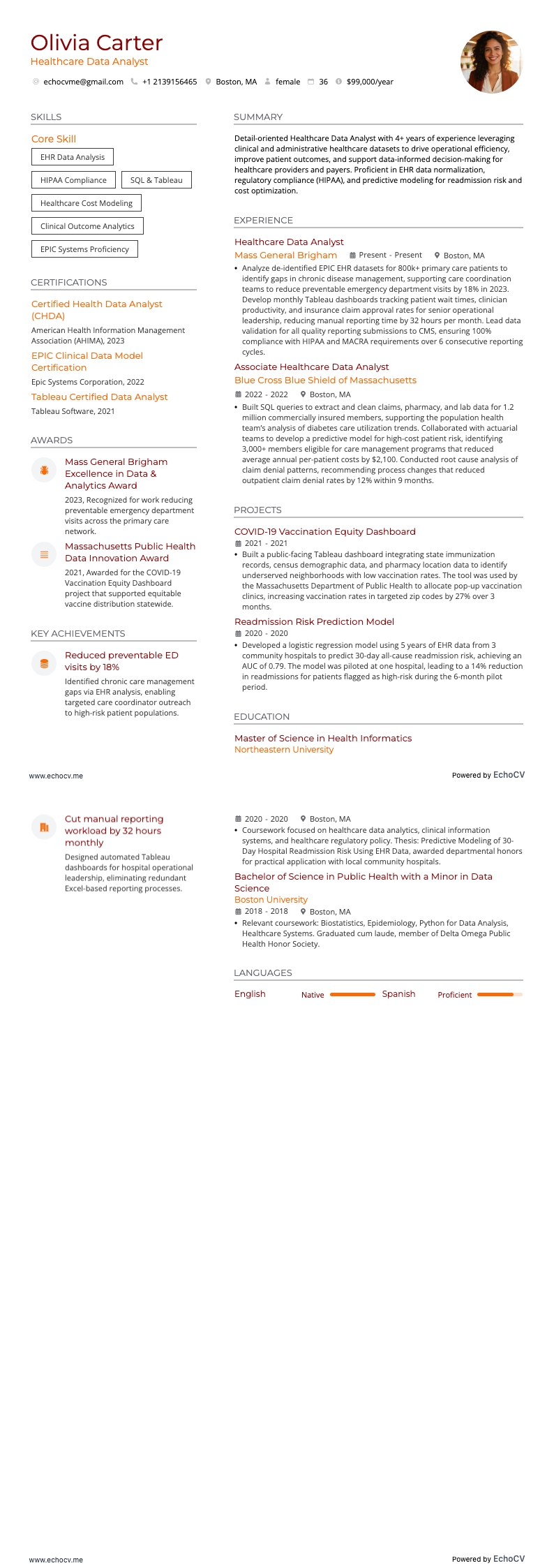
Healthcare Data Analyst example resume

Healthcare Data Analyst

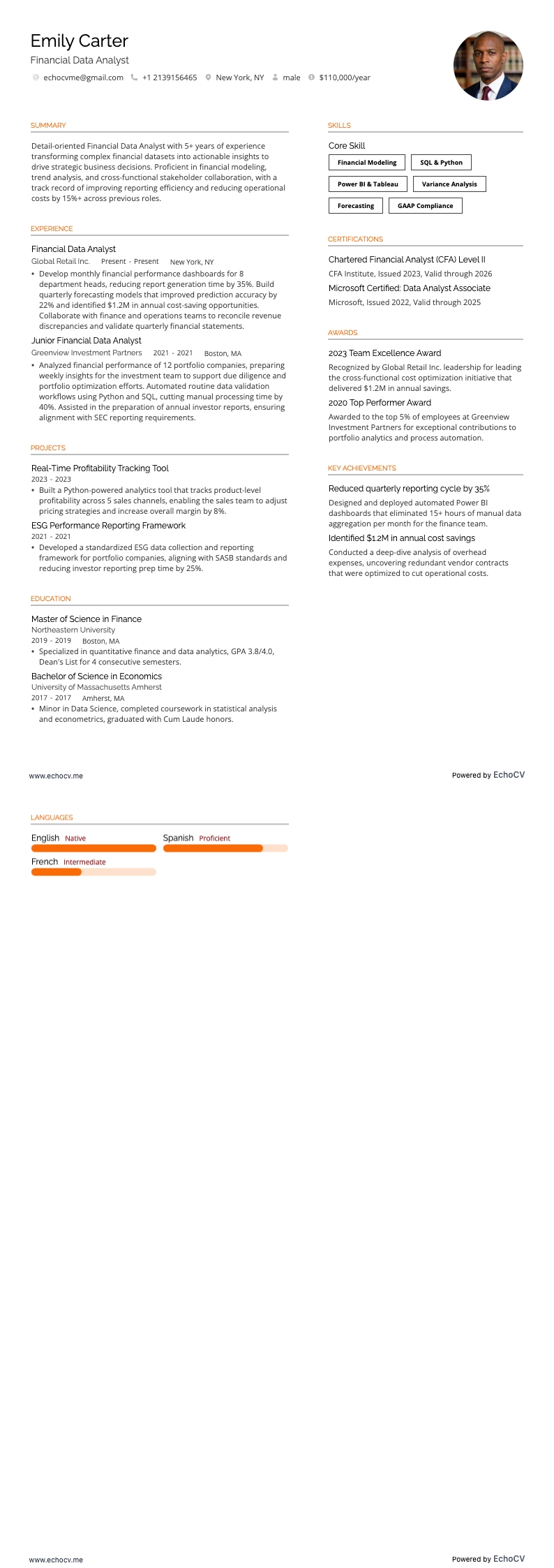
Financial Data Analyst example resume

Financial Data Analyst

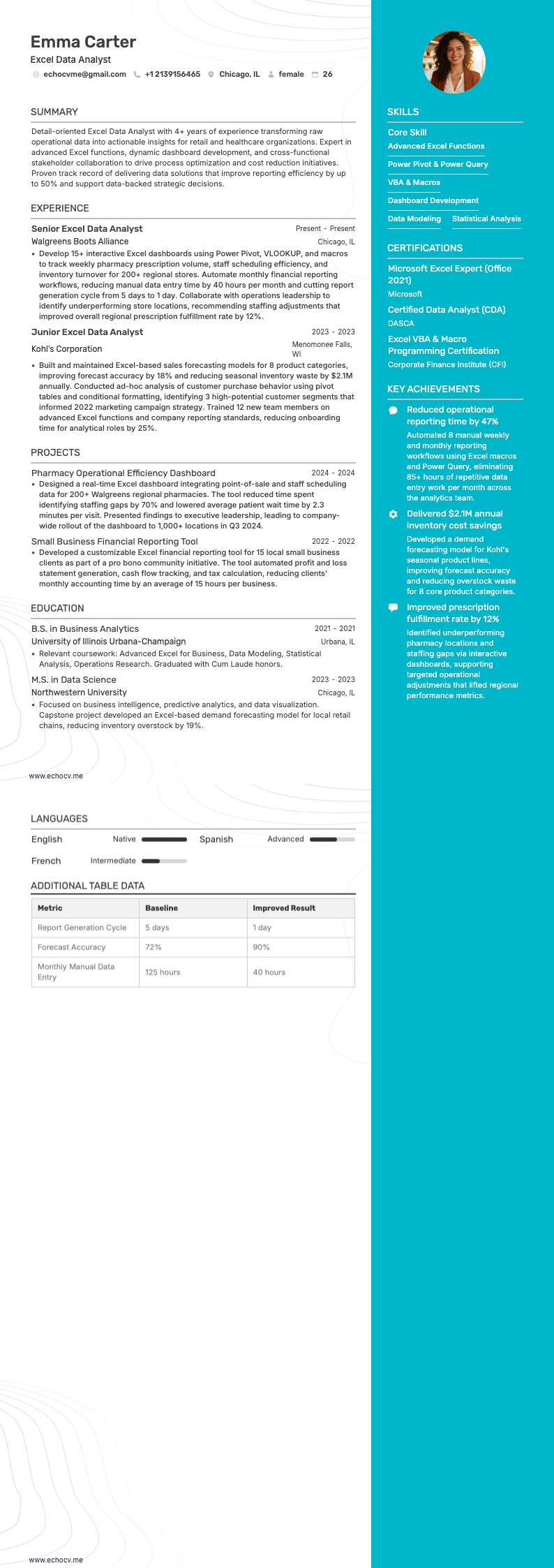
Excel Data Analyst example resume

Excel Data Analyst

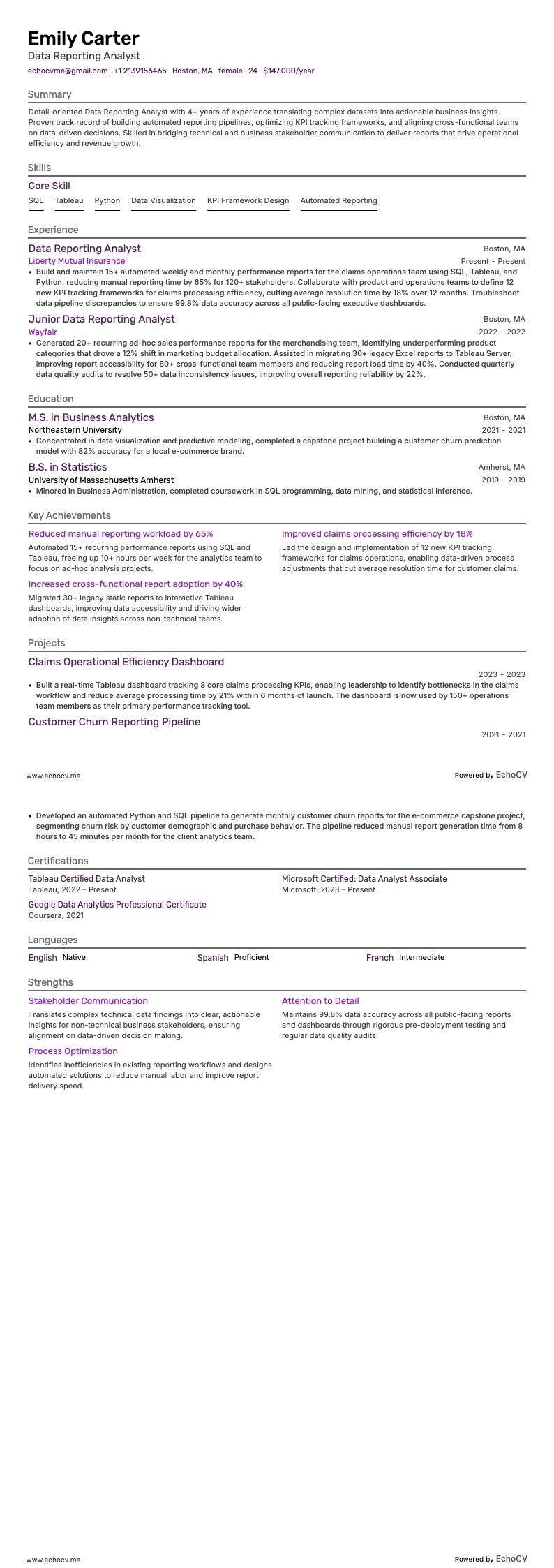
Data Reporting Analyst example resume

Data Reporting Analyst

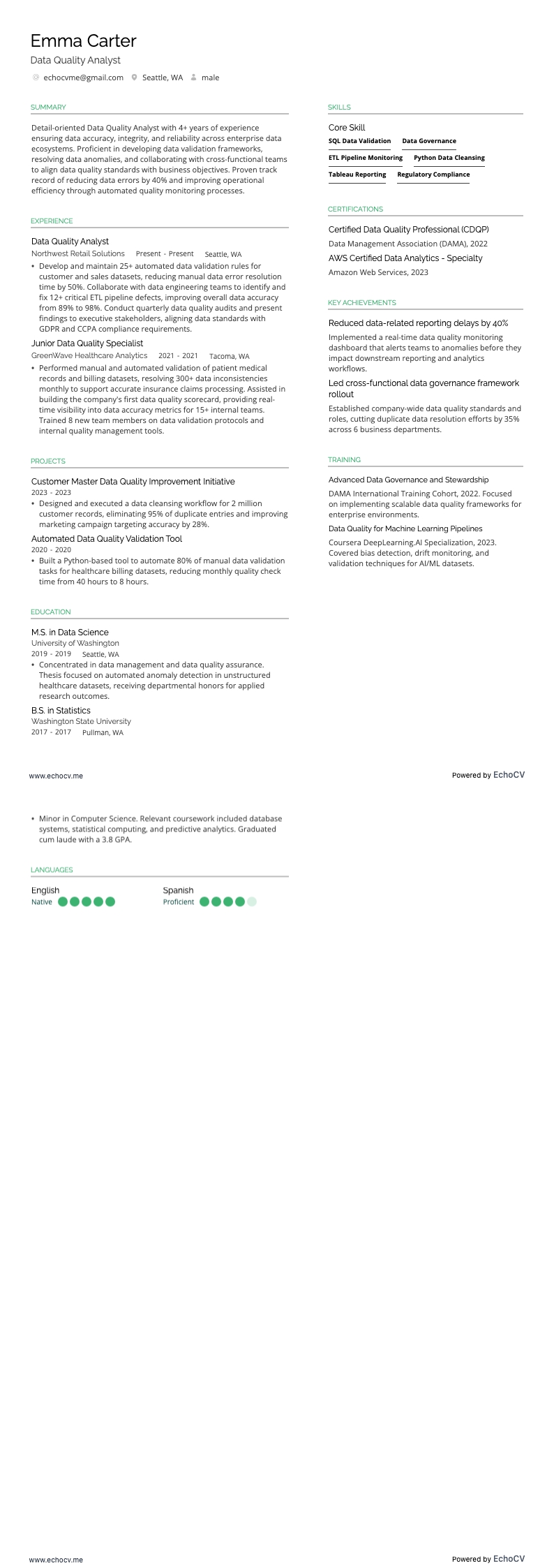
Data Quality Analyst example resume

Data Quality Analyst

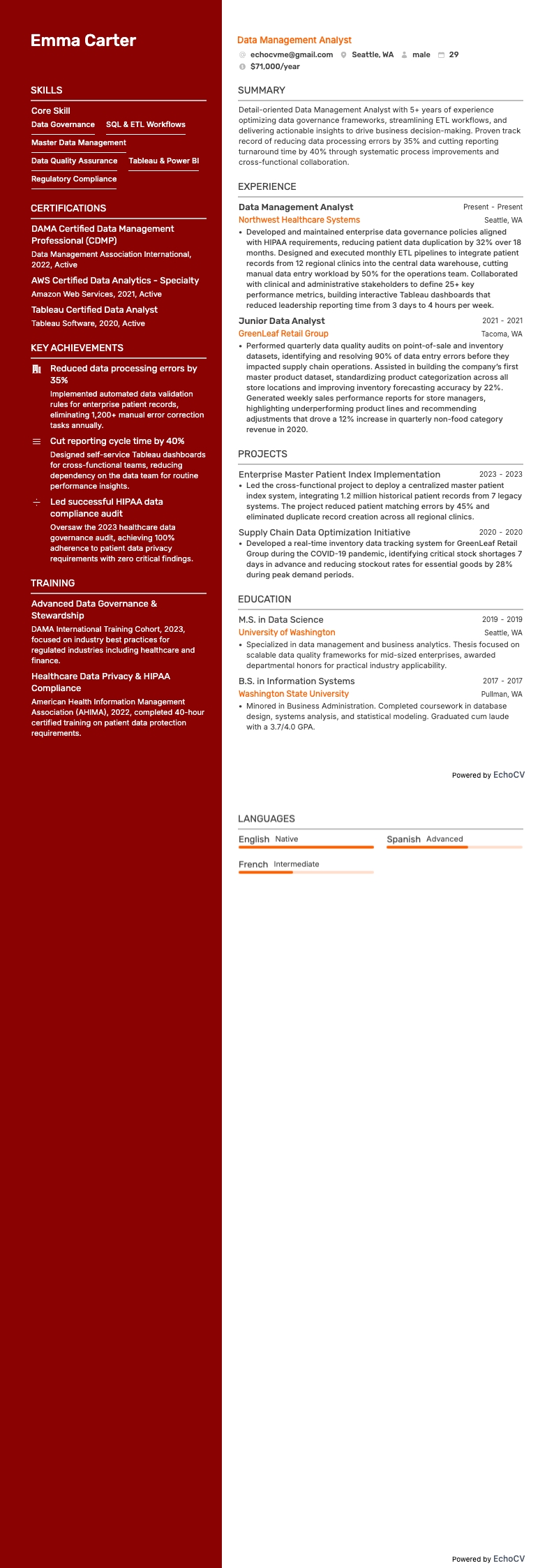
Data Management Analyst example resume

Data Management Analyst

Our world today is, more than ever, driven by data and statistics. Every decision businesses make is informed by actionable insights derived from complex data.

Because of this, there’s been a growing recognition of the data analyst role — which explains why this field is becoming increasingly competitive. From 2020 to 2030 only, experts predict that data science fields will grow by 25%, much faster than the average for all occupations.

That’s why a strong data analyst resume is no longer just a luxury but actually a golden ticket to standing out in your job search.

This data analysis resume guide will teach you:

  • How to tailor your data analytics resume to specific roles based on the job description
  • Tips for creating a resume layout that is both visually appealing and easy to read
  • Strategies for highlighting your skills and achievements
  • Real-world data analyst resume examples to draw inspiration from


Let’s get to it.

Data analyst resume example

Principal Data Analyst resume preview

How to format a data analyst resume

The demand for skilled data analysts is ever-growing, but so is the number of candidates vying for these positions. So to stand out from this multitude of applicants, it’s vital to build a well-formatted resume that presents your impact in a digestible manner.

A well-structured resume, tailored to reflect one's career level, not only captures the recruiter's attention but also demonstrates the candidate's professionalism and attention to detail.

Now,there are many ways you can format your resume, and it all comes down to your level of experience. For entry-level applicants, a streamlined layout focusing on education and skills is essential. A seasoned professional, on the other hand, should opt for a more comprehensive format, showcasing a rich history of achievements and experience.

Here are some key formatting tips to consider when building your data analyst resume:

  • Prioritize recent experiences: The reverse-chronological format is the gold standard when building resumes, especially for those with a solid work history. It showcases your career trajectory, highlighting your most recent, relevant experiences first.
  • Craft a clear header section: Think of this as your first handshake with the hiring manager. A good header introduces you in a concise manner and leaves a memorable impression. Make sure it's clean, uncluttered, and includes all necessary contact information (name, job title, phone number, email, and LinkedIn profile.)
  • Highlight key sections: For a data analyst, certain sections such as the summary and experience are non-negotiable. Skills in data processing, relevant certifications, and your educational background are also crucial.
  • Stick to an optimal resume length: The one-page resume is a classic, but for seasoned professionals, stretching to two pages is acceptable. The key is relevance and conciseness. Every line should add value and relate directly to the data analyst role you aspire to.

Different markets have specific resume formats – a Canadian resume could vary in layout.

PRO TIP

The file format of your data analyst resume has a significant effect on your response rate and job offer rate. PDF is often the safest bet as it preserves your formatting across different devices and platforms. However, some companies use applicant tracking systems (ATS) that prefer Word documents. It’s always a good idea to check the job listing for any specific requirements.

The top sections on a data analyst resume:

  • Header: This is where you introduce yourself, leave a strong first impression, and ensure that recruiters can easily reach you.

  • Experience: This section showcases your professional journey, highlighting specific achievements that demonstrate your expertise and value as a data analyst.

  • Skills: Here, you’ll list any technical and soft skills that directly align your capabilities with the requirements of the data analyst role you're applying for.

  • Certifications: Including certifications emphasizes your commitment to professional development. It also shows your expertise in specific areas relevant to data analysis.

  • Education: Education is where you detail your academic background, providing credibility and context to your skills and knowledge.

  • Summary: A well-crafted summary offers a concise overview of your professional identity, capturing your unique strengths and career objectives.

What recruiters want to see on your resume:

  • Proficiency in Data Analysis Tools: Expertise in tools like SQL, Python, R, and Excel, as these are fundamental to data manipulation and analysis.

  • Data Visualization Skills: Demonstrated ability in tools such as Tableau or Power BI, showcasing the capability to present complex data in an accessible format.

  • Advanced Educational Credentials: Degrees in fields like Statistics, Computer Science, or Data Science, or relevant certifications, which validate technical knowledge and analytical skills.

  • Quantifiable Achievements: Specific examples of how your data analysis has positively impacted a business, such as increasing efficiency or driving revenue growth.

  • Communication and Collaboration Abilities: Evidence of working effectively in team environments and conveying complex data insights to non-technical stakeholders.

Looking for inspiration? Explore more captivating resume templates to fast-track your job search journey.

How to write your data analyst resume experience

The experience section highlights any past roles in which you've applied your analytical skills and technical knowledge to overcome real-world challenges. This is far from just a list of previous jobs you held but actually a compelling narrative of your professional journey in the world of data analysis.

As we’ve mentioned earlier, expertise is the cornerstone of your resume when applying for highly competitive jobs as a data analyst. The experience section is your opportunity to showcase how you've applied your skills in real-world situations, making it the most critical part of your resume.

So, how do you craft an outstanding resume experience to stand out?

  • Tailor your experience: It’s essential to align your resume with the specific data analyst role you're applying for. You must only highlight experiences that resonate with the job description to show that you're a perfect fit for the position.

  • Quantify your achievements: There’s no better way to illustrate impact than by using numbers and data in your resume. Focus on the outcomes and results of your actions, not just the tasks you performed.

  • Use action verbs: Start bullet points with dynamic verbs like 'analyzed,' 'developed,' or 'implemented' to make your experiences more compelling and demonstrate assertiveness.

  • Incorporate ATS keywords: Use keywords related to skills, certifications, and achievements that align with data analysis. This ensures your resume passes through applicant tracking systems (ATS) used by many recruiters to filter candidates.

Experience
Data Analyst
NextGen Tech
Chicago, IL
  • Worked with data analysis to support various departments.
  • Responsible for regular data reporting tasks.
  • Assisted in miscellaneous data projects as needed.
WRONG

Any recruiter would quickly skim over this example and think, 'not interesting,' due to its lack of engaging content. For three simple reasons:

  • Duty descriptions are too general and barely mention any specifics about what the job entailed.
  • There's no mention of achievements, tools, or methodologies used — which is the first thing headhunters look for.
  • The language is passive, failing to highlight any initiative or significant contributions.

Let’s make some changes based on that and see how the section will improve:

Experience
Data Analyst
NextGen Tech
Chicago, IL
  • Analyzed over 1 million data points using SQL to identify trends, contributing to a 15% increase in customer retention.
  • Led a team of 4 in developing automated data reports using Python, reducing report generation time by 40% and enhancing team productivity.
  • Spearheaded a data cleansing initiative, improving data accuracy by 25%, which directly influenced strategic decision-making and increased operational efficiency.
RIGHT

How to quantify impact on your resume

Quantitative metrics are crucial in making a strong impression on recruiters because they provide concrete evidence of your capabilities. Numbers, percentages, and specific metrics transform your experiences from vague statements into compelling proofs of your effectiveness.

Here are the best quantifiable results to show recruters the scope of your impact:

  • Increased sales through data analysis: Can you quantify the percentage or amount your data analysis strategies contributed to sales growth?
  • Enhanced efficiency in data processing: In what ways did your improvements or innovations reduce the time or resources required for data processing tasks?
  • Achieved cost reduction: How much cost savings, in percentage or dollar amount, were realized through your data-driven optimizations?
  • Boosted customer satisfaction: Reflect on the increase in customer satisfaction scores or ratings due to your analytical insights.
  • Accelerated project completion: Describe the time saved in project completion, such as finishing ahead of schedule, due to your management or analytical skills.
  • Influenced decision-making: How did your data insights impact key business decisions, and what changes in market share or business growth were observed?
  • Improved data accuracy: Quantify the improvement in data accuracy or reduction in errors achieved through your data validation or cleaning processes.
  • Enhanced predictive model accuracy: What was the percentage improvement in the accuracy of predictive models you developed?
  • Streamlined reporting processes: Estimate the hours or resources saved per week or month due to more efficient reporting systems or tools you implemented.
  • Optimized marketing campaigns: Discuss the improvement in marketing outcomes, like lead generation or conversion rates, due to your data-driven strategies.

How do I write a data analyst resume with no experience

Embarking on a career as a data analyst can be both exciting and daunting, especially when you're just starting out. Your lack of experience may be the reason you’re missing out on some of the positions you’ve always dreamed of.

But it’s vital to remember that every seasoned data analyst was once a beginner, standing exactly where you are now. The key to breaking into this field is crafting a resume that showcases your potential and puts your best foot forward. This is your first step towards landing that dream job in data analysis.

Here are our tips to help you build an appealing resume despite a lack of direct experience:

  • Highlight educational achievements: Emphasize relevant coursework, degrees, or certifications in data analysis as a key part of your resume.
  • Showcase transferable skills: Many skills you learned from other disciplines like problem-solving and attention to detail can be applicable to data analysis.
  • Include relevant projects: Detail any academic or personal projects involving data analysis.
  • Demonstrate enthusiasm for learning: Recruiters love to see that you’re committed to growing in the field through courses or self-teaching.
  • Leverage internship experience: Use any internships to display workplace adaptability and skills.
  • Craft a compelling resume objective: Write a strong objective focusing on your passion and career goals in data analysis.

How to list your hard skills and soft skills on your resume

When hiring data analysts, recruiters seek candidates who possess a dynamic mix of technical skills and interpersonal traits. These abilities are not just perks but necessities, allowing data analysts to excel in their daily tasks and thrive in their roles.

Before we delve into how you can list skills on a resume, let us first define what soft skills and technical skills are.

Soft skills encompass the personal and interpersonal talents that shape how you interact in a professional setting. This includes traits that enable you to navigate complex data challenges, such as problem-solving, articulate data-driven insights to diverse audiences, such as communication, and collaborate across various departments, exemplified by teamwork.

Technical skills refer to the specific expertise required to perform various job functions. In data analysis, this includes proficiency in tools like SQL, Python, R, and Excel for data manipulation, skills in data visualization tools such as Tableau or Power BI, among others.

Blending these soft and technical skills is key to catching a recruiter's eye and distinguishing yourself from other candidates. Here’s how you can do that in your data analyst resume:

  1. Read carefully through the job description to identify the skills the employer values.

  2. Align your skillset with those required, highlighting a mix of technical and soft skills.

  3. Prioritize your most relevant and strongest skills at the top of your skills section.

  4. Provide context with examples of how you've applied these skills in your career in the summary, experience, and achievements section.
Best hard skills for your data analyst resume

  • SQL

  • Python programming

  • R programming

  • Data Visualization (Tableau, Power BI)

  • Statistical Analysis

  • Microsoft Excel

  • Machine Learning techniques

  • Data Cleaning and Preprocessing

  • Big Data platforms (Hadoop, Spark)

  • Data Warehousing

  • Business Intelligence (BI) tools

  • Predictive Modeling

  • Data Mining

  • SAS (Statistical Analysis System)

  • MATLAB

  • Google Analytics

  • Database Management

  • ETL (Extract, Transform, Load) processes

  • Report Writing and Presentation Skills

How to list your certifications and education on your resume

A strong educational background will significantly impact your job search since it is a key requirement to get hired as a data analyst. In fact, if you’ve been perusing online job offers, you may have noticed that almost all companies expect at least a bachelor's degree in a related field such as computer science, statistics, or mathematics.

The reason for that is straightforward: education demonstrates in-depth foundational knowledge and a commitment to the discipline.

To list education on a data analyst resume, you need to do the following:

  1. Start with Your highest degree: List your highest degree first, followed by lower degrees.
  2. Add your degree and major: Specify your degree and major.
  3. Include the name of the institution: Clearly state the name of the university or college.
  4. Mention your graduation year: If you're a recent graduate, include your graduation year.

If applicable, you may also mention specific coursework or projects that are particularly relevant to the job to further showcase your expertise and alignment with the role.


Here’s what that should be like on a resume:

Education
Master of Science in Data Analytics
Massachusetts Institute of Technology (MIT)
RIGHT

Certifications on a data analyst resume are equally important — as they demonstrate ongoing learning and specialization in specific areas of data analysis. They can be particularly crucial for showcasing skills in emerging technologies that may not have been covered in traditional degree programs.

The way you list certificates on your resume is even simpler. As long as it’s relevant and recent, all you have to do is add the name of your certificate to a separate section in your resume.

Below, we’ve gathered a list of the most sought-after data analyst certificates to ignite your job search:

How to write your data analyst resume summary or objective

A resume summary is a brief, impactful statement that showcases your qualifications and unique value proposition. It is a crucial element in your data analyst resume because it shapes the first impression recruiters will have about you within a few seconds.
Before we dive into how to craft a powerful resume summary, what's the difference between a resume objective vs. a resume summary?

  • A resume summary is most suitable for experienced professionals who have a lot to show on their resumes. It can be a great way to showcase career highlights, feature professional accomplishments, and demonstrate what they can bring to the table.
  • A resume objective is typically used by applicants who are entering the workforce, changing careers, or have gaps in their employment history. The objective is more about potential and promises as it focuses on your career goals and how the candidate can benefit the company.

Here are some examples of data analyst resume summaries:

Summary
Data Analyst with some years of experience in handling data. I am familiar with data analysis tools and have worked in various industries. I have many skills in data management and reporting tasks. Looking for a challenging role to further develop my analytical skills.
WRONG

In this first example, the summary is vague and lacks specifics about what the candidate actually did in the job. It uses phrases like "some years of experience" and "familiar with data analysis tools,” which fail to quantify the applicant’s impact within the company.

Additionally, the whole statement feels generic, especially when it mentions "have worked in various industries" without specifying any fields. This lack of detail and quantification fails to differentiate the candidate from others, making the whole resume non-compelling to the hiring manager.

Let’s make some changes and see how it can improve:

Summary
Seasoned Data Analyst with over 5 years of experience specializing in predictive modeling and business intelligence. Proficient in SQL, R, and Python, with a proven track record of leveraging data to drive business decisions and growth. Recognized for exceptional knowledge in statistical analysis and machine learning, contributing to a 15% improvement in data processing efficiency. Eager to bring expertise in advanced analytics to a dynamic team focused on innovative data solutions.
RIGHT

This improved summary not only provides a clear picture of the candidate's capabilities but also showcases their potential value to the organization. Here are a few ways it did that:
  • Quantifiable expertise: 5 years of experience
  • Relevant skills: predictive modeling, business intelligence
  • Demonstrates clear impact: increased revenue by 20%

Additional sections for a data analyst resume

  • Strengths: Highlight the key strengths that make you an exceptional data analyst, such as analytical thinking or attention to detail.

  • Projects: Showcase specific data analysis projects you've worked on, especially those that had a significant impact or showcase unique skills.

  • Awards: List any relevant awards or recognitions you've received to underscore your expertise and dedication in the field.

  • Achievements: Mention any notable achievements (either professional or personal) that reflect your determination and growth mindset.

  • Passions: Include personal interests or passions that align with the data analysis field. This is an excellent way to demonstrate your genuine enthusiasm for the industry.

  • Read data analyst job descriptions carefully to align your resume with the specific requirements of this position.

  • Organize your resume into well-defined sections, using a neat layout and design to immediately draw the recruiter's eye.

  • Organize your experience in reverse chronological order to showcase your most significant achievements prominently.

  • Include both soft and technical skills to demonstrate your comprehensive fitness for the data analyst role.

  • Highlight your educational background and certifications to stand out and increase your chances of landing interviews.

  • Incorporate additional sections like projects and key strengths to further bolster your data analyst resume.

Data Analyst resume examples

Explore additional Data Analyst resume samples and guides and see what works for your level of experience or role.

By Experience

Principal Data Analyst

Principal Data Analyst resume preview

Senior Insurance Data Analyst

Senior Insurance Data Analyst resume preview

Senior Data Analyst

Senior Data Analyst resume preview

Junior Data Analyst

Junior Data Analyst resume preview

Entry-Level Risk Adjustment Data Analyst

Entry-Level Risk Adjustment Data Analyst resume preview

Data Analyst Intern

Data Analyst Intern resume preview

Data Analyst Entry Level

Data Analyst Entry Level resume preview

Data Analyst resume examples

Explore additional Data Analyst resume samples and guides and see what works for your level of experience or role.

By Role

Digital Data Analyst

Digital Data Analyst resume preview

Data Visualization Analyst

Data Visualization Analyst resume preview

Strategic Data Analyst

Strategic Data Analyst resume preview

Product Data Analyst

Product Data Analyst resume preview

Big Data Analyst

Big Data Analyst resume preview

Data Governance Analyst

Data Governance Analyst resume preview

Data Analytics Consultant

Data Analytics Consultant resume preview

Sales Data Analyst

Sales Data Analyst resume preview

Data Integration Analyst

Data Integration Analyst resume preview

Data Warehouse Analyst

Data Warehouse Analyst resume preview

Data Research Analyst

Data Research Analyst resume preview

Data Systems Analyst

Data Systems Analyst resume preview

Business Data Analyst

Business Data Analyst resume preview

Data Operations Analyst

Data Operations Analyst resume preview

Data Security Analyst

Data Security Analyst resume preview

Clinical Data Analyst

Clinical Data Analyst resume preview

Revenue Reporting Data Analyst

Revenue Reporting Data Analyst resume preview

Data Analytics Manager

Data Analytics Manager resume preview

AWS Data Analyst

AWS Data Analyst resume preview

Lead Data Analyst

Lead Data Analyst resume preview

Statistical Data Analyst

Statistical Data Analyst resume preview

SQL Data Analyst

SQL Data Analyst resume preview

Marketing Data Analyst

Marketing Data Analyst resume preview

Healthcare Data Analyst

Healthcare Data Analyst resume preview

Financial Data Analyst

Financial Data Analyst resume preview

Excel Data Analyst

Excel Data Analyst resume preview

Data Reporting Analyst

Data Reporting Analyst resume preview

Data Quality Analyst

Data Quality Analyst resume preview

Data Management Analyst

Data Management Analyst resume preview