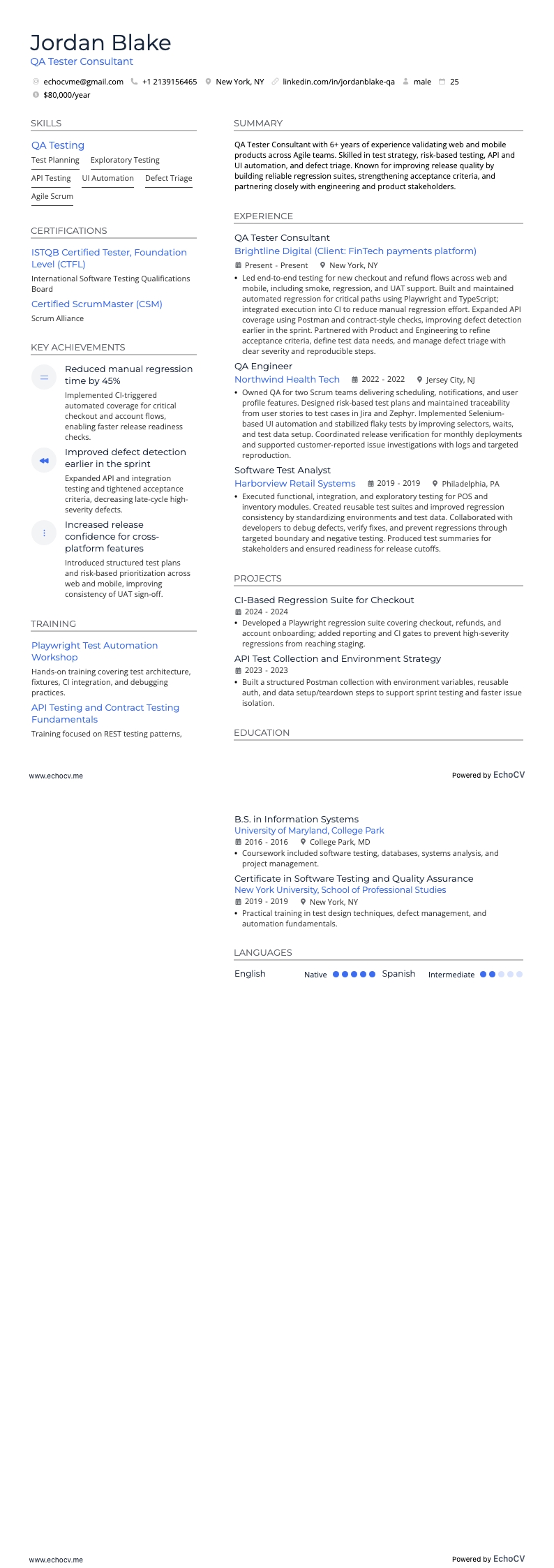
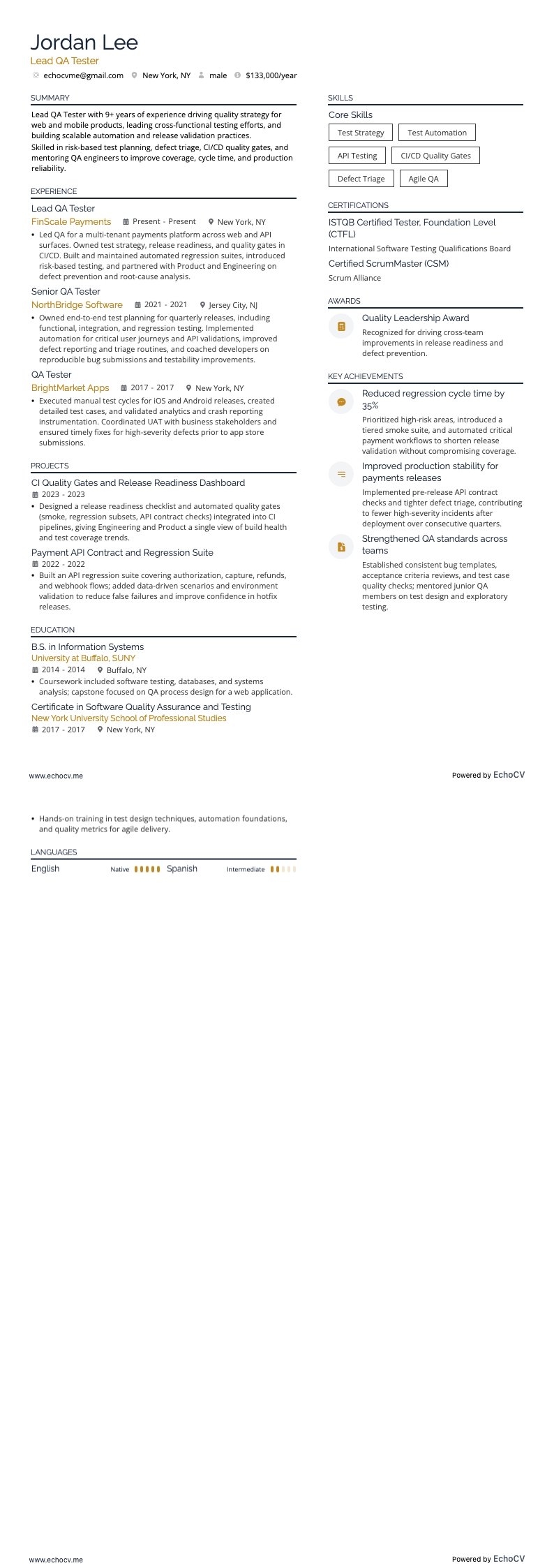
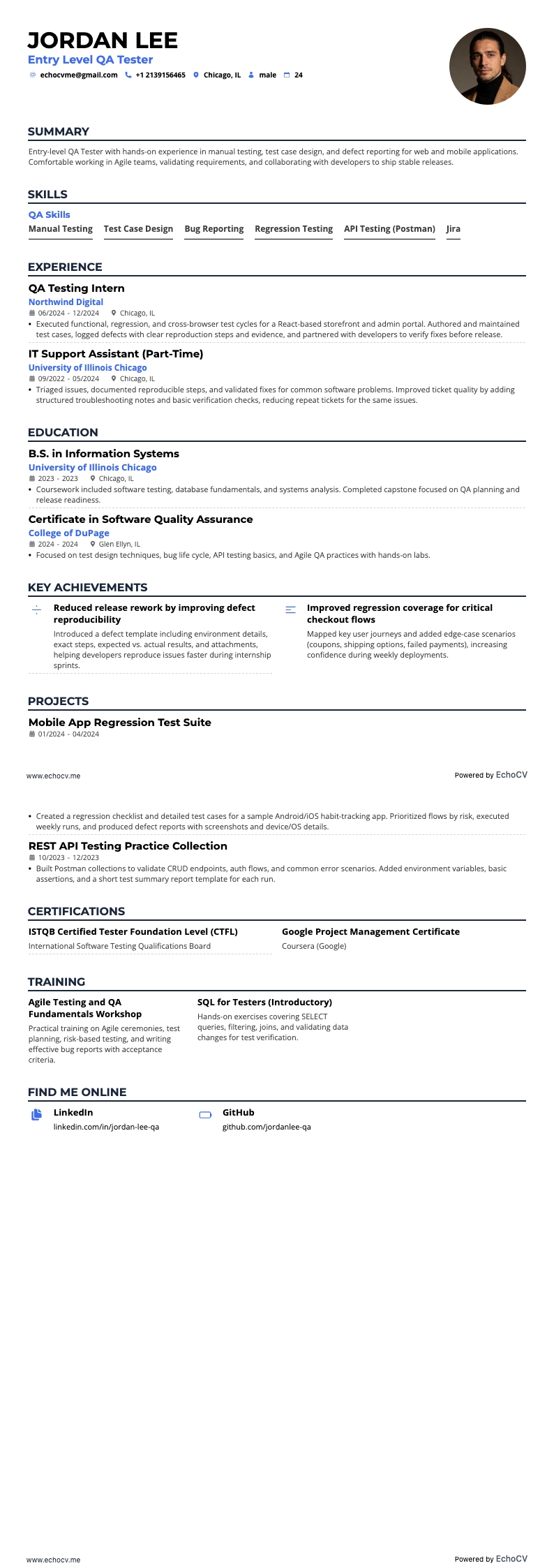
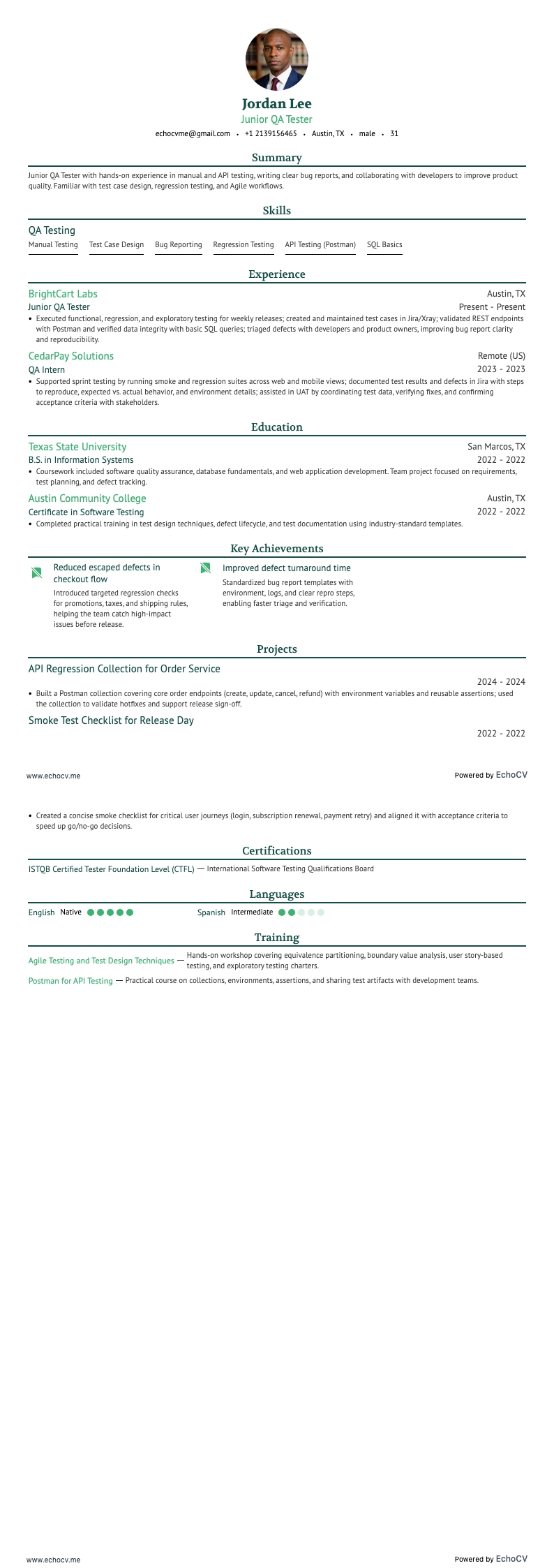
Here’s why this entry catches the attention of recruiters:
- Quantifiable achievements: This candidate demonstrates significant results with real numbers—developed test plans and cases from user requirements, boosting test coverage by 30%, and executed 1,000+ automated tests, increasing efficiency by 25%.
- Relevant experience: The resume shows how the candidate performed manual testing and data validation, cutting critical defects by 20%.
- Technical proficiency: Used SQL queries to analyze and manipulate data, improving processing speed by 15%. This highlights the candidate's strong technical skills.
- Collaboration skills: Collaborated with teams to understand functionality, reducing testing cycle time by 10%. This demonstrates the ability to work effectively with others to achieve project goals.
- Impactful results: Each responsibility includes clear metrics, showing not just what the candidate did, but how well they did it and the difference it made. This approach is sure to catch the eye of recruiters.
This resume demonstrates how the candidate's experience meets the job requirements. Follow these tips to make your experience section impactful with clear metrics.
How to quantify impact on your resume
Using numbers and percentages can vividly illustrate how your QA work has improved software performance. This approach highlights your real impact, like minimizing bugs or optimizing test processes.
Here are some examples to showcase your achievements in previous QA positions.
- Include the number of test cases created, executed, and managed in order to demonstrate your practical experience and productivity.
- Indicate the percentage of defects you were able to detect and fix, showcasing your effectiveness and thoroughness as a QA tester.
- Mention the number of testing tools you’re proficient in, suggesting your versatility and adaptability in handling various QA testing platforms.
- Highlight the amount of time saved by automating tests, showing your ability to increase efficiency and productivity.
- Quantify the amount of possible client-reported issues prevented due to your testing, proving your contribution to user experience and satisfaction.
- State the number of critical system failures prevented during your testing, which illustrates the value and impact of your work on the system's stability.
- Detail the number of software releases you were involved in testing, indicating your experience with real-world software deployment.
- Specify the number of bugs detected and fixed per software release, showing your efficiency in ensuring the quality of the software.
How do I write a QA tester resume with no experience
Many people start their QA careers as manual QA testers before advancing to more complex test automation roles. Manual QA testing is often an entry-level position, while automation roles typically require coding knowledge, such as Python. If you want to start working in the computer science field, manual QA is the easiest way. In this role, you’ll mostly perform manual tests to find bugs in software applications and record the outcomes.
Don’t worry if you lack professional experience. Instead, emphasize your transferable skills, education, and personal interests such as solving puzzles, playing chess, etc. Highlight any relevant projects or informal experiences that demonstrate your abilities in testing and quality assurance.
Here are several ideas:
- Objective statement: Craft a brief statement that conveys your passion for QA testing, underscores your relevant experience, and outlines your career goals. Keep it clear and engaging, ideally within 3 sentences.
- Education: List any formal education in computer science, technology, or related fields. Highlight courses relevant to QA, such as software testing, coding, or data analysis.
- Internships: Mention any internships you've completed related to QA testing, whether paid or unpaid.
- Projects: This is crucial, especially if you lack professional experience. Describe any QA projects on your resume you've worked on, including personal experiments, class assignments, hackathons, or volunteer work. Detail your role, your approach, and the results.
- References: Provide references from teachers or mentors if you have them, or simply state that they’re available upon request.
How to list your hard and soft skills on your resume
When tailoring the skills section of your QA resume, aim for a clean and impactful layout. Include both your technical knowledge, such as experience with Selenium and JIRA, and your soft skills, like problem-solving and collaboration. Also, don’t forget to emphasize your proficiency in programming languages, especially Python.