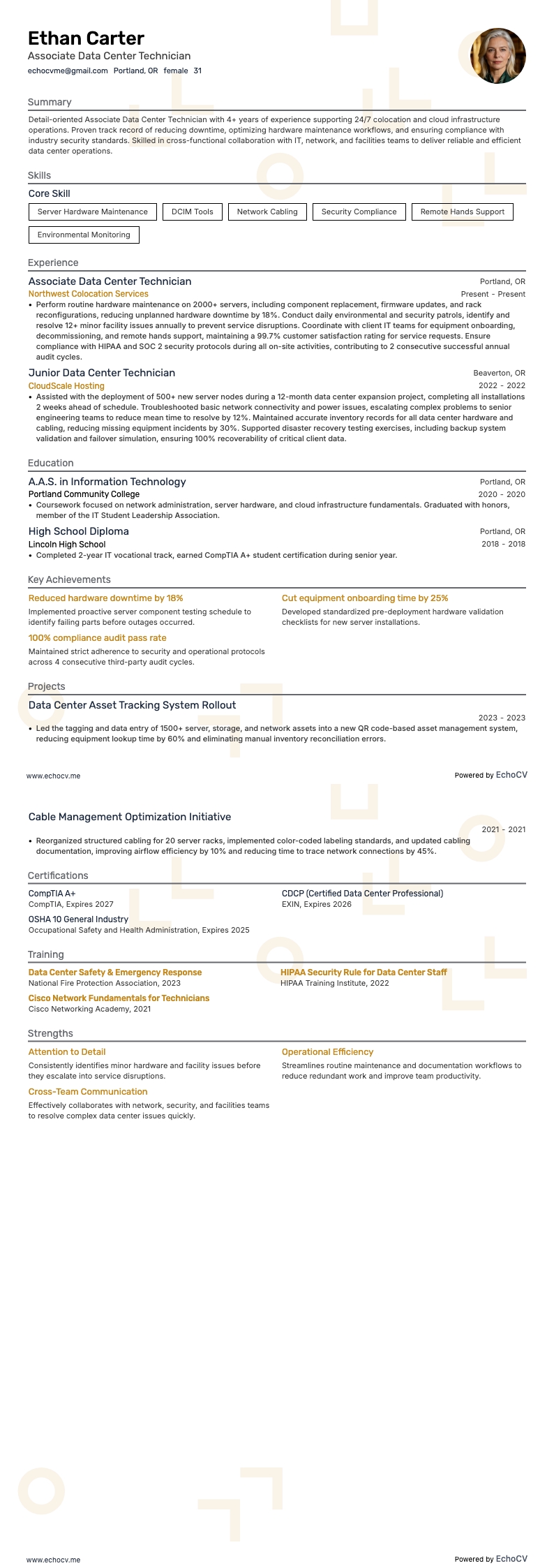
Data-Center-Techniker (Associate) Vollvorschau

19 Beispiele für Lebensläufe als Rechenzentrumstechniker

EchoCV

Verfasst vom EchoCV-Team

Aktualisiert: 5/28/20248 min read

Sehen Sie alle Lebenslauf-Beispiele in diesem Leitfaden oder erstellen Sie mit Ihrem persönlichen Prompt Ihr eigenes Beispiel.

Data-Center-Techniker (Associate) example resume
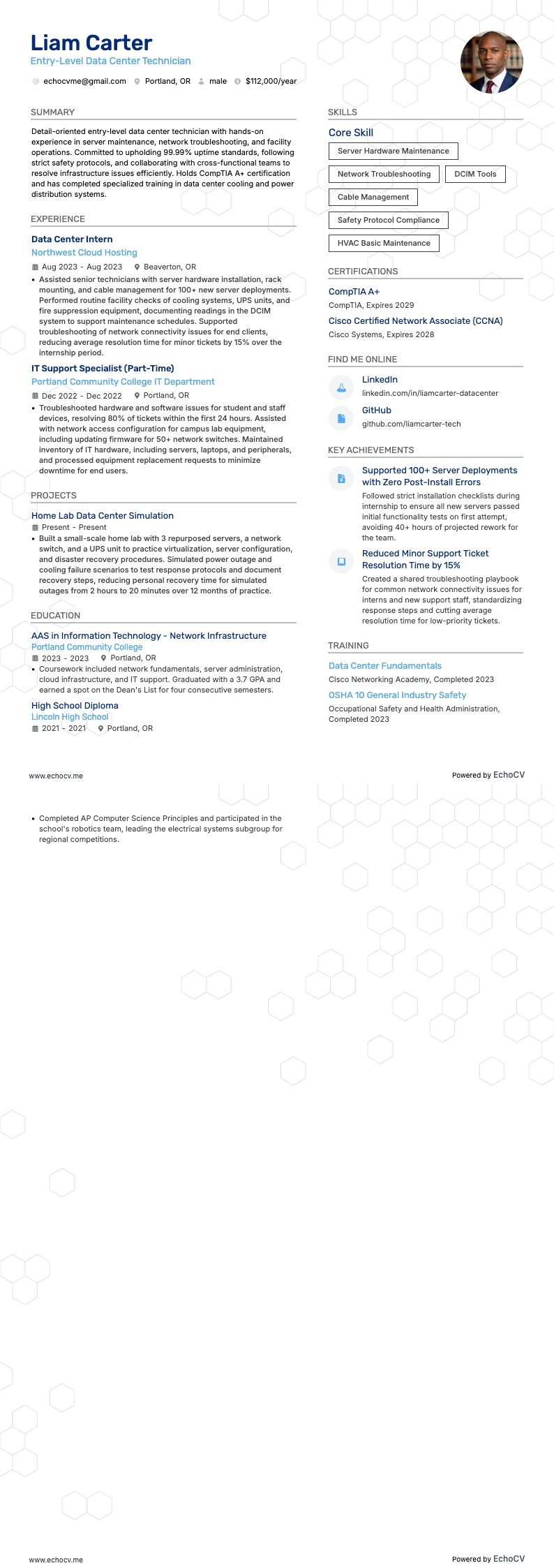
Data-Center-Techniker (Associate)

Data-Center-Techniker/in (Einstieg) example resume
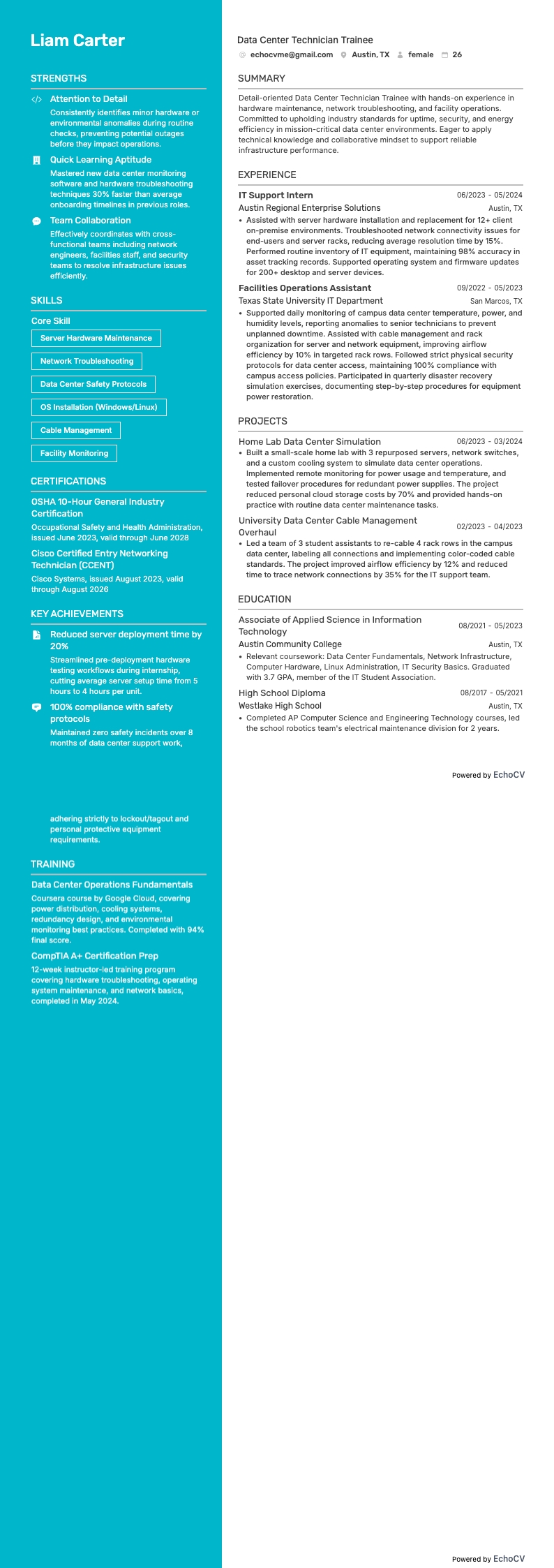
Data-Center-Techniker/in (Einstieg)

Data-Center-Techniker in Ausbildung example resume
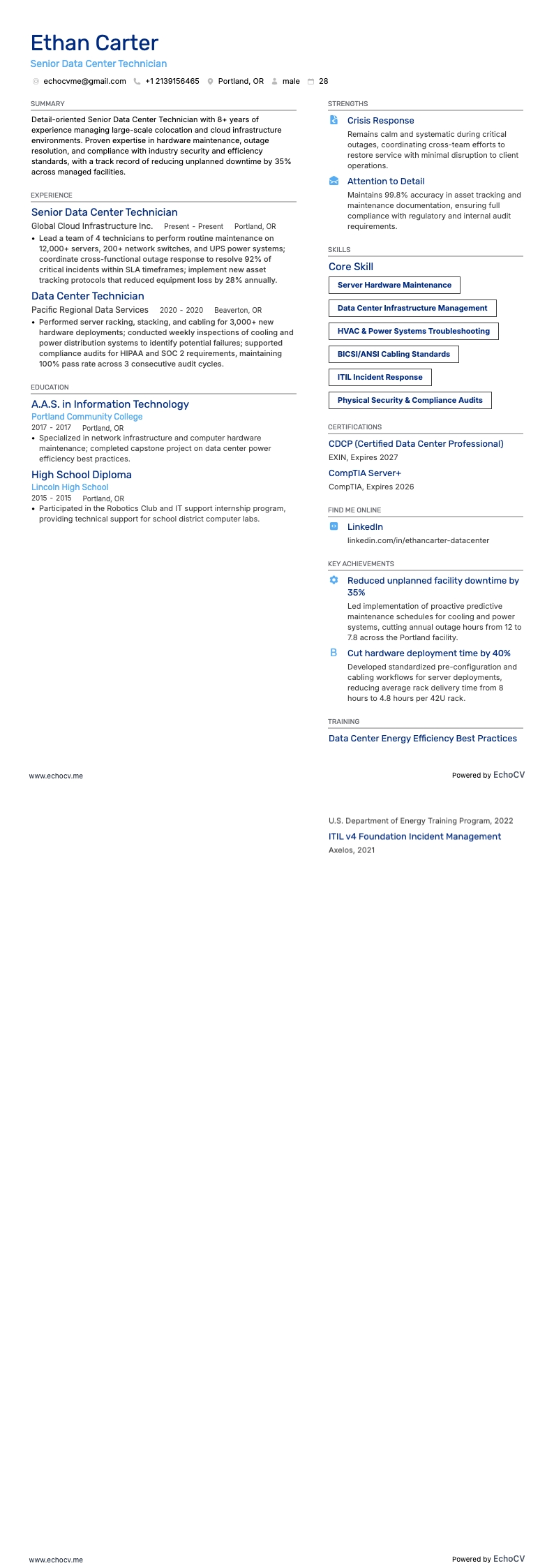
Data-Center-Techniker in Ausbildung

Leitender Rechenzentrumstechniker example resume
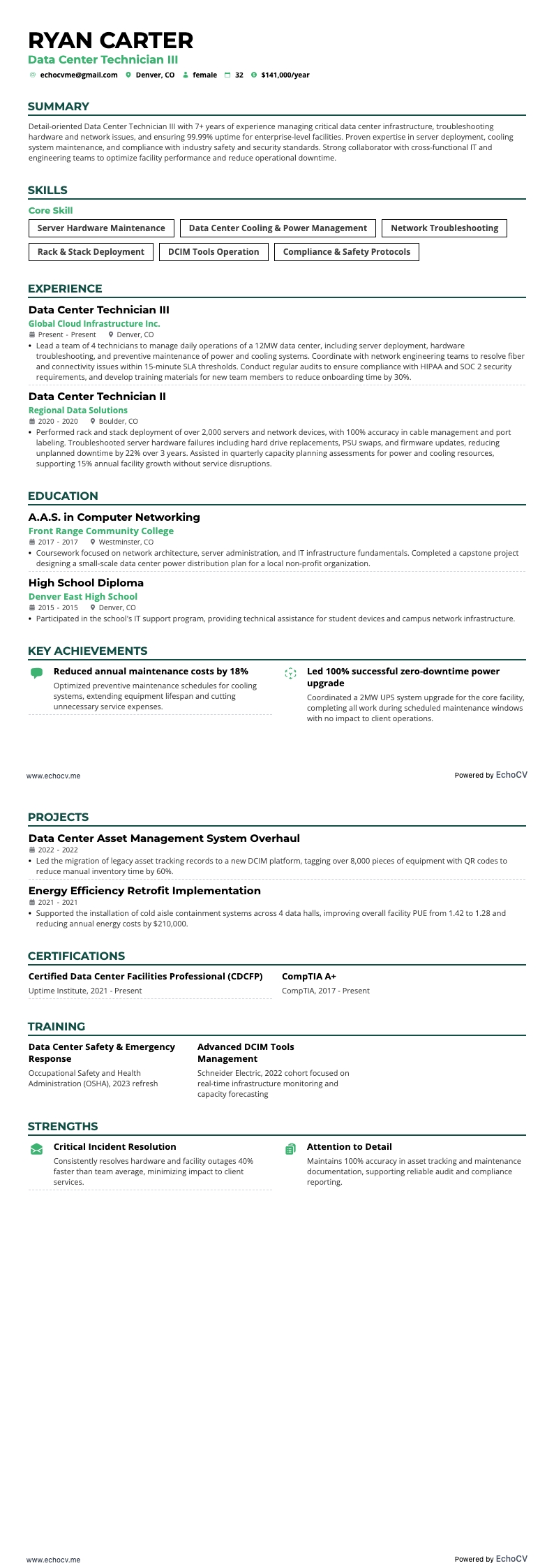
Leitender Rechenzentrumstechniker

Rechenzentrumstechniker III example resume
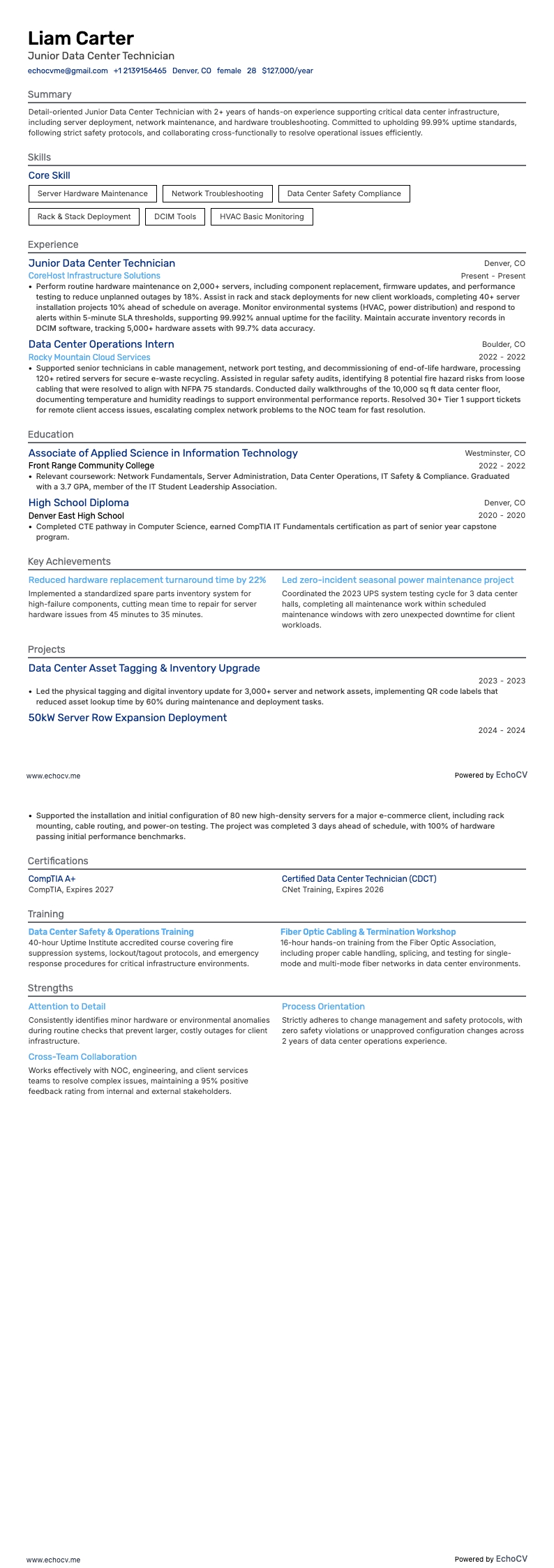
Rechenzentrumstechniker III

Junior-Rechenzentrumstechniker example resume
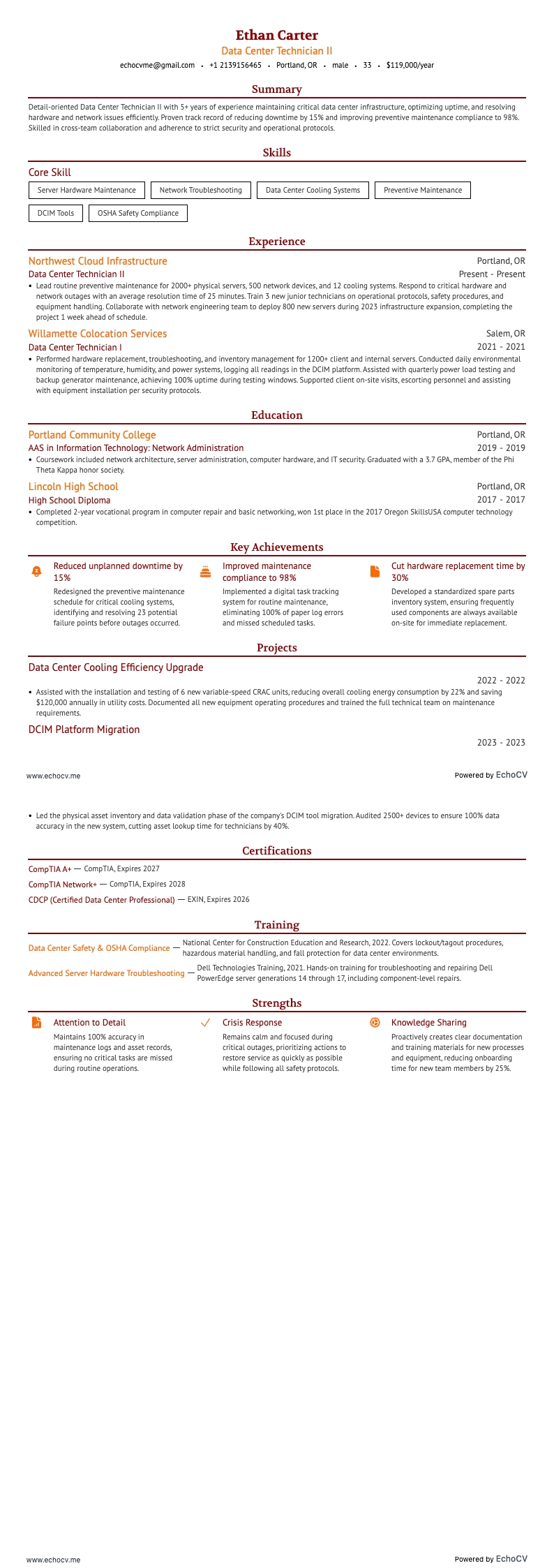
Junior-Rechenzentrumstechniker

Rechenzentrumstechniker II example resume
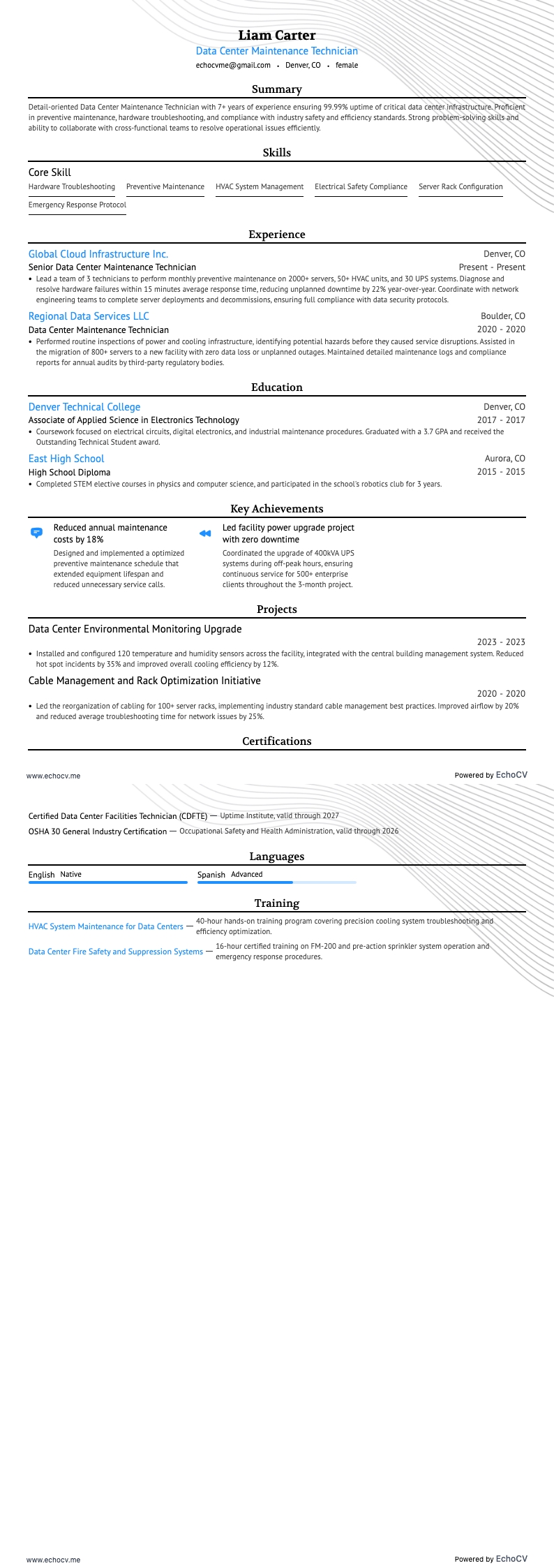
Rechenzentrumstechniker II

Wartungstechniker für Rechenzentren example resume
Wartungstechniker für Rechenzentren

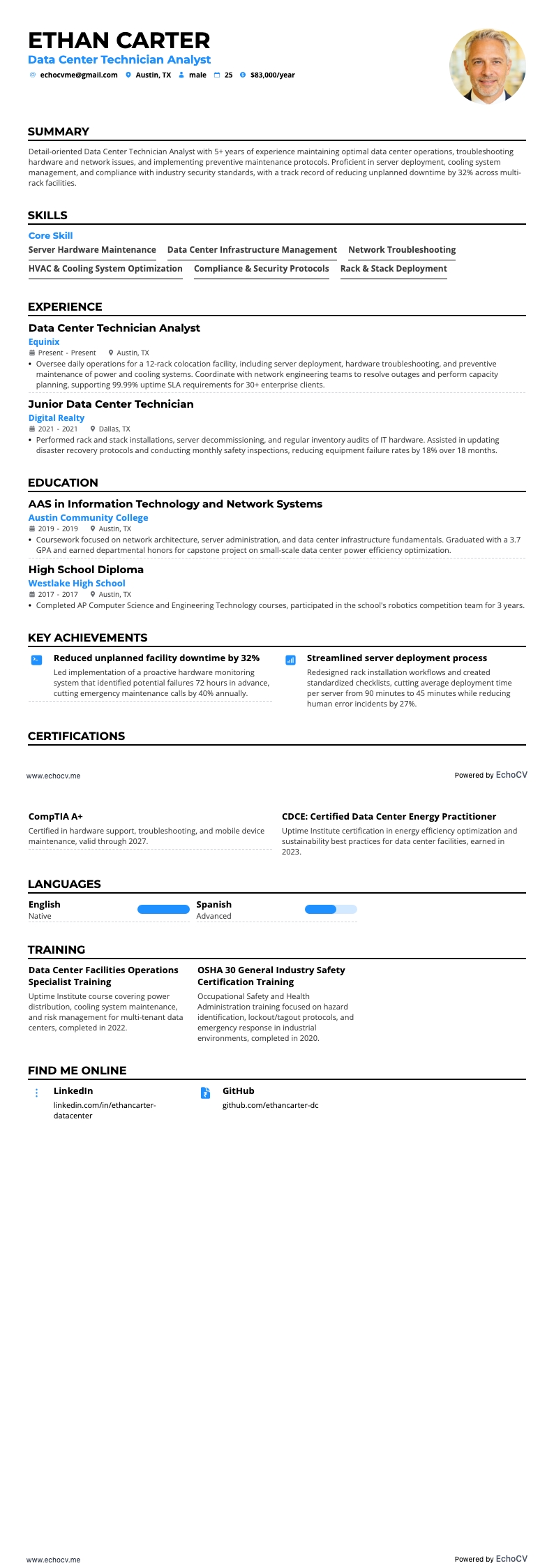
Rechenzentrums-Technikeranalyst example resume
Rechenzentrums-Technikeranalyst

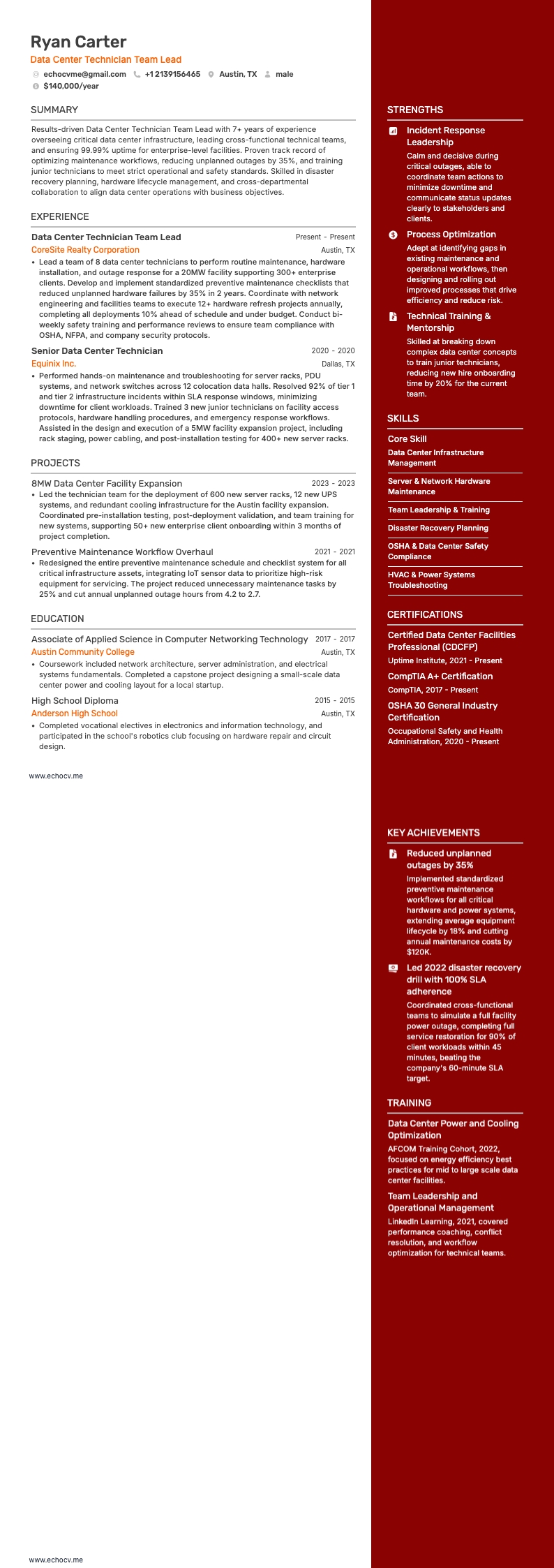
Teamleiter Data-Center-Techniker example resume
Teamleiter Data-Center-Techniker

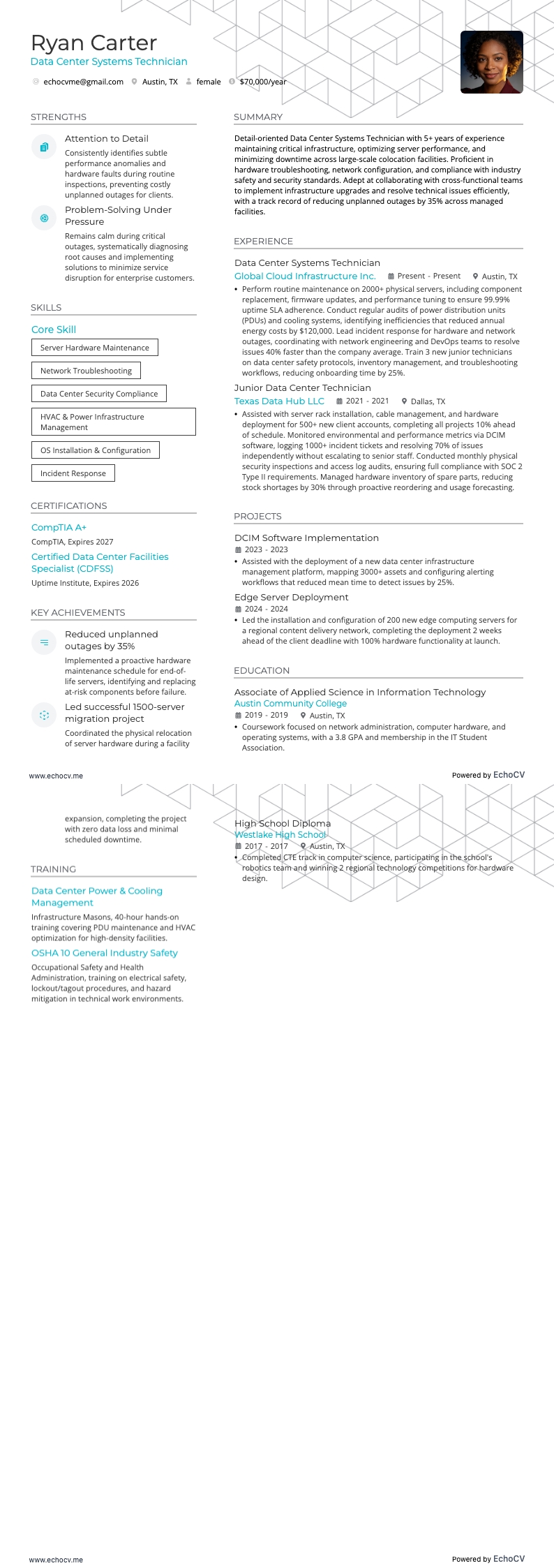
Techniker für Rechenzentrumssysteme example resume
Techniker für Rechenzentrumssysteme

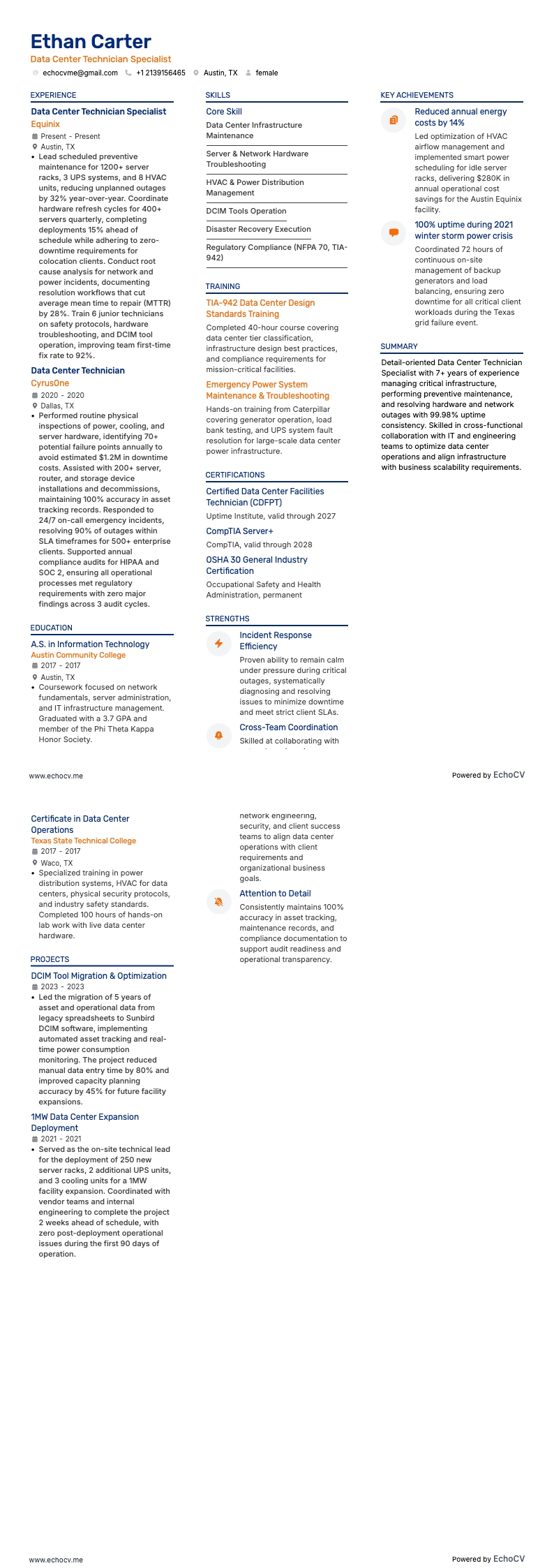
Spezialist für Rechenzentrumstechnik example resume
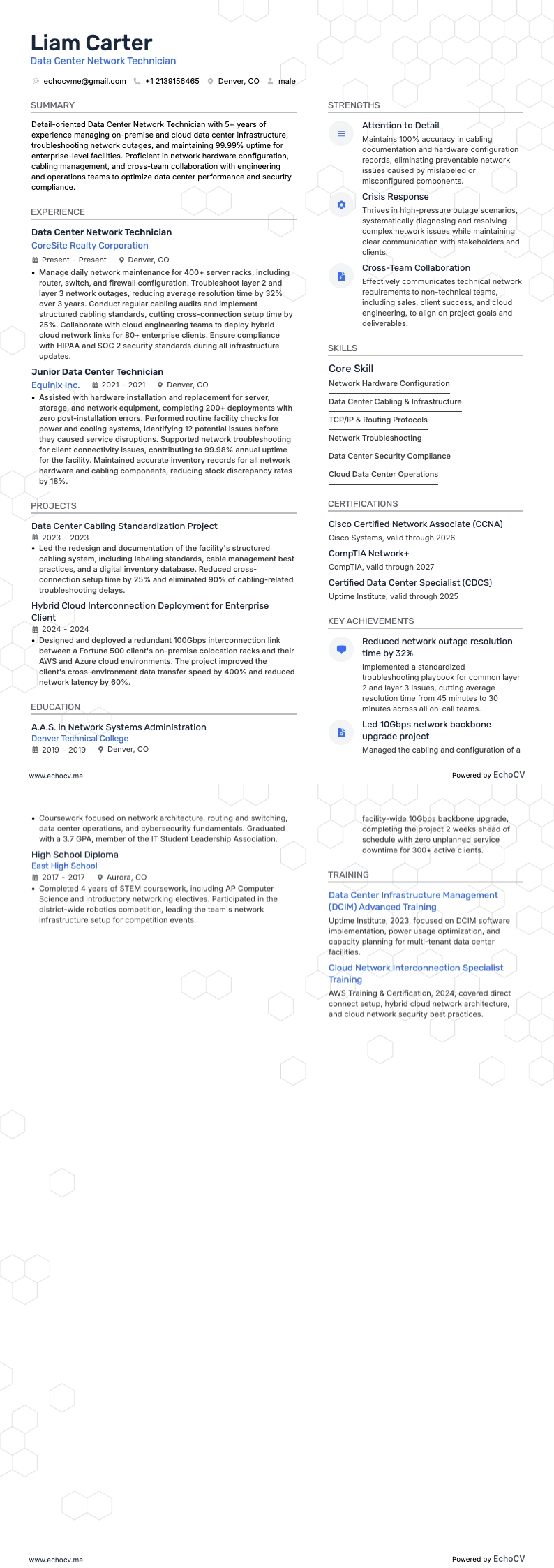
Spezialist für Rechenzentrumstechnik

Rechenzentrums-Netzwerktechniker example resume
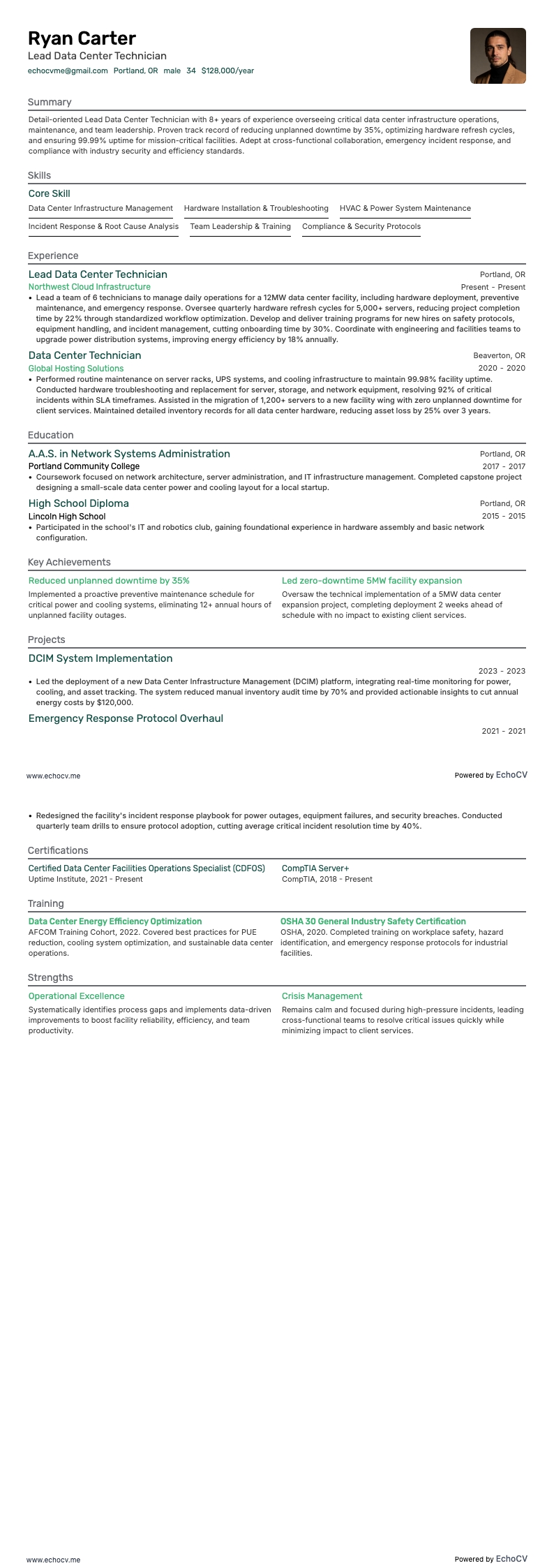
Rechenzentrums-Netzwerktechniker

Leitender Rechenzentrumstechniker example resume
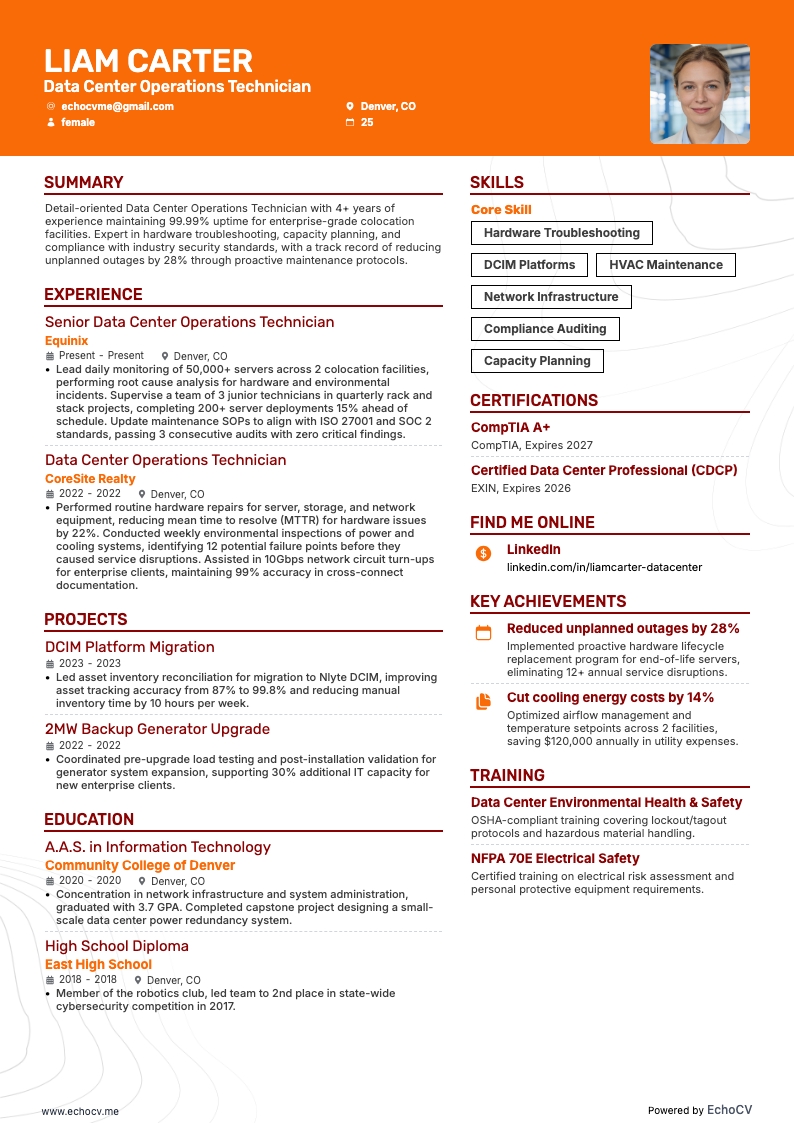
Leitender Rechenzentrumstechniker

Techniker für Rechenzentrumsbetrieb example resume
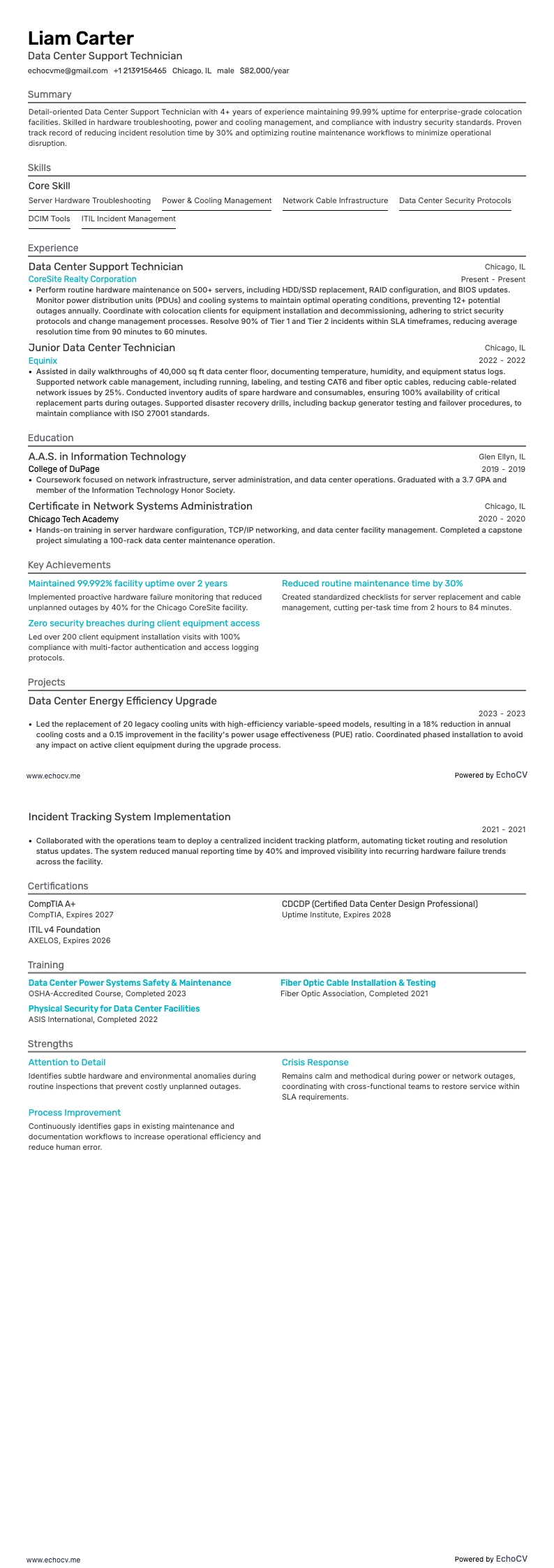
Techniker für Rechenzentrumsbetrieb

Supporttechniker für Rechenzentren example resume
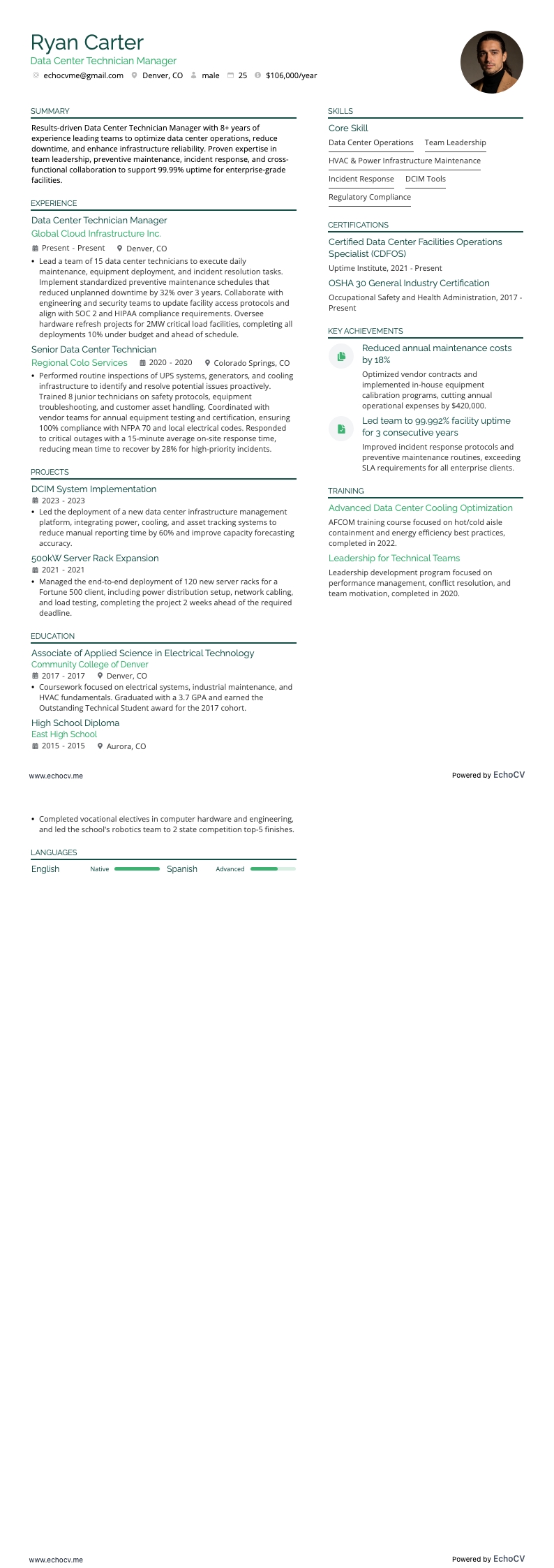
Supporttechniker für Rechenzentren

Leiter Rechenzentrumstechnik example resume
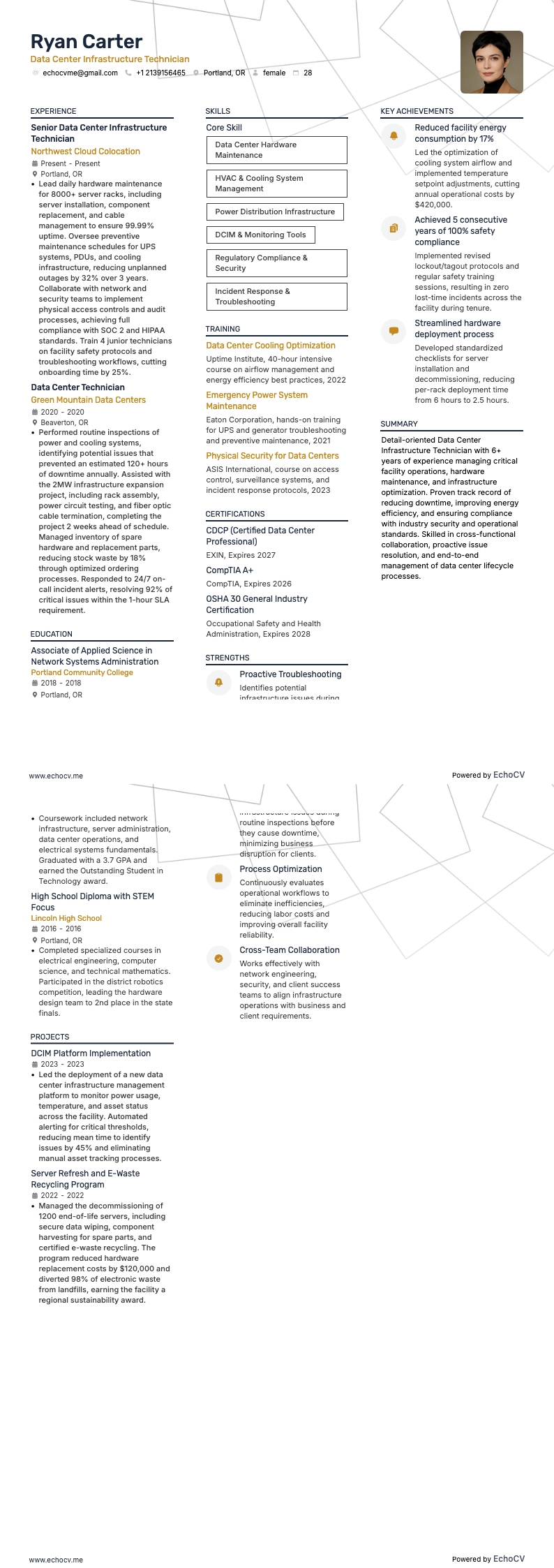
Leiter Rechenzentrumstechnik

Techniker für Rechenzentrumsinfrastruktur example resume

Techniker für Rechenzentrumsinfrastruktur

Here's something you'll want to hear: Statista predicts the Data Center market worldwide will grow by 6.56% from 2026 to 2028, reaching a massive $438.70 billion by 2028. And guess what? Most of this cash is expected to come from the US, highlighting a massive demand for data center services and the skilled pros who make it all happen.

Considering a career in a data center? You're in good company. Despite the on-call shifts and the high-stress environment, data centers offer competitive salaries for those with the right mix of specialized skills and certifications.

Let's ensure your resume showcases these in-demand skills, helping you secure a position as a data center technician right away. Our resume guide is crafted to strategically communicate your competencies to recruiters.

Here's what we'll cover:

  • How to showcase your broad range of technical skills;
  • How to demonstrate hands-on experience in troubleshooting, server maintenance, and network configuration;
  • How to highlight essential soft skills for data center technicians;
  • How to stay current with the technology landscape and optimize your job search.

Looking for something else? Check out these resume guides :

Data center technician resume sample 

Data-Center-Techniker (Associate) Lebenslaufvorschau

Sleek, right? Not only is it a well-designed resume, it has a few major benefits:

  • It demonstrates specialized skills and certifications relevant to the role. Advanced certifications like CISSP and Data Center Infrastructure Specialist are directly relevant to the fields of cybersecurity and data center management.
  • Quantifies achievements show impact. Specific metrics are key to demonstrating achievements, such as reducing equipment failures by 25% and maintaining system uptime at 99.98%.
  • Showcases leadership and initiative in projects: Leading cross-functional teams, implementing significant improvements in operational efficiency, and spearheading major network upgrades and security measures are valuable assets for data center technicians.

But how do we build a resume that’s as effective as the one above? Let’s start from the basics.

How to format a data center technician resume

When you start building your resume, there are a few factors to consider. You know the drill:

  • Choose standard 1-inch resume margins to make your resume look neat;
  • Go for traditional resume fonts size 10-12pt for easy reading. If you’re unsure which one to choose, our resume builder will help you with a selection of the most readable and ATS-friendly fonts.
  • Tailor the length of your resume to your experience. Choose a one-page template if you have less than 10 years of work experience;
  • Save your data center technician resume as a PDF to avoid formatting issues and potential unauthorized editing.

You probably have a lot of practical experience in keeping servers alive and kicking, so a traditional, reverse chronological resume is likely your best bet. It describes your most recent job first and moving backward.

For entry-level candidates, a functional resume is a great choice. This format emphasizes skills and abilities over hands-on experience, making it perfect for those applying for their first job in a data center.

Finally, data center technicians who need to showcase both their work history and professional skills can go for the combination (hybrid) resume. This format merges the strengths of a chronological resume with a functional resume, allowing you to highlight your most relevant skills and achievements while also providing a detailed employment history.

To immediately capture the recruiter's attention (and pass the ATS with flying colors), customizing your resume for each job application is crucial. This is how we create a targeted resume. Let’s face it, if you take the time to align your resume with the job description, you become one of the 10% of selected candidates.

Keep in mind the market you’re applying to – a Canadian resume, for instance, might have a unique layout.

If you already have a resume, run it through an AI-powered resume checker to see how it scores against real automated filters.

Now that we’ve got it clear, let’s see what key sections you shouldn’t miss:

The top sections on a data center technician resume

  • Professional experience in data centers: Highlights hands-on experience with data center operations like maintenance and troubleshooting.
  • Soft skills and team contributions: Demonstrates communication, problem-solving abilities, and crisis management, essential for data center environments.
  • Education and continuous learning: Indicates formal education and any ongoing training.
  • Technical skills and certifications: Showcases specific hardware, software, and networking skills along with relevant certifications, crucial for the job.
  • Projects and achievements: Details specific projects or accomplishments, such as efficiency improvements or successful system upgrades.

Brilliant. But how do you impress HR managers? It’s not just about having the right sections.

What recruiters want to see on your resume

  • Relevant technical certifications. Recruiters love these because they show off your skills and know-how in specific technologies, and validate standards that keep data centers humming.
  • Hands-on experience with data center equipment. It demonstrates the technician’s ability to manage, troubleshoot, and maintain critical infrastructure.
  • Knowledge of data center protocols and standards. That's gold. It means you're all about keeping things compliant and efficient.
  • Experience with virtualization and cloud technologies. Because of the growing integration of cloud services in data center operations, the ability to adapt to modern IT environments is a standout trait.
  • Problem-solving skills. Recruiters are on the lookout for people who can tackle any curveball and keep things reliable with as little downtime as possible.

Now, let us show you how to translate all these HR expectations into your resume.

How to write a data center technician resume experience section

Let’s put it this way. Data center technicians’ resumes should be packed with numbers. То demonstrate efficiency, problem-solving skills, and the ability to manage complex systems, you should be able to meet and exceed specific goals.

Your experience section should ooze precision, reliability, and measurable improvements in technology environments.

Below is an example of how NOT to do it.

Experience
Data Center Technician
Dell
San Jose, California
  • Upgrading hardware and software
  • Managing data distribution and storage
  • Emergency planning
  • Technical support
FALSCH

3 reasons why we consider it a bad example:

  • Position too general: A broadly defined role fails to highlight the candidate’s specialized skills and unique contributions.
  • No description of tasks: Simply listing job titles without explaining what they did leaves recruiters guessing about the applicant's actual contributions and skills.
  • Lack of measured experience: Without quantifiable achievements, it's hard to gauge the impact of one’s work or compare it against other candidates.

Stay with us to see how this can be improved with some more details in the mix.

Experience
Data Center Infrastructure Specialist
Dell
San Diego, California
  • Upgraded hardware and software across 150+ servers, enhancing processing speed by 30% and reducing system downtime by 20%.
  • Managed data distribution and storage for over 50TB of critical data, implementing compression techniques that increased storage efficiency by 25%.
  • Led emergency planning initiatives, resulting in a 40% improvement in disaster recovery times and a 50% reduction in data loss during unplanned outages
  • Provided technical support, resolving over 500+ technical queries per month with a 95% satisfaction rate, significantly improving operational efficiency and system reliability.
RICHTIG

Just from the look of it, you can tell this is way better. On top of the better-defined position, we have three major amplifications:

  • Quantifiable achievements. It features detailed metrics (like "30% faster processing speed"), vividly showcasing the candidate's tangible impact.
  • Varied skills and responsibilities. The sections span a wide array of duties, from emergency planning to technical support, highlighting the candidate's comprehensive skill set and adaptability.
  • Leadership and problem-solving. Phrases such as "Initiated emergency planning" emphasize the candidate's initiative in leadership and their strategic approach to complex challenges.

To get to this level of strategic resume building, you need to know how to measure impact so that you stand out from the crowd. We tackle this in the following section of this guide.

How to quantify impact on your resume

Quantified data simply means backing up your experience with solid examples. No fluff, no lies, just the real deal. Here’s how you can stand out:

  • Uptime percentage: Highlight the uptime you've maintained, showing you’re a pro at keeping things running smoothly.
  • Data volume: Talk about the tons (or terabytes and petabytes) of data you've managed, proving you can handle big data challenges.
  • Servers upgraded: Share how many servers you've set up or upgraded, showcasing your hands-on tech skills.
  • Faster responses: Mention how you've slashed response times, proving you're quick on your feet.
  • Saving money: Detail the savings from making things run more efficiently or green, showing you're mindful of the budget.
  • Security compliance: List how many security audits you've sailed through, showing your commitment to keeping data safe.
  • Energy efficiency: Share any improvements in energy use, proving you're all about sustainability.
  • Learning and leading: Talk about the training sessions you've rocked, either as a learner or leader, showing your eagerness to grow and help others do the same.

If you support your resume with real numbers, it will pack a punch like no other.

Starting out fresh? Don't stress, we've got tips coming up just for newcomers in the field.

How to write an entry-level data center technician resume

Everyone begins their journey at some point. If you're on the cusp of starting your first job in a data center, the key is to showcase your eagerness to learn, your ability to adapt, and solid IT fundamentals. True, stepping in without prior experience is daunting, but not impossible.

To make your resume stand out, focus on the following:

  • A strong objective statement highlighting your career goals and enthusiasm for the field.
  • Detailed education and training section, especially if you have relevant coursework or certifications in IT, networking, or computer science.
  • Proven skill set, best combined with relevant tools or technologies you've practiced with, even in a learning environment.
  • Transferable experience, like any internships, part-time jobs, or volunteer work related to IT. Remember to describe any projects or tasks you completed.
  • Relevant certifications, such as CompTIA A+ or Cisco's CCNA, and any training courses you've completed that relate to data center operations. Note that some employers might cover your certification costs as a form of compensation, as long as you train and work with them.

You can even highlight any experiences from class projects or personal tinkering to demonstrate your hands-on skills and interest in technology. Then follow the formatting guidelines above and you’re set.

Junior data center technician resume sample

Data-Center-Techniker/in (Einstieg) Lebenslaufvorschau

Looking for advice on which skills to include in your data center resume? Our next section is just for you.

How to list data center skills on your resume

Securing a technician role in a data center requires a balanced combination of technical knowledge and interpersonal skills. It's crucial to be well-versed in a wide range of hardware technologies while also showing a great deal of stamina and teamwork capabilities.

If you're unsure where to start, we've compiled a list of essential tech skills to enhance your resume and make it stand out.

Best hard skills for a data center technician resume

  • Server hardware installation and maintenance
  • Network configuration and troubleshooting
  • Virtualization technologies (VMware, Hyper-V)
  • Cloud computing services (AWS, Azure, Google Cloud)
  • Data storage solutions (SAN, NAS)
  • Operating systems (Windows Server, Linux)
  • Scripting languages (PowerShell, Bash)
  • Database management (SQL, Oracle)
  • Disaster recovery and backup solutions
  • Environmental monitoring systems
  • Physical security systems
  • Data center infrastructure management (DCIM) software
  • Network security protocols (SSL/TLS, VPN)
  • Energy management and cooling systems
  • Fiber optic and copper cabling standards
  • Compliance standards (ISO, SOC 2, GDPR)
  • Performance monitoring tools
  • Automation and orchestration tools
  • Cybersecurity measures and tools
  • Incident response and management

When incorporating soft skills into your resume, it's not enough to merely list them. Like every other part of your resume, these skills should be substantiated with real examples. Simply enumerating traits won’t cut it.

Show who you are as an individual by connecting your real-life qualities and habits to the job you're targeting.

Consider our collection of transferable skills as a starting point to brainstorm and tailor your own resume.

After thoughtfully showcasing your skills, you better your chances of getting called for an interview. This shows recruiters that you understand the job requirements and know which skills will be valued.

Equally critical for landing a position in a data center are certifications —a topic we delve into in the next section.

How to list certifications and education on your resume

Holding the right industry certifications can be more valued than general IT training or online courses. This underscores the value and credibility that certified professionals bring to their resumes. Being certified by a recognized organization, with a current certificate at the time of application, significantly boosts your chances of getting noticed.

Below are the top 5 certifications to consider for a career in data centers.

Finally, create a dedicated section for certifications on your resume. Include names, issuing organizations, and serial numbers, to make it easier for recruiters to spot what they seek.

Next, we'll discuss how to concisely summarize your skills and experiences into a few impactful sentences, ensuring your resume stands out.

How to write a data center technician resume summary or objective

If you’re a data center technician with at least 3 to 5 years of experience, then you should go for a career summary. It will focus on your strengths, skills, and what you’re bringing to the company.

You can craft your career summary by following three simple steps:

  • Start with your most relevant experience. Not the most recent, but the most relevant to the job you’re applying for.
  • Provide a brief overview of your strong points.
  • Wrap it up within 5 sentences.

Let’s explore the two examples below.

Summary
With 5 years in IT support and a focus on data center operations, I bring a mix of server management and problem-solving skills. My experience also includes customer service, enhancing my technical communication and stress management capabilities.
FALSCH

You already see why this summary doesn’t really pack a punch. Three mistakes:

  • The summary is vague. It fails to provide specific achievements or skills that would make the candidate stand out for a data center technician position.
  • It includes experience not fully relevant to the role (“customer service”), potentially distracting from the core qualifications for the role.
  • It lacks a value proposition, missing a clear statement of what the candidate can offer to the company.

Now, shall we see how this summary can be improved?

Summary
Detail-oriented Data Center Technician with over 5 years of experience, specializing in server management and network infrastructure optimization, achieving a 99.9% uptime record. Successfully led a team in a major data migration project, enhancing system efficiency by 30%. Adept at navigating high-pressure environments and ready to drive operational excellence and innovation in data center operations.
RICHTIG

What has changed?

  • Relevant experience and achievements. It specifically highlights expertise in server management and network optimization, including a quantifiable achievement (“99.9% uptime record”).
  • Showcased skills. The candidate demonstrates leadership by mentioning the successful lead of a data migration project, resulting in a significant efficiency improvement (30%).
  • Value proposition. The candidate's ability to handle high-pressure environments and contribute to operational excellence and innovation are clearly articulated.
  • Word choice: The use of descriptive words (detail-oriented, specializing, successfully, adept) and action verbs effectively communicates the candidate's skills, experience, achievements, and readiness to contribute positively to a new role.

Resume objectives, on the other hand, are shorter statements, more suitable for those with less experience or gaps in their employment. They’re up to 3 sentences long and focus on your career aspirations. See a good example of an objective statement below.

Objective
Energetic and knowledgeable Data Center Technician, recently graduated with a degree in Information Technology. Proficient in server management, network configuration, and troubleshooting, seeking to apply fresh skills and theoretical knowledge in a professional environment. Committed to ensuring high system uptime and optimizing data center operations through innovative solutions.
RICHTIG

If you're all set and wondering where to apply, the upcoming section’s got you covered.

How to add a project section to a data center technician resume

The technology landscape, especially within data centers, evolves constantly. A resume that was relevant two years ago might now lack mention of emerging technologies (like edge computing or AI-driven monitoring tools).

To maintain a competitive edge, consider adding a section for ongoing training or projects to your resume. This not only demonstrates your alignment with potential employers' core business interests but also your commitment to staying abreast of industry trends.

Make sure you include details for every project in the section:

  • an overview of the project
  • project duration
  • results in numbers

Like this one:

Data Center Expansion and Optimization
Cincinnati Bell Data Center, Cincinnati, Ohio
Led a comprehensive expansion and optimization project for a 10,000 sq. ft. data center, aiming to increase capacity and improve energy efficiency.
  • Increased data center capacity by 30% without compromising system performance or reliability.
  • Achieved a 15% reduction in energy consumption, significantly lowering operational costs.
  • Enhanced system monitoring and alerting capabilities, reducing downtime by 20% and improving response times to incidents.
RICHTIG

Key takeaways

  • Create a professional email . Set up an email account just for job hunting to keep spam away.

  • Use multiple job sites . Don't stick to just one site. Different employers post on different platforms.

  • Choose sites wisely . Pick a few job sites that are most relevant to data center technician roles.

  • Apply carefully. Avoid using automatic application features. Customize your resume for each job to stand out. This is crucial to prevent your resume from being overlooked by ATS.

  • Broad technical skills . Make sure your resume shines a light on your wide range of tech know-how, covering everything from software knowledge to hardware skills.

  • Real-world experience . Talk about your direct involvement in hands-on tasks like fixing problems, keeping servers running smoothly, and setting up networks. It’s important to show you can put theory into practice.

  • Essential soft skills . Don’t forget to highlight your people skills, like how well you communicate, work in a team, and solve problems. You can’t go without these in a data center setting.

  • Keeping up-to-date. Stay in the loop with the latest tech trends and tools. It shows you’re ready to grow and adapt, which is key in this fast-moving field.

Rechenzentrumstechniker Lebenslauf-Beispiele

Entdecken Sie weitere Rechenzentrumstechniker-Lebenslauf-Beispiele und Leitfäden und sehen Sie, was für Ihr Erfahrungsniveau oder Ihre Rolle am besten funktioniert.

Nach Erfahrung

Data-Center-Techniker (Associate)

Data-Center-Techniker (Associate) Lebenslaufvorschau

Data-Center-Techniker/in (Einstieg)

Data-Center-Techniker/in (Einstieg) Lebenslaufvorschau

Data-Center-Techniker in Ausbildung

Data-Center-Techniker in Ausbildung Lebenslaufvorschau

Leitender Rechenzentrumstechniker

Leitender Rechenzentrumstechniker Lebenslaufvorschau

Rechenzentrumstechniker III

Rechenzentrumstechniker III Lebenslaufvorschau

Junior-Rechenzentrumstechniker

Junior-Rechenzentrumstechniker Lebenslaufvorschau

Rechenzentrumstechniker II

Rechenzentrumstechniker II Lebenslaufvorschau

Rechenzentrumstechniker Lebenslauf-Beispiele

Entdecken Sie weitere Rechenzentrumstechniker-Lebenslauf-Beispiele und Leitfäden und sehen Sie, was für Ihr Erfahrungsniveau oder Ihre Rolle am besten funktioniert.

Nach Rolle

Wartungstechniker für Rechenzentren

Wartungstechniker für Rechenzentren Lebenslaufvorschau

Rechenzentrums-Technikeranalyst

Rechenzentrums-Technikeranalyst Lebenslaufvorschau

Teamleiter Data-Center-Techniker

Teamleiter Data-Center-Techniker Lebenslaufvorschau

Techniker für Rechenzentrumssysteme

Techniker für Rechenzentrumssysteme Lebenslaufvorschau

Spezialist für Rechenzentrumstechnik

Spezialist für Rechenzentrumstechnik Lebenslaufvorschau

Rechenzentrums-Netzwerktechniker

Rechenzentrums-Netzwerktechniker Lebenslaufvorschau

Leitender Rechenzentrumstechniker

Leitender Rechenzentrumstechniker Lebenslaufvorschau

Techniker für Rechenzentrumsbetrieb

Techniker für Rechenzentrumsbetrieb Lebenslaufvorschau

Supporttechniker für Rechenzentren

Supporttechniker für Rechenzentren Lebenslaufvorschau

Leiter Rechenzentrumstechnik

Leiter Rechenzentrumstechnik Lebenslaufvorschau

Techniker für Rechenzentrumsinfrastruktur

Techniker für Rechenzentrumsinfrastruktur Lebenslaufvorschau