CONSEJO PRO
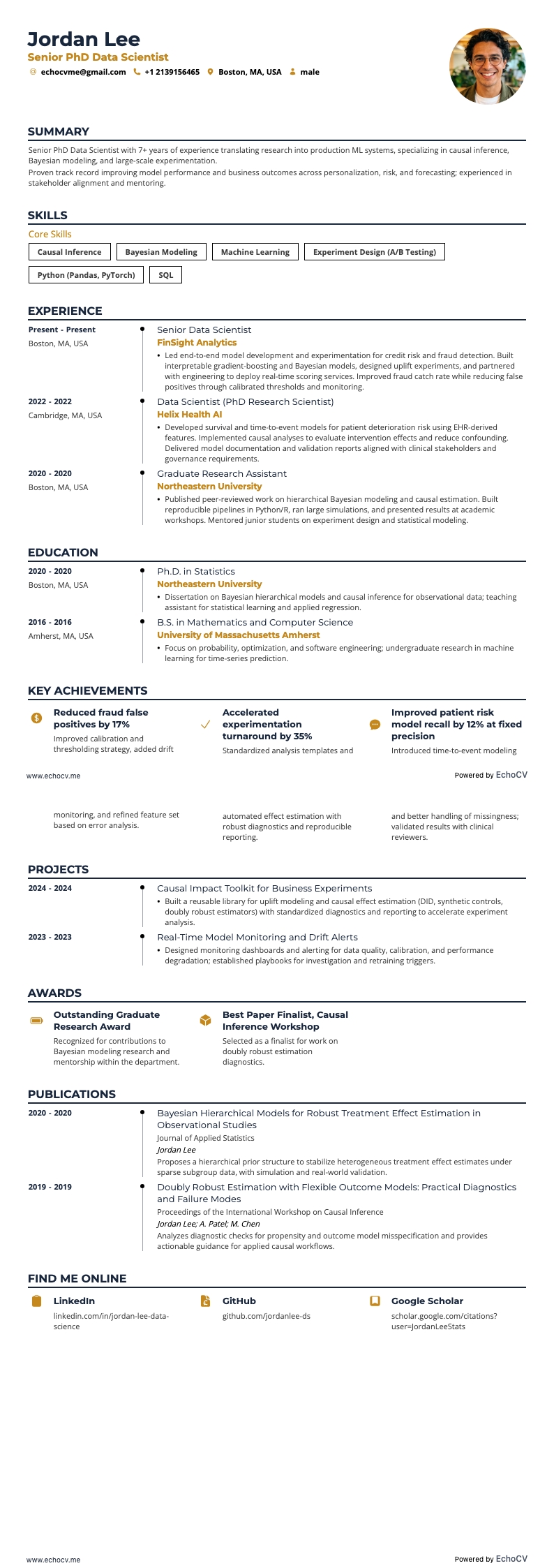
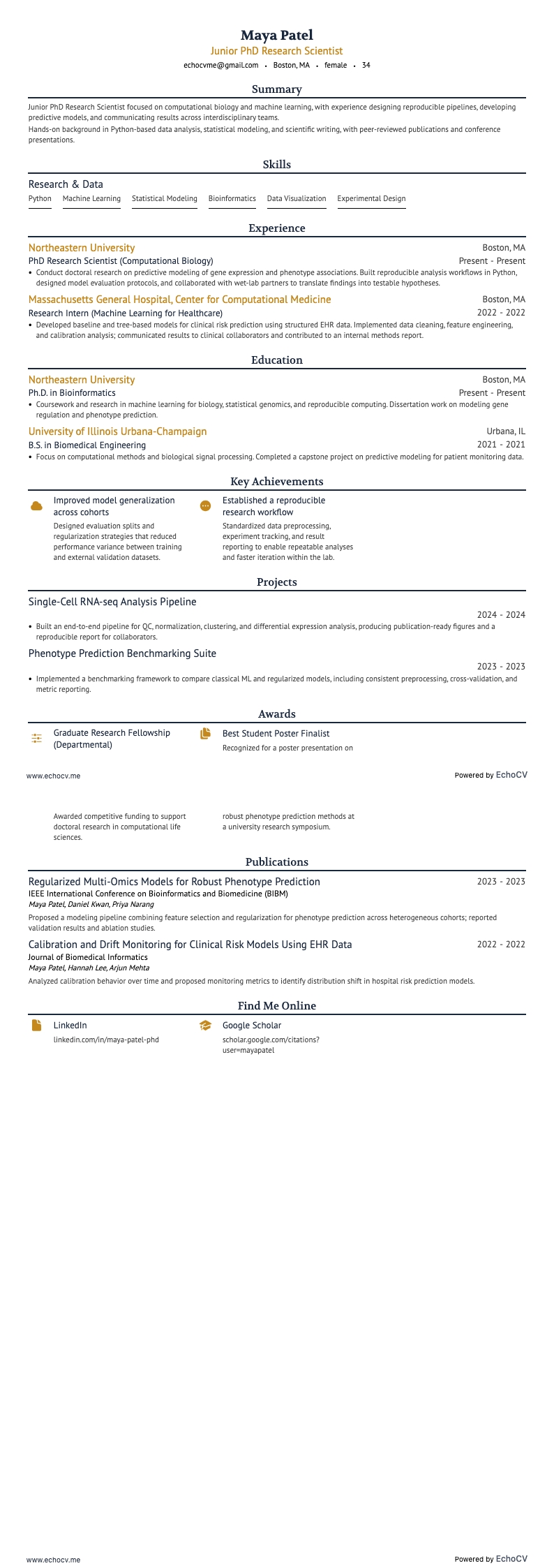
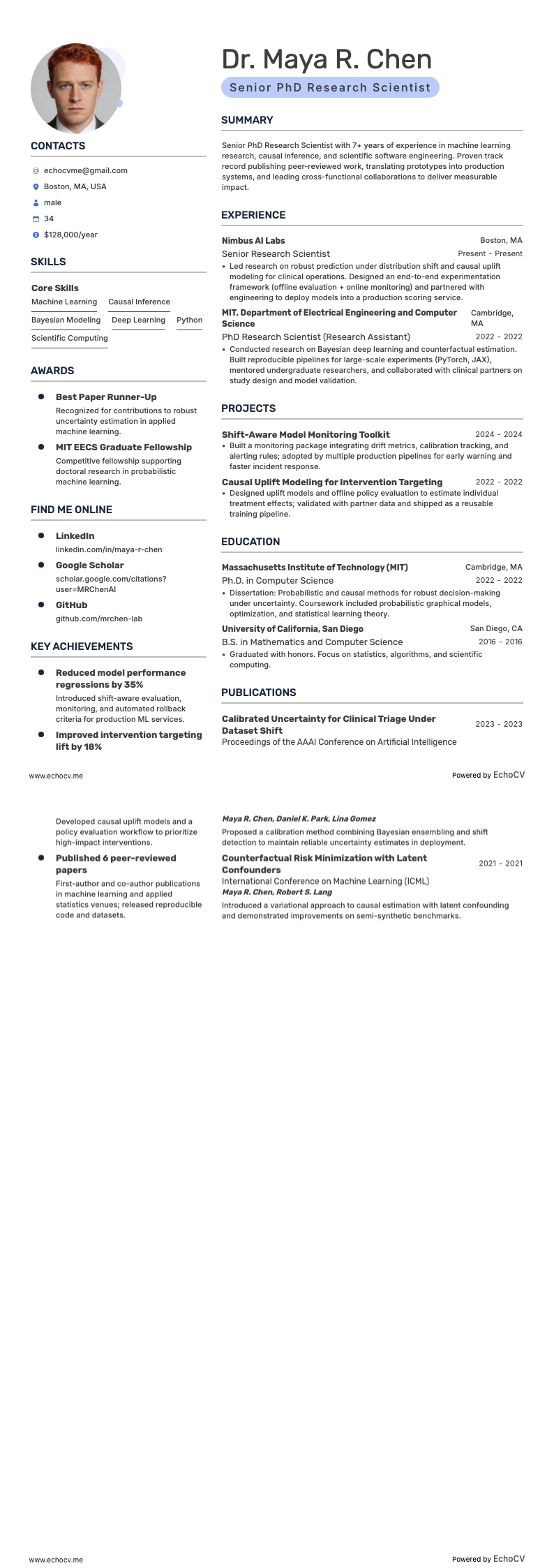
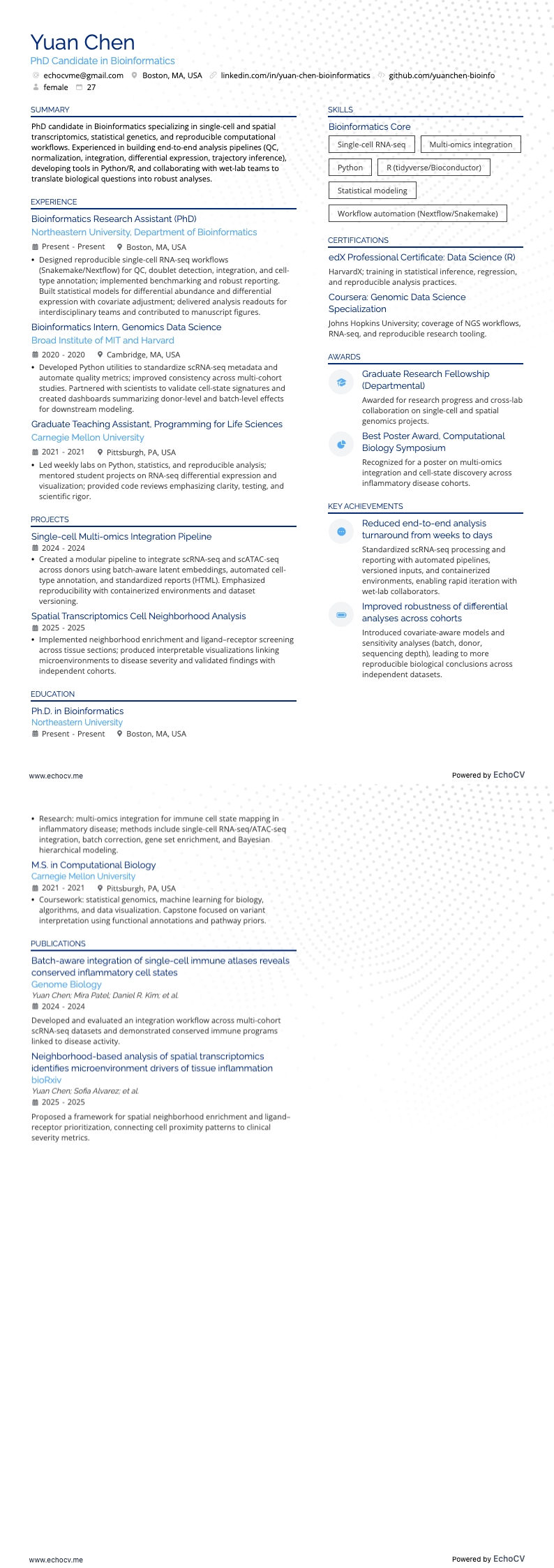
if you’ve participated in any extracurricular activities during your studies, they could indicate various soft skills on your resume, including leadership, initiative, organization, etc.
Escrito por el equipo de EchoCV
if you’ve participated in any extracurricular activities during your studies, they could indicate various soft skills on your resume, including leadership, initiative, organization, etc.
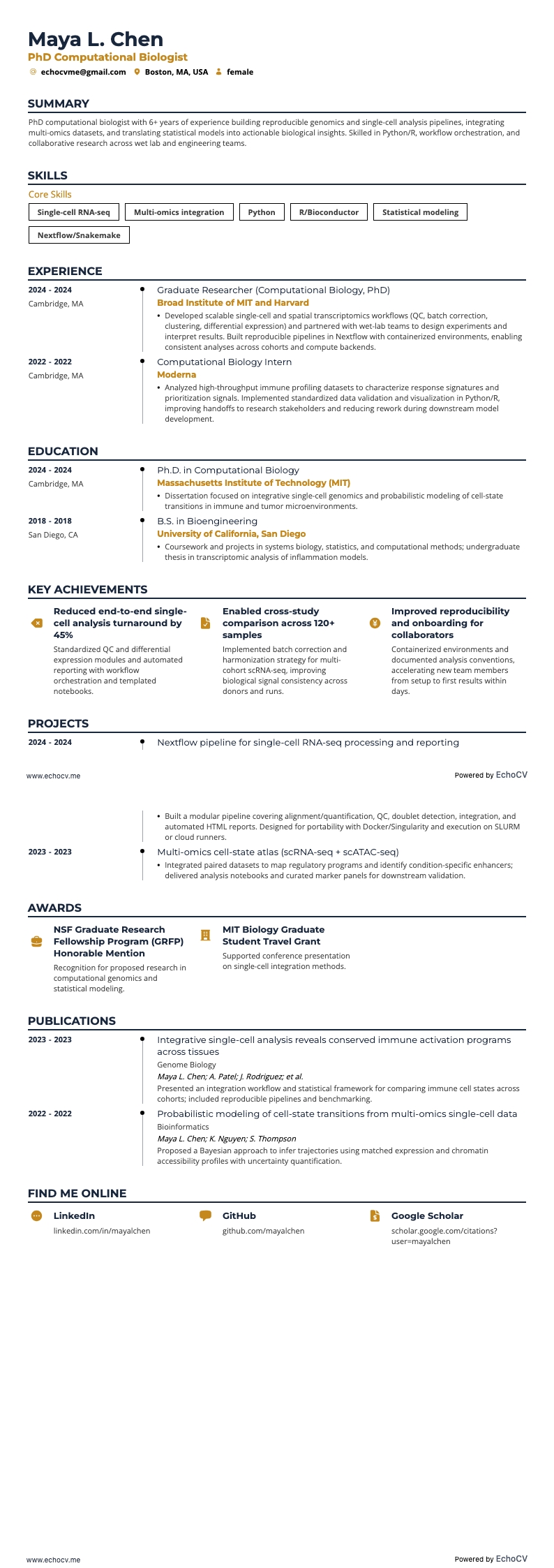
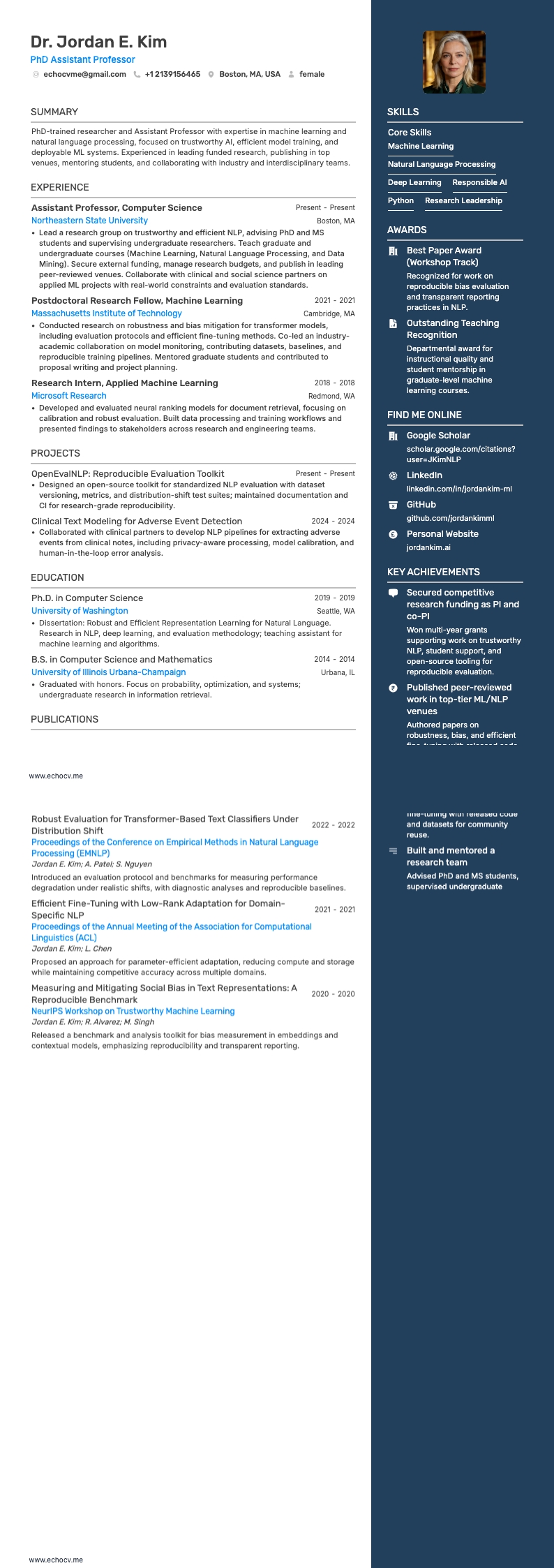
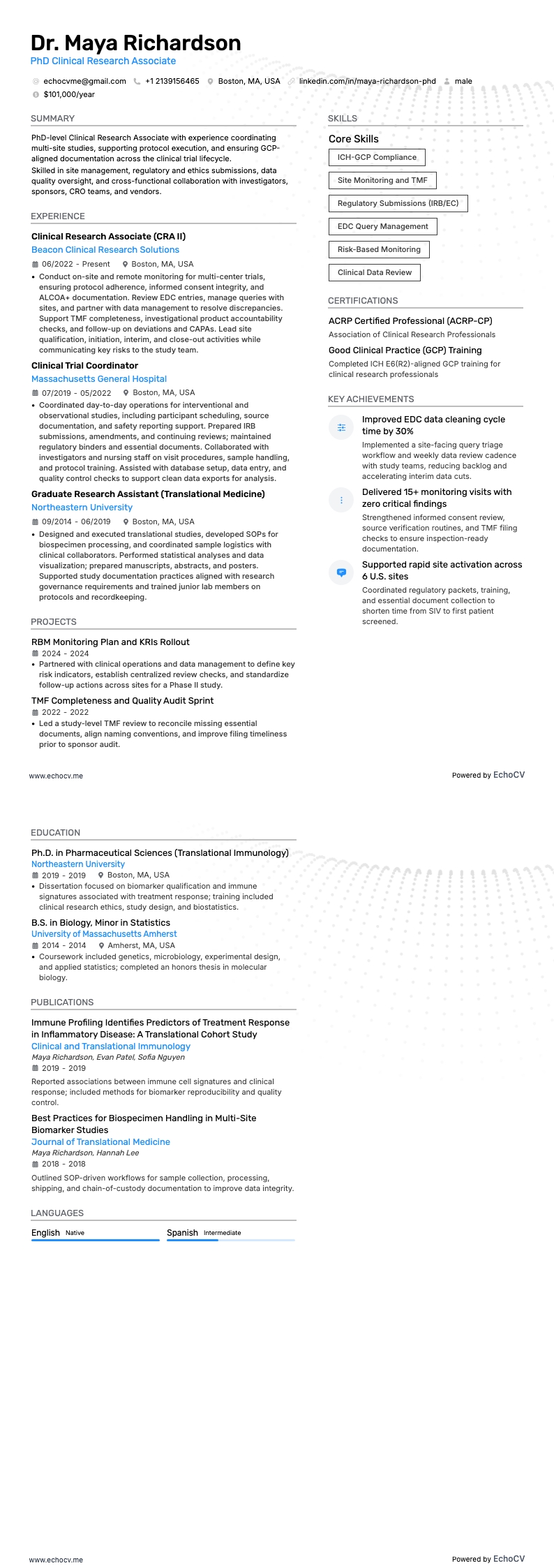
Are you a current Ph.D. student, wondering how to include your ongoing degree on your resume?
Charles Flack’s resume includes some of the best how-to practices.
Charles uses the resume headline and summary’s first section to specify his research niche, which is followed by his ongoing Ph.D. Status.
N.B. Remember that the recruitment process is one of building trust with honesty. If you note in your resume that you’re a Ph.D. graduate (without this being the reality), recruiters will find out.
Continuing with Charles’s resume summary. It goes on to include an array of expertise and soft skills (e.g. leadership, adaptiveness, perfectionism) all within achieved results in academia.
His experience section includes roles in leadership, technical writing, and private tutoring, denoting individual skills and contributions.
The strengths Charles has included are more specific and tie in with data science roles. Those include quantitative problem-solving, deep learning, and iterative process.
Let's start with a big no-no: your academic CV, the one you used to secure that tenure position, is a No-go. Put simply - it lacks personality.
HRs and the Applicant Tracking System (ATS) need more context to your experience.
Unfortunately, here comes one of the biggest disadvantages you may face, leaving academia. Often, Ph.D. graduates get rejected as they lack practical work experience.
Don't get discouraged. Instead, find a resume format that works for you.
For Ph.D. graduates that have less work experience, we recommend a functional-skill-based format. It will help you highlight your unique skill set and academic excellence.
Also, it'll align your niche area of expertise with the role expectations.
Now that we've settled the formatting debate, let's look at a couple of more quick pointers for your Ph.D. resume.
1. The top one-third of your resume - the resume header and summary - is crucial to getting a high score on the ATS.
That's why you should try to include as many of the advert's relevant requirements within this section.
2. Expand your qualifications and skills within the experience section.
Don't just list plain bullets, but focus on the outcomes of your studies, research, or publications.
3. Speaking of impact, detail your accomplishments within your academic work.
Focus on the picture and your research's influence on the scientific field, business/ industry, or communities.
Bonus: Remember to always list all work and academic experience that is relevant to the job you’re applying for.
Your Ph.D. experience can open many doors for you, giving you a front-row seat on the cutting edge of new technologies.
But let's not get ahead of ourselves, here are a couple more bits and pieces to keep in mind when writing your Ph.D. resume.
Your Ph.D. resume should balance your knowledge with how fast it can be applied in a real-world environment.
That's why you need to be precise about the resume sections you chose to prove your merit.
After endless hours of searching different platforms, you've finally found that cancer research position that perfectly matches your profile.
Avoiding all emotional attachment and excitement, you finally decide on the following header:
Let’s look at the bright side of things. If the organization would like to get in touch with Dr. Garnett, they'd easily find his contact details.
But on the other hand, he is making one huge mistake: Dr. Garnett isn't taking advantage of the power of the top section of his resume. More specifically - his headline.
This crucial section could provide Ph.D. graduates with an opportunity to include all relevant keywords that could match their profile. And at the same time, tease their professional story.
This may be obvious, but this example works as it shows that Dr. Garnett is not only a Ph.D. graduate, but his specific area of research and interest, which should supposedly match with the role he’s applying for.
A rule of thumb for headers is to never be vague about your research and expertise.
You could list your Ph.D. degree within your resume title so that it’s the first thing recruiters (and the ATS) see.
In the case of Dr. Garnett, his resume title could read “Dr. David Garnett, Ph.D.”.
Our suggestion is to be wary about the organization you’re applying for because if the culture is more informal, this may come off as “pretentious”.
The Ph.D. resume summary is a really useful section for good first impressions and explaining your experience.
The summary can be used to highlight your skills, strengths, and achievements. While telling the story of your professional growth.
We know how important real-world examples are for you.
So, without further ado, here's how Dr. Lucina Collard rewrote her resume summary. And in the end, got the attention of a prestigious software development company.
Dr. Collard may have spent too much time in the lab, as her Ph.D. resume summary just lists what courses she took and her thesis statement.
No results, no outcomes.
In the end, she did decide to include some soft skills and passions, but without actually pointing out the “why” behind her work. This doesn’t make sense at all.
Here’s what her modified resume summary looked like in the end:
This summary works for one simple reason: it qualifies the achievements.
Dr. Collard has noted that within the past 6 years, she has been specializing in the job advert keywords “robotics” and “mechatronics”. The award is also a nice touch to paint the big picture of her experience.
Dr. Collard is apt at achieving results within a dynamic environment. That includes various professionals from different backgrounds.
When talking about her thesis, she goes on to show her familiarity with the process.
Editing Dr. Collard’s summary may seem just like one small step for her, but it’s actually a giant leap to securing an interview.
When listing their experience section, most Ph.D. graduates are probably making the same mistakes.
The first one: leaving out your academic practice, thinking that recruiters only want to see work experience.
That's not true at all.
Your education would not only prove your technical capabilities, but also your soft skills. But, more on that in the following paragraphs.
The second error: those tricky job titles.
You'd find 1000+ resumes, listing each experience using the given academic titles; e.g. Professor, Lecturer, Post Doctorate Student, Graduate Student, etc.
Robotic vs personalized approach: 1:0.
The ATS, reviewing your resume, is set to recognize keywords that are vital for the job. The faster those appear at the top of your experience, the better.
Instead of listing that you used to be a "Lecturer at XYZ University", go with "Data Science and Machine Learning Lecturer at XYZ University".
Third slip-up: those tricky experience bullets.
Some Ph.D. graduates just list all their courses, research, and publications.
This isn't the way to go.
You should rather align your knowledge with the job description to prove tangible results.
A couple of questions to help:
Let’s look at an example of how your experience can be showcased within your resume as crucial for the job.
This experience section is pretty negligent and robotic. Did you just get a diploma during those three-plus years?
You may be exiting from a leading higher education institution, but putting in the extra effort to your resume shows that you are diligent.
And that you’re actually invested in getting that particular job.
There’s no ground for comparison between the two examples. But let’s look at some of the basics.
The first experience bullet hints that the professional can write technical papers for their niche.
Next, the candidate showcases an eye for detail, collaboration, and teamwork.
Finally, they have found a way to get their thesis submitted on time and also make it more understandable.
On a side note - did you notice how a better job title could be a complete game-changer?
General practice is that you'd create one single resume experience section.
But what if while writing your Ph.D. resume, you realize that in the past six years, all your experience is for the same institution?
Here's an idea to spice up your experience section. You can create a couple of experience sections, based on functionality.
Thus highlighting job advert keywords and, at the same time, including more details.
So you could have some of the following headers, under which you could classify your work:
Feel free to align your transferable skills, which would be beneficial for the job you're applying for.
Here's the advice you've probably been waiting for; introducing…
… "How to write about your degree without sounding like a snob?"
And there are two possible scenarios at play.
The first is that you're applying for a job related to your area of study.
You should list your Ph.D. degree in detail, including research topics, method expertise, and publications.
As you're writing for non-specialized audiences, don't go overboard with the complex terms. Instead, weave keywords from the job requirements within your education section.
In the second case scenario, you're applying for a job that has nothing to do with your degree.
Keep your education section plain and simple with your degree, university/college, dates, and location.
Either way, remember to always list all of your degrees in chronological order, starting with the latest.
This isn't just some made-up rule or HR caprice. Your resume education helps recruiters determine if:
Being transparent on your Ph.D. resume is what builds that fantastic initial relationship with the company you're applying for.
Thus, you have to be very clear and precise, especially in your education section.
If you're still pursuing your Ph.D. degree, shift the focus from the future to what you've achieved so far.
Your education section could answer any of the following questions:
Being on the course to completing your Ph.D. is definitely commendable, but sometimes life happens. And you may be forced to drop out of your Ph.D. education.
Should you then list the degree you didn't complete?
The answer is 100% yes, as your Ph.D.:
Making it clear to recruiters that your degree is "Incomplete" or that you "Didn't Graduate" is very important.
List your degree, dates, university/college, and status.
If you get to the interview stage, recruiters will ask you why you dropped out. Be prepared to talk about why it wasn't the best option for your career at the time, or hint at the circumstances.
Even if it's hard to believe, HR managers are people - just like you and me - and they are able to show understanding and compassion.
Recruiters review your resume to see how your experience aligns with the role, with a big focus on transferrable skills.
Or in other words, what else can you bring to the table to help the business or institution grow?
And transferable skills can be both hard (or technical) and soft skills.
Your hard skills include the technology you used to complete your studies.
Consider the opportunities you've has to:
The list can go and on and on. Your Ph.D. has probably provided you with a pretty solid technical background.
When writing your resume’s separate technical skills section, ever wonder which technology should go first?
Rule of thumb: align the technology within the job description with your expertise.
The more proficient you are at a certain skill, the sooner you should list it.
Wondering what some of the most popular Ph.D. resume hard and technical skills are?
Check out our list, based on some of the most popular industries.
There's still no precise formula for how soft skills are gained and applied in the workplace.
How many times have you seen an advert that requires "a can-do attitude and teamwork"?
Yet soft skills are on all recruiters' must-have checklists.
In the case of Ph.D. applicants, these transferable skills are built thanks to all the healthy habits you've maintained through your education, including your:
Soft skills hint to recruiters more about your character and style of work.
Here are some ideas as to which ones you can include within your resume:
When describing your leadership or mentorship soft skills, here are a couple of questions you could answer within your resume to qualify your achievements:
Back in the day, you earned a couple of extracurricular certificates and wondering if you should include those on your Ph.D. resume.
Again, it's a matter of analyzing how necessary your certification is for the job.
E.g. if AICPA's CPA certificate is listed as obligatory within the job description - and you have earned yours - you know what to do.
Certificates show that you're willing to put in the extra effort to stay relevant. Proving that you're committed, flexible, and a life-long learner.
So, think about the relevancy the certificate would have within your field.
Then, consider including some of these popular certificates:
Publications or Projects - focus on topic, methodology, and impact; include your grant ID code, if your research won any funding
Academic Awards - once more, consider if those would shine a better light on your expertise
Conference Presentations - this would showcase your public speaking abilities
Language Skills - be honest when listing your language proficiency
The extra effort to align your Ph.D. skills with the job you're applying for always gets recruiters' attention.
Include as many relevant keywords within the header and summary of your Ph.D. resume.
Have separate sections, detailing how your academic background has helped you attain experience, skills, and certifications.
List chronologically all degrees you've earned through your education, with an adaptable approach to details.
Remember that the recruiters or the ATS assessing your resume may not be that scientifically literate. Substitute complex terminology with impact and results.
Explore más ejemplos y guías de currículum de Doctorado y vea qué funciona para su nivel de experiencia o rol.