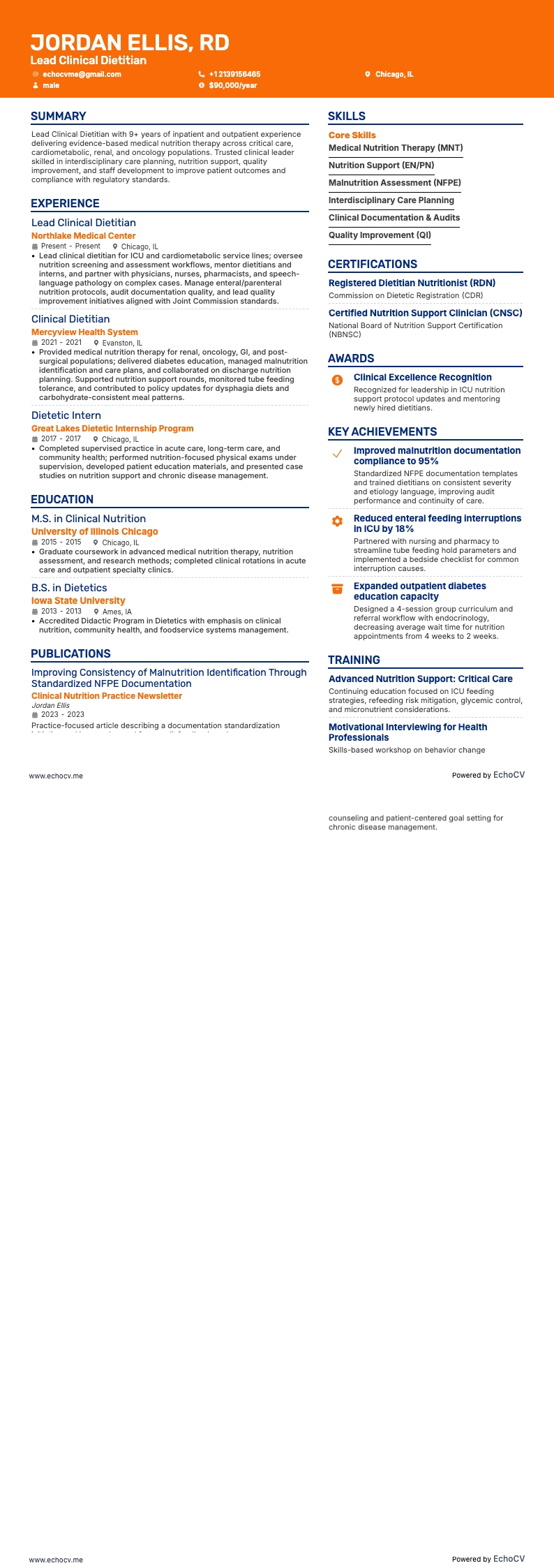
Dieticians looking for a new job will find plenty of opportunities in a variety of industries, from healthcare and food services to education, sports and fitness, and many other fields. Because dieticians come from such diverse backgrounds, it makes creating an attention-grabbing resume that tailors to the job post a bit of a challenge.
In this guide for creating a professional dietician resume, we’ll discuss the common issues that dieticians face when crafting their resume, such as:
- Effectively using professional jargon in a way that HR staff, families, and others can understand.
- Tailoring your work experience to reflect your versatility while focusing on the specific requirements of the job post.
- Accurately detail your scientific and nutritional knowledge and interpersonal skills using multiple resume sections.
- Highlighting your connection to the industry through membership in the Academy of Nutrition and Dietetics or other national associations.
- Demonstrating your commitment to learning through workshops, seminars, and conferences that cover advances in nutrition research and dietetics.
We’ll use some real-world dietician resume examples to help you create a targeted resume that includes specifics from the job post, which will boost your chances of getting an interview.
If this dietician resume guide does not match your specific career objectives, check out these resume guides for similar roles:
Before we can add your relevant work experience, education, and hard and soft skills, you need to decide on the design and layout of your resume.
How to format a dietician resume
Formatting your resume is the first step in ensuring your resume passes applicant tracking systems and gets noticed by recruiters. You’ll need to use specific document settings, which include:
- One-inch margins on all sides: Margins help improve the overall readability of your resume and keep everything organized.
- A plain white background color: A white background with black text is more legible and gives your resume a professional look.
- Line spacing set to single space: This setting allows you to create more concise, compact sentences and get enough information on a single page.
- Font size between 10-12 points: A font size between 10-12 points is the optimal setting for all print media and is becoming the standard font size for digital media as well.
- Two-page limit: The industry-standard page length for your resume is two pages as it gives you enough space to list your skills and experience.
- Document type: When you submit your resume, send it as a PDF document. This is the standard format for all resumes and will retain the look and feel of it, no matter what operating system they open it on.
These are the typical settings for most new Word or Google Docs, so there is not much you need to worry about here.
Not all resumes are the same, and the design and layout you pick is a chance to customize it to your liking. Echocv offers a wide range of resume templates which you can choose from.
Where you are in your career will determine which format you should use for your resume:
- Functional resume: This format is for dieticians with little to no experience and focuses more on education and hard and soft skills.
- Reverse chronological resume: If you have a few years of experience as a dietician, this format lists your work experience, starting with the most recent job first and going backward from there.
- Chronological resume: For senior dieticians, you can list your past work, starting with the most relevant experience. You’ll need to pay close attention to the job post to know which experience you should highlight.
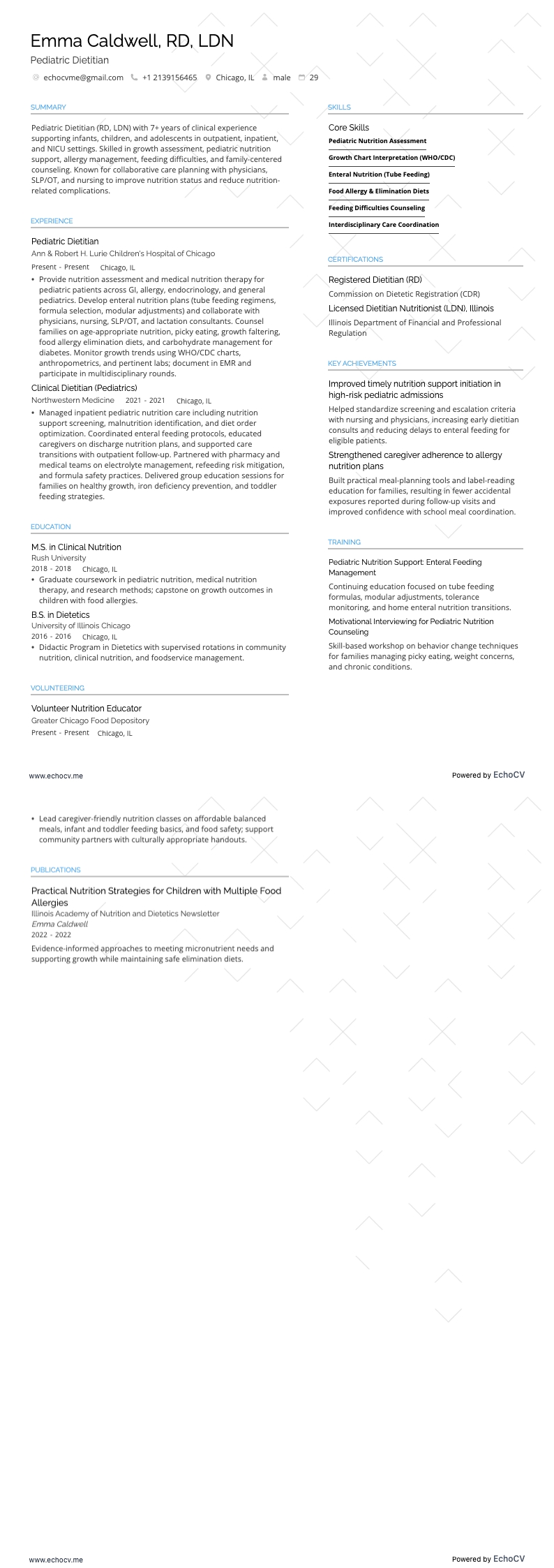
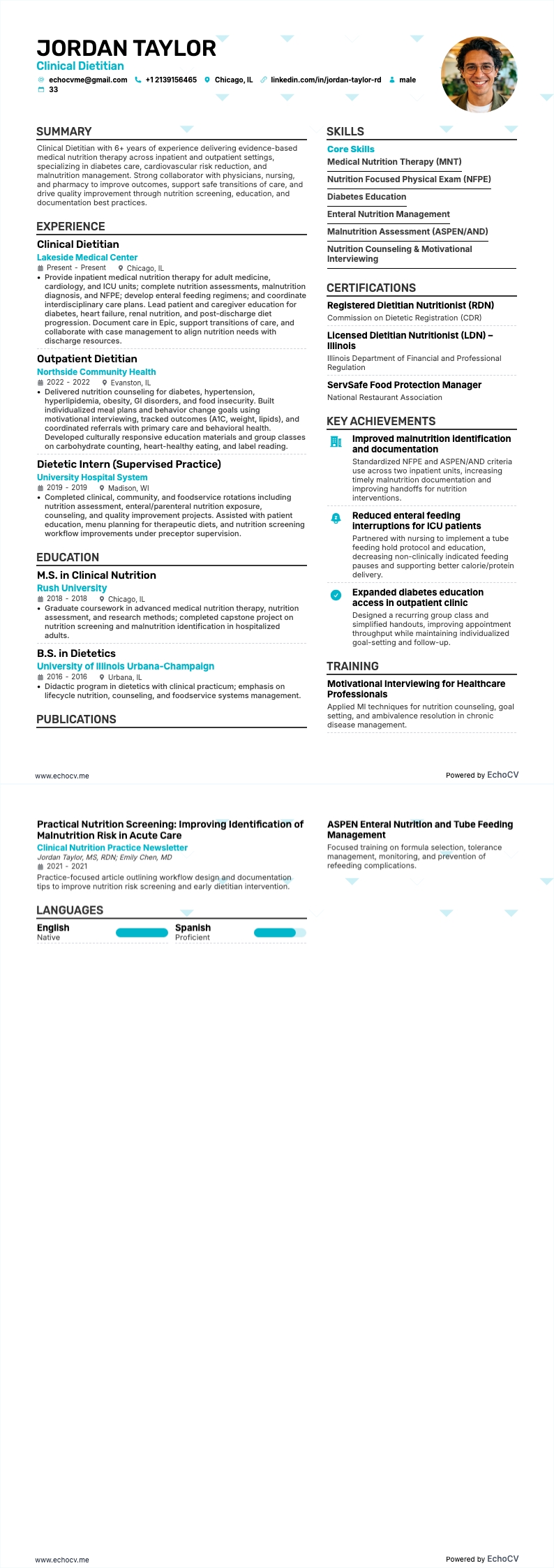
If you’ve looked online at other dietician resume formats, you’ll notice that some resumes have two columns. Which one is best for you?
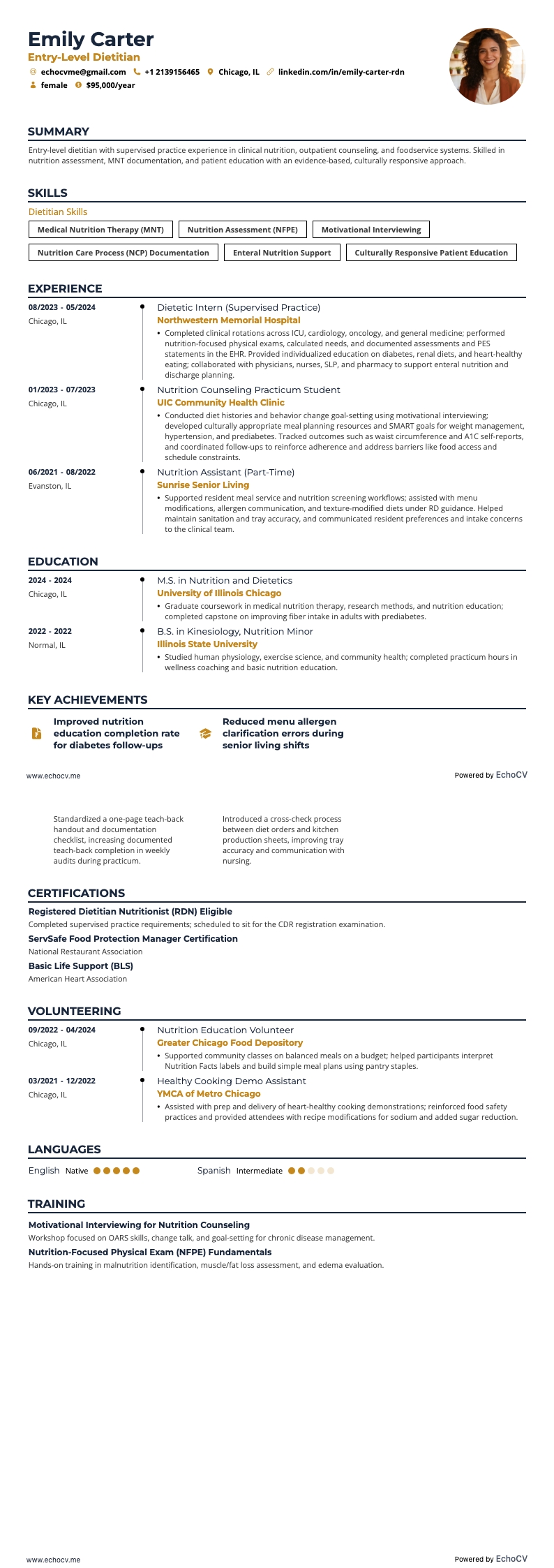
Single-column resumes are better for entry-level dieticians with no to minimal professional experience as dieticians. It is a simple and clean layout. Try one of Echocv single-column resume templates to see if you like it.
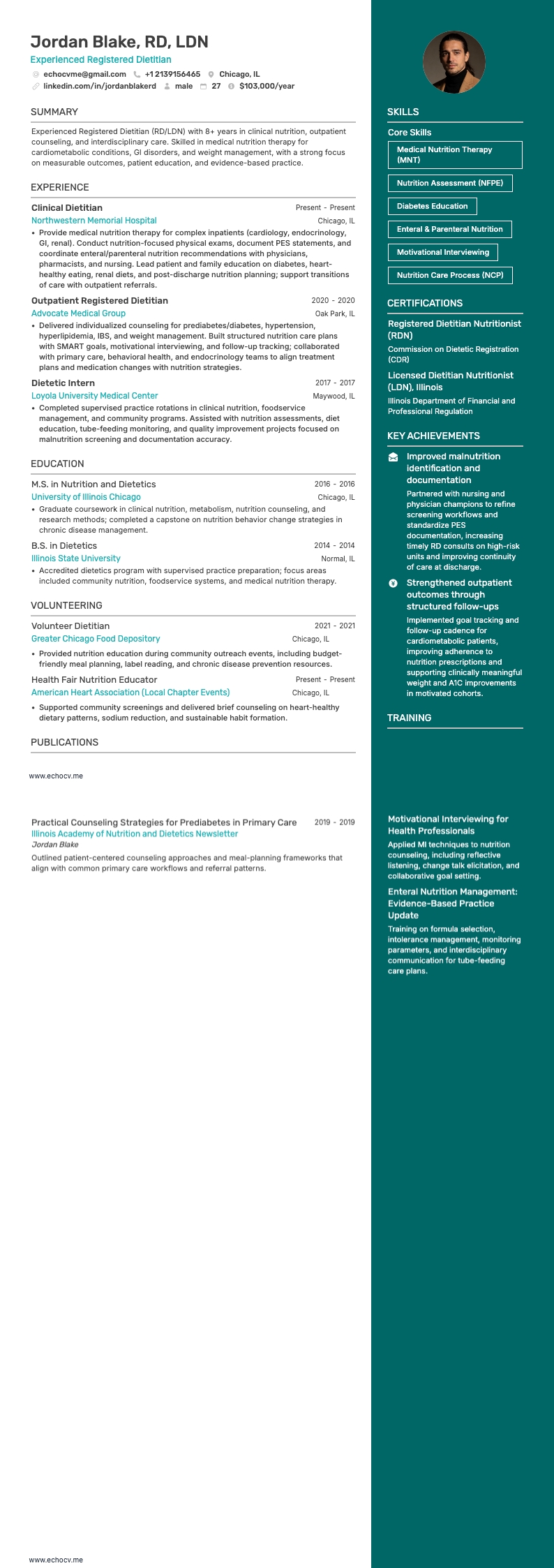
A two-column resume is better suited for more experienced dieticians. You can place more information on a single page and be more creative with the layout, including using a colored background, graphics, and text icons.
Another option you have is the font choice. Avoid decorative or script fonts as they are difficult to read and may not fair well with applicant tracking systems or HR teams. Only use a serif or sans-serif font, such as Volkhov, Rubix, Railway, Montserrat, Lato, and Exo 2.
If you prefer the classics, like Arial, Times New Roman, and Courier, these are still acceptable to use, just a little old school.
Echocv includes a number of modern fonts when you use our resume builder.
Keep in mind market-specific formats – for example, a Canadian resume might follow a different structure.
If you have a resume ready to go and like to see how well it compares to others, run it through our resume checker for a free analysis.