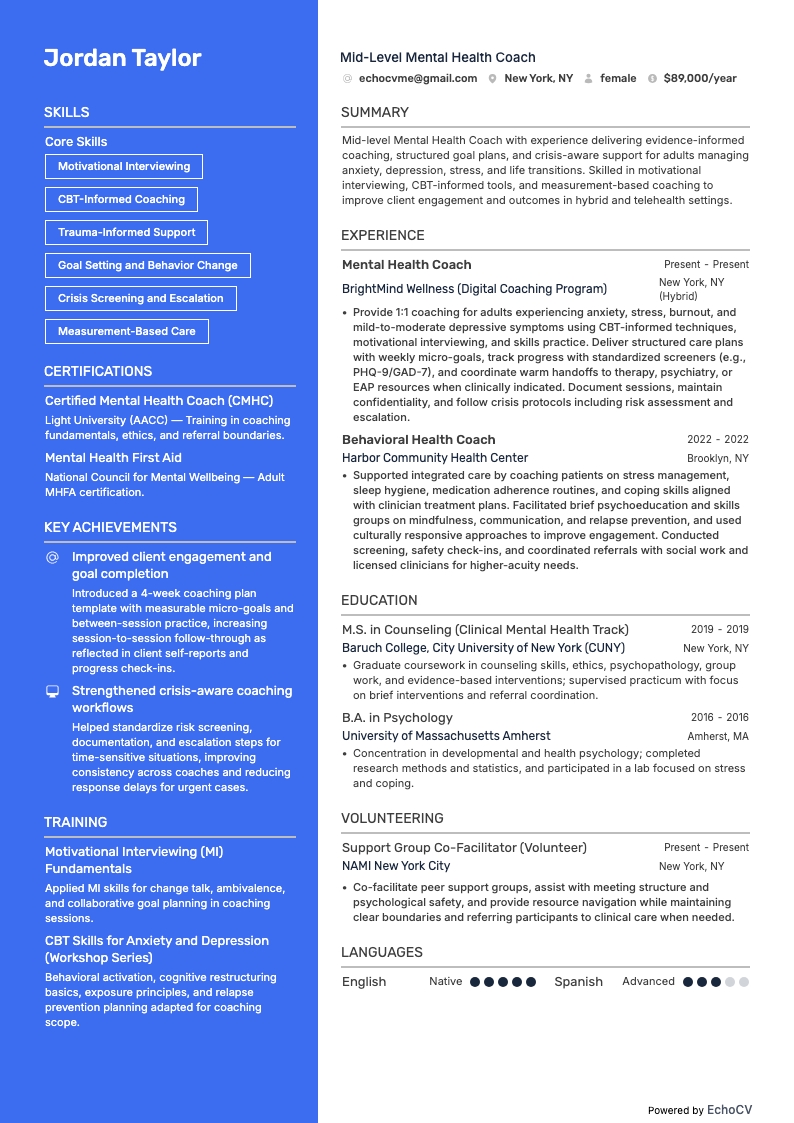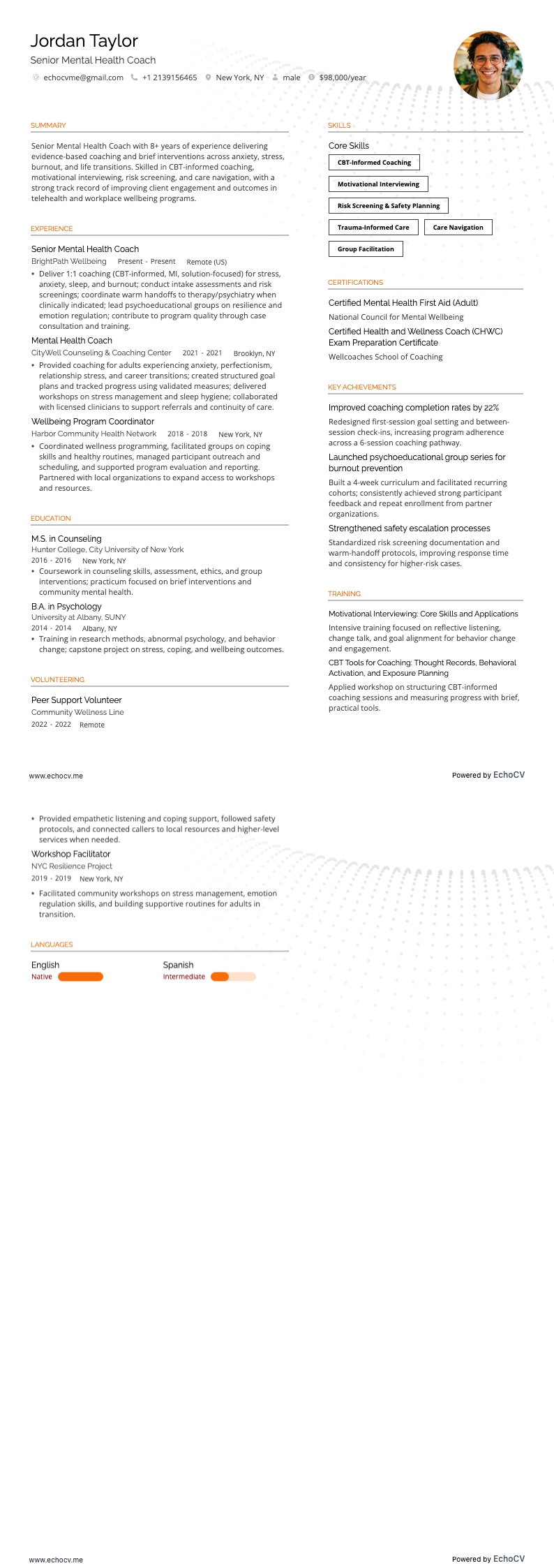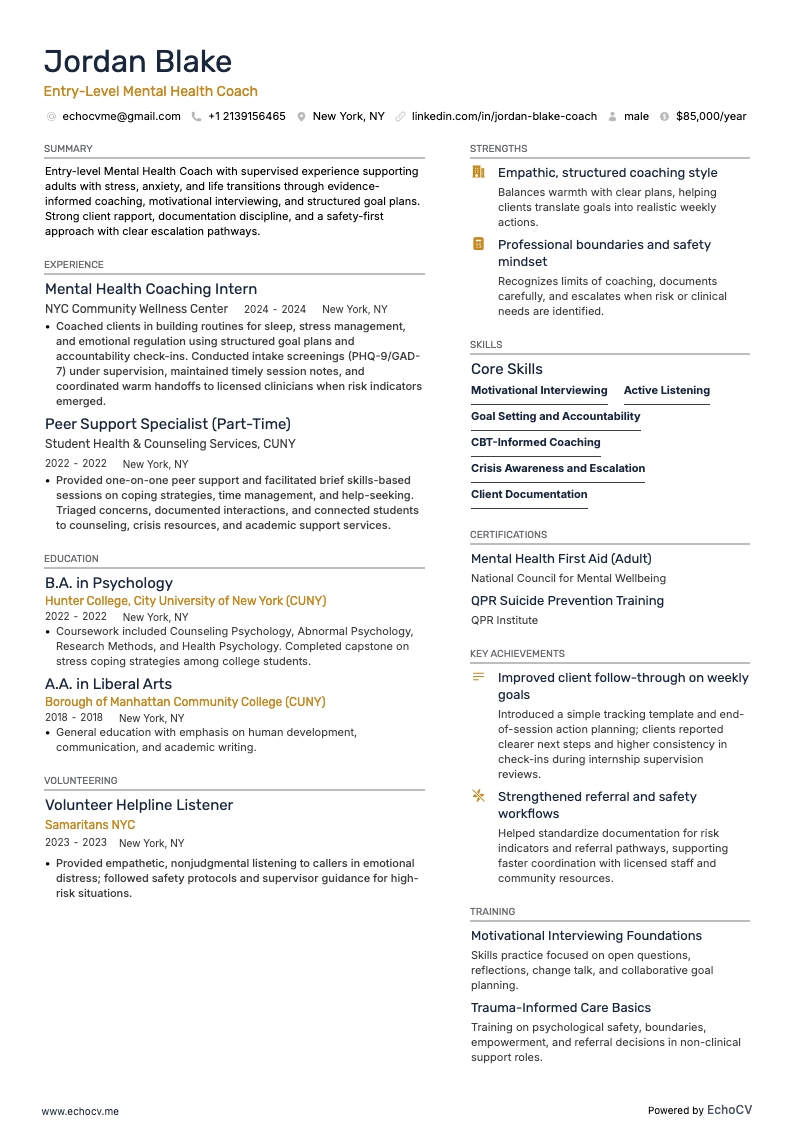
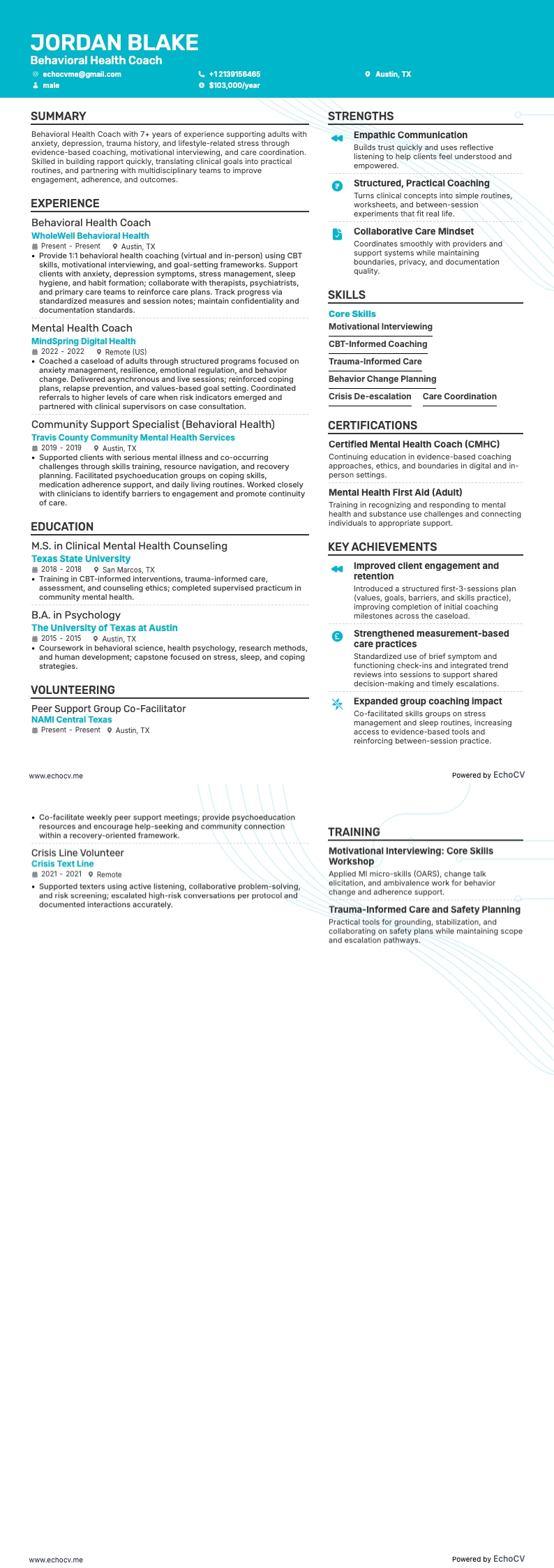
The topic of mental health has become more and more prominent in the past two years. Impacted by the COVID-19 pandemic, the war between Russia and Ukraine, the energy crisis...
No one is safe from the after-effects of the post2020 reality.
Scritto dal team EchoCV
The topic of mental health has become more and more prominent in the past two years. Impacted by the COVID-19 pandemic, the war between Russia and Ukraine, the energy crisis...
No one is safe from the after-effects of the post2020 reality.
A 2022 State of Mental Health in America report found that +27 million adults in the US live with a mental health illness - that has gone untreated.
Organizations are hence taking baby steps to ensure that employees' emotional, psychological, and social well-being are safeguarded.
But the big question needs to be addressed sooner than later.
What can be done to improve and sustain teams' and individuals' mental health?
That's where you come in.
Mental health coaches are not just having their moment, but becoming vital structures to
Wondering how to show your mental health coach experience and skills on your resume?
Our guide will help you
...to understand why you're the best fit for the role.
Working in mental health, you know how important it is to assess your patients' needs, set goals, strategize, and adapt at every step of the way.
When writing your resume, take a page from your practice.
Once you've mapped out your key strengths, experience, and achievements, it's time to choose your resume format.
We recommend functional-based, where you detail all your related experience and skills. And then go on to list other experience points, only if you deem those relevant.
The reverse-chronological format could also work wonders for your mental health coach resume. It allows you to include all the roles you've had, starting with your most recent experience.
Hybrid formatting balances your experience and skills. Use this format if you have had many past contract or temp roles.
Recruiters or the applicant tracking system (ATS), assessing your resume, would need to find your relevant contact information on the spot.
Hint: your resume header is the perfect opportunity to do so.
Apart from the obvious (your name), don't forget to include your:
This information is followed by your resume headline. It needs to show potential employers what makes you unique.
There are a few strategic paths you could take.
The first is to focus more on your professional background. Highlight (briefly) your approach, relevant certifications, or a key achievement in your headline. Don't forget to always add numbers to qualify your success.
The second is to showcase your soft skills, including ethics, values, and communication. This would build on to answering the “what else can you bring to the job, apart from experience?” recruiters' question.
Always make sure to consider what the top requirements for the role are, and then structure your headline from there.
Don't forget that headers are meant to be skimmed over, quickly, so don't go overboard with too many details.
The first header doesn’t define what the unique value of the coach is. On top of everything, the empty link doesn’t showcase his previous experience.
The second obviously works, as it has the candidate’s full contact information and qualifies his results.
The summary of your mental health coach resume gives you the space to explain your unique selling points as a coach.
To do so, select some of the following key achievements to highlight your expertise.
All these elements should help you to paint the full picture of your professional expertise.
Your summary has to be three-to-five sentences long and leave a lasting impression. Use it to hint at your further experience, and intrigue recruiters to find out more.
Avoid the first-person narrative as much as possible, as it doesn’t make a good impression on recruiters. The above example only maps years and patients; including a keyword or two.
You need to have more substantial proof in your mental health coach resume summary.
The resume summary example above works as it:
Resume work experience should better define your expertise in managing patients' journeys.
First, consider what roles you could include. A few relevant choices are
Once you've selected the roles you deem are closest to the job requirements, it's time to further branch out into your unique value.
First, define the non-clinical mental health niche you've specialized in. Issues you help patients resolve could include
Use your experience to define how you've guided, supported, and motivated patients to bolster their mental health.
Specifics could include:
Another strategy you could is to showcase the action plans you've created to facilitate behavioral change. And the steps you've set to improve accountability and reach patient goals.
When you’ve decided on your previous roles, niche, and outcomes, it’s time to get into the…
Obviously, there's a wrong way to list your experience.
"I did this + skill"; "I did that + skill"; "I succeeded at+ skills" immediately damage your chances of landing an interview.
This format makes recruiters believe that you're all talk and no real action.
Your resume should narrate the story of what you've actually achieved.
As a mental health coach, it's your role to understand your patient needs and help them clarify their values or purpose. You'd thus set the ball rolling with a goal-oriented plan.
Mental health coaches help patients ultimately:
Within your resume, think about ways to illustrate this with achievements.
Think of it as a numbers game, where you use percentage, time, and cases you've resolved to prove your experience.
So, a good example would be: "Improved 12+ patients' work-life balance over 5 years by implementing daily goals."
Be as creative as you deem relevant to the job you're applying for.
Looking for more examples of what you should do?
Check out:
This first example vaguely lists what the person did, with no mention of personality, skills, or actual achievements.
Within the “right example”, you’d notice that the candidate has listed a few key details in the description of their role/workplace.
Moving on, this mental health coach has qualified each achievement using percentage and experience.
What’s more, the candidate shows why they have attained a 5-star rating. That’s important as it gives you an opportunity to add extra skills: both technical and soft.
Speaking of skills, let’s get into the next section of our guide:
As a mental health coach, it's important to show that you possess both hard or technical and soft skills.
Hard skills relate to the technologies you use through your practice. Think about the tools that make your life easier in communicating with patients.
Soft skills have more to do with who you are as a person and the qualities you've built over time. They're transferable from role to role and are individual.
Having a healthy mix of both skills signifies to recruiters that you are:
And yes, we've created for you a list of some of the most relevant skills you can add to your mental health resume.
Emotional intelligence (EQ) is precisely the must-have skill for mental health coaches.
Working with patients, you'd help them build their EQ or:
And being on the topic, emotional intelligence is a niche within which many coaches chose to specialize in.
Did you know that 75% of long-term job success depends on skills directly related to EQ?
—Research by the Stanford Research Institute International and the Carnegie Mellon Foundation
So, how do you go about qualifying emotional intelligence on your resume?
Some may suggest listing a test score or the like. But imagine how confusing it's for recruiters to see "EQ107" from an unqualified test.
This means absolutely nothing to them.
Instead, you can create a separate strengths section - one that focuses on your experience and achievements.
This approach can be used to explain your emotional intelligence and other soft skills, including
Your educational background shows recruiters your commitment to the field.
Most often, mental health coaches have a bachelor's degree in Sociology, Psychology, etc.; or a master's in Social Work. This is usually supplemented with relevant certifications and licenses.
Include all your higher education degrees by listing:
If your degree is incomplete, make sure to note your expected graduation date.
If you've just graduated from high school and are thinking of starting a career as a mental health coach, here's what you can do.
Substitute the education section by leveraging your volunteering experience and certifications from relevant institutions (but more on that in the next section).
This is one of the sections of your mental health coach resume you can't skip!
Certification is crucial for the coaching industry. They pinpoint ethical coaching that follows standards.
The truth is that accredited institutions have set a pretty high bar to pass. Having your knowledge, experience, and services certified with a "stamp of approval" sets you apart.
We have all seen many self-proclaimed experts and "pariahs". Ones who preach that they're the best but lack real-life expertise.
So, dedicate a separate section to your license(s) and International Coach Federation (ICF) certification. Thus showing recruiters that your experience has substantial proof.
And that your ability to help patients resolve issues, dive into emotions, and sustain relationships is more sophisticated.
You can also add any of the following, relevant certificates:
respond to inquiries
build interpersonal relationships
deal with crisis situations.
Languages to better focus on your communication skills
My Philosophy or My Time to show more personality
Before starting to write your mental health coach, assess the job requirements and align those to your previous work with patients.
In the resume summary, include your years of practice and niche; methodology and various extracurriculars.
Always ensure that you can add a numerical value to each of your achievements to shine a light on the outcomes of your experience.
Have a healthy balance between technical and soft skills, like therapy and emotional intelligence, to hint at your unique value as a professional.
Your certificates should be used to highlight your ethics and standards of coaching.
Esplora altri esempi e guide di curriculum Coach per la salute mentale e scopri cosa funziona per il tuo livello di esperienza o ruolo.