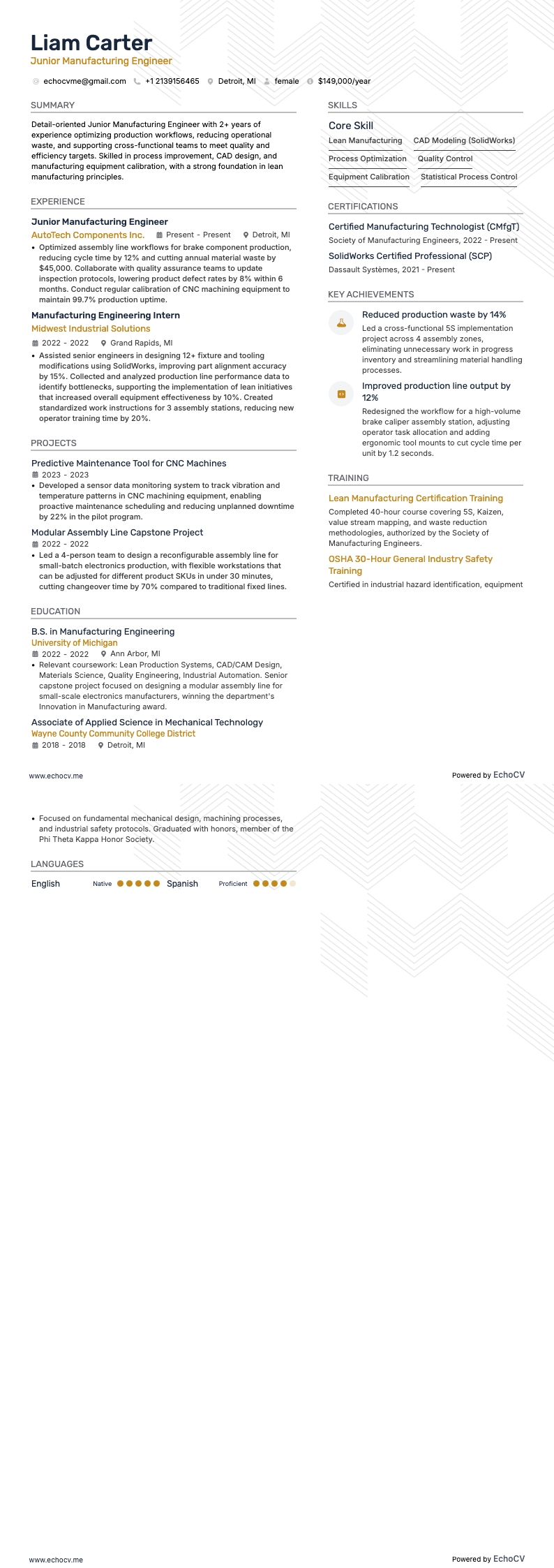
ジュニア生産技術エンジニア の全体プレビュー

製造エンジニアの履歴書例21選

EchoCV

EchoCV チームによる執筆

更新日: 10/28/20238 min read

このガイド内のすべての履歴書サンプルを見るか、あなた専用のプロンプトで独自の履歴書サンプルを生成してください

ジュニア生産技術エンジニア example resume

ジュニア生産技術エンジニア

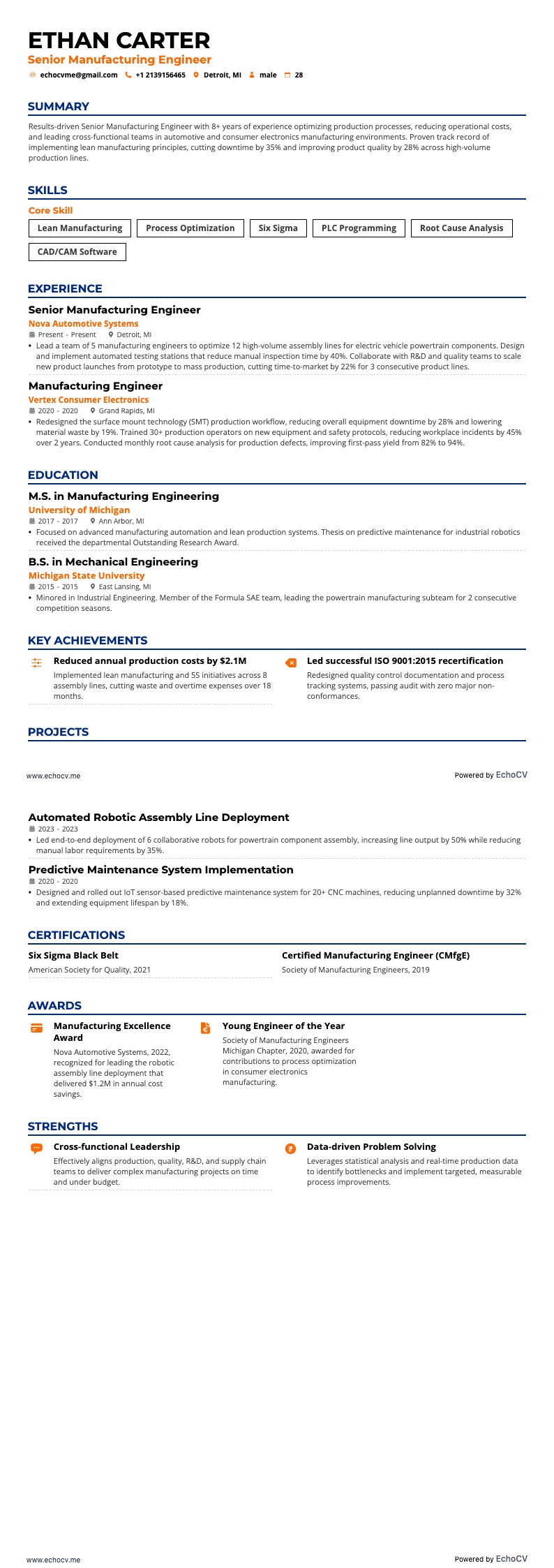
シニア生産技術エンジニア example resume

シニア生産技術エンジニア

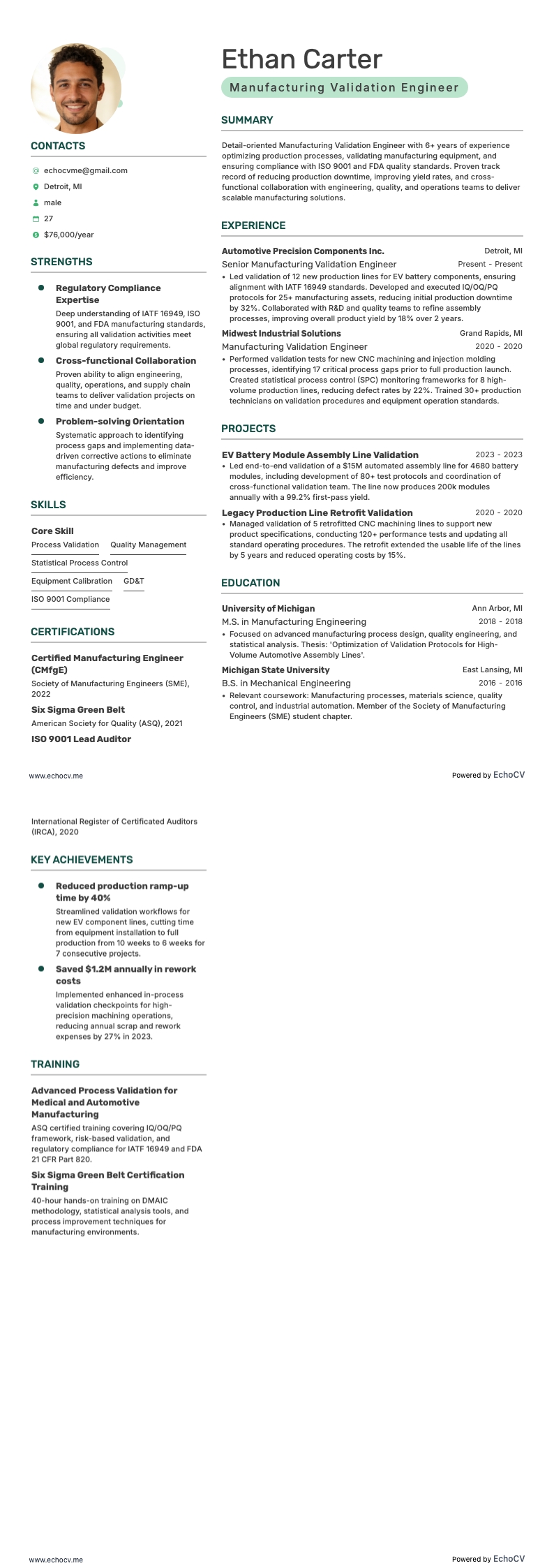
製造バリデーションエンジニア example resume

製造バリデーションエンジニア

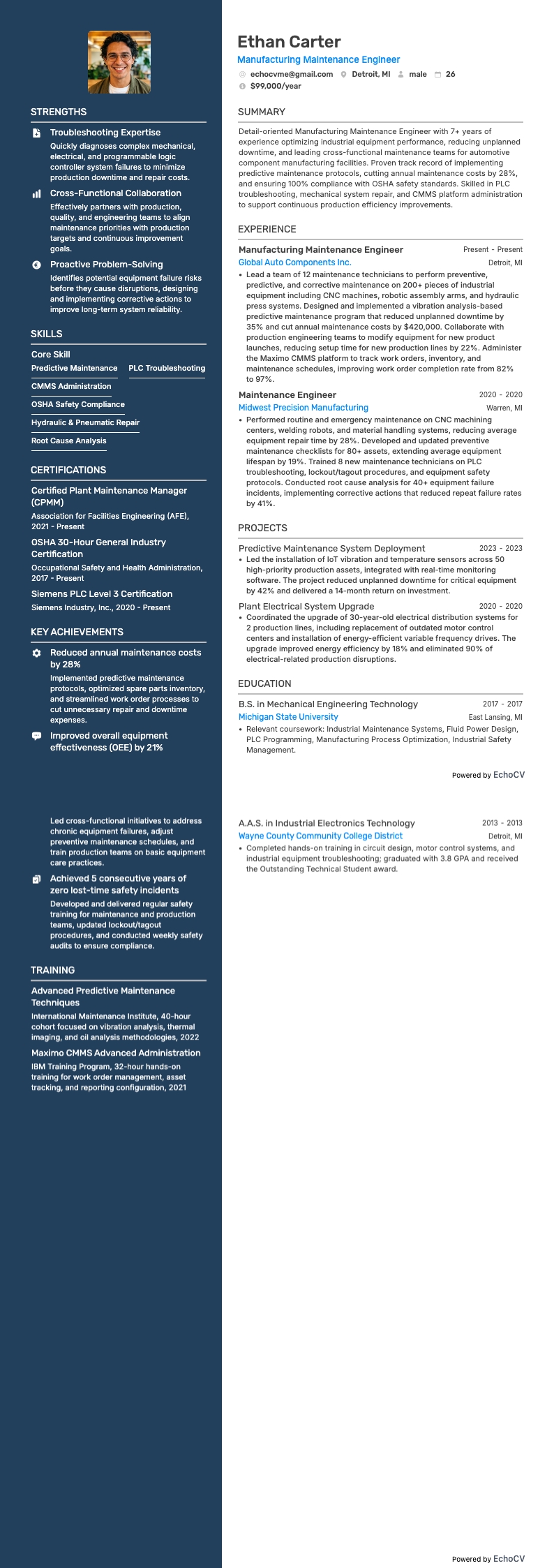
製造保全エンジニア example resume

製造保全エンジニア

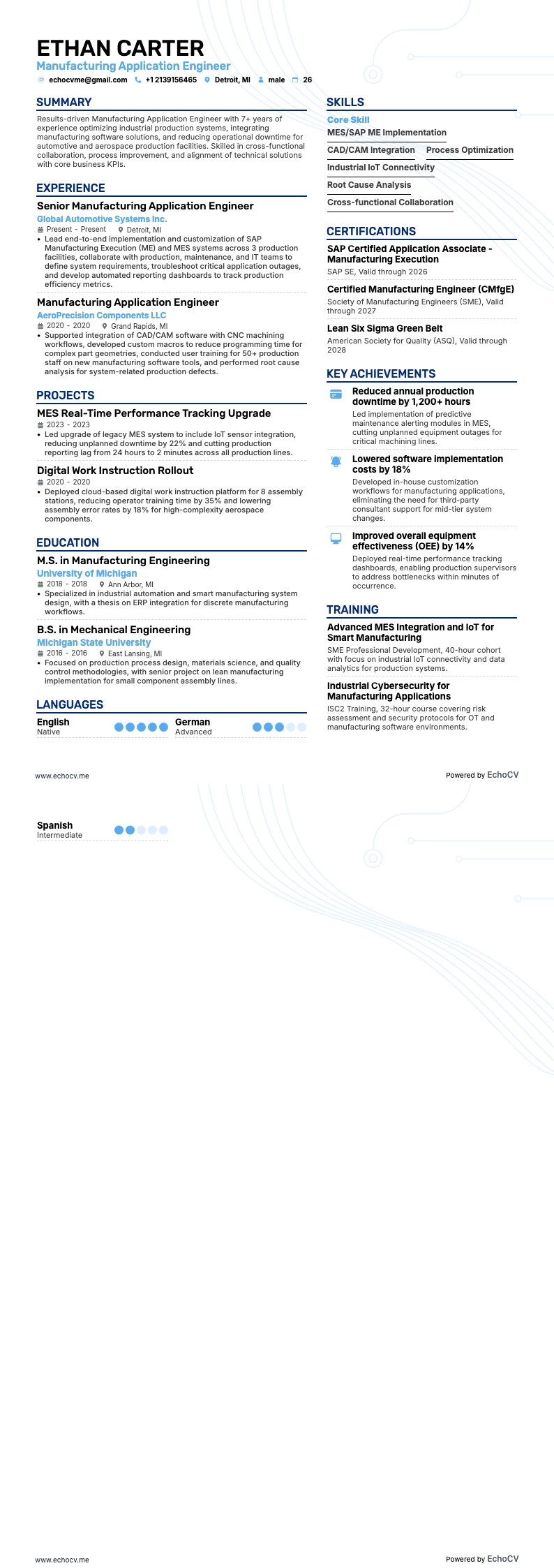
製造アプリケーションエンジニア example resume

製造アプリケーションエンジニア

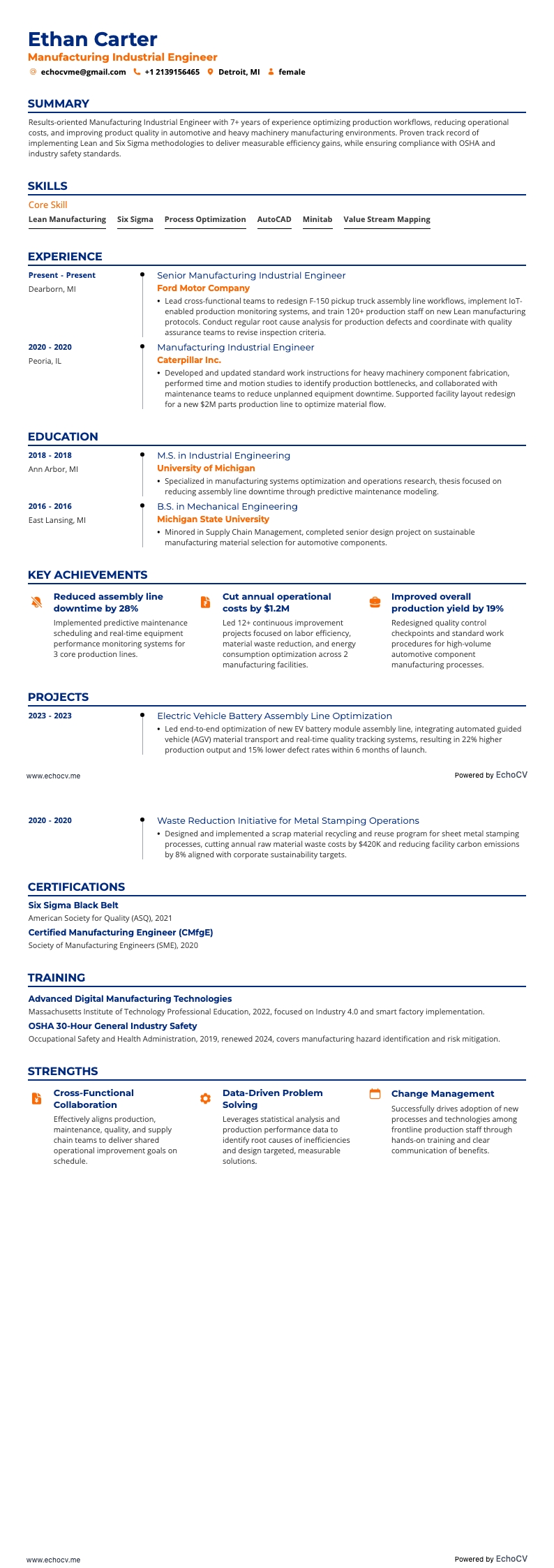
製造業の生産技術エンジニア example resume

製造業の生産技術エンジニア

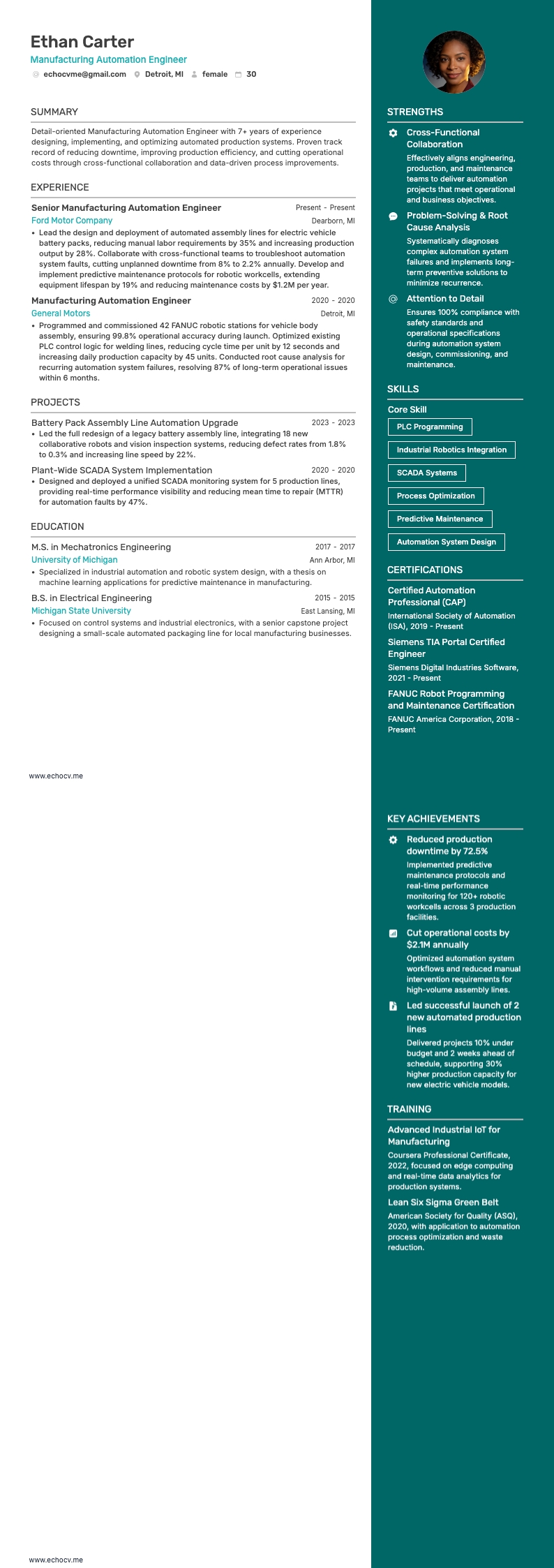
製造自動化エンジニア example resume

製造自動化エンジニア

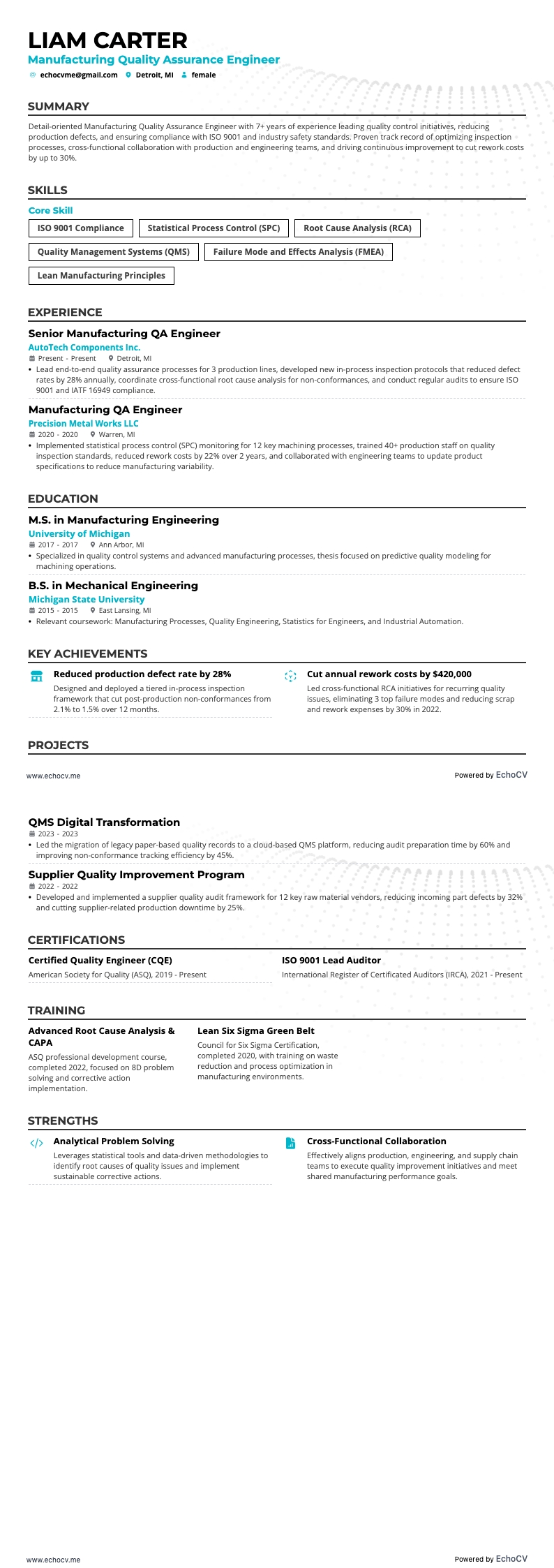
製造品質保証エンジニア example resume

製造品質保証エンジニア

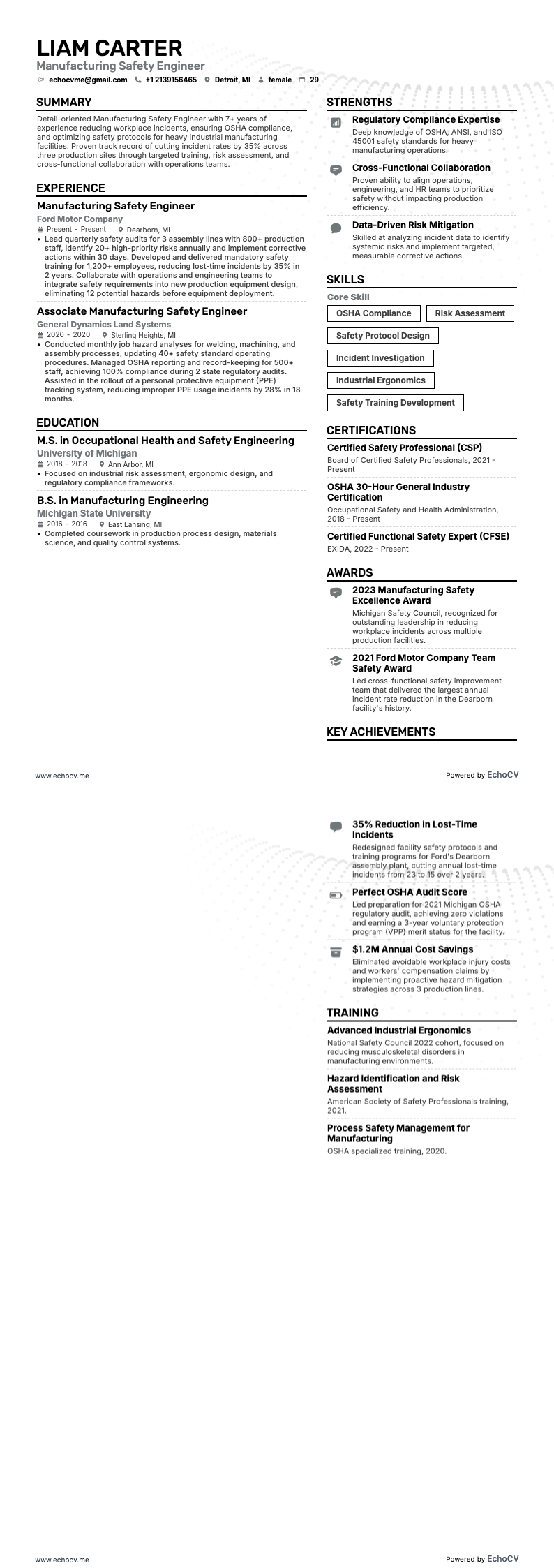
製造安全エンジニア example resume

製造安全エンジニア

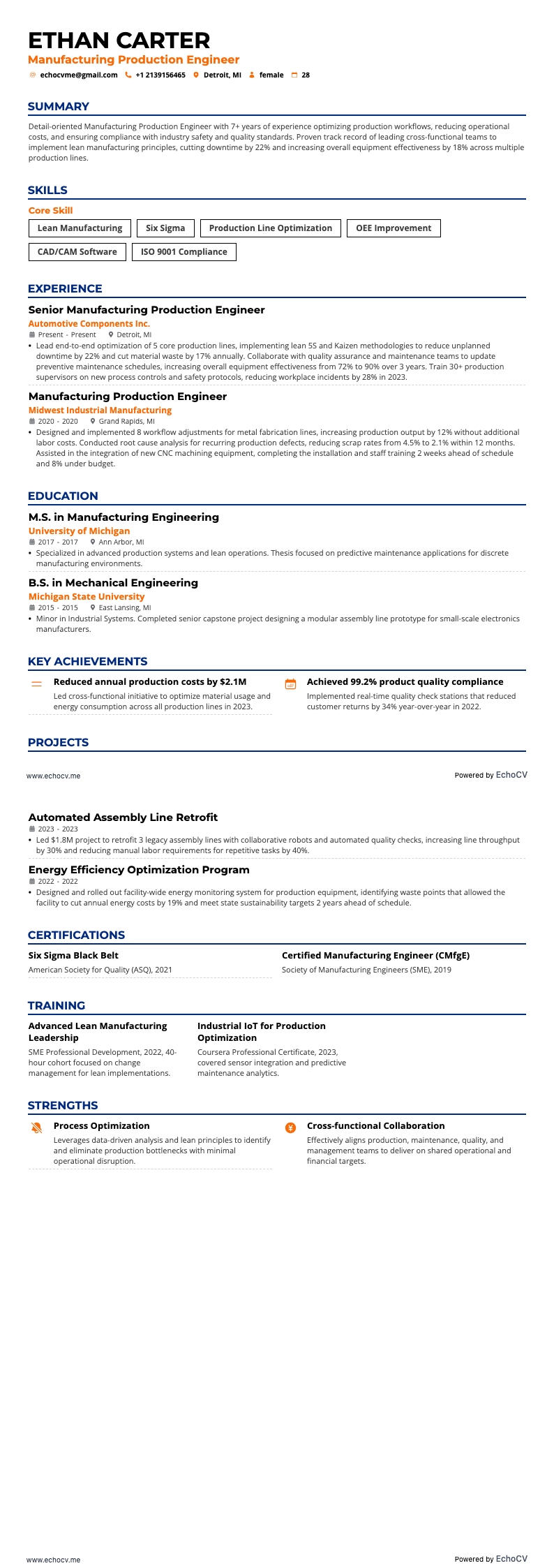
製造生産エンジニア example resume

製造生産エンジニア

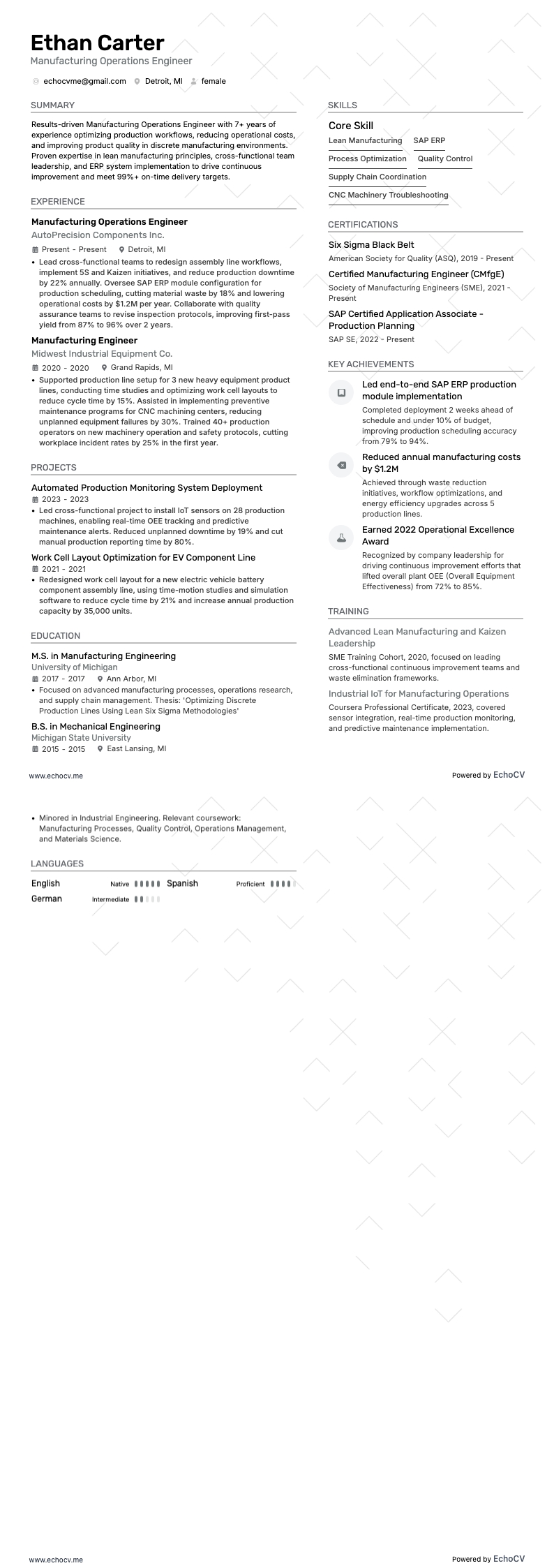
製造オペレーションエンジニア example resume

製造オペレーションエンジニア

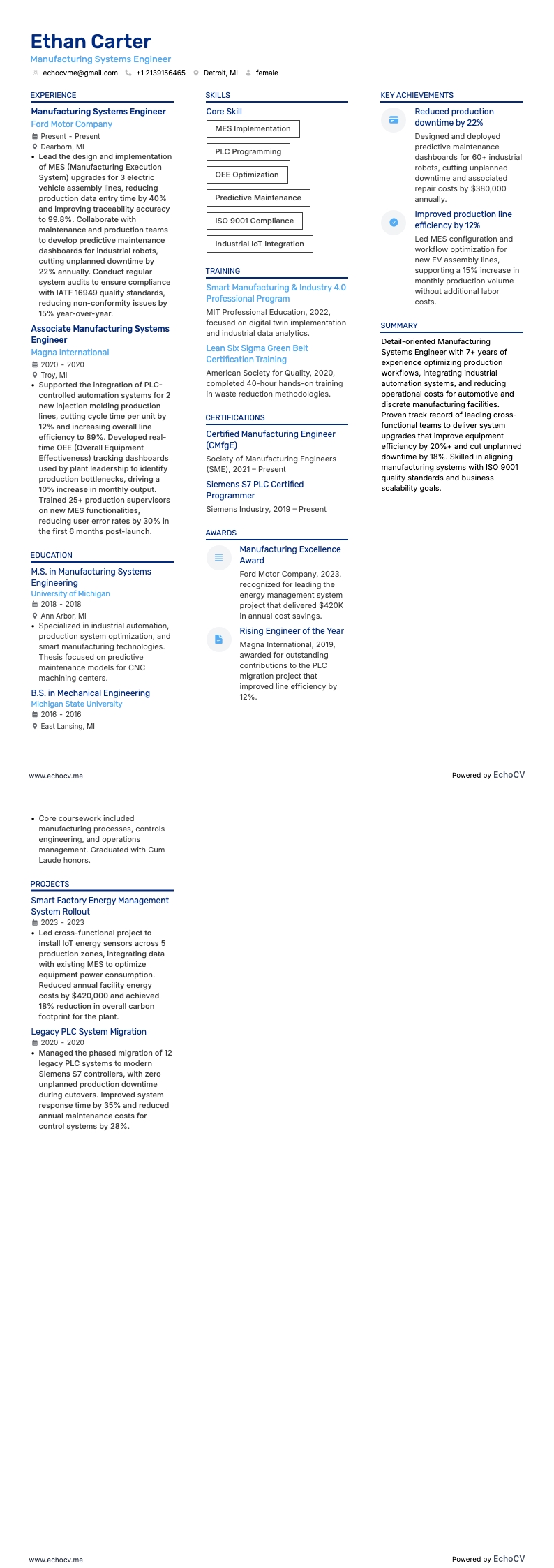
製造システムエンジニア example resume

製造システムエンジニア

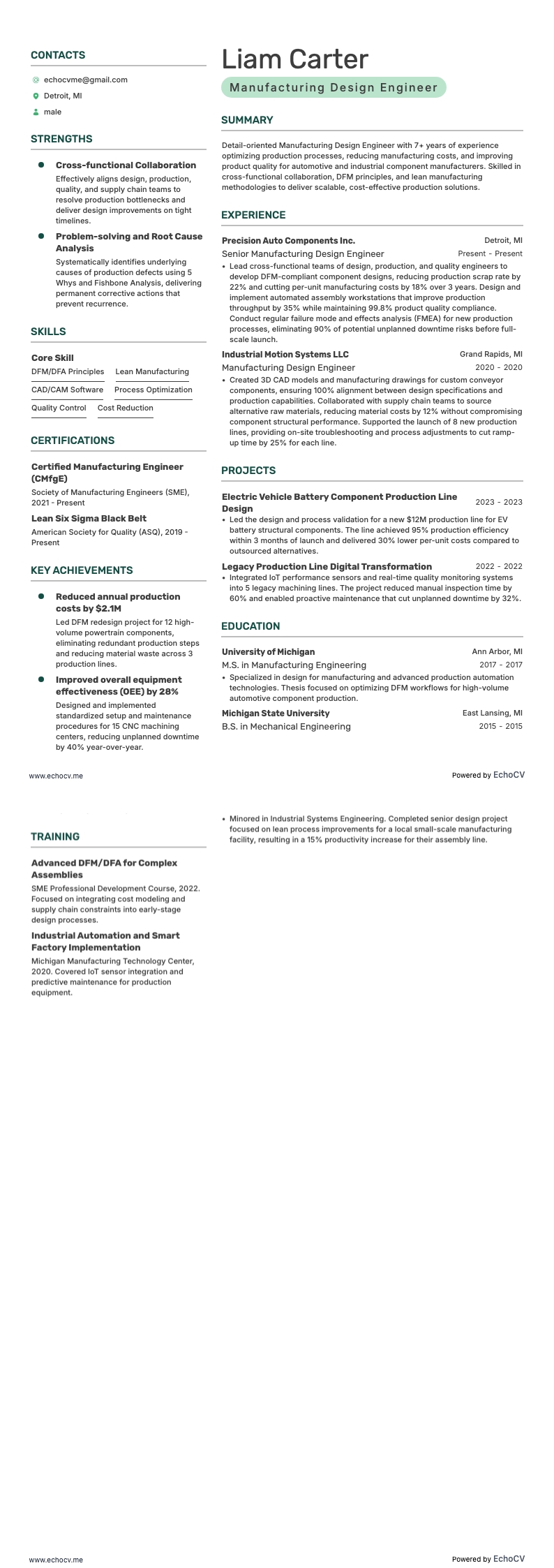
製造設計エンジニア example resume

製造設計エンジニア

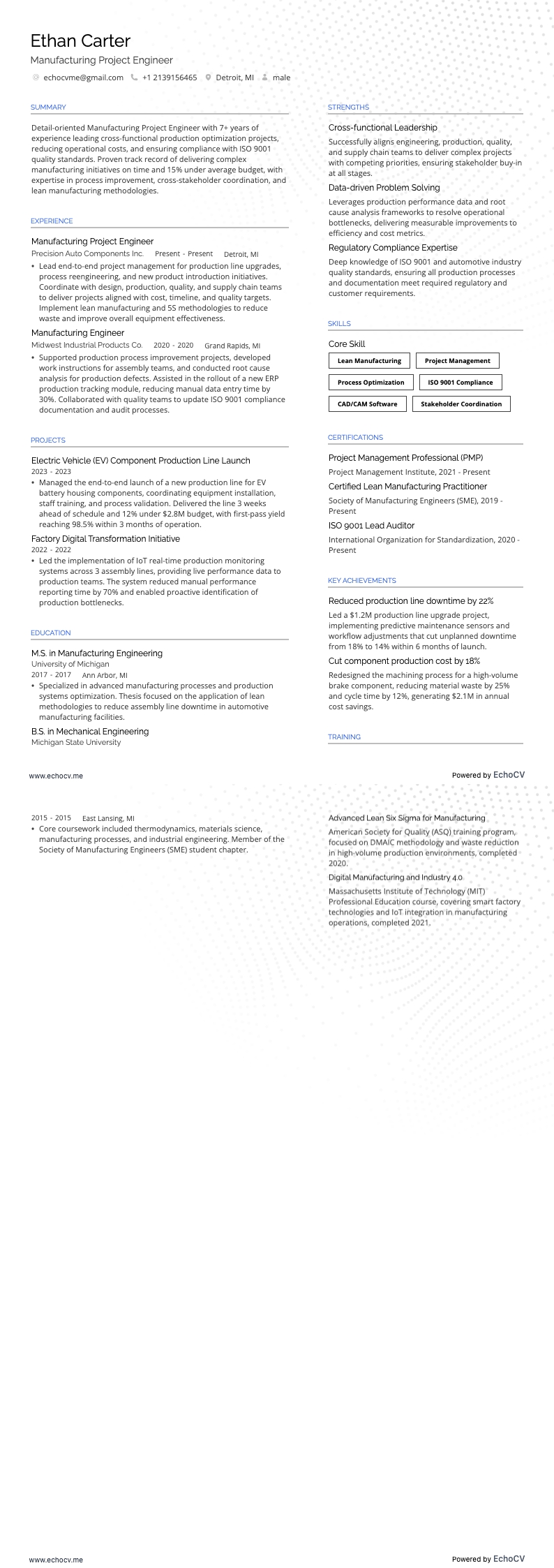
製造プロジェクトエンジニア example resume

製造プロジェクトエンジニア

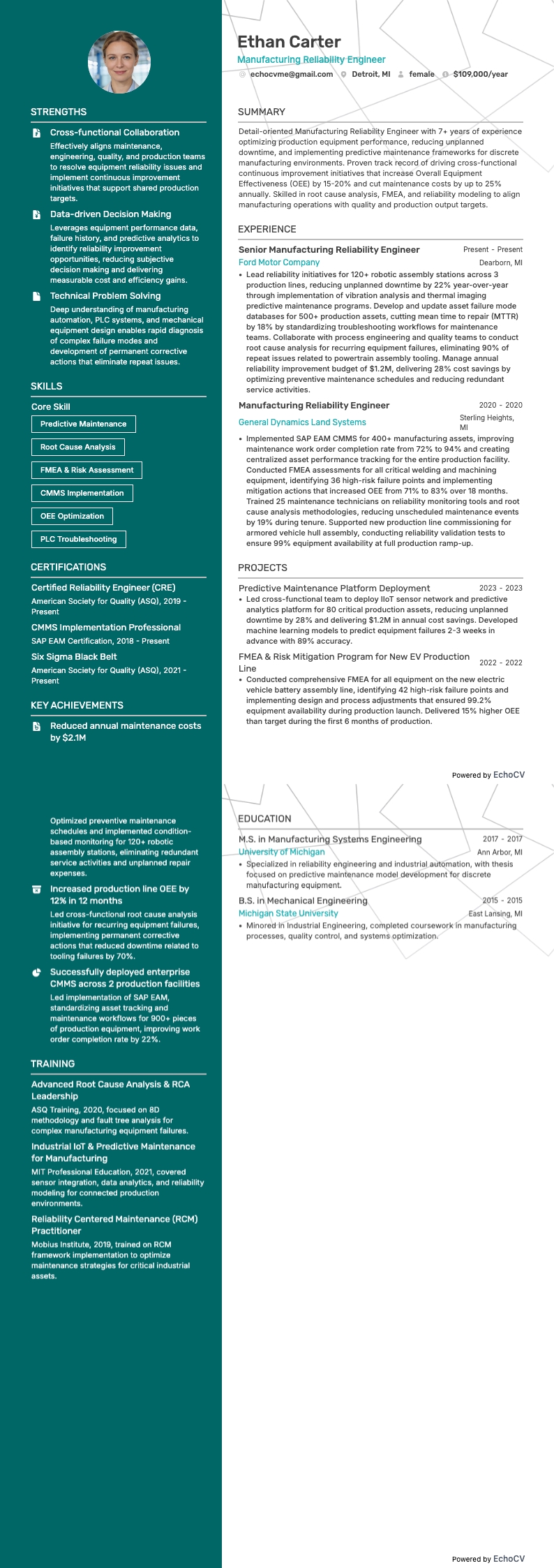
製造信頼性エンジニア example resume

製造信頼性エンジニア

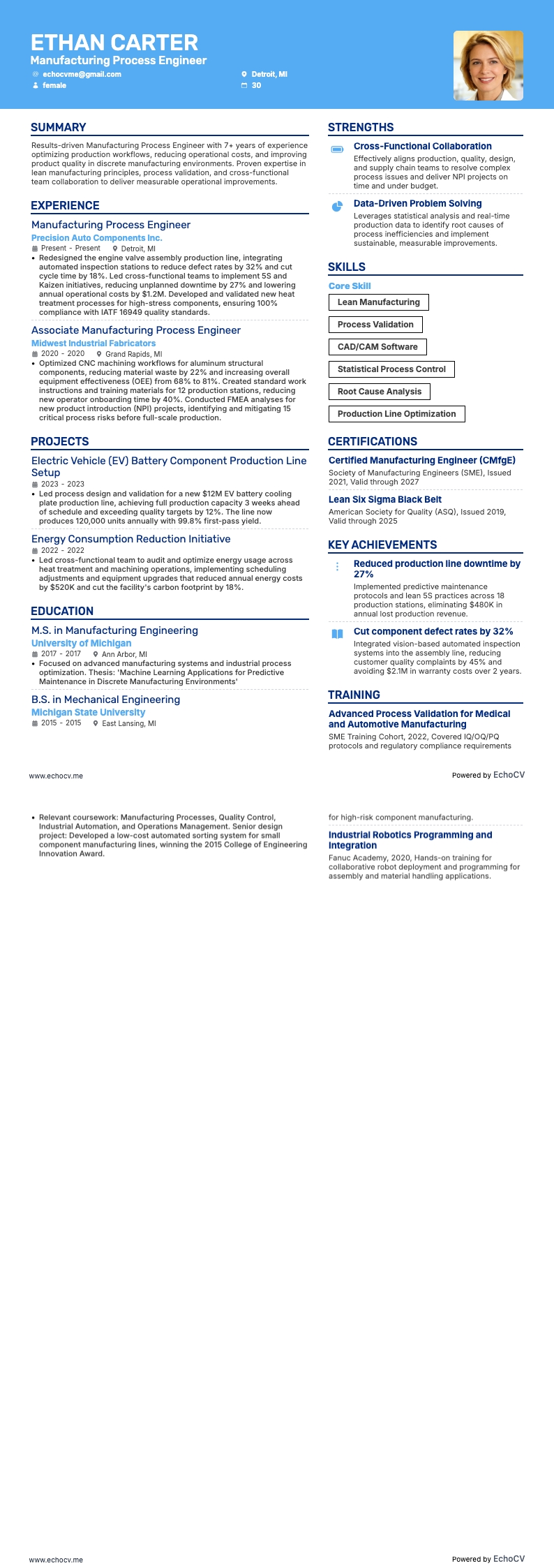
製造プロセスエンジニア example resume

製造プロセスエンジニア

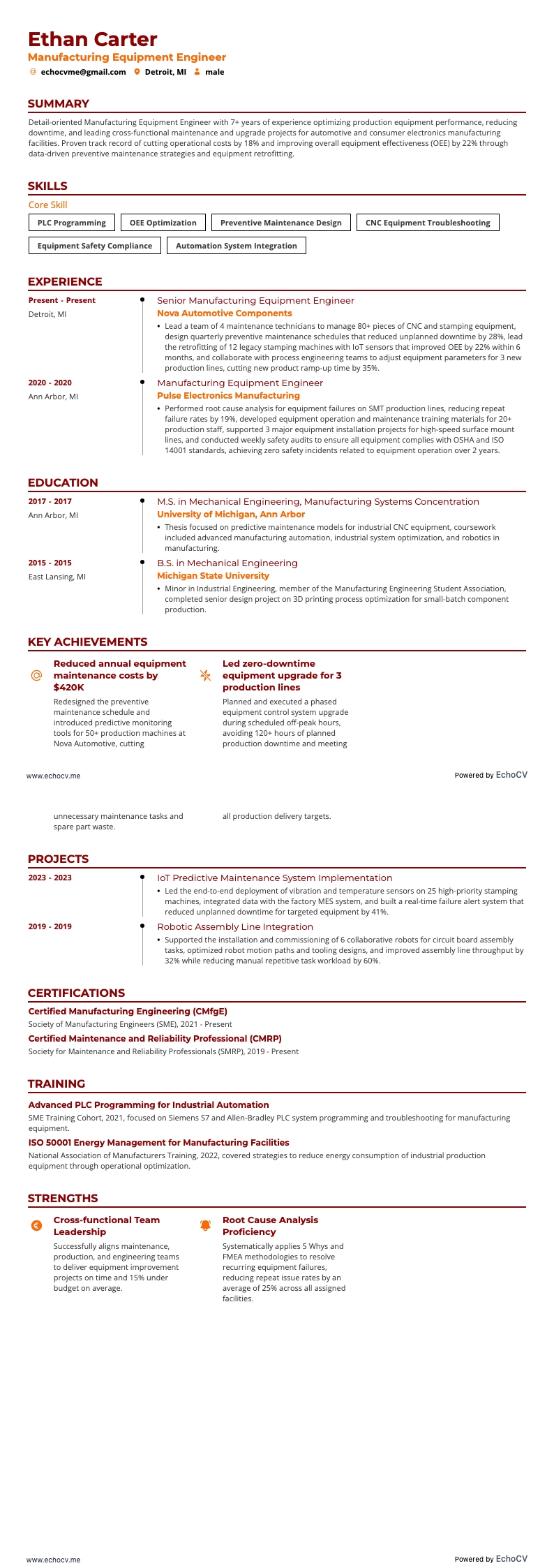
生産設備エンジニア example resume

生産設備エンジニア

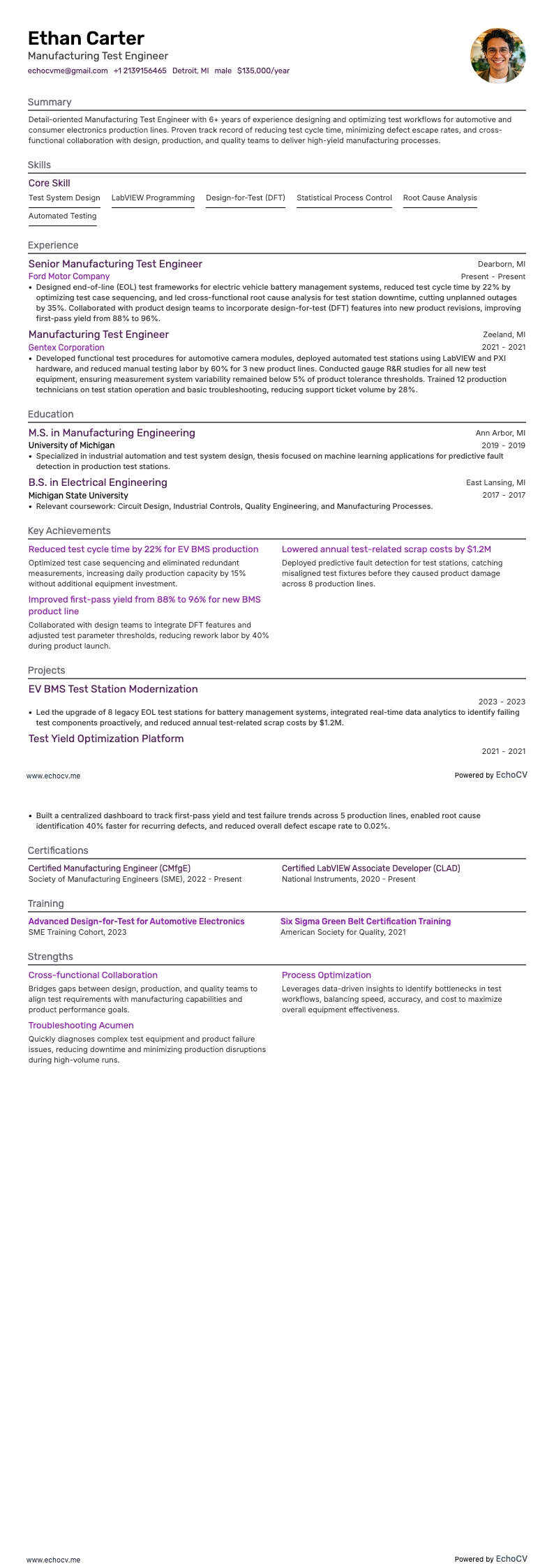
製造テストエンジニア example resume

製造テストエンジニア

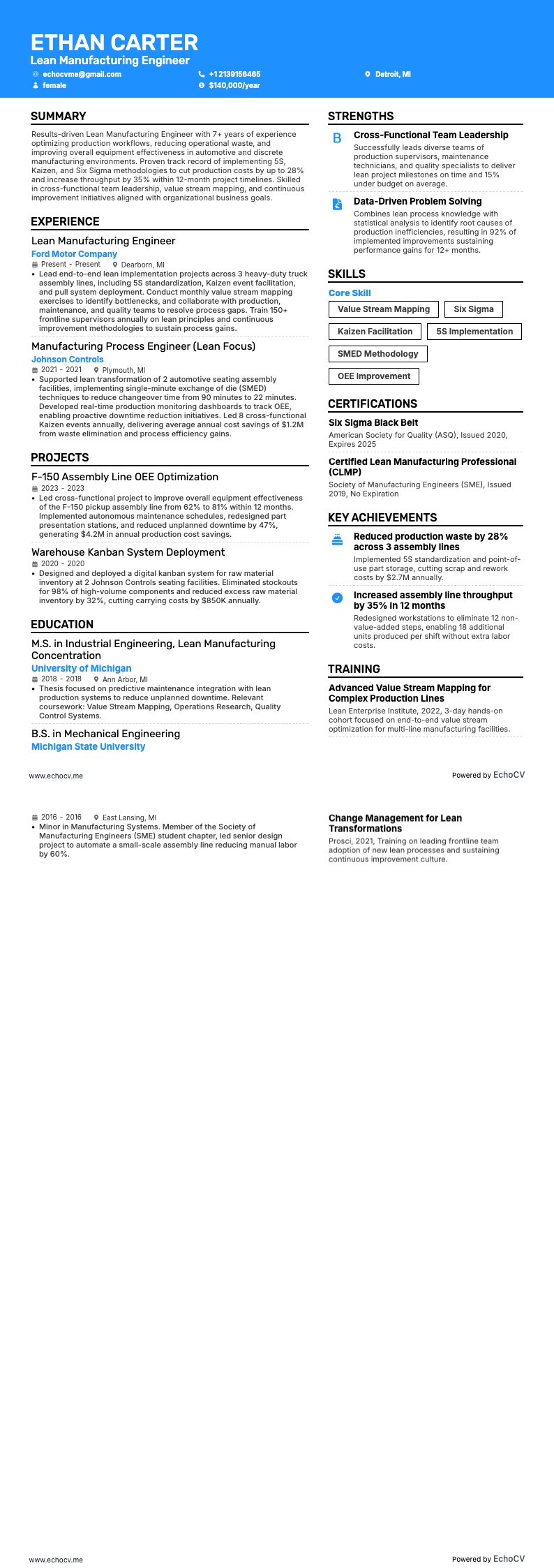
リーン生産エンジニア example resume

リーン生産エンジニア

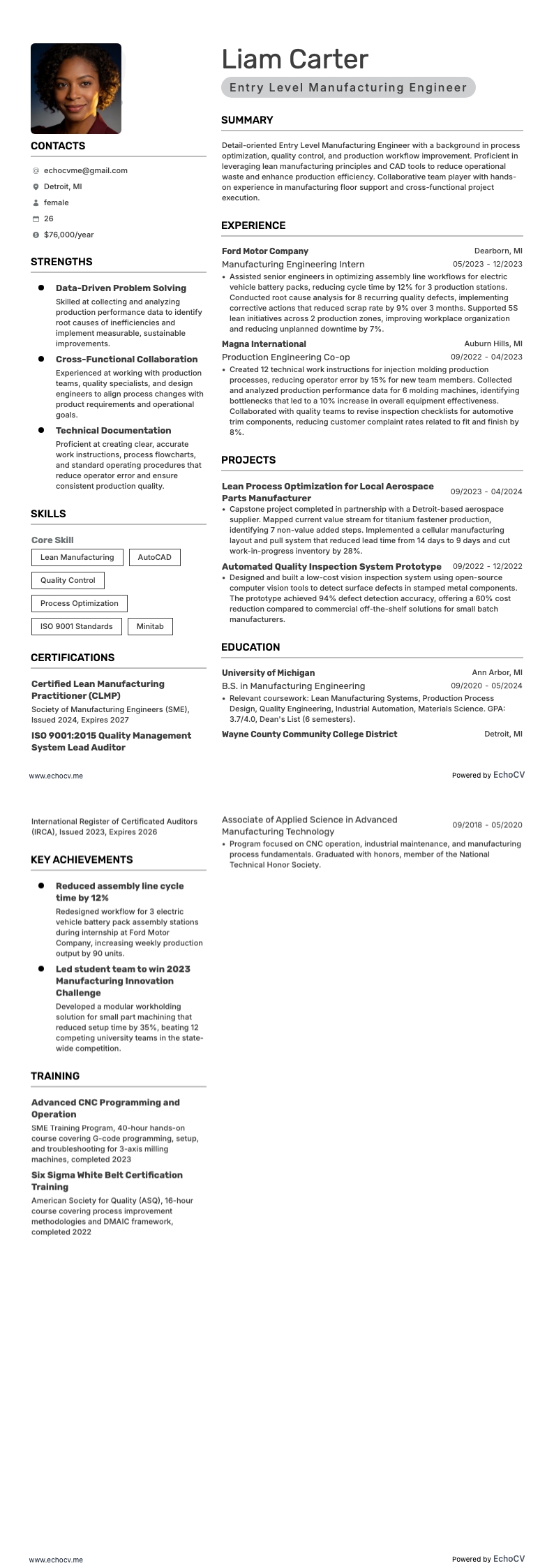
製造エンジニア(未経験者向け) example resume

製造エンジニア(未経験者向け)

Writing a resume as a manufacturing engineer can be much like fine-tuning a complex machine. You know how to make production lines run smoothly, but putting your own skills and achievements into words might feel like a whole different challenge. Don’t worry, we’ve got this!

Think of your resume as your ultimate showcase. It needs to be as efficient and precise as your best engineering work. According to Michigan Technological University, manufacturing engineers play crucial roles across various industries in the US, including textiles, metal products, and electronics. With the US being the second-largest exporter of textile-related products, there's a broad range of opportunities, even for entry-level professionals. They’ll all need a resume that’s as streamlined as a well-optimized production line.

In this guide, we'll break down the process step-by-step. By the end, you'll have a resume reflecting your engineering expertise and helping you stand out to employers. Here’s the gist:

Key takeaways

  • Customize your resume to align with the job description, highlighting the most relevant skills and experiences for the specific role.

  • Use clear metrics to demonstrate your manufacturing engineer's impact, such as "reduced production defects by 15%" or "improved efficiency by 20%."

  • Include relevant certifications like CMfgE to showcase your specialized knowledge and commitment to quality improvement.

  • Create a dedicated section for your technical skills and list important competencies like CAD software, CNC machines, and Six Sigma methodologies.

  • Craft a concise, impactful summary that highlights your experience, key skills, and certifications, setting the tone for the rest of your resume.

Now that you understand the essentials, let's look at a text-only resume template to see how it all comes together.

Manufacturing engineer resume sample

The sample resume below is a great starting point for those of you who don’t have time to engineer a resume from scratch.

Elijah Brown

Senior manufacturing engineer

[email protected]     @LinkedIn    Cupertino, CA


Summary

Innovative and detail-oriented Advanced manufacturing engineer with over 5 years of experience in designing and implementing precision assembly and measurement processes. Proven ability to drive quality improvements and deliver automated solutions for complex engineering problems. Expertise in statistical analysis, process engineering, and providing technical leadership for multi-functional teams and suppliers.


Experience

Advanced manufacturing engineer
Apple Inc., Cupertino, CA

June 2019 – Present

  • Design precision assembly and measurement processes for Apple products, resulting in a 15% improvement in production efficiency.
  • Conduct research and development on new technologies to solve complex assembly and automation issues, reducing defect rates by 20%.
  • Successfully scale automated and semi-automated solutions based on sound engineering principles, leading to a 25% increase in throughput.
  • Create Request for Quotation/Proposal (RFQ/RFP) for automated equipment design and documentation, facilitating contracts worth over $2 million.

Manufacturing engineer
Tesla, Inc., Fremont, CA


May 2016 – May 2019

  • Provided early and ongoing manufacturing involvement to ensure new products were manufacturable, resulting in a 30% reduction in time-to-market for new vehicle models.
  • Worked on all phases of product development from concept to repeat manufacturing and end of life, supporting over 10 successful product launches.
  • Utilized statistical tools such as GR&R, SPC, and Cp/Cpk to ensure scalable processes and fixtures, achieving a 98% yield rate in production.
  • Used Design of Experiments (DOE) and Six Sigma principles for statistical analysis, improving process efficiency by 22% and reducing costs by 18%.

Education

Master of Science in Mechanical Engineering (MSME)
Stanford University, Stanford, CA

2014 – 2016

Bachelor of Science in Mechanical Engineering (BSME)
University of California, Berkeley, CA

2010 – 2014

Certifications

  • Six Sigma Green Belt
  • Certified Automation Professional (CAP)

Skills

  • Precision assembly and inspection
  • Automation equipment design
  • Tolerance analysis
  • Machine qualification requirements
  • Design of experiments (DOE)
  • Failure analysis
  • Process engineering
  • Statistical process control (SPC)
  • Gage repeatability & reproducibility (GR&R)
  • Leadership and mentorship

Languages

  • Spanish (Fluent)
  • Mandarin (Beginner)

If you’re still hungry for in-depth expert advice, stay with us for tips on building a perfectly organized resume.

How to format a manufacturing engineer resume

Think of the iPhone. It wouldn't be what it is without its meticulous design. The same goes for your resume. Just as every component of the iPhone is crafted to perfection, your resume should be clear and precise to impress recruiters. Here’s how you create a top-notch resume.

The best resume format for a manufacturing engineer is the reverse chronological order. This layout lets you showcase your most recent and relevant experience first, crucial for highlighting your current skills and expertise. Here’s how the order of the sections should flow (we’ll discuss each of these further in the article):

  • Header
  • Summary
  • Professional experience
  • Education
  • Certifications
  • Key skills
  • Languages

You’re in luck, as this structure is recruiters’ favorite, as it’s organized in the most natural and appealing order.

Let’s move on to the particulars:

Resume designs

Contact information

File format

  • Keep a clear file name like "ElijahBrownManufacturingEngineerResume.pdf" to ensure recruiters can easily identify your resume among many others. Save your resume as a PDF unless otherwise specified in the job posting. Plus, the PDF option preserves its formatting which is great for ATS parsability.

Different regions expect different formats – Canadian resumes, for example, may look unique.

ATS (Applicant Tracking Systems) often causes unnecessary fear. Contrary to popular belief, our tests showed that fonts, colors, columns, and resume length don’t affect parsing. Focus on matching job description language and formatting details like dates and bullet symbols as those may affect your application. However, not all companies use ATS, so avoid keyword stuffing and keep your resume clear and readable.

Having clarified that, are you ready to test your existing resume against our free and fast AI checker?  It will help you identify which areas you can improve to secure that interview call.

Next, we’ll dive into the most substantial part of any resume for manufacturing engineers—the experience section.

How to write your manufacturing engineer resume experience

When creating the experience section of your manufacturing engineer resume, it's important to tailor your content to your audience, usually hiring managers and technical recruiters. Focus on highlighting your key achievements with quantifiable results like efficiency improvements, cost reductions, and quality enhancements.

Keep your resume clear and well-organized by using bullet points for readability and listing your experience in reverse chronological order. To really convince the recruiter that you’re their right person, you need to know how to tailor your resume to the specific job requirements.

Tips for creating a targeted manufacturing engineer resume

Tailoring your resume is key for manufacturing engineers because it lets you match your skills and knowledge with what each job specifically needs. This is called a targeted resume.

For instance, if a job posting highlights expertise in lean manufacturing and robotics, you can make your resume shine by showcasing your experience in implementing robotic automation that reduced assembly time by 15%. By addressing the employer's needs directly, you demonstrate that you understand the role and are ready to tackle their challenges, like optimizing production processes or integrating new technologies.

Here’s what to keep in mind when tailoring your resume to a job description.

  • Carefully read the job posting: Identify specific skills and qualifications required, and incorporate these keywords and phrases into your work experience descriptions.
  • Highlight relevant experience: Emphasize parts of your past jobs that closely align with the new role’s requirements, such as experience with CAD software, process optimization, or automation.
  • Quantify your achievements: Whenever possible, provide specific metrics to demonstrate the direct benefits of your contributions, like “increased production efficiency by 20%.”
  • Focus on relevant roles: If you’ve held various positions, prioritize the titles and responsibilities that align most closely with the position you’re applying for, even if it means focusing more on certain aspects of your past roles.

Let’s explore what a targeted resume looks like. Below is a real-world manufacturing engineer job posting that we'll use to create a tailored example.

要約

At NVIDIA, we design and produce advanced technology Printed Circuit Board Assembly (PCBA) used in consumer, automotive, data center, and enterprise solutions.

What you’ll be doing:

  • Drive manufacturing engineering requirements and standard processes at vendors and contract manufacturers.
  • Develop SMT processes to scale new products, including mechanical fixture design.
  • Collaborate closely with contract manufacturers (CM)to ensure on-time builds execution and champion process improvements and tool development to address workmanship issues.
  • Provide DFX feedback and collaborate with multi-functional teams to improve final product yield, reliability, and ensure robust design for manufacturing.
  • Ensure mass production launch readiness and provide feedback to optimize PCBA process.
  • Establish and implement critical-to-quality process control measures, including manufacturing limits and critical Process Control Indicator (CpK).
  • Monitor SMT process data critical metrics for New Product Introduction (NPI) and mass production (MP) builds, driving suppliers to corrective action to meet established six sigma quality goals.
  • Plan and implement advanced Research and Development programs and DOE’s as required to achieve and exceed product performance and customer Reliability requirements.

What we need to see:

  • Minimum 5+ years of Proven experience in a Manufacturing Process Engineering role.
  • Extensive expertise in all PCBA Technologies and Manufacturing with a strong background in Quality and Supplier Management.
  • Experience with temperature profiling process to achieve optimum solderability.
  • Experience in Surface Mount Technology (SMT), wave soldering, and Backend Processes including boards and systems assembly and test.
  • Knowledge and understanding of solder alloy materials, SPI, AOI, X-Ray inspection machines, Routers (mechanical & laser), Press-Fit mechanical process, and Rework Processes per IPC7711/7721.
  • BS/MS or equivalent experience in Electronics/Electrical Engineering, Mechanical Engineering, or related field.

So, what should a candidate do if they’re really keen on getting that job at NVIDIA? They should look closely at the job description and identify which of their skills and experiences match the keywords from the requirements. This is how they’ll prove to the recruiter that they have what it takes to do the job right.

Say the words in bold are the keywords that need to be added to the engineer’s targeted experience section. Here’s what it can look like:

Experience
Manufacturing Process Engineer
Intel Corporation
Santa Clara, CA
  • Developed and scaled Surface Mount Technology processes for new products, including mechanical fixture design, resulting in a 25% reduction in production time.
  • Collaborated closely with contract manufacturers to ensure on-time builds execution and led process improvements, achieving a 30% reduction in workmanship issues.
  • Ensured mass production launch readiness and provided feedback to optimize PCBA process, increasing production efficiency by 20%.
  • Established and implemented critical-to-quality process control measures, including manufacturing limits and CpK, enhancing product reliability.
  • Monitored SMT process data critical metrics for NPI and mass production builds, driving suppliers to corrective actions and meeting Six sigma quality goals.
良い例

Here’s why this experience section is perfectly tailored to the job description:

  • Relevant expertise: The entry highlights experience in developing and scaling SMT processes, which is exactly what NVIDIA is looking for.
  • Collaboration: It emphasizes working closely with contract manufacturers to ensure on-time builds and process improvements, directly aligning with the company’s requirements.
  • Quality focus: The section showcases the implementation of process control measures and achieving quality goals, demonstrating a strong background in quality and supplier management.
  • Quantifiable achievements: By including specific metrics like a 25% reduction in production time and a 30% reduction in workmanship issues, it shows the direct impact of the candidate’s contributions.
  • Comprehensive skill set: It covers essential skills and tools mentioned in the job description, such as DFX feedback, PCBA process optimization, and advanced R&D programs, ensuring all key areas are addressed.

How to quantify your experience on a resume

We've already emphasized the importance of using numbers and results on a resume because they make your achievements tangible and convincing. To quantify them properly, use specific metrics like percentages, dollar amounts, or other concrete figures that underline your impact and contributions.

For example, a manufacturing engineer’s experience section might include the following bullet points:

  • reduced production downtime by 15% through the implementation of preventative maintenance schedules
  • improved assembly line efficiency by 20% by redesigning workflow and optimizing machinery layout
  • decreased material waste by 10% by introducing a new recycling process for manufacturing scraps
  • cut production costs by $200,000 annually by negotiating better supplier contracts and bulk purchasing
  • increased output by 25% by automating key manufacturing processes and upgrading equipment

Try to use this approach even if you're a manufacturing engineer with no direct experience. If that’s your case, you can still create a compelling resume. See how in the next section.

How do i write a manufacturing engineer resume with no experience

Manufacturing engineering opens the door to a world of possibilities – everything you interact with on a daily basis somehow ties to manufacturing from the chips you eat to the medical devices in your grandpa’s knee. Manufacturing engineering is arguably the best job to start your career in.

Emily Tacopina, Consultant Engineer at FM Global

Starting out as a manufacturing engineer can be exciting but also a bit daunting if you lack direct experience. Don’t worry! You can still craft a strong resume that showcases your potential and sets you apart. Here are some tips on what to include:

  • Use the skills-based resume format to highlight your skills and academic achievements.
  • Choose a simple template to present yourself professionally despite limited experience.
  • List relevant coursework and academic projects that demonstrate your understanding of engineering principles and problem-solving skills.
  • Prove to recruiters that you have the technical skills and knowledge of manufacturing processes essential for the job by emphasizing your technical training or software courses.
  • Underline any hands-on experience with machinery, such as operating CNC machines or using CAD software.
  • Include volunteer work or extracurricular activities that involved engineering tasks or teamwork .
  • Emphasize your transferable skills. Summer jobs or internships, even if they’re not directly related to manufacturing engineering, can help you develop transferable skills like project management or technical troubleshooting, so do mention those.

Resume objective for entry-level manufacturing engineers

The most important part of your first resume is the objective statement. It provides a snapshot of your passion, goals, and what you bring to the table, even with limited experience. These 3 sentences can quickly grab the recruiter’s attention and set the tone for the rest of your resume. When crafting yours, follow these rules:

  • Be specific: clearly state the position you’re applying for and how your skills and interests align with the company’s goals.
  • Underscore relevant skills: focus on your key skills and strengths that are most relevant to the role, such as technical proficiency, problem-solving abilities, and teamwork.
  • Show enthusiasm: convey your excitement for the role and the industry, demonstrating your eagerness to contribute and grow within the company.

Here’s an example of a manufacturing engineer resume objective done right:

Objective
Motivated and detail-oriented manufacturing engineering graduate with hands-on experience in CAD software and CNC machine operation. Seeking to leverage technical skills and problem-solving abilities to contribute to innovative projects at Nissan USA. Eager to join a dynamic team where I can grow and help improve production efficiency and quality.
良い例

Next, we’ll tackle one of the most important components of any engineer’s resume — the skills section.

How to list your hard and soft skills on your resume

The most common industries for US manufacturing engineers are technology, automotive, and healthcare. Depending on your target role, the required skills will differ. However, there's a common set of skills that every engineer should possess.

Let’s start with hard skills. These are the technical abilities you’ve learned, like using specific machinery or software. In a resume, it's best to list them in a dedicated section near the top.

Best hard skills for your manufacturing engineer resume

  • CAD software (e.g., AutoCAD, SolidWorks)
  • CAM software
  • CNC machines
  • PLC programming
  • ERP systems
  • Lean manufacturing tools
  • Six Sigma methodologies
  • 3D printing
  • Robotics and automation
  • Finite Element Analysis (FEA) software
  • SCADA systems
  • Industry 4.0 technologies
  • IoT (Internet of Things) for manufacturing
  • MES (Manufacturing Execution Systems)
  • MRP (Material Requirements Planning)
  • Laser cutting technology
  • Ultrasonic welding
  • AGVs (Automated Guided Vehicles)
  • EAM (Enterprise Asset Management) software
  • Digital twins technology

Soft skills, on the other hand, are personal traits like problem-solving and analytical thinking. They should be woven into other resume sections, such as the summary or experience parts, where they can be easily quantified and described. For instance, you could say that you thrive in teamwork like so: “Collaborated with a cross-functional team to redesign the assembly line, increasing production efficiency by 20%.”

Look at the examples of the most sought-after people skills for manufacturing engineers:

Now that we've covered the essential skills for a manufacturing engineer, it's time to focus on certifications and education. These credentials can further demonstrate your expertise and commitment to the field.

Manufacturing engineer education & certifications on a resume

To become a manufacturing engineer, a strong educational background is essential. Most positions require a four-year bachelor's degree, along with significant work-related skills, knowledge, and experience.

The education section of your resume needs to demonstrate that you have both the foundational engineering and technical knowledge needed for the job you want. Like your work history section, this one should be tailored to the job description. Employers look at this to ensure you have the right training to back up your skills.

Here’s what to include in an education entry:

And of course, check out a good example that’s tailored to the job description we provided above.

Education
Bachelor of Science in Mechanical Engineering
University of California, Berkeley
  • Relevant coursework: Advanced Manufacturing Processes, Materials Science, Quality Control Systems
良い例

This education section is a good example for several reasons:

  • Degree and major: Clearly states the degree and major, showing relevant qualifications.
  • Institution: Specifies the full name of a reputable university.
  • Date range: Demonstrates a completed degree.
  • Relevant coursework: Lists pertinent courses that align with the job requirements, showcasing relevant knowledge and skills.

One thing can make things even better, though — a strong certifications section.

Manufacturing engineers do not typically need specific certifications to practice in their field, but certain certifications can enhance their qualifications and career prospects. Some valuable certifications for manufacturing engineers include:

Now that we’ve covered all the practical details of your resume, it’s time to focus on the most creative, and potentially compelling part — the resume summary.

How to write your manufacturing engineer resume summary

Just like a manufacturing engineer optimizes production processes to deliver high-quality results with minimal waste, a resume summary captures the essential points of a longer text. They both require taking complex processes and distilling them into efficient, streamlined, and effective outcomes.

Here are our tips to make your manufacturing engineer summary stand out:

  • Be concise: Keep your summary brief and to the point, ideally 3-4 sentences.
  • Highlight key skills: Mention your top technical skills and relevant experience.
  • Show achievements: Include specific accomplishments or metrics that demonstrate your impact.
  • Use industry keywords: Incorporate terms relevant to manufacturing engineering to pass applicant tracking systems and make a good impression on recruiters.
  • Tailor to the job: Customize your summary to align with the specific role you’re applying for.
  • Include certifications: Underline any important certifications that add value to your profile.
  • Focus on value: Emphasize how you can add value to the prospective employer.
  • Maintain professionalism: Keep the tone professional and aligned with industry standards.

Below is an excellent example of a top-notch summary:

Summary
Detail-oriented manufacturing engineer with over 5 years in driving manufacturing engineering requirements and standard processes at vendors and contract manufacturers. Certified in Lean Six Sigma and well-versed in IPC standards. Proficient in all PCBA technologies, with a strong background in quality and supplier management. Led a team to reduce production defects by 15% through targeted process improvements. Passionate about implementing advanced R&D programs to exceed product performance and customer reliability requirements.
良い例

This summary packs a punch. It underscores over 5 years of relevant experience and specific certifications. It includes a quantifiable achievement, showing a proven track record of success. The summary also conveys the engineer’s passion and expertise in R&D and quality management, making it clear they can add value to the employer.

Now you’re equipped with everything you need to create a job-winning resume. Feel free to use Echocv’s resume builder to customize the content and rearrange sections in the way that suits you best.

Additional sections for a manufacturing engineer resume

Sometimes, you can enhance your application by adding optional sections to your manufacturing engineer resume. This can help highlight your unique qualifications and experiences, making you stand out to employers.

Here are the extra sections you can include if the space on your resume allows you to:

  • Projects: Highlighting key projects can provide concrete examples of your accomplishments and problem-solving abilities.
  • Professional affiliations: Mentioning memberships in professional organizations such as the Society of manufacturing engineers (SME) can demonstrate your engagement with the industry and ongoing professional development.
  • Publications and patents: Including any publications or patents can underline your contributions to the field and your innovative mindset.
  • Language skills: Add a language skills section to underline your ability to work in diverse environments and communicate with a broader range of colleagues and clients.

In conclusion

Now you know how to create a standout manufacturing engineer resume by tailoring it to the job description, emphasizing  key skills and certifications, and quantifying your achievements. Use these tips to make your resume as precise and impactful as your engineering work.

生産技術エンジニア 履歴書サンプル

さらに多くの 生産技術エンジニア 履歴書サンプルとガイドを確認し、経験レベルや職種に合う内容を見つけましょう。

経験別

ジュニア生産技術エンジニア

ジュニア生産技術エンジニア の履歴書プレビュー

シニア生産技術エンジニア

シニア生産技術エンジニア の履歴書プレビュー

生産技術エンジニア 履歴書サンプル

さらに多くの 生産技術エンジニア 履歴書サンプルとガイドを確認し、経験レベルや職種に合う内容を見つけましょう。

職種別

製造バリデーションエンジニア

製造バリデーションエンジニア の履歴書プレビュー

製造保全エンジニア

製造保全エンジニア の履歴書プレビュー

製造アプリケーションエンジニア

製造アプリケーションエンジニア の履歴書プレビュー

製造業の生産技術エンジニア

製造業の生産技術エンジニア の履歴書プレビュー

製造自動化エンジニア

製造自動化エンジニア の履歴書プレビュー

製造品質保証エンジニア

製造品質保証エンジニア の履歴書プレビュー

製造安全エンジニア

製造安全エンジニア の履歴書プレビュー

製造生産エンジニア

製造生産エンジニア の履歴書プレビュー

製造オペレーションエンジニア

製造オペレーションエンジニア の履歴書プレビュー

製造システムエンジニア

製造システムエンジニア の履歴書プレビュー

製造設計エンジニア

製造設計エンジニア の履歴書プレビュー

製造プロジェクトエンジニア

製造プロジェクトエンジニア の履歴書プレビュー

製造信頼性エンジニア

製造信頼性エンジニア の履歴書プレビュー

製造プロセスエンジニア

製造プロセスエンジニア の履歴書プレビュー

生産設備エンジニア

生産設備エンジニア の履歴書プレビュー

製造テストエンジニア

製造テストエンジニア の履歴書プレビュー

リーン生産エンジニア

リーン生産エンジニア の履歴書プレビュー

製造エンジニア(未経験者向け)

製造エンジニア(未経験者向け) の履歴書プレビュー