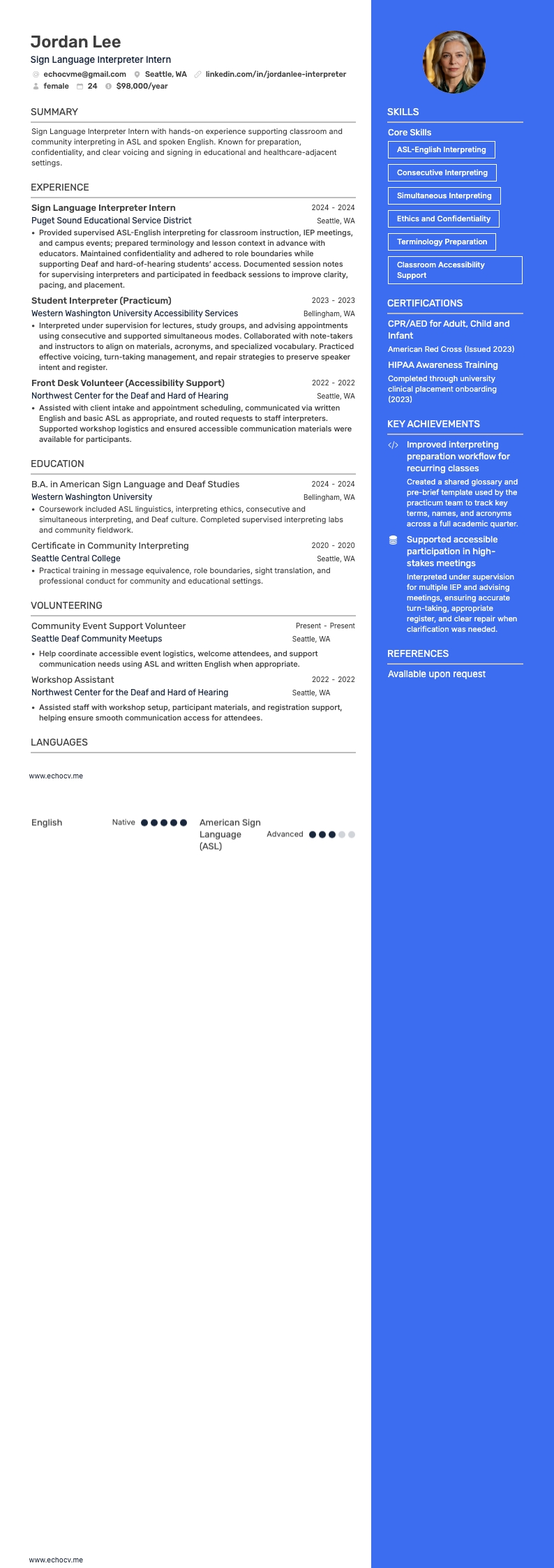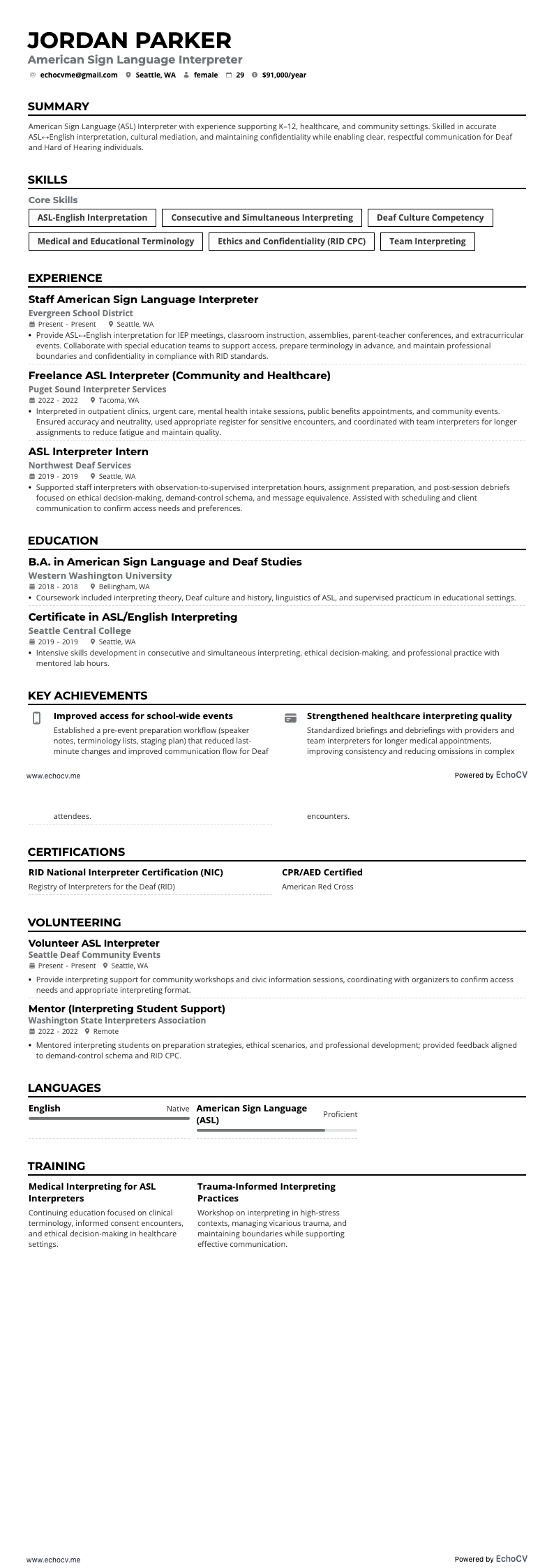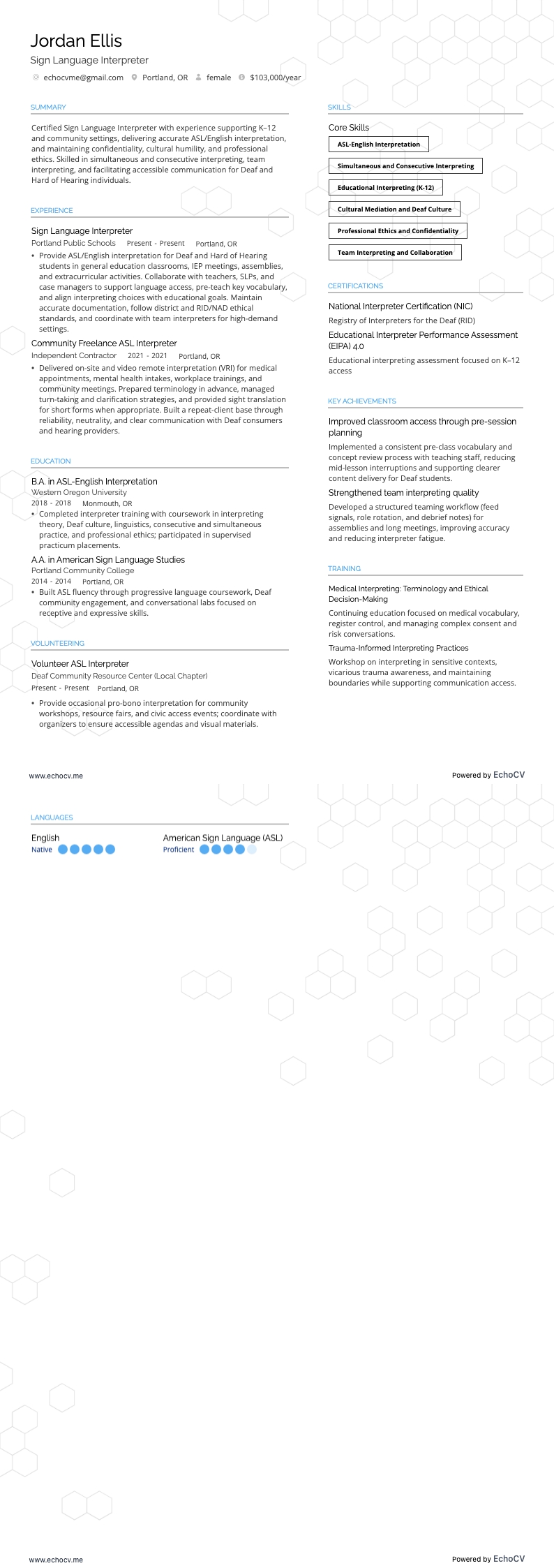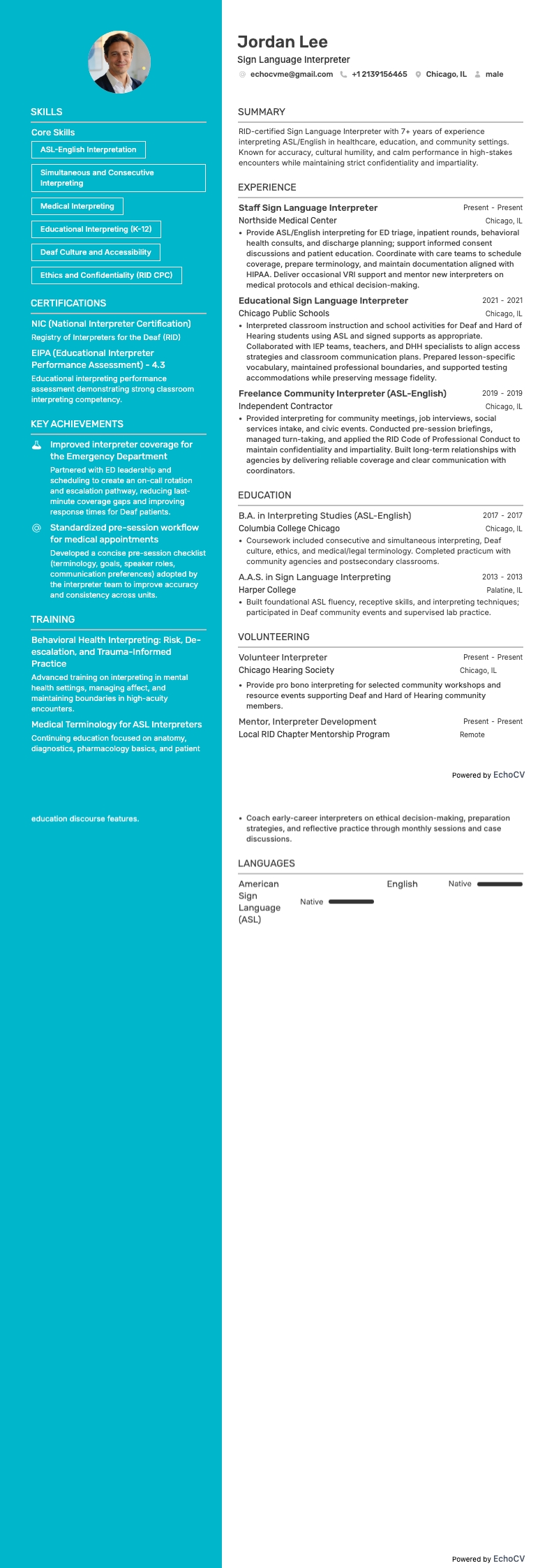
手話通訳者 の全体プレビュー

手話通訳者の履歴書の例10選

EchoCV

EchoCV チームによる執筆

更新日: 8/18/20238 min read

このガイド内のすべての履歴書サンプルを見るか、あなた専用のプロンプトで独自の履歴書サンプルを生成してください

手話通訳者 example resume
手話通訳者

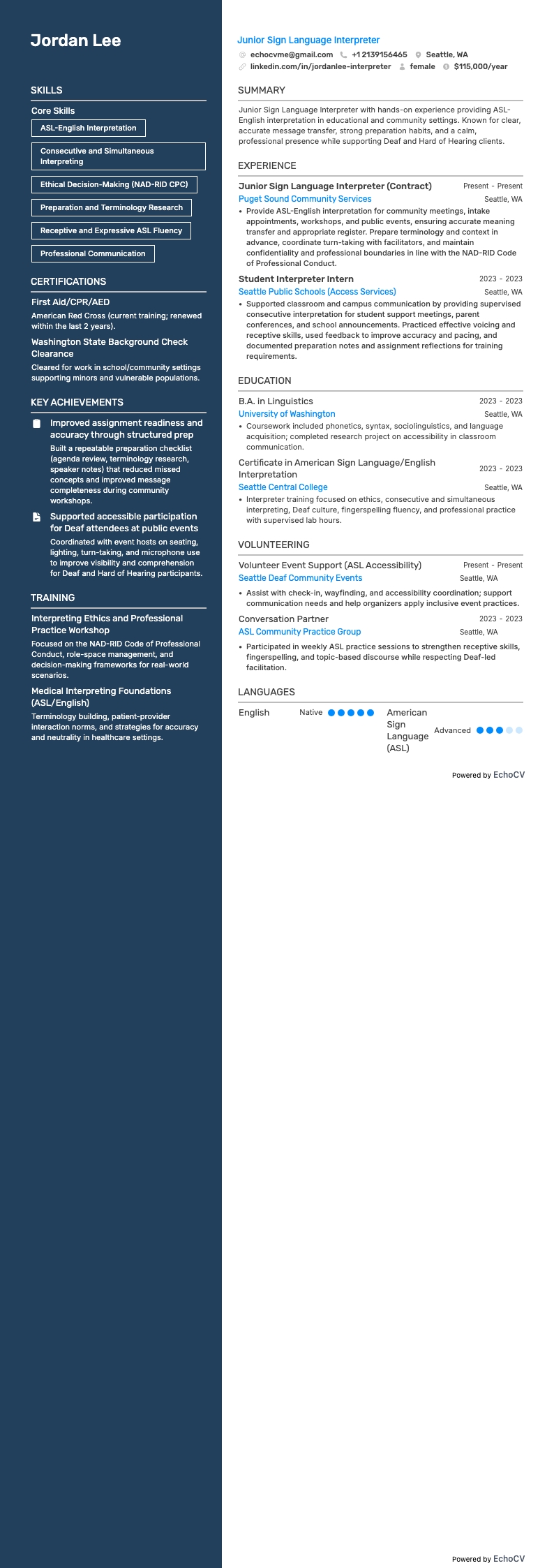
ジュニア手話通訳者 example resume

ジュニア手話通訳者

手話通訳インターン example resume

手話通訳インターン

アメリカ手話通訳者 example resume

アメリカ手話通訳者

手話通訳者 example resume

手話通訳者

Many sign language interpreter resumes fail because they bury interpreting settings, certification, and language pairs in dense summaries. In today's ATS screens and fast recruiter scans, that hides your fit and costs interviews in a crowded market.

A strong resume shows what changed because you were there, not just what you did. Knowing how to make your resume stand out means highlighting accuracy rates, session volume, turnaround time, complaint reductions, and outcomes for patients, students, or legal clients. Include scope like remote coverage hours, specialized terminology, and accessibility improvements.

Key takeaways

  • Quantify interpreting impact with accuracy rates, session volume, and satisfaction scores.

  • Choose reverse-chronological format for experienced interpreters and hybrid format for career changers.

  • Place certifications like NIC, CDI, or BEI where recruiters see them immediately.

  • Tailor each resume to the job posting's interpreting settings, terminology, and tools.

  • Demonstrate skills through outcome-driven experience bullets, not standalone keyword lists.

  • Use Echocv to turn vague interpreting duties into measurable, recruiter-ready resume bullets.

  • Include practicum hours, volunteer work, and community interpreting if you lack paid experience.

Job market snapshot for sign language interpreters

We analyzed 81 recent sign language interpreter job ads across major US job boards. These numbers help you understand regional hotspots, industry demand, career growth patterns at a glance.

What level of experience employers are looking for sign language interpreters

Years of ExperiencePercentage found in job ads
1–2 years4.9% (4)
Not specified95.1% (77)

Sign language interpreter ads by area of specialization (industry)

Industry (Area)Percentage found in job ads
Healthcare46.9% (38)
Education30.9% (25)
Finance & Banking19.8% (16)

Top companies hiring sign language interpreters

CompanyPercentage found in job ads
Language Services Associates39.5% (32)
The Stepping Stones Group12.3% (10)

Role overview stats

These tables show the most common responsibilities and employment types for sign language interpreter roles. Use them to align your resume with what employers expect and to understand how the role is structured across the market.

Day-to-day activities and top responsibilities for a sign language interpreter

ResponsibilityPercentage found in job ads
American sign language75.3% (61)
Medical interpreting39.5% (32)
Mental health interpreting39.5% (32)
Rid certification39.5% (32)
Interpreting38.3% (31)
Asl13.6% (11)
Sign language interpreting8.6% (7)
Asl certification7.4% (6)
English7.4% (6)
Educational interpreting6.2% (5)
Sign language6.2% (5)
Bei certification3.7% (3)

How to format a sign language interpreter resume

Recruiters evaluating sign language interpreter resumes prioritize fluency credentials (such as NIC, CDI, or BEI certification), specialized interpreting settings (medical, legal, educational), and a clear record of consistent, professional interpreting experience. A well-chosen resume format ensures these qualifications and your depth of fieldwork are immediately visible rather than buried beneath generic formatting.

要約

Use a reverse-chronological format to showcase your interpreting career progression, expanding scope of assignments, and deepening specialization across settings. Do:

  • Lead with your most recent and highest-responsibility interpreting positions, highlighting the settings, team sizes, and populations you served (e.g., K–12, post-secondary, courtroom, medical).
  • Feature your certifications, language pairs, and specialized domains—such as tactile interpreting, Deaf-Blind communication, or legal proceedings—prominently in a dedicated skills or credentials section.
  • Quantify outcomes and business impact wherever possible, including caseload volume, accuracy benchmarks, client satisfaction rates, or scope of assignments managed.
Example bullet: "Provided ASL interpretation for 200+ medical appointments annually across three hospital departments, maintaining a 98% patient satisfaction rating and reducing appointment miscommunication incidents by 35%."

要約

A hybrid format works best, letting you lead with relevant interpreting skills and credentials while still providing a concise timeline of your experience or related work. Do:

  • Place your certifications, language fluencies, and core interpreting competencies (simultaneous, consecutive, transliteration) at the top of the resume so recruiters see qualifications before scanning work history.
  • Include practicum hours, volunteer interpreting, internships, or community work as dedicated entries to demonstrate hands-on experience, even if unpaid.
  • Connect every listed skill or project to a clear action and result so hiring managers understand the real-world application of your training.
Example scaffold: "Simultaneous ASL interpreting → provided real-time interpretation for a 15-week university lecture series → enabled full classroom access for three Deaf students, contributing to a 100% course completion rate."

要約

A functional format strips away the timeline and context recruiters need to evaluate where, when, and how consistently you've interpreted, making it harder to verify your readiness for professional assignments.

  • A functional resume may be acceptable if you're transitioning from a related field (such as Deaf education or speech-language pathology), have significant gaps between interpreting roles, or are building your career primarily through volunteer and practicum hours—but even then, every listed skill should be tied directly to a specific project, setting, or measurable outcome.
Avoid a functional format entirely if you have any sustained interpreting work history, as it will raise questions about gaps or lack of professional experience that a chronological or hybrid layout would easily resolve.

Now that you've established a clean, readable layout, it's time to fill it with the right sections that showcase your qualifications effectively.

What sections should go on a sign language interpreter resume

Recruiters expect a sign language interpreter resume to show your interpreting credentials, settings served, and measurable outcomes. Understanding which resume sections to include ensures maximum clarity:

  • Header
  • Summary
  • Experience
  • Skills
  • Projects
  • Education
  • Certifications
  • Optional sections: Awards, Volunteering, Languages

Strong experience bullets should emphasize interpreting context and scope, accuracy and compliance, stakeholder outcomes, and measurable results.

Once your resume’s structure is in place, focus next on writing the experience section to show how you’ve applied those qualifications in real interpreting roles.

How to write your sign language interpreter resume experience

The experience section of your sign language interpreter resume should highlight work you've delivered—specific interpreting assignments, communication methods you employed, and measurable outcomes that reflect your effectiveness. Hiring managers prioritize demonstrated impact over descriptive task lists, so focus on what changed because of your interpreting rather than simply listing duties you performed. Building a targeted resume for each application ensures your experience aligns with what the employer is looking for.

Each entry should include:

  • Job title
  • Company and location (or remote)
  • Dates of employment (month and year)

Three to five concise bullet points showing what you owned, how you executed, and what outcomes you delivered:

  • Ownership scope: the interpreting settings, client populations, subject domains, or communication programs you were directly accountable for as a sign language interpreter.
  • Execution approach: the interpreting modalities, sign language systems, assistive technologies, or preparation methods you used to deliver accurate and culturally appropriate interpretation.
  • Value improved: changes to communication accessibility, comprehension accuracy, client satisfaction, compliance with accommodation standards, or reduction in miscommunication risk resulting from your interpreting work.
  • Collaboration context: how you partnered with Deaf and hard-of-hearing individuals, hearing participants, educators, medical professionals, legal teams, or event coordinators to ensure seamless communication access.
  • Impact delivered: outcomes expressed through the scope of assignments handled, populations served, service reliability, or organizational improvements to accessibility—rather than a list of interpreting activities performed.

要約

Action verb + technology + what you built/fixed + measurable result

A sign language interpreter experience example

✅ Right example - modern, quantified, specific.

ASL Interpreter

Metro Health Network | Chicago, IL

2022–Present

Provided American Sign Language access across a five-hospital system serving acute care, outpatient clinics, and telehealth.

  • Interpreted ASL–English for an average of twenty-five medical encounters per week across emergency, oncology, and behavioral health, sustaining a 4.9 out of 5 patient communication score and reducing appointment delays by 18%.
  • Coordinated Video Remote Interpreting (VRI) coverage using LanguageLine and Zoom for Healthcare, cutting average interpreter wait time from fourteen minutes to six minutes and supporting over 1,200 telehealth visits annually.
  • Documented encounters and accommodations in Epic using standardized templates and HIPAA-compliant notes, improving audit pass rate from 92% to 99% and reducing documentation rework by 30%.
  • Partnered with clinicians, patient advocates, and risk management to standardize informed-consent workflows, decreasing interpreter-related incident reports by 40% and improving on-time surgery starts by 12%.
  • Mentored four new interpreters on medical terminology, trauma-informed practice, and CDI (Certified Deaf Interpreter) collaboration protocols, increasing scheduling fill rate from 78% to 90% during peak demand.

Now that you've seen how a strong experience section comes together, let's look at how to adjust those details to match the specific job you're applying for.

How to tailor your sign language interpreter resume experience

Recruiters evaluate your sign language interpreter resume through both human review and applicant tracking systems. Tailoring your resume to the job description increases your chances of passing both screening stages.

Ways to tailor your sign language interpreter experience:

  • Match interpreting settings like medical legal or educational from the posting.
  • Mirror the specific sign language systems listed such as ASL or SEE.
  • Use the exact terminology for interpreting standards or certification requirements mentioned.
  • Highlight team interpreting or collaboration models referenced in the description.
  • Emphasize compliance with ADA or accessibility protocols when specified.
  • Include relevant domain experience like mental health or courtroom interpreting.
  • Reflect performance benchmarks or quality assurance practices the employer prioritizes.
  • Reference platform or video relay technology tools named in the job listing.

Tailoring means aligning your real interpreting achievements with what the employer needs rather than forcing keywords where they don't belong.

Resume tailoring examples for sign language interpreter

Job description excerptUntailoredTailored
Provide ASL interpretation for deaf and hard-of-hearing students in K–12 classroom settings, including IEP meetings and parent-teacher conferencesInterpreted for various clients in different settings.Delivered ASL interpretation for 15+ deaf and hard-of-hearing students across K–12 classrooms, IEP meetings, and parent-teacher conferences, supporting full academic participation throughout the school year.
Interpret medical appointments and emergency room consultations using specialized healthcare terminology while maintaining HIPAA complianceHelped with communication during appointments.Interpreted 20+ weekly medical appointments and emergency room consultations, applying specialized healthcare terminology while maintaining strict HIPAA compliance and ensuring accurate provider-patient communication.
Facilitate real-time ASL and tactile sign interpretation for deafblind individuals during community events and vocational training programsProvided sign language services at events.Provided real-time ASL and tactile sign interpretation for four deafblind individuals during community events and vocational training programs, adapting techniques to each participant's communication preferences.

Once you’ve aligned your experience with the role’s requirements, quantify your achievements to show the measurable impact of that work.

How to quantify your sign language interpreter achievements

Quantifying your achievements shows the real impact of your interpreting beyond "good communication." Focus on volume, accuracy, turnaround time, compliance, and satisfaction scores from patients, students, clinicians, or event stakeholders.

Quantifying examples for sign language interpreter

MetricExample
Volume handled"Interpreted 18–25 medical appointments weekly across cardiology and oncology, supporting over 900 patient encounters annually."
Accuracy rate"Maintained 98% accuracy on quarterly QA reviews using recorded-session spot checks and peer feedback rubrics."
Turnaround time"Reduced on-demand video interpreting response time from 12 minutes to under five minutes by triaging requests in the scheduling queue."
Compliance risk"Achieved 100% HIPAA compliance across three clinics by standardizing consent language and documenting interpreter notes in the electronic health record."
Satisfaction score"Improved patient satisfaction from 4.2 to 4.7 out of five by confirming understanding with teach-back and coordinating post-visit summaries."

Once you've crafted strong bullet points for your experience section, you'll want to apply that same precision to presenting your hard and soft skills.

How to list your hard and soft skills on a sign language interpreter resume

Your skills section shows you can interpret accurately and ethically in real-time, and recruiters and an ATS (applicant tracking system) scan this section to match you to setting-specific requirements, so aim for a balanced mix of hard skills and role-specific soft skills.

sign language interpreter roles require a blend of:

  • Product strategy and discovery skills.
  • Data, analytics, and experimentation skills.
  • Delivery, execution, and go-to-market discipline.
  • Soft skills.

Your skills section should be:

  • Scannable (bullet-style grouping).
  • Relevant to the job post.
  • Backed by proof in experience bullets.
  • Updated with current tools.

Place your skills section:

  • Above experience if you're junior or switching careers.
  • Below experience if you're mid/senior with strong achievements.

Hard skills

  • American Sign Language fluency
  • Conceptual equivalence interpreting
  • Simultaneous and consecutive interpreting
  • ASL-English transliteration
  • DeafBlind tactile interpreting
  • Video remote interpreting platforms
  • CART coordination and integration
  • HIPAA and FERPA compliance
  • RID Code of Professional Conduct
  • Medical terminology and protocols
  • Legal interpreting procedures
  • Interpreter scheduling systems

Soft skills

  • Clarify intent with speakers
  • Manage turn-taking and pacing
  • Maintain neutrality under pressure
  • Make split-second meaning decisions
  • Set boundaries and role clarity
  • Coordinate with providers and staff
  • Advocate for access needs appropriately
  • Repair misunderstandings quickly
  • Take accurate, minimal notes
  • Stay composed during conflict
  • Debrief and document assignments
  • Seek feedback and self-correct

How to show your sign language interpreter skills in context

Skills shouldn't live only in a dedicated skills list. Explore resume skills examples to see how interpreters present their abilities effectively.

They should be demonstrated in:

  • Your summary (high-level professional identity)
  • Your experience (proof through outcomes)

Here's how that looks in practice.

Summary example

Senior ASL interpreter with 12 years in medical and legal settings. Skilled in Certified Deaf Interpreter teaming, VRI platforms, and cultural mediation. Maintained a 99% client satisfaction rate across 3,000+ interpreted sessions.

  • Reflects senior-level expertise immediately
  • Names specific tools and methods
  • Includes a concrete, measurable outcome
  • Highlights cultural mediation as soft skill
Experience example

Senior Sign Language Interpreter

Bridges Communication Services | Portland, OR

June 2018–Present

  • Interpreted 1,200+ medical appointments annually using ASL and tactile signing, achieving a 98% patient comprehension score.
  • Collaborated with Deaf advocacy coordinators and nursing staff to develop a visual consent protocol, reducing intake errors by 35%.
  • Delivered real-time interpretation through Sorenson VRI during 400+ telehealth sessions, maintaining a 4.9/5 provider satisfaction rating.
  • Every bullet includes a measurable outcome.
  • Skills surface naturally through real achievements.

Once you’ve demonstrated your interpreting abilities through real examples, the next step is to structure a resume that highlights those strengths even if you don’t have formal experience.

How do I write a sign language interpreter resume with no experience

Even without full-time experience, you can demonstrate readiness through:

  • Interpreter training lab simulations
  • Community event interpreting practicum
  • Volunteer interpreting for nonprofits
  • Classroom note-taking with interpreting
  • Shadowing certified sign language interpreter
  • Video remote interpreting practice sessions
  • ASL (American Sign Language) tutoring

If you're building a resume without work experience, focus on:

  • Verified interpreting hours and settings
  • ASL proficiency and assessment scores
  • Interpreting methods and ethics training
  • Industry vocabulary: medical, legal, education

要約

Use a combination resume format because it highlights interpreting skills and training first, while still showing relevant experience substitutes and hours. Do:

  • Lead with a skills summary tied to evidence.
  • List training, practicum, and volunteer hours.
  • Add tools: video remote interpreting platforms.
  • Include ASL assessments and dates.
  • Tailor vocabulary to target industries.
Example project bullet:
  • Volunteered as sign language interpreter for three nonprofit workshops using consecutive interpreting and team notes, supporting forty attendees and earning 4.8 out of 5 feedback.

Once you've structured your resume to highlight transferable strengths rather than direct experience, presenting your education effectively becomes the next critical step in demonstrating your qualifications.

How to list your education on a sign language interpreter resume

Your education section helps hiring teams confirm you have the foundational training needed. It validates your knowledge of linguistics, Deaf culture, and interpreting theory essential for any sign language interpreter role.

Include:

  • Degree name
  • Institution
  • Location
  • Graduation year
  • Relevant coursework (for juniors or entry-level candidates)
  • Honors & GPA (if 3.5 or higher)

Skip month and day details—list the graduation year only.

Here's a strong education entry tailored for a sign language interpreter:

Example education entry

Bachelor of Arts in ASL/English Interpreting

Gallaudet University, Washington, D.C.

Graduated 2021

GPA: 3.8/4.0

  • Relevant coursework: Interpreting Theory, Deaf Culture Studies, Linguistics of ASL, Consecutive and Simultaneous Interpreting
  • Honors: Magna Cum Laude, Dean's List (all semesters)

How to list your certifications on a sign language interpreter resume

Certifications on your resume show a sign language interpreter's commitment to learning, proficiency with interpreting tools and standards, and relevance to current industry expectations.

Include:

  • Certificate name
  • Issuing organization
  • Year
  • Optional: credential ID or URL

  • Place certifications below education when they are older, less role-specific, or secondary to your degree and formal interpreter training.
  • Place certifications above education when they are recent, highly relevant to your target role, or required by the employer or contract.

Best certifications for your sign language interpreter resume

  • RID National Interpreter Certification (NIC)
  • RID Certified Deaf Interpreter (CDI)
  • BEI Basic Certification
  • BEI Advanced Certification
  • NAD IV (National Association of the Deaf)
  • QAST (Quality Assurance Screening Test)
  • EIPA (Educational Interpreter Performance Assessment)

Once you’ve presented your credentials in a clear, easy-to-scan format, you’re ready to write your sign language interpreter resume summary to highlight those qualifications upfront.

How to write your sign language interpreter resume summary

Your resume summary is the first thing a recruiter reads, so it needs to immediately convey your value. A strong summary tailored to a sign language interpreter role sets the tone for everything that follows.

Keep it to three to four lines, with:

  • Your title and total years of interpreting experience.
  • The settings you work in, such as educational, medical, legal, or community environments.
  • Core skills like ASL fluency, Signed Exact English, or certified deaf interpreter collaboration.
  • One or two measurable achievements, such as assignments completed or accuracy ratings.
  • Soft skills tied to real outcomes, like cultural mediation that improved client satisfaction scores.

プロのヒント

At this level, emphasize your interpreting credentials, relevant settings, and concrete skills. Highlight early wins like volume of assignments or positive feedback scores. Avoid vague phrases like "passionate communicator" or "dedicated professional." Recruiters want proof of competence, not motivation.

Example summary for a sign language interpreter

NIC-certified ASL interpreter with three years of experience in educational and medical settings. Completed over 500 interpreting assignments with a 98% client satisfaction rate. Skilled in cultural mediation and real-time adaptability.

Now that your summary captures your interpreting expertise and value, make sure your header presents the essential contact and credential details hiring managers need to reach you.

What to include in a sign language interpreter resume header

A resume header lists your key contact and professional details, helping sign language interpreter candidates stay visible, credible, and easy to screen.

Essential resume header elements

  • Full name
  • Tailored job title and headline
  • Location
  • Phone number
  • Professional email
  • GitHub link
  • Portfolio link
  • LinkedIn

A LinkedIn link helps recruiters verify experience quickly and supports screening.

Don't include a photo on a sign language interpreter resume unless the role is explicitly front-facing or appearance-dependent.

Keep your header consistent with the job posting's wording, and place it at the top so recruiters can contact you in seconds.

Sign language interpreter resume header
Jordan Rivera

Sign language interpreter | Educational and medical interpreting

Austin, TX

(512) 555-01XX

[email protected]

github.com/yourname

yourwebsite.com

linkedin.com/in/yourname

Once your header clearly identifies you and makes it easy for employers to contact you, add supporting resume sections that reinforce your qualifications and fit for the role.

Additional sections for sign language interpreter resumes

Adding extra sections helps you stand out when your core qualifications match other candidates. They showcase unique strengths and role-specific credibility.

  • Languages and sign language systems
  • Volunteer interpreting experience
  • Professional affiliations and memberships
  • Continuing education and workshops
  • Publications or conference presentations
  • Community involvement and advocacy

Once you've strengthened your resume with relevant additional sections, the next step is pairing it with a cover letter that adds even more context to your qualifications.

Do sign language interpreter resumes need a cover letter

A cover letter isn't required for a sign language interpreter, but it helps in competitive roles or when employers expect one. If you're unsure what a cover letter is or when to use one, it can make a difference when your resume doesn't fully show fit, context, or communication approach.

Use a cover letter to add details your resume can't:

  • Explain role and team fit: Match your interpreting settings, collaboration style, and boundaries to the team's workflows and expectations.
  • Highlight one or two relevant projects or outcomes: Share a specific assignment, your approach, and a measurable result, such as reduced miscommunication or improved access.
  • Show understanding of the product, users, or business context: Connect your experience to the audience, compliance needs, and service goals of the organization.
  • Address career transitions or non-obvious experience: Clarify shifts from education to healthcare, freelance to staff roles, or related work that supports interpreting performance.

Once you’ve decided whether to include a cover letter to add context beyond your resume, the next step is using AI to strengthen your sign language interpreter resume more efficiently.

Using AI to improve your sign language interpreter resume

AI can sharpen your resume's clarity, structure, and impact. It helps reframe experience into stronger, more targeted language. But overuse strips authenticity. Once your content feels clear and role-aligned, step away from AI. For guidance on ChatGPT resume writing prompts, these examples can help you get started.

Here are 10 practical prompts to strengthen specific sections of your resume:

要約

Rewrite my sign language interpreter resume summary to highlight years of experience, specialization areas, and key certifications in under four lines.

要約

Add measurable outcomes to these sign language interpreter experience bullets, focusing on client volume, accuracy rates, or session frequency.

要約

Compare my sign language interpreter resume experience section to this job description and suggest edits that better align with its requirements.

要約

Organize my sign language interpreter skills into grouped categories—interpreting techniques, language fluency, technology tools, and soft skills.

要約

Replace weak or repetitive verbs in my sign language interpreter experience bullets with precise, industry-relevant action verbs.

要約

Rewrite my sign language interpreter certifications section to clearly list credential names, issuing bodies, and expiration dates.

要約

Edit my sign language interpreter education section to emphasize coursework, honors, or training directly relevant to interpreting roles.

要約

Write a concise sign language interpreter resume projects section based on these details, emphasizing scope, setting, and outcomes.

要約

Identify and remove vague or redundant phrasing from my sign language interpreter resume without changing the original meaning.

要約

Review my entire sign language interpreter resume for inconsistent tense, tone, or formatting and suggest specific corrections.

Conclusion

A strong sign language interpreter resume shows measurable outcomes, role-specific skills, and a clear structure. It highlights interpreting settings, certifications, and language proficiency, plus results like accuracy scores, caseload volume, or on-time session rates.

Keep each section easy to scan, with focused bullets and consistent formatting. This approach shows you’re ready for today’s hiring market and near-future needs across in-person, remote, and hybrid interpreting roles.

手話通訳者 履歴書サンプル

さらに多くの 手話通訳者 履歴書サンプルとガイドを確認し、経験レベルや職種に合う内容を見つけましょう。

経験別

手話通訳者

手話通訳者 の履歴書プレビュー

ジュニア手話通訳者

ジュニア手話通訳者 の履歴書プレビュー

手話通訳インターン

手話通訳インターン の履歴書プレビュー

手話通訳者 履歴書サンプル

さらに多くの 手話通訳者 履歴書サンプルとガイドを確認し、経験レベルや職種に合う内容を見つけましょう。

職種別

アメリカ手話通訳者

アメリカ手話通訳者 の履歴書プレビュー

手話通訳者

手話通訳者 の履歴書プレビュー