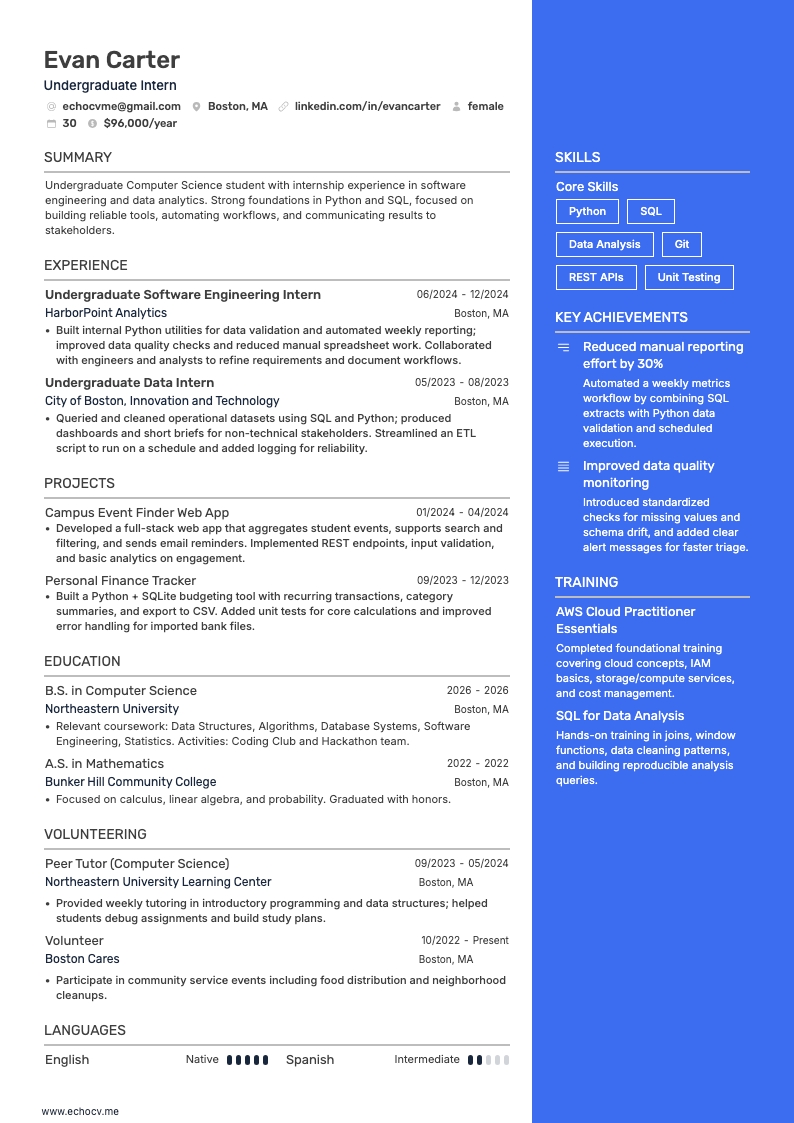
학부 인턴 전체 미리보기

학부생 이력서 예시 18가지

EchoCV

EchoCV 팀 작성

업데이트: 7/8/20258 min read

이 가이드의 모든 이력서 예시를 보거나, 나만의 프롬프트로 맞춤 이력서 예시를 생성해 보세요

학부 인턴 example resume
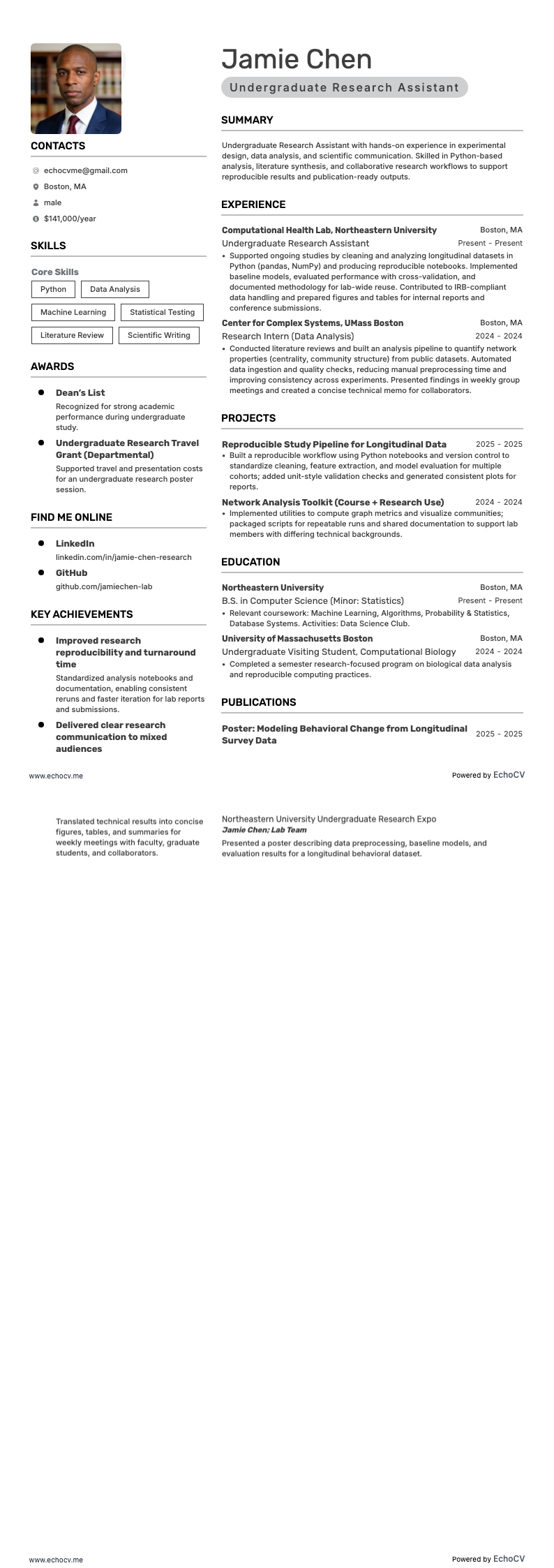
학부 인턴

학부 연구 조교 example resume

학부 연구 조교

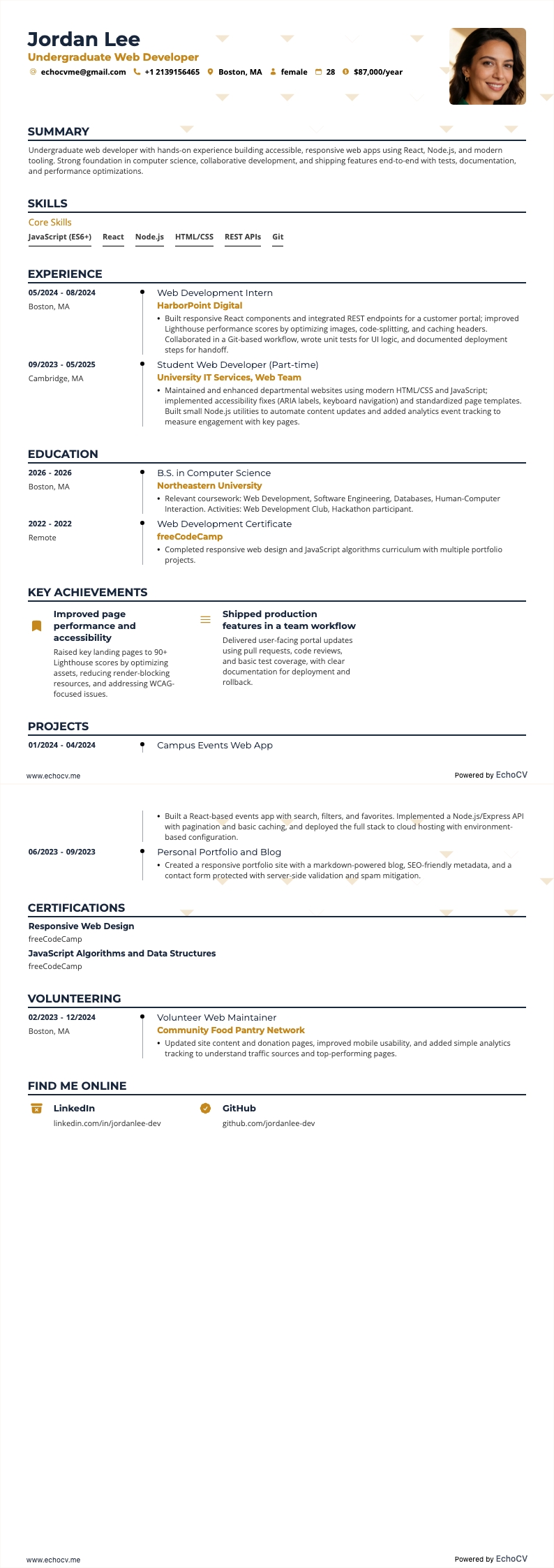
학부생 웹 개발자 example resume

학부생 웹 개발자

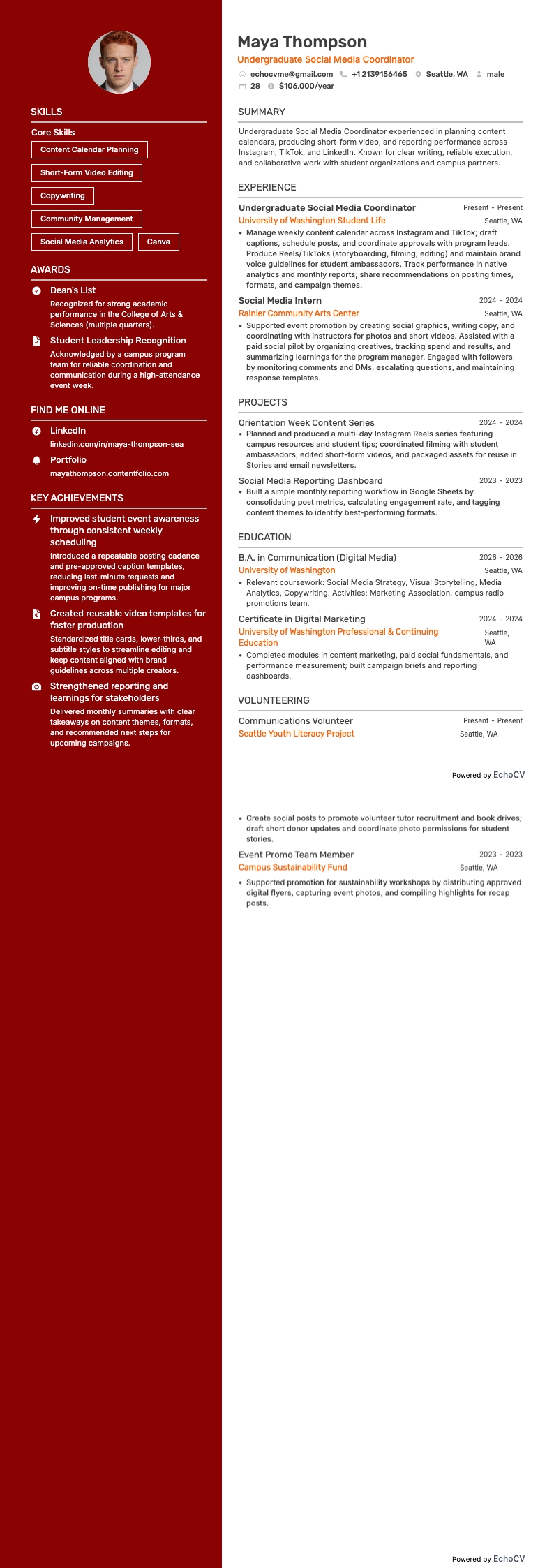
학부 소셜 미디어 코디네이터 example resume

학부 소셜 미디어 코디네이터

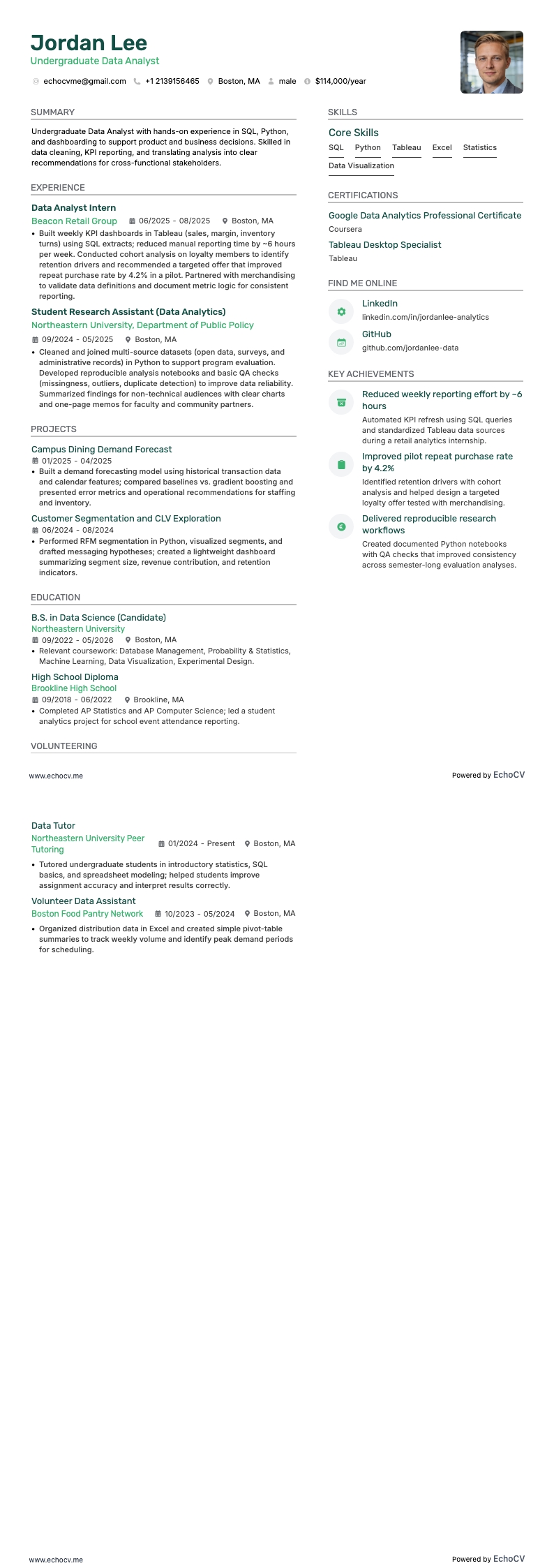
학부생 데이터 분석가 example resume

학부생 데이터 분석가

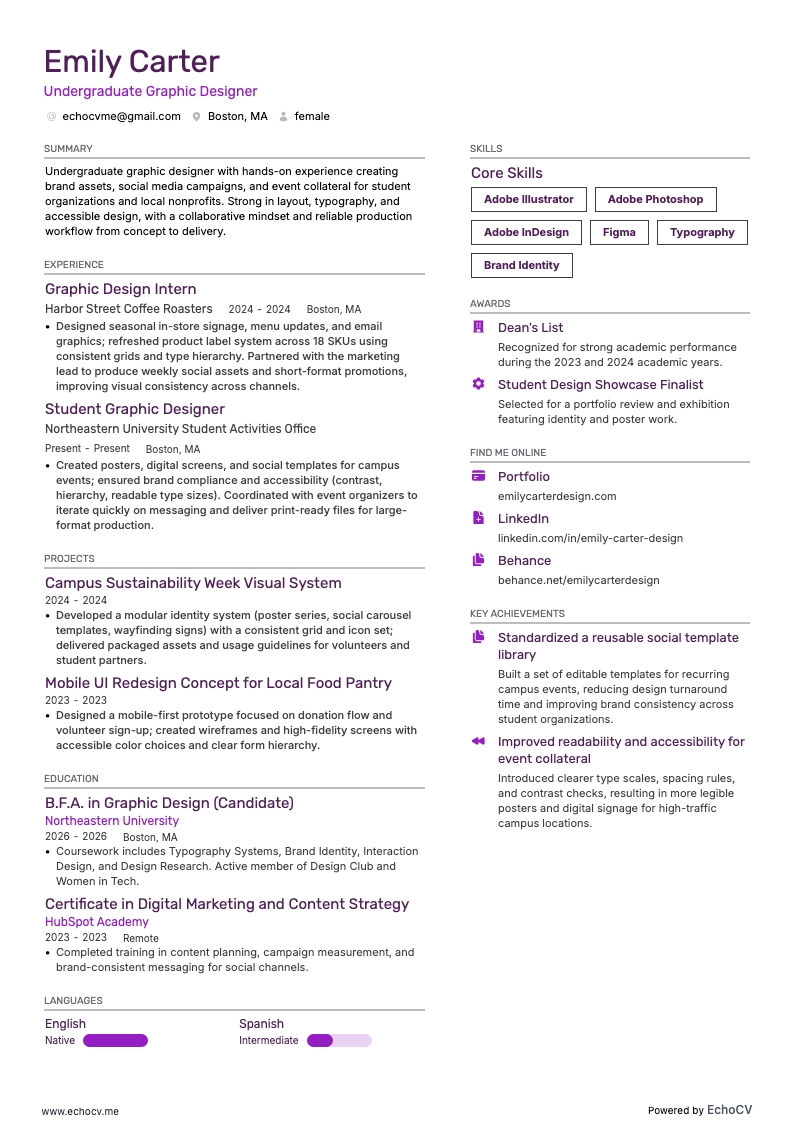
학부생 그래픽 디자이너 example resume

학부생 그래픽 디자이너

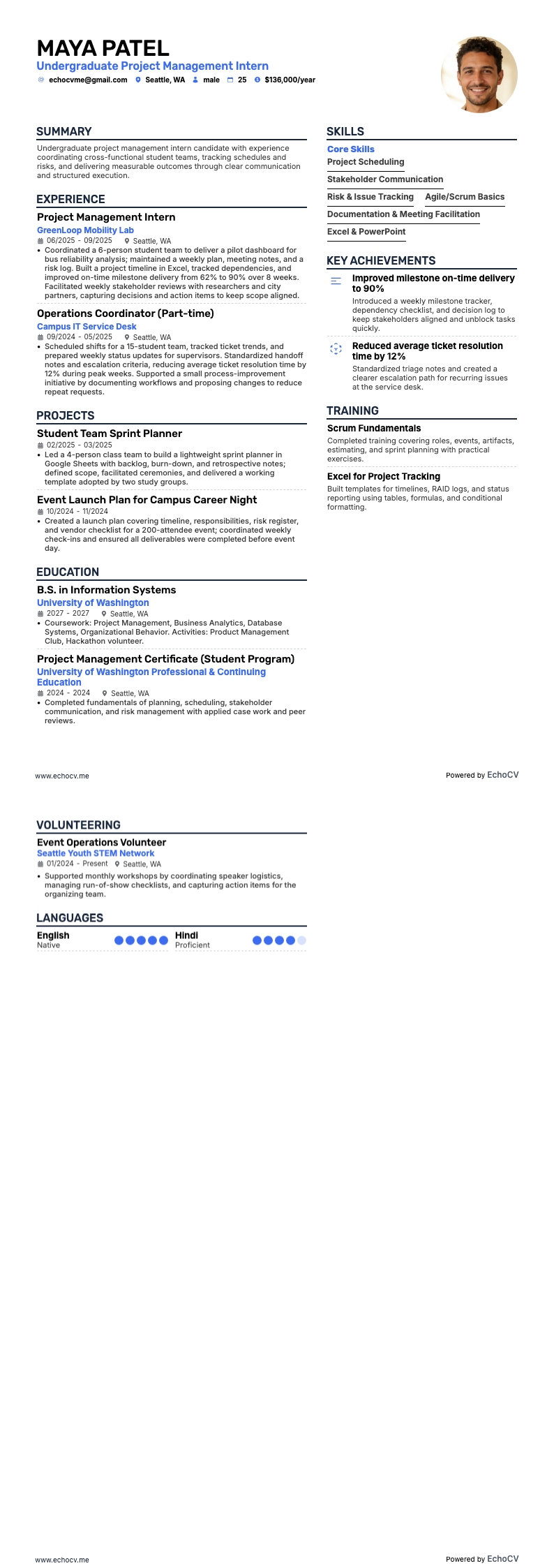
학부생 프로젝트 관리 인턴 example resume

학부생 프로젝트 관리 인턴

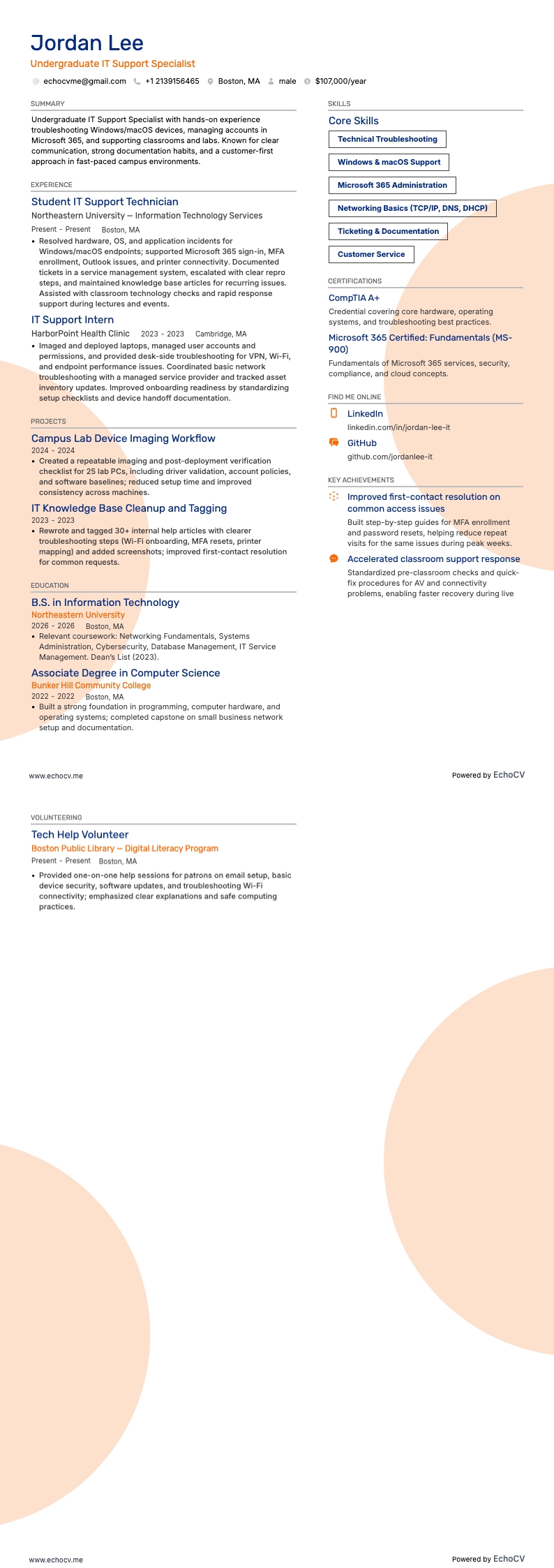
학부생 IT 지원 전문가 example resume

학부생 IT 지원 전문가

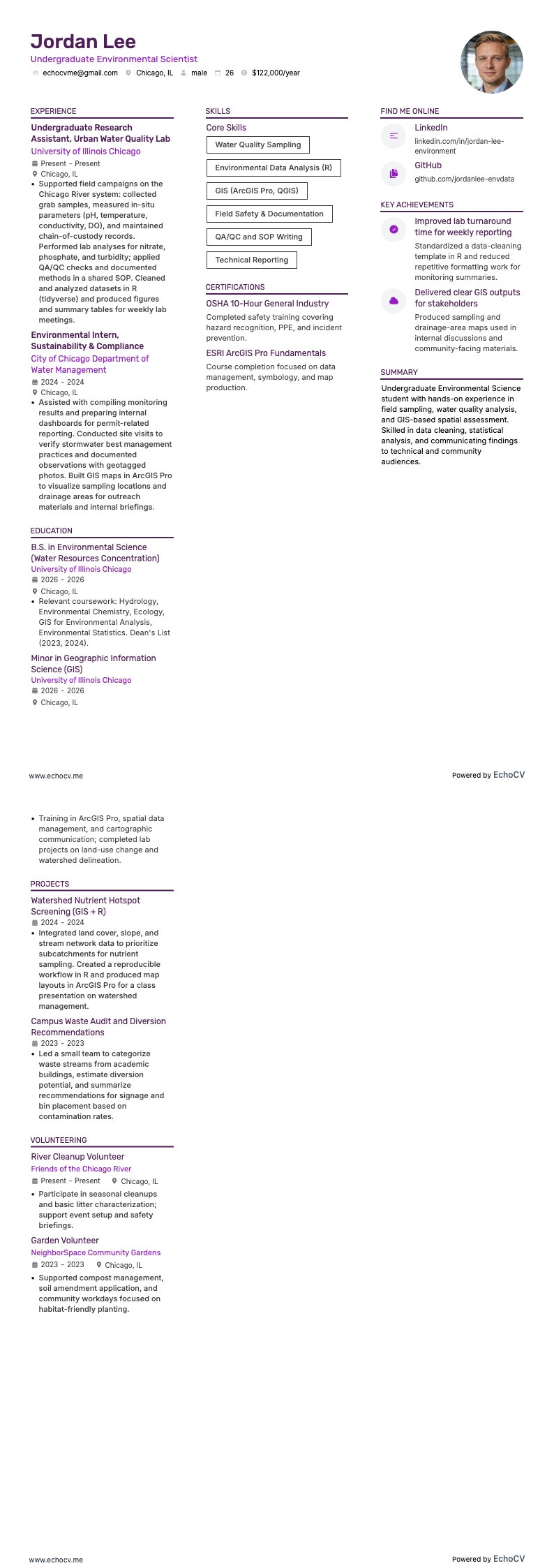
학부 환경 과학자 example resume

학부 환경 과학자

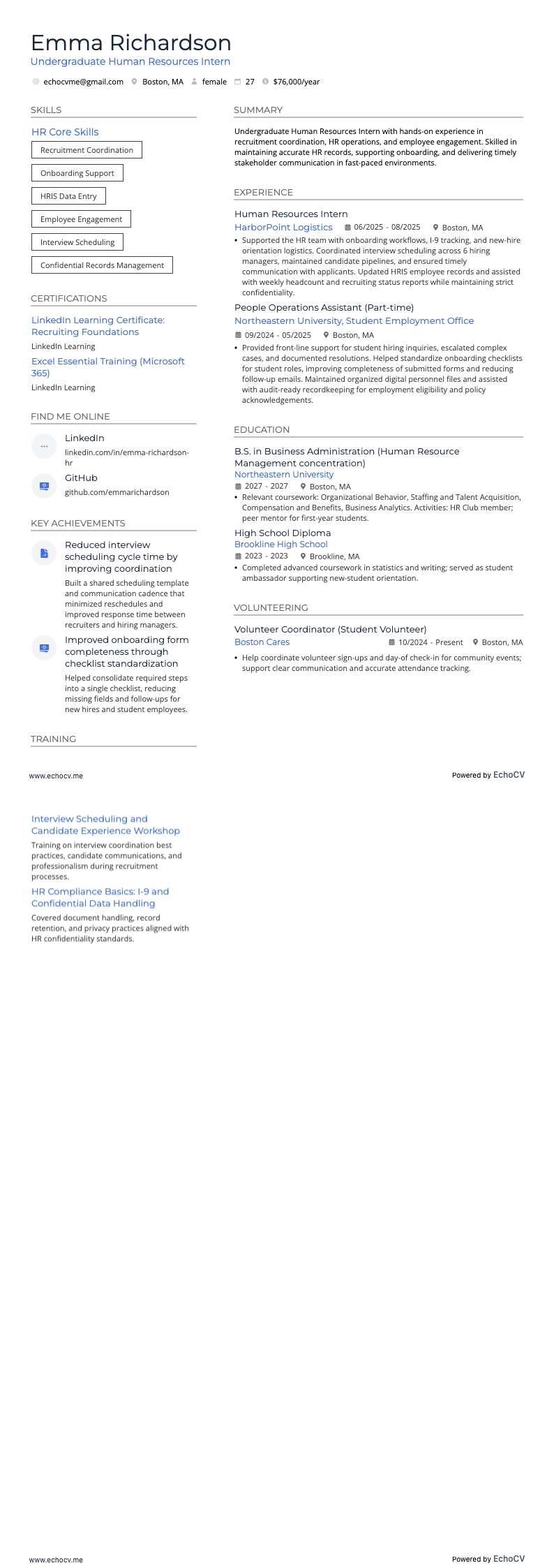
학부생 인사 인턴 example resume

학부생 인사 인턴

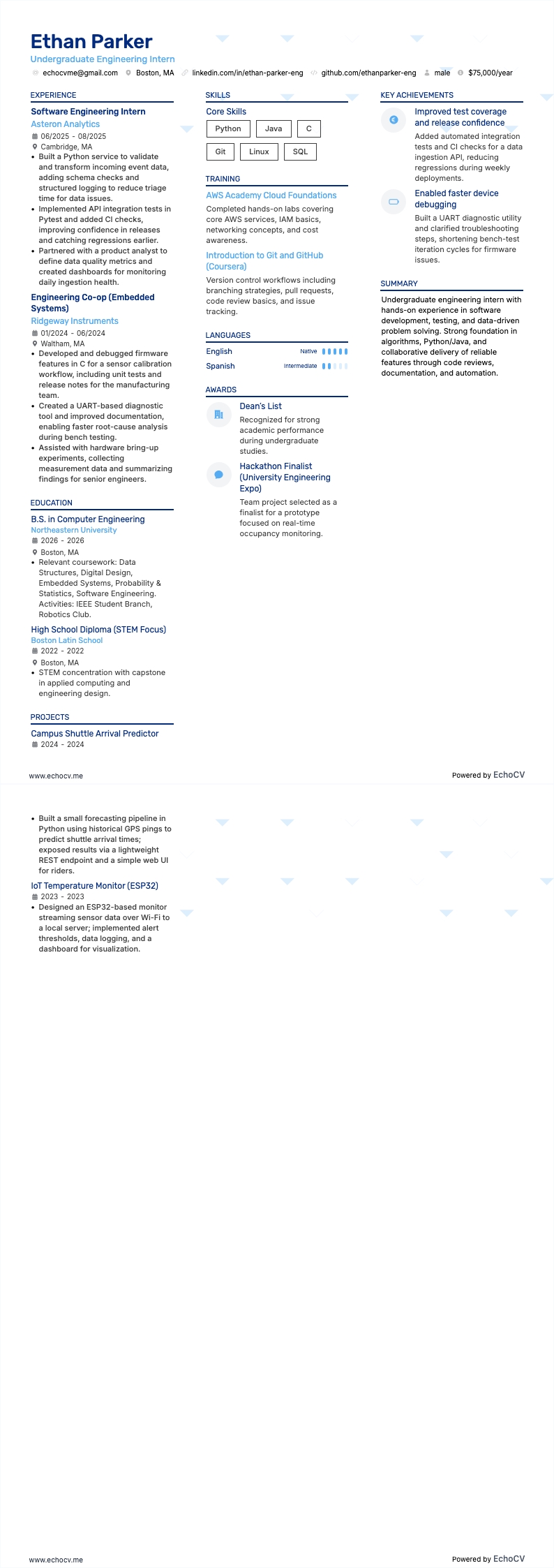
학부 엔지니어링 인턴 example resume

학부 엔지니어링 인턴

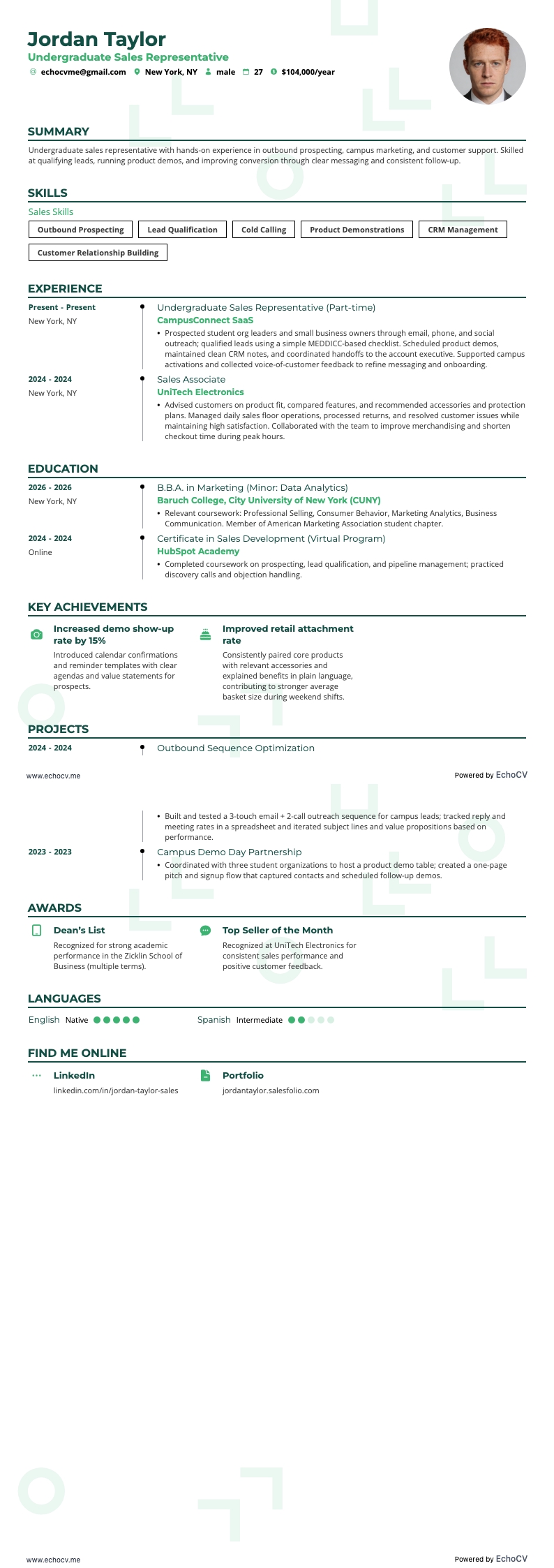
대학생 영업 담당자 example resume

대학생 영업 담당자

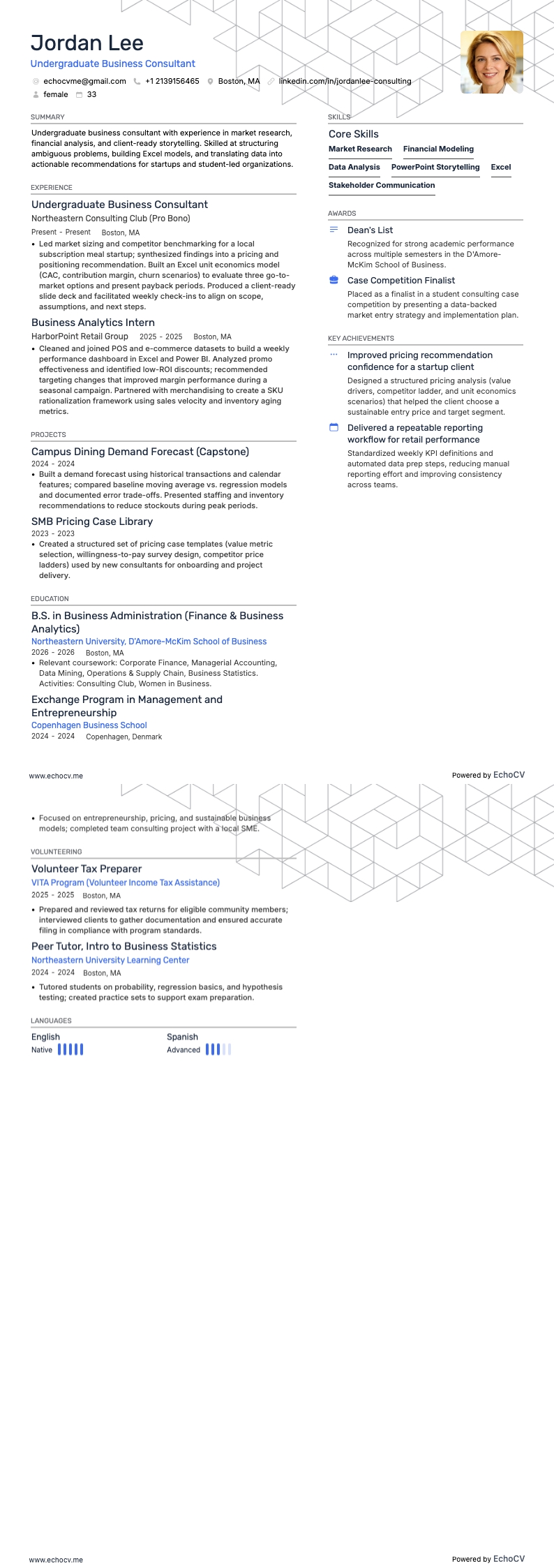
학부생 비즈니스 컨설턴트 example resume

학부생 비즈니스 컨설턴트

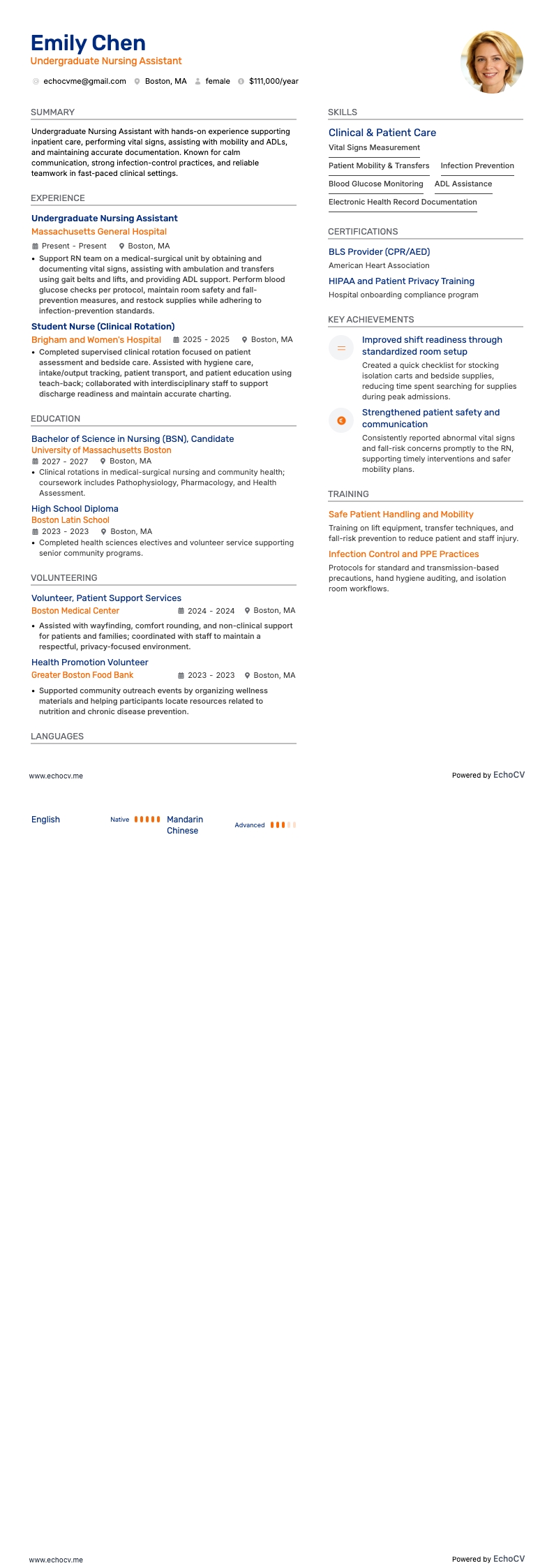
학부 간호 보조원 example resume

학부 간호 보조원

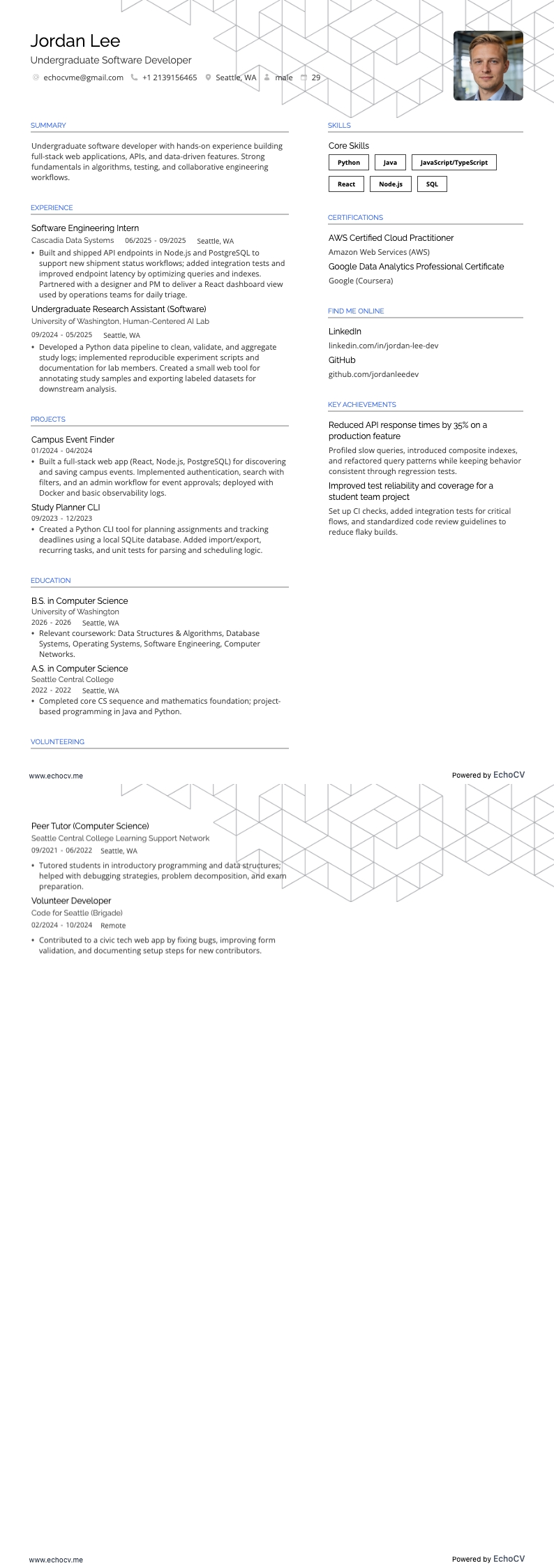
학부생 소프트웨어 개발자 example resume

학부생 소프트웨어 개발자

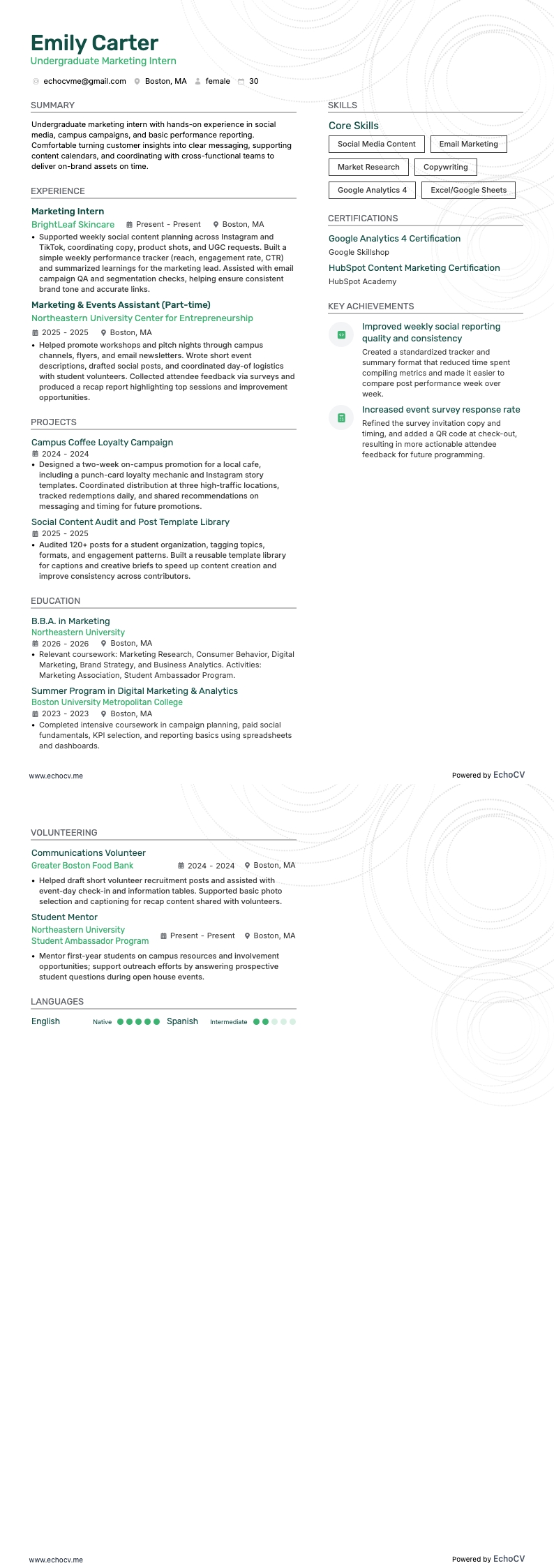
학부 마케팅 인턴 example resume

학부 마케팅 인턴

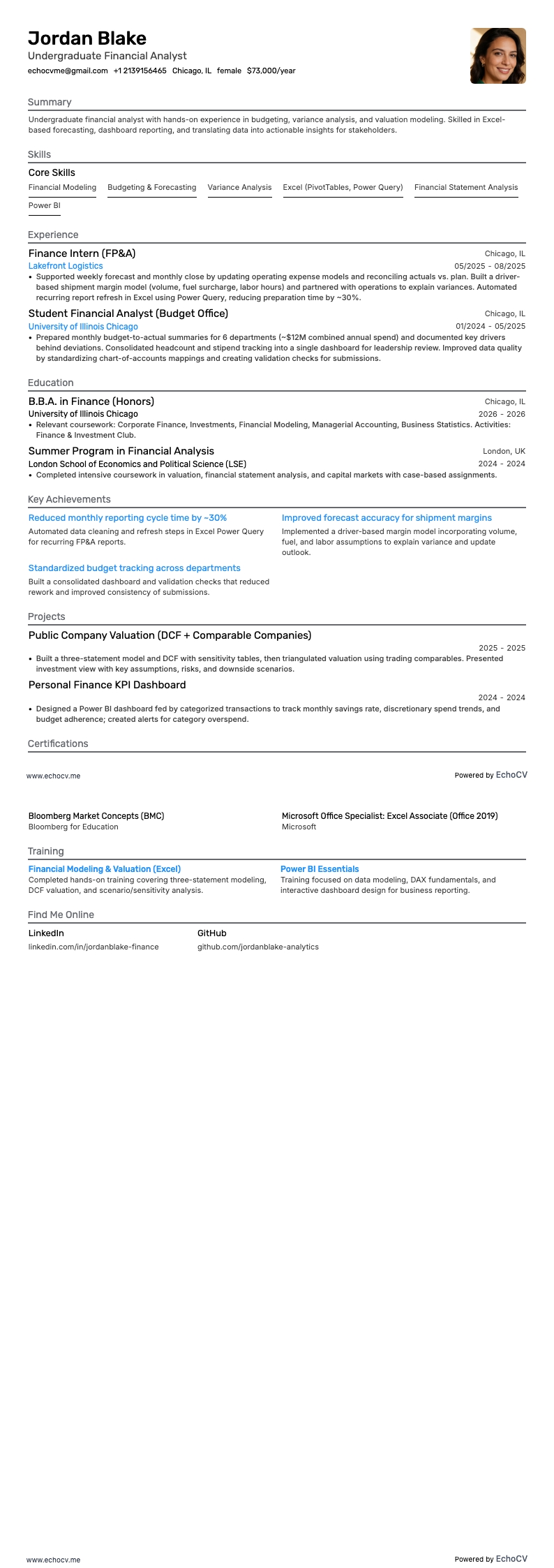
학부생 재무 분석가 example resume

학부생 재무 분석가

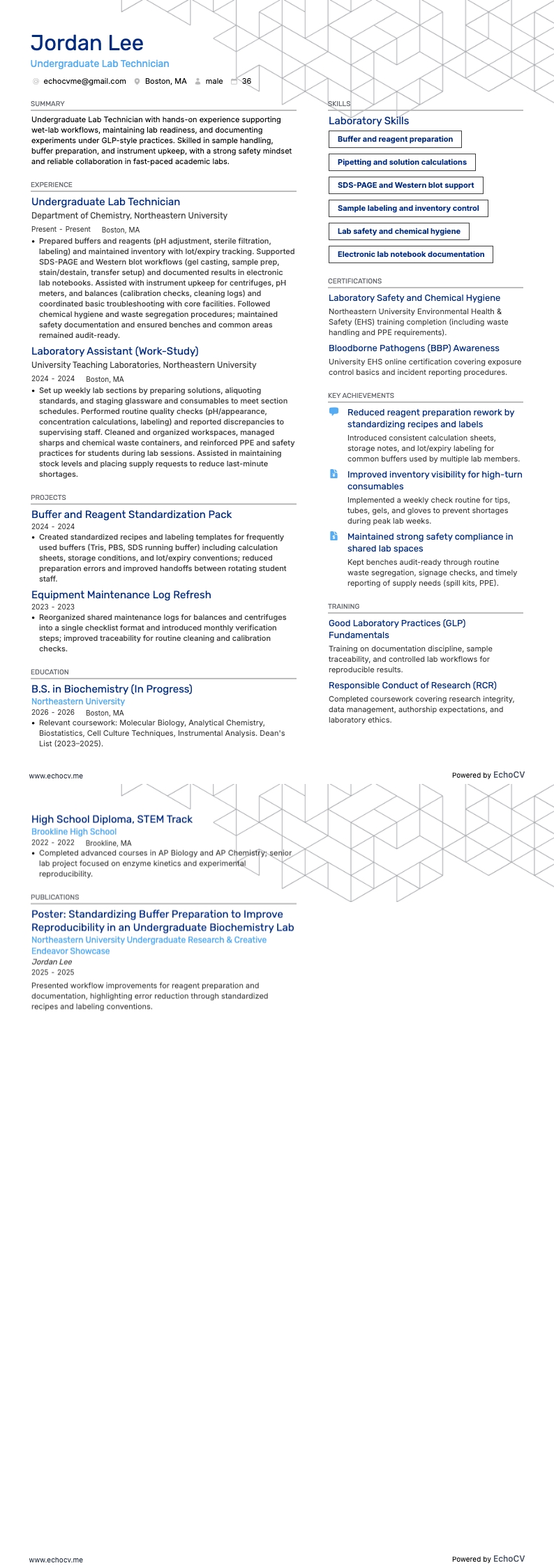
학부 연구실 실험기술 보조원 example resume

학부 연구실 실험기술 보조원

What’s the first thing you think about when you hear the word ‘resume’?

If you’re like most people, probably something that instantly comes to your mind is ‘experience’. And that’s quite understandable.

Generally speaking, a resume is one of the easiest ways to demonstrate your experience and skills to potential employers.

But what if you have no experience? What should undergraduate students who have focused their efforts on studying put on their resumes?

Long story short: even undergraduates with no experience need strong resumes.

In fact, the experience section is just one bit recruiters pay attention to. There are many other things they want to learn about you.

For instance, your skills, ability to deal with challenging situations, general approach to conflict, desire to learn and grow, and many more.

And these things can make you stand out from other applicants - regardless of whether you’re looking for an internship or a full-time entry-level position.

If you’re keen to learn how to write an undergraduate resume that makes you stand out - read on!

Median earnings for bachelor’s degree holders are 84% higher than those whose highest degree is a high school diploma.

U.S. Bureau of Labor Statistics

This undergraduate resume guide will help you:

  • Find out what sections your resume needs to have
  • Craft a compelling resume summary that gets the attention
  • Highlight your strengths and education without putting emphasis on your lack of experience
  • Showcase your college activities in a way that fascinates recruiters
  • Separate the wheat from the chaff and focus on what matters.

The perfect format for your undergraduate resume

When looking for resume advice online, most things you’d find would typically include stuff like “talk about your education”, or “focus on your relevant hard skills”, or even “share why you’re the best applicant”.

But when you’re an undergrad with no experience whatsoever, general advice often sounds irrelevant and even inadequate.

In fact, you might be wondering what your relevant hard skills are and how to describe your education in a meaningful way.

We get that.

But we also know that you want to build a resume that gets the attention of recruiters in the most positive way possible.

And the first thing you should think about is the resume format.

Some of the most popular resume formats include:

  • The reverse-chronological format
  • The functional format
  • The hybrid format.

Now, the reverse-chronological format is not really something you, as an undergraduate, should consider. It’s more suitable for professionals with long years of experience.

The functional format, on the other hand, is great for inexperienced undergraduates who want to emphasize their transferable skills, interests, and activities.

And if you have some experience to mention, go for the hybrid resume format. It’s a combination of the first two that allows you to focus on both your experience and your personality.

Some general tips to keep in mind include:

Once you’ve mastered the formatting, another question comes up: what should your undergraduate resume include?

Something great about undergraduate resumes is that you can experiment with sections. Here are some worth considering:

Remember, resume layouts can vary by country – for example, a Canadian resume format could look different.

Top sections for your undergraduate resume:

  • Header - for your name, email address, phone, and a link to your LinkedIn or personal website
  • Objective - for your long-term vision and priorities
  • Skills section - for your hard, soft, and transferable skills
  • Education section - for all your degrees and relevant courses
  • Certification section - for your certifications
  • Strengths section - for the qualities that make you stand out from others
  • Achievements section - for the times your hard work paid off.

When you choose the top sections you want to include in your undergraduate resume, it’s important to add specific information that recruiters value. For instance:

What recruiters love seeing on undergraduate resumes:

  • The top courses you’ve taken and how they relate to the job you’re applying for
  • Some of the challenges you’ve faced and how you’ve dealt with them
  • Your ability to learn and master new skills quickly
  • Whether you’ve done some volunteering or work shadowing
  • What your biggest strengths are
  • The things you’d like to learn more about
  • Where you take inspiration from
  • The awards you’ve received
  • The publications you’ve published
  • Whether you’ve taken any additional courses that have upskilled you.

The ideal header for your undergraduate resume

The header section is often treated as unimportant by many undergraduates. Probably due to the fact that it’s the shortest part of your resume.

However, if you make even the slightest mistake in your email address or your phone number, recruiters will not be able to get back to you.

So make sure your header section is free from mistakes. Let’s check out some examples:

2 undergraduate resume header examples

Can you spot any mistakes?

Firstly, look at the title - it says ‘Student’. It’s okay, but it’s far from perfect.

Ideally, here you would mention the position you’re applying for or at least your major.

Then let’s look at the e-mail address - it’s very informal. We advise you to stick to the [email protected], [email protected], [email protected] format instead.

Then comes the location - it’d be better if Lesley had mentioned the city she currently resides in. That’s especially important if she’s applying for an on-site job.

Last but not least, the link. It leads us to Lesley’s personal Facebook account, and that’s a huge no-no. Especially if Lesley has some wild party photos in there.

Much better!

This resume summary looks much better and paints a much more precise picture of the applicant.

It starts by mentioning the person’s looking to become a journalist. In this way, employers know exactly what position would match the applicant’s wants and needs.

Moreover, this fits well with their link - we can assume that it leads to all articles Lesley has written for the university newspaper.

The email and location also look neat.

Now that’s a perfect header! Time to look at your undergraduate resume’s objective.

An inspiring objective to keep recruiters’ attention

Once you’ve decided what positions you want to apply to, it’s time to craft a resume objective.

Regardless of whether you’re in your first or last year of studies, a well-written resume objective can help you land an interview even when you have no work experience whatsoever.

That’s why describing how you’ll add value to the team is mandatory here.

Another thing worth considering is adding relevant keywords. This can help you pass applicant tracking systems that most recruiters use, even if you have little to no experience.

In short, think of your resume objective as a quick way to get recognition for your skills and qualifications from employers.

Let’s look at some good and bad resume objectives examples!

Focusing on what matters: 3 undergraduate resume objective examples

Summary
I have no experience, but I am motivated. Looking forward to our interview! Thank you!
나쁜 예

How does that resume objective make you feel?

Not too excited or impressed, right?

This automatically means you should stay away from such short, uninspiring objectives. Otherwise, you risk having your resume tossed in the bin.

Let’s try again:

Summary
I am an undergraduate student with strong administrative and PowerPoint skills. I am passionate about astronomy and fintech.
나쁜 예

Although this resume objective looks a bit better, it’s still far from ideal.

It’s a good idea to mention your top skills. However, linking them to the actual area of work or position is what would make you stand out.

Let’s give it one last try:

Summary
A final-year Computer Science undergraduate passionate about software development and fintech. Strong collaboration skills. Confident in Python and C++, keen to learn everything else! Looking for a role as a Software Development Intern in a fintech company.
좋은 예

Now that’s something else!

This computer science undergraduate has done a great job in highlighting their education, interests, and top skills.

What’s more, they have also mentioned the position and field they’re interested in.

It’s now time to move on to the next section, where we’ll discuss what needs to be done if you’re one of the few chosen undergraduates who have some work experience.

We advise you to read through that section even if you have no relevant work experience.

How to highlight work experience in your undergraduate resume

It’s common for undergrads to look for jobs - regardless of whether they’re doing it to get money or to get experience.

In both cases, there are some dos and don'ts when it comes to highlighting your previous experience. Be it relevant to what you’re applying for or not.

Generally speaking, your experience section should always include:

  • The name of your previous employer
  • The position
  • The dates of employment
  • A short description of the company
  • Your main responsibilities

Let’s look at some examples first and discuss our findings after:

Right and wrong: 2 undergraduate resume experience examples

Experience
Waiter
Soul Kitchen
Cleveland, OH
Restaurant
  • Served food
  • Greeted customers
  • Shift work
  • Always on time
나쁜 예

Treat the example above as something you shouldn’t do.

Let’s start from the beginning.

The ‘position’ and ‘workplace’ fields look alright, but the description needs attention. Instead of plainly stating the place is a restaurant, this applicant could have said what kind of food the restaurant serves, for instance.

Also, look at the way they have listed their responsibilities. Do you spot anything wrong?

First off, there is no consistency. Some bullets start with verbs, others - with nouns or even adverbs.

Our advice is to always list your responsibilities using action verbs. They make you look responsible and ready to take action. And to be honest, recruiters love this.

Then, we need to look at the actual wording of the responsibilities.

Serving food requires valuable skills like attention to detail. At the same time, working in shifts means you have to be adaptable and have strong time management skills.

But as you can see, the applicant has not highlighted any of these transferable skills in their experience section.

See how this could have been done differently:

Experience
Waiter
Soul Kitchen
Cleveland, OH
Soul Kitchen is a vegetarian dog-friendly restaurant in Cleveland
  • Helped customers choose their food according to their requirements and preferences
  • Delivered orders in a timely manner and according to restaurant policies
  • Improved my multitasking skills by covering 6-10 tables at a time
  • Guaranteed 100% customer satisfaction even during night shifts
좋은 예

See the difference?

Using action verbs and describing your responsibilities in detail makes a much stronger first impression than simply stating what you had to do.

What’s more, when you start thinking about the results of your work and how much you have actually achieved, you prepare for one of the most common interview questions - “Tell me about your experience”.

This piece of advice is also suitable for you if you have only volunteer experience.

The volunteering section: a great way to showcase your transferable skills

As mentioned earlier, not all undergraduates have experience.

Yes, those who do are usually considered lucky, but that’s mostly because they can prove they have the required skills.

The same goes for volunteering.

And while the volunteering section is a bit easier to tackle, there are still some things to keep in mind.

Inspiring change: 1 good and 1 bad volunteering section examples

Volunteering
Chair
Global Shapers
I used to be the chair of the Global Shapers LA Hub
나쁜 예

Look at the example above. What do you get from it?

Not much, right? That’s why you should strive to do better.

The aim of every section of your resume should be to add value. So focus on this when describing exactly what you’ve done as a volunteer.

Let’s try again:

Volunteering
Chair
Global Shapers
The Global Shapers community is a network of students who work together to address and solve different local and global problems. As a chair, I had to coordinate two large and five smaller projects. I was responsible for leading a team of 15 shapers aged 18 to 24 and coordinating all events.
좋은 예

The second example helps you get a clearer understanding of the volunteer role and the skills required for it.

More specifically, it tells us that this person has great people-, event-, and time-management skills.

Speaking of skills, let’s look at the two different types of skills your undergraduate resume needs.

The top skills your undergraduate resume needs

As an undergraduate, you can often lack perspective regarding the skills you have and the skills you need to develop.

Knowing that there are two main types of skills - hard and soft - might make things easier for you.

In general, hard skills depend on your major and your interests. Some of the most popular hard skills for undergraduates include:

Hard Skills for undergraduates' resumes

  • MS Word
  • MS Excel
  • MS Powerpoint
  • MS Outlook
  • C++
  • Python
  • Software development
  • Web development
  • Research
  • Analysis
  • CAD
  • Linear progression
  • HTML, CSS
  • Troubleshooting
  • Database management
  • Editing
  • Proofreading
  • Writing
  • MySQL
  • Forecasting
  • Data mining
  • Data engineering
  • Reporting
  • SEO
  • SEMrush
  • Ahrefs
  • Marketing
  • Data visualization
  • Photoshop
  • Illustrator
  • InDesign
  • CorelDRAW
  • Graphic design
  • HubSpot
  • UX/UI design
  • Google Analytics
  • Google Search Console
  • Google Ads
  • Meta ads
  • Planning
  • Budgeting
  • Resourcing
  • Agile
  • Project management
  • Kanban
  • Scrum
  • Financial modeling
  • Performance tracking

If you’re pursuing a more technical degree (e.g. in Computer Science or Engineering), then you can also go for a section outlining your technical skills.

How to describe soft skills on an undergraduate resume

Recently, recruiters and applicants alike have started to put more and more emphasis on the importance of soft skills.

They are applicable to almost any industry and role, and that’s exactly why some of them are often called transferable skills.

For instance, if you’re an experienced problem-solver, you’d be able to adopt a problem-solving approach as a software developer, accountant, or even translator.

A great way to emphasize your soft skills is by adding a talent section to your undergraduate resume.

Strengths
Problem-Solving
Able to come up with effective solutions in a timely manner
Communication
Be it written or verbal, communication is my superpower
Teamwork
I am a real team player because working in a team can help you achieve twice as many as goals
좋은 예

Here’s a list of soft skills worth considering by undergraduates!

Soft skills for undergraduates' resumes

  • Communication
  • Active listening
  • Presentation skills
  • Empathy
  • Awareness
  • Positive mindset
  • Open-mindedness
  • Conflict management
  • Communication
  • Cultural sensitivity
  • Collaboration
  • Encouragement
  • Cooperation
  • Coordination
  • Idea exchange
  • Mediation
  • Negotiation
  • Curiosity
  • Self-management
  • Decision-making
  • Self-confidence
  • Brainstorming
  • Decision-making
  • Team-building
  • Resilience
  • Self-motivation
  • Lateral thinking
  • Logical reasoning
  • Initiative
  • Persistence
  • Observation
  • Persuasion
  • Calmness
  • Optimism
  • Analysis
  • Negotiation
  • Time-management
  • Leadership
  • Networking
  • Public speaking
  • Integrity
  • Responsibility
  • Initiative
  • Diplomacy
  • Goal setting
  • Prioritization
  • Planning
  • Focus
  • Stress management
  • Organization

And while adding your hard and soft skills to a ‘strengths’ or ‘talents’ section is great, make sure to also include a separate skills section to your undergraduate resume.

This will help you pass applicant tracking systems (ATS) that screen applicant documents for certain keywords.

The education section: your time to shine

Since you’re still a student, the education section is something you should devote great attention to.

Make sure that you include the relevant courses you’ve taken and the highest grades you’ve received.

And remember: pointing out how different majors, minors, and projects have helped you develop certain skills and personal qualities will without a doubt impress recruiters.

It will also give them more insight into the industry knowledge you have and the value you can bring to the company.

And if you want to get bonus points, combine your undergraduate resume’s education section with a strong certificates section.

Certificates - the key to every recruiter’s heart

Certificates show you are willing to learn more than what’s expected from you. They also show you know how to put theory into practice.

That being said, they are a great way to stand out from other applicants and land an interview.

If you’re wondering which certificates are worth listing in your resume, think about the impact they have had on your life.

For instance, if you’re applying for a position in finance, a Power BI certificate would be much more relevant than a first aid certificate.

And remember: list only certificates you actually have.

If you’ve not taken any courses, then don’t include a ‘courses’ / ‘certificates’ section. Hiring managers can tell if you make skills and certifications up!

Top #3 undergraduate certificate types for your resume

  • Foreign language certificates
  • Soft skills certificates
  • Technical certifications

Need more? add some of these sections to your undergraduate resume!

  • Choose the correct format for your undergraduate resume! We recommend the functional one, but it all depends on you

  • Make sure you type your name, phone number, and email address correctly - you can’t hear back from recruiters if your contact details are full of mistakes

  • Focus on crafting an inspiring objective that demonstrates what your contribution to the team would be

  • If you have some experience to list, do it in an engaging and descriptive way

  • Use the education section as much as you can - share more about the courses you’ve taken and link them to specific skills

학부생 이력서 예시

추가 학부생 이력서 예시와 가이드를 살펴보고, 경력 수준이나 역할에 맞는 구성을 확인하세요.

경력별

학부 인턴

학부 인턴 이력서 미리보기

학부생 이력서 예시

추가 학부생 이력서 예시와 가이드를 살펴보고, 경력 수준이나 역할에 맞는 구성을 확인하세요.

직무별

학부 연구 조교

학부 연구 조교 이력서 미리보기

학부생 웹 개발자

학부생 웹 개발자 이력서 미리보기

학부 소셜 미디어 코디네이터

학부 소셜 미디어 코디네이터 이력서 미리보기

학부생 데이터 분석가

학부생 데이터 분석가 이력서 미리보기

학부생 그래픽 디자이너

학부생 그래픽 디자이너 이력서 미리보기

학부생 프로젝트 관리 인턴

학부생 프로젝트 관리 인턴 이력서 미리보기

학부생 IT 지원 전문가

학부생 IT 지원 전문가 이력서 미리보기

학부 환경 과학자

학부 환경 과학자 이력서 미리보기

학부생 인사 인턴

학부생 인사 인턴 이력서 미리보기

학부 엔지니어링 인턴

학부 엔지니어링 인턴 이력서 미리보기

대학생 영업 담당자

대학생 영업 담당자 이력서 미리보기

학부생 비즈니스 컨설턴트

학부생 비즈니스 컨설턴트 이력서 미리보기

학부 간호 보조원

학부 간호 보조원 이력서 미리보기

학부생 소프트웨어 개발자

학부생 소프트웨어 개발자 이력서 미리보기

학부 마케팅 인턴

학부 마케팅 인턴 이력서 미리보기

학부생 재무 분석가

학부생 재무 분석가 이력서 미리보기

학부 연구실 실험기술 보조원

학부 연구실 실험기술 보조원 이력서 미리보기