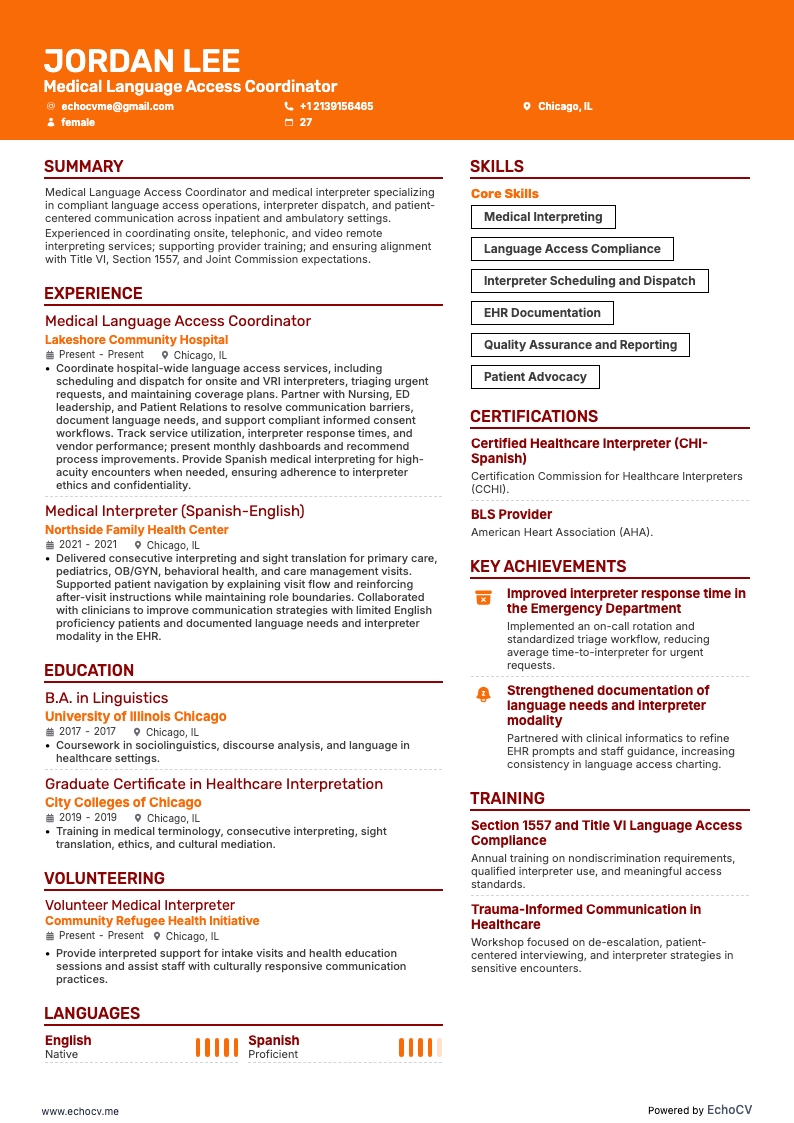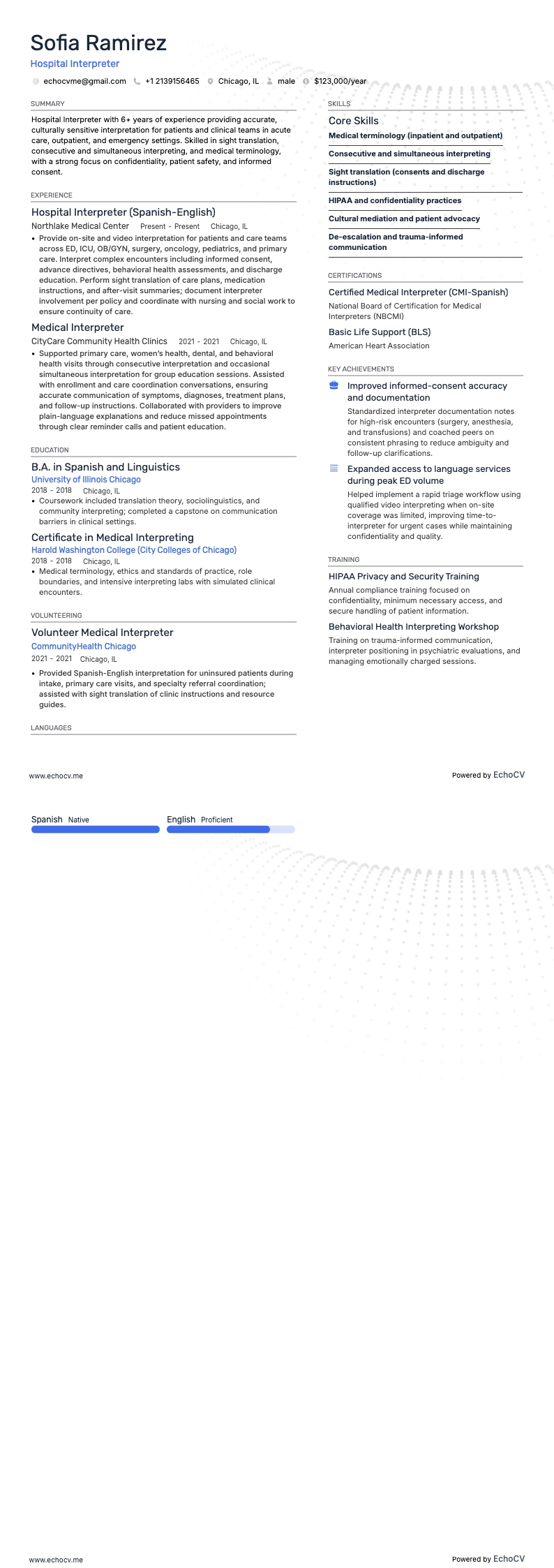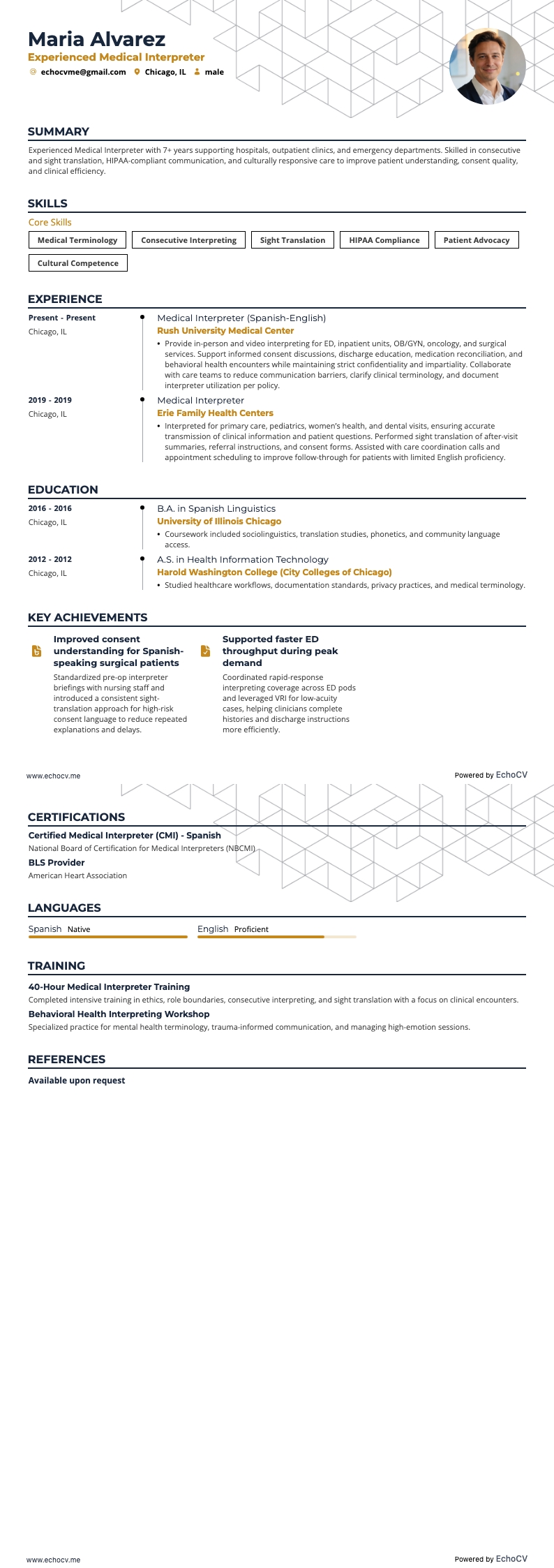
Now that you’ve organized the key resume components, the next step is to write your medical interpreter experience section so it supports each part with clear, role-specific proof.
How to write your medical interpreter resume experience
The experience section of your medical interpreter resume should demonstrate the interpreting work you've delivered, the tools and methodologies you've relied on, and the measurable outcomes you've produced for patients, providers, and healthcare organizations. Hiring managers prioritize demonstrated impact—accurate communication that improved patient outcomes, reduced errors, or streamlined clinical workflows—over descriptive task lists. Building a targeted resume ensures each bullet speaks directly to the role you're pursuing.
Each entry should include:
- Job title
- Company and location (or remote)
- Dates of employment (month and year)
Three to five concise bullet points showing what you owned, how you executed, and what outcomes you delivered:
- Ownership scope: the interpreting assignments, language pairs, clinical departments, patient populations, or care settings you were directly accountable for as a medical interpreter.
- Execution approach: the interpreting modes, terminology management systems, electronic health record platforms, telehealth tools, or standards of practice you used to deliver accurate, culturally competent communication between patients and providers.
- Value improved: changes to patient comprehension, diagnostic accuracy, appointment efficiency, informed-consent compliance, language-access coverage, or risk reduction that resulted from your interpreting work.
- Collaboration context: how you partnered with physicians, nursing staff, social workers, case managers, compliance teams, or community organizations to facilitate seamless multilingual communication across the care continuum.
- Impact delivered: outcomes expressed through patient satisfaction improvements, reductions in miscommunication incidents, expanded language-access capacity, shortened encounter times, or contributions to regulatory compliance—framed as results rather than activities.