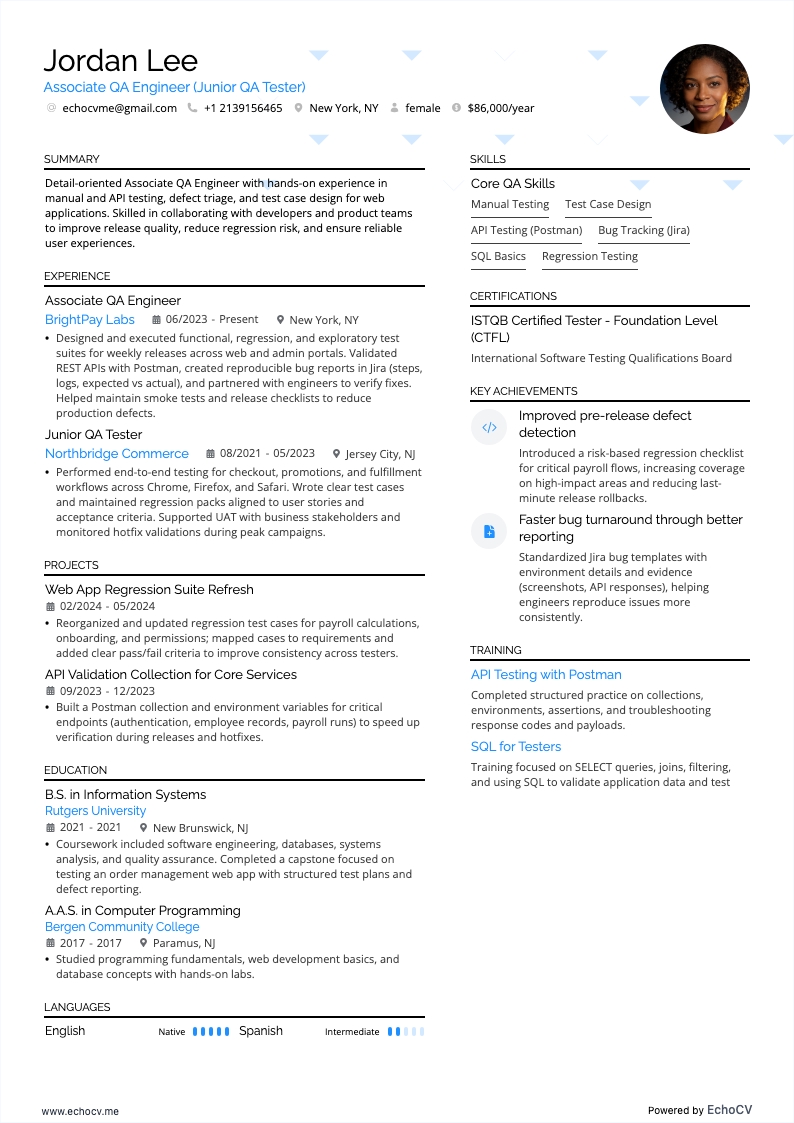
Prévia completa de Engenheiro de QA associado

10 exemplos de currículo para Testador de QA Júnior

EchoCV

Escrito pela equipe EchoCV

Atualizado: 3/5/20248 min read

Veja todos os exemplos de currículo neste guia ou gere seu próprio exemplo com seu prompt personalizado

Engenheiro de QA associado example resume
Engenheiro de QA associado

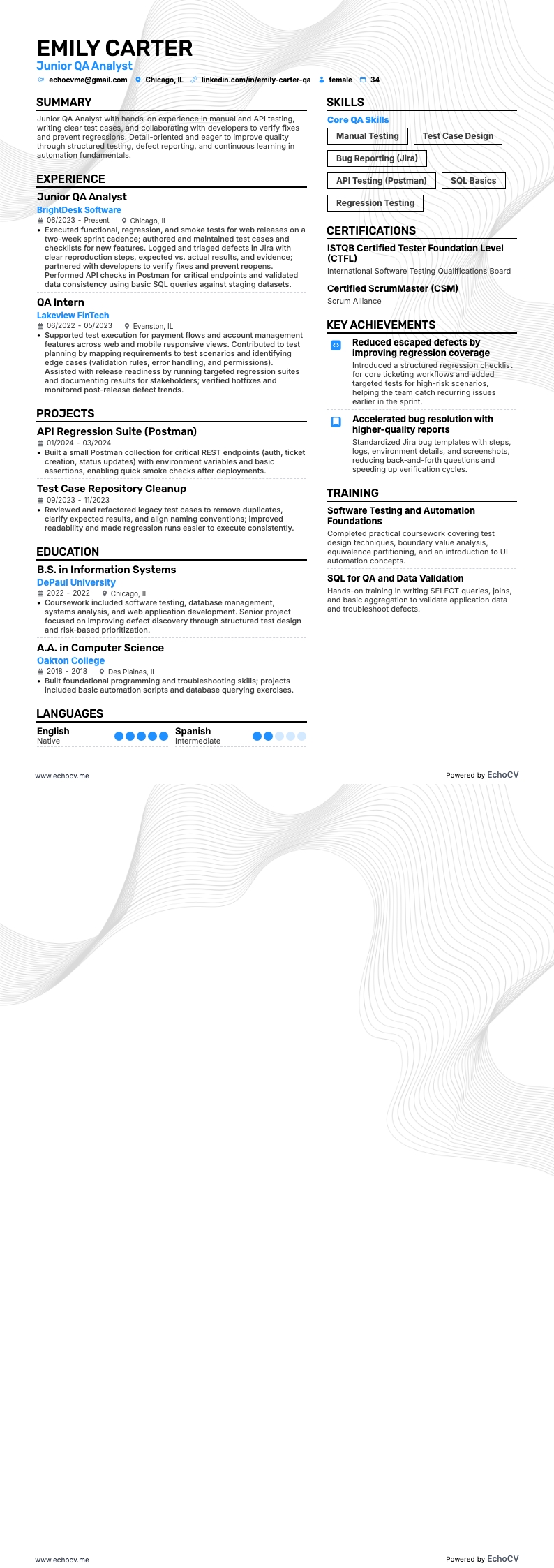
Analista de QA Júnior example resume
Analista de QA Júnior

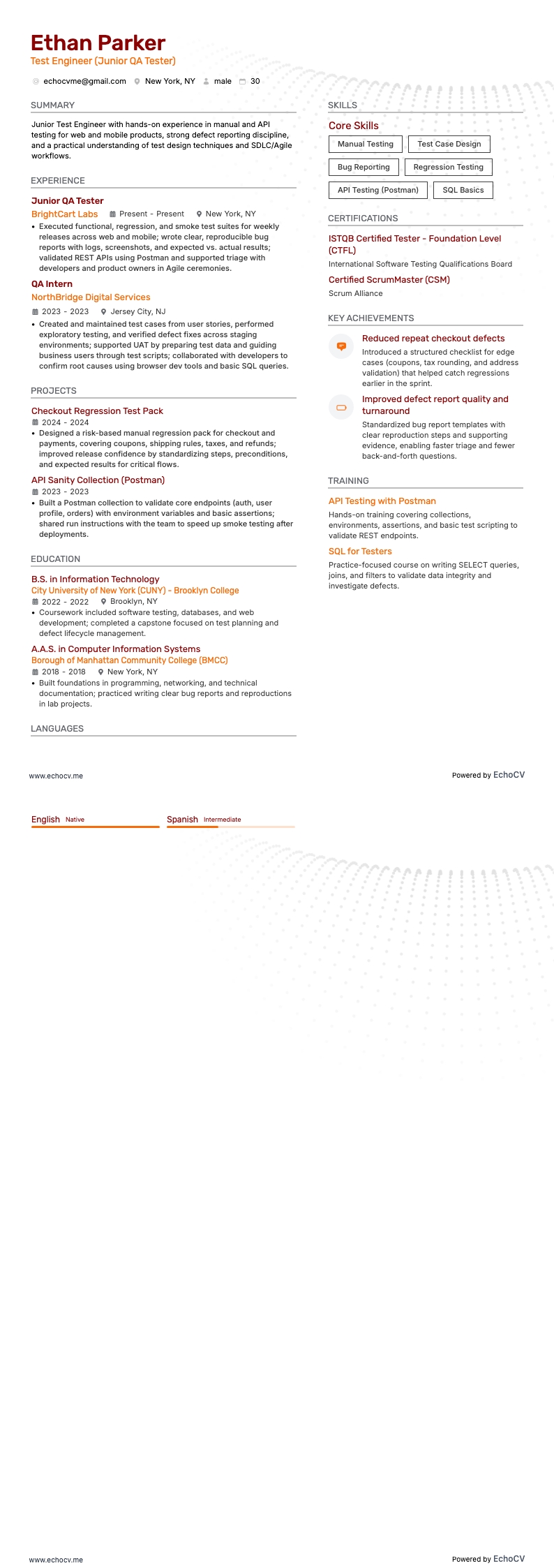
Engenheiro de testes example resume
Engenheiro de testes

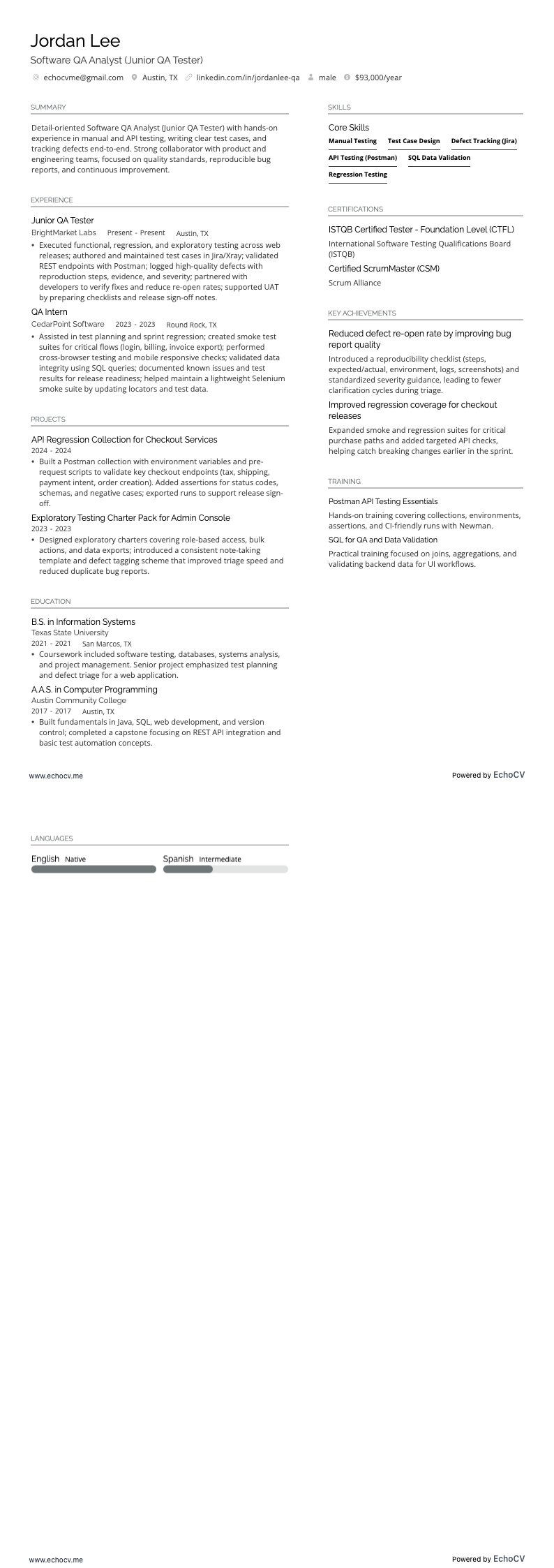
Analista de QA de software example resume

Analista de QA de software

Many junior QA tester resume submissions fail because they list tools and duties but don't show measurable testing impact. That hurts when an ATS (applicant tracking system) filters keywords, recruiters skim fast, and entry-level roles draw heavy competition.

A strong resume shows what changed because of your work. Knowing how to make your resume stand out means you can highlight reduced escaped defects, improved test coverage, faster release cycles, fewer support tickets, clearer bug reports, and stable builds across devices or browsers.

Key takeaways

  • Quantify your testing impact with metrics like defect rates, escape rates, and cycle time reductions.

  • Use a hybrid resume format if you're junior or switching into QA testing.

  • Tailor every experience bullet to match the specific job posting's tools and terminology.

  • Place your skills section above experience when you lack extensive professional QA history.

  • Build a GitHub QA portfolio with test cases and bug reports to replace missing work experience.

  • Earn certifications like ISTQB Foundation Level to validate hands-on testing knowledge for recruiters.

  • Use Echocv's tools to turn everyday QA tasks into measurable, recruiter-ready resume bullets.

How to format a junior QA tester resume

Recruiters hiring for junior QA tester roles prioritize foundational testing knowledge, familiarity with bug-tracking tools, and evidence that you can follow test plans while catching real defects. Choosing the right resume format determines how quickly a hiring manager spots these signals, so the right structure keeps your strongest qualifications visible to both human reviewers and applicant tracking systems.

Resumo

Use a reverse-chronological format to give recruiters a clear, linear view of your growing QA responsibilities and testing contributions. Do:

  • Lead with your most recent QA position and highlight the scope of products, modules, or platforms you tested.
  • List the specific tools and methodologies you've worked with—Jira, Selenium, TestRail, manual regression testing, API validation—directly within each role.
  • Quantify your impact wherever possible, using metrics like defect detection rates, test coverage percentages, or cycle-time reductions.
Example bullet: "Executed 200+ manual and automated test cases per sprint using Selenium and TestRail, increasing defect detection rate by 18% and reducing post-release bugs by 12% over two quarters."

Resumo

A hybrid format works best because it lets you lead with relevant QA skills and tools while still providing a concise work history that shows where you applied them. Do:

  • Place a dedicated skills section near the top of your resume featuring testing methodologies, tools (Jira, Postman, SQL), and any ISTQB or equivalent certifications.
  • Include academic projects, personal testing portfolios, internships, or freelance QA work to demonstrate hands-on experience even without a long professional history.
  • Connect every skill or project to a concrete action and a measurable or observable result so recruiters see real application, not just a keyword list.
Example scaffold: SQL querying skills → wrote and executed database validation queries during a capstone project → identified 15 data-integrity discrepancies before the application reached user acceptance testing.

Resumo

A functional format is rarely the best choice for a junior QA tester, but it can work in a narrow set of circumstances:

  • You're making a career change from a non-technical field and need to reframe transferable skills—like analytical thinking or documentation—as QA-relevant competencies.
  • You have a significant gap in your work history but completed QA coursework, earned a certification such as ISTQB Foundation Level, or built a portfolio of test cases during that time.
Even in these situations, a functional resume can raise concerns because it hides the timeline of your experience and makes it harder for recruiters to verify how and where you applied your skills. Avoid this format entirely if you have any relevant internship, freelance, or project-based QA experience that could anchor a hybrid layout instead.

With your resume's structure and layout established, the next step is filling it with the right sections to showcase your qualifications effectively.

What sections should go on a junior QA tester resume

Recruiters expect you to present your testing skills, tools, and hands-on contributions in a clean, easy-to-scan format. Understanding which resume sections to include helps you organize your qualifications for maximum clarity.

Use this structure:

  • Header
  • Summary
  • Experience
  • Skills
  • Projects
  • Education
  • Certifications
  • Optional sections: Awards, Open-source work, Languages

In your experience bullets, emphasize defects found and prevented, test coverage, tools used, collaboration with developers, and measurable results.

Once you’ve organized your resume with the right sections, the next step is writing your junior QA tester experience so it supports those sections with relevant, easy-to-scan details.

How to write your junior QA tester resume experience

Your experience section should highlight testing work you've shipped, the QA tools and methodologies you've applied, and the measurable outcomes your efforts produced. Hiring managers prioritize demonstrated impact on product quality and release readiness over descriptive task lists. Building a targeted resume ensures every bullet speaks directly to what the role demands.

Each entry should include:

  • Job title
  • Company and location (or remote)
  • Dates of employment (month and year)

Three to five concise bullet points showing what you owned, how you executed, and what outcomes you delivered:

  • Ownership scope: the specific features, modules, test suites, regression cycles, or product areas you were directly accountable for as a junior QA tester.
  • Execution approach: the testing tools, bug-tracking platforms, automation frameworks, or QA methodologies you used to identify defects, validate builds, and inform release decisions.
  • Value improved: the changes you drove in defect detection rates, test coverage, release stability, regression turnaround, or overall product reliability through your testing efforts.
  • Collaboration context: how you partnered with developers, product managers, DevOps engineers, or UX designers to reproduce issues, clarify requirements, and ensure fixes met acceptance criteria.
  • Impact delivered: the outcomes your QA work produced—expressed through improvements in product quality, reduced post-release defects, faster release cycles, or strengthened confidence in deployment readiness rather than a list of tasks performed.

Resumo

Action verb + technology + what you built/fixed + measurable result

A junior QA tester experience example

✅ Right example - modern, quantified, specific.

Junior QA Tester

BrightCart | Austin, TX

2023–2025

E-commerce platform supporting 1M+ monthly active users across web and iOS.

  • Executed manual functional, regression, and exploratory testing in Jira for biweekly releases, reducing production defects by 18% over two quarters.
  • Authored and maintained sixty-plus test cases and end-to-end checklists in TestRail, cutting regression cycle time from two days to one day.
  • Automated twenty smoke tests in Playwright with TypeScript and integrated runs into GitHub Actions, catching an average of five blocking issues per release before deployment.
  • Logged and triaged one hundred-plus bugs with clear reproduction steps, logs, and screenshots using Chrome DevTools and Charles Proxy, improving developer turnaround time by 22%.
  • Collaborated with product managers, designers, and engineers in sprint planning and bug bashes, validating acceptance criteria and lowering reopened defects by 30%.

Now that you've seen how a strong experience section comes together, let's look at how to adjust those details to match the specific job you're applying for.

How to tailor your junior QA tester resume experience

Recruiters evaluate your junior QA tester resume through both applicant tracking systems and manual review. Tailoring your resume to the job description increases your chances of passing both.

Ways to tailor your junior QA tester experience:

  • Match specific testing tools and platforms listed in the job description.
  • Mirror the exact terminology used for QA methodologies or standards.
  • Reflect bug tracking systems referenced like Jira or Bugzilla.
  • Highlight manual or automated testing focus based on the posting.
  • Include relevant domain experience such as e-commerce or healthcare.
  • Emphasize regression or accessibility testing if the role requires it.
  • Align your workflow descriptions with collaboration models they mention.
  • Reference compliance or security testing when the job calls for it.

Tailoring means aligning your real accomplishments with what the role demands, not forcing unrelated keywords into your experience.

Resume tailoring examples for junior QA tester

Resume tailoring examples for junior QA tester

Job description excerptUntailoredTailored

Once you’ve aligned your experience with the role’s testing needs and keywords, the next step is to quantify your junior QA tester achievements so hiring managers can quickly see your impact.

How to quantify your junior QA tester achievements

Quantifying your achievements shows how your testing improved releases, reduced risk, and sped up delivery. Track defects found, escape rate, test coverage, cycle time, and performance regressions using tools like Jira, TestRail, and Selenium.

Quantifying examples for junior QA tester

MetricExample
Defect discovery"Logged 87 high-quality bugs in Jira across three sprints, with 92% accepted without rework after adding clear steps, logs, and screenshots."
Escape rate"Cut production defect escapes from 6 to 2 per release by adding smoke tests for login, checkout, and password reset in TestRail."
Test throughput"Executed 210 manual test cases per sprint and increased daily runs by 25% by batching setups and reusing test data."
Automation coverage"Built 18 Selenium WebDriver regression tests in Java, raising automated coverage of critical flows from 0% to 30% in six weeks."
Performance regression"Flagged three performance regressions before release using JMeter, preventing a 40% API latency increase on the /search endpoint."

Once your bullet points clearly showcase your accomplishments, it's time to highlight the specific hard and soft skills that make you a strong junior QA tester candidate.

How to list your hard and soft skills on a junior QA tester resume

Your skills section shows you can execute test work day-to-day, and recruiters and ATS scan it to confirm you match required tools and workflows; aim for a balanced mix of hard skills like testing tools and soft skills like clear defect communication. junior QA tester roles require a blend of:

  • Product strategy and discovery skills.
  • Data, analytics, and experimentation skills.
  • Delivery, execution, and go-to-market discipline.
  • Soft skills.

Your skills section should be:

  • Scannable (bullet-style grouping).
  • Relevant to the job post.
  • Backed by proof in experience bullets.
  • Updated with current tools.

Place your skills section:

  • Above experience if you're junior or switching careers.
  • Below experience if you're mid/senior with strong achievements.

Hard skills

  • Test case design, execution
  • Manual functional testing
  • Regression testing
  • Smoke, sanity testing
  • Exploratory testing
  • Jira, Azure DevOps
  • TestRail, Zephyr
  • API testing with Postman
  • SQL querying basics
  • Browser DevTools, Charles Proxy
  • Git basics, pull requests
  • CI pipelines (Jenkins)

Soft skills

  • Write clear bug reports
  • Ask precise clarifying questions
  • Triage issues by impact
  • Reproduce defects reliably
  • Communicate risk early
  • Collaborate with developers daily
  • Follow test plans consistently
  • Manage time across tickets
  • Document steps and outcomes
  • Accept feedback and iterate
  • Escalate blockers quickly
  • Own follow-through to closure

How to show your junior QA tester skills in context

Skills shouldn't live only in a dedicated skills list. Explore resume skills examples to see how other candidates weave competencies throughout their applications.

They should be demonstrated in:

  • Your summary (high-level professional identity)
  • Your experience (proof through outcomes)

Here's what that looks like in practice.

Summary example

Detail-oriented QA tester with two years of experience in fintech. Skilled in Selenium, JIRA, and regression testing. Reduced critical post-release defects by 30% through structured test case design and close collaboration with development teams.

  • Specifies a clear experience level
  • Names industry-relevant tools directly
  • Leads with a measurable outcome
  • Highlights cross-team collaboration skills
Experience example

Junior QA Tester

BrightLedger Technologies | Remote

March 2022–January 2024

  • Executed 200+ manual and automated test cases in Selenium, catching 95% of bugs before production releases.
  • Collaborated with four developers to streamline defect triage in JIRA, cutting average resolution time by 20%.
  • Documented regression testing procedures that reduced onboarding time for new QA hires by two weeks.
  • Every bullet includes measurable proof.
  • Tools and collaboration appear naturally.

Once you’ve tied your junior QA tester skills to real examples and outcomes, the next step is learning how to write a junior QA tester resume with no experience so you can present that evidence clearly without relying on prior job titles.

How do I write a junior QA tester resume with no experience

Even without full-time experience, you can demonstrate readiness through test artifacts and personal projects. Our guide on writing a resume without work experience covers additional strategies for showcasing your potential.

  • Personal QA portfolio test cases
  • Bug reports from practice apps
  • Test plans for sample features
  • API tests in Postman collections
  • SQL queries validating test data
  • GitHub repo with test artifacts
  • ISTQB Foundation prep coursework
  • Freelance website testing gigs

Focus on:

  • Clear test cases and steps
  • Reproducible bug reports with evidence
  • Tooling: Jira, Postman, SQL
  • Metrics: coverage, defect rates

Resumo

Use a skills-based resume format because it highlights test artifacts, tools, and projects when your work history is limited. Do:

  • Lead with a QA projects section.
  • Add a tools list: Jira, Postman, SQL.
  • Include two to four quantified project bullets.
  • Attach links to a GitHub QA portfolio.
  • Mirror keywords from the job post.
Example project bullet:
  • Built a GitHub QA portfolio with thirty test cases and twelve Jira bug reports for a sample ecommerce app, cutting duplicate defects by twenty percent through retest tracking.

Since your education can serve as one of the strongest sections on your resume when you lack professional experience, let's look at how to present it effectively.

How to list your education on a junior QA tester resume

Your education section helps hiring teams confirm you have foundational knowledge in testing concepts, logic, and software systems relevant to the junior QA tester role.

Include:

  • Degree name
  • Institution
  • Location
  • Graduation year
  • Relevant coursework (for juniors or entry-level candidates)
  • Honors & GPA (if 3.5 or higher)

Skip month and day details—list the graduation year only.

Here's a strong education entry tailored to a junior QA tester:

Example education entry

Bachelor of Science in Computer Science

University of Central Florida, Orlando, FL

Graduated 2024

GPA: 3.7/4.0

  • Relevant coursework: Software Testing & Verification, Database Systems, Introduction to Automation, and Agile Development Methodologies
  • Honors: Dean's List (six consecutive semesters), Magna Cum Laude

How to list your certifications on a junior QA tester resume

Certifications on your resume show a junior QA tester's commitment to learning, tool proficiency, and industry relevance. They also signal readiness to follow standards, use modern testing practices, and grow quickly in a QA role. Include:

  • Certificate name
  • Issuing organization
  • Year
  • Optional: credential ID or URL

  • Place certifications below education when your degree is recent and your certifications are older or less relevant to junior QA tester roles.
  • Place certifications above education when you earned them recently or they directly match the tools and methods in junior QA tester job postings.

Best certifications for your junior QA tester resume

  • ISTQB Certified Tester Foundation Level (CTFL) Certified Associate in Software Testing (CAST) ICAgile Certified Professional—Agile Testing (ICP-TST) Certified ScrumMaster (CSM) Microsoft Certified: Azure Fundamentals (AZ-900) Postman Student Expert Google Cloud Digital Leader

Once you’ve positioned your credentials where hiring managers can spot them quickly, move on to your junior QA tester resume summary to tie those qualifications to the value you’ll bring in the role.

How to write your junior QA tester resume summary

Your resume summary is the first thing a recruiter reads. A strong one immediately signals you have the right skills and potential for the junior QA tester role.

Keep it to three to four lines, with:

  • Your title and relevant years of experience in QA or testing.
  • The domain or product type you've worked with, such as web apps or mobile.
  • Core tools and skills like Selenium, JIRA, SQL, or manual testing methodologies.
  • One or two quantified achievements, such as bugs caught or test cases written.
  • Soft skills tied to real outcomes, like attention to detail that reduced post-release defects.

DICA PRO

At the junior level, emphasize specific tools you've used and measurable contributions from internships, coursework, or early roles. Avoid vague phrases like "passionate learner" or "team player." Replace them with concrete examples of what you did and the result it produced.

Example summary for a junior QA tester

Junior QA tester with one year of experience testing web applications using Selenium and JIRA. Wrote 200+ manual test cases and identified 40 critical bugs before production release.

Now that your summary is ready to showcase your QA skills and career goals, make sure the header above it presents your contact details correctly so recruiters can actually reach you.

What to include in a junior QA tester resume header

A resume header is the top section with your key details, and it boosts visibility, credibility, and recruiter screening for a junior QA tester.

Essential resume header elements

  • Full name
  • Tailored job title and headline
  • Location
  • Phone number
  • Professional email
  • GitHub link
  • Portfolio link
  • LinkedIn

A LinkedIn link helps recruiters verify experience quickly and supports screening.

Don't include a photo on a junior QA tester resume unless the role is explicitly front-facing or appearance-dependent.

Match your header title and headline to the job posting, and keep your contact details consistent across every profile.

Example

Junior QA tester resume header
Jordan Lee

Junior QA Tester | Manual testing, test cases, Jira

Austin, TX

(512) 555-12XX

[email protected]

github.com/yourname

yourwebsite.com

linkedin.com/in/yourname

Once your contact details and role focus are clear at the top, add targeted additional sections to reinforce your fit and provide relevant context.

Additional sections for junior QA tester resumes

When your work experience is limited, additional sections help you stand out by showcasing relevant skills and genuine interest in quality assurance. For example, listing language skills on your resume can be especially valuable if the company operates internationally or serves multilingual users.

  • Certifications (e.g., ISTQB Foundation Level)
  • Technical projects and personal testing portfolios
  • Languages
  • Relevant coursework in software testing or development
  • Hobbies and interests related to technology or problem-solving
  • Volunteer experience involving technical or analytical work
  • Publications or blog posts on QA methodologies

Beyond strengthening your resume with relevant extra sections, pairing it with a well-crafted cover letter can further set your application apart.

Do junior QA tester resumes need a cover letter

A cover letter isn't required for a junior QA tester, but it helps in competitive roles or when the employer expects one. If you're unsure where to start, learning what a cover letter is and how it complements your resume can clarify when it's worth including one. It can make a difference when your resume needs context, or when you want to show clear fit for the team.

Use these tips to decide when to include one and what to say:

  • Explain role or team fit: Match your testing approach to their stack, process, and collaboration style, and name the role you're targeting.
  • Highlight one or two relevant projects or outcomes: Call out a bug you found, a test suite you improved, or a workflow you streamlined, with a clear result.
  • Show understanding of the product, users, or business context: Mention a feature, user journey, or risk area you'd focus on, and why it matters.
  • Address career transitions or non-obvious experience: Connect past work to testing skills like documentation, triage, or customer impact, and explain the shift briefly.

Even if you decide to include a cover letter to add context and show fit, you can use AI to improve your junior QA tester resume so it communicates your value clearly and consistently.

Using AI to improve your junior QA tester resume

AI can sharpen your resume's clarity, structure, and impact. It helps you refine language and highlight relevant skills. But overuse strips authenticity. If you're curious about which AI is best for writing resumes, start with tools that let you stay in control of your content. Once your content is clear and role-aligned, step away from AI.

Here are 10 practical prompts to strengthen specific sections of your junior QA tester resume:

Resumo

Rewrite my resume summary to clearly position me as a junior QA tester with hands-on testing experience and strong attention to detail.

Resumo

Add measurable outcomes to my junior QA tester experience bullets, focusing on bugs found, test cases executed, or defects reported.

Resumo

Review my skills section and remove anything irrelevant to a junior QA tester role. Prioritize manual testing and bug tracking tools.

Resumo

Rewrite my project descriptions to highlight specific junior QA tester contributions, including testing methods used and results achieved.

Resumo

Refine my education section to emphasize coursework and academic projects directly relevant to a junior QA tester position.

Resumo

Rewrite my certifications section to explain how each credential supports my qualifications as a junior QA tester.

Resumo

Identify and replace vague phrases in my junior QA tester resume with specific, concrete descriptions of tasks and results.

Resumo

Replace weak or repetitive verbs in my junior QA tester experience section with strong, precise action verbs.

Resumo

Restructure each experience bullet on my junior QA tester resume to follow a clear action-task-result format.

Resumo

Review my full junior QA tester resume and flag any content that doesn't directly support this specific role.

Conclusion

A strong junior QA tester resume highlights measurable outcomes, role-specific skills, and a clear structure. Use numbers to show defect impact, test coverage, and cycle time improvements. Keep sections consistent, and make your work easy to scan.

This approach shows you can support reliable releases and collaborate with developers and product teams. It also signals you’re ready for today’s hiring market and the next hiring cycle. Stay precise, focused, and confident.

Exemplos de currículo de Testador de QA Júnior

Explore mais exemplos e guias de currículo de Testador de QA Júnior e veja o que funciona para seu nível de experiência ou função.

Por experiência

Engenheiro de QA associado

Prévia do currículo Engenheiro de QA associado

Analista de QA Júnior

Prévia do currículo Analista de QA Júnior

Exemplos de currículo de Testador de QA Júnior

Explore mais exemplos e guias de currículo de Testador de QA Júnior e veja o que funciona para seu nível de experiência ou função.

Por função

Engenheiro de testes

Prévia do currículo Engenheiro de testes

Analista de QA de software

Prévia do currículo Analista de QA de software