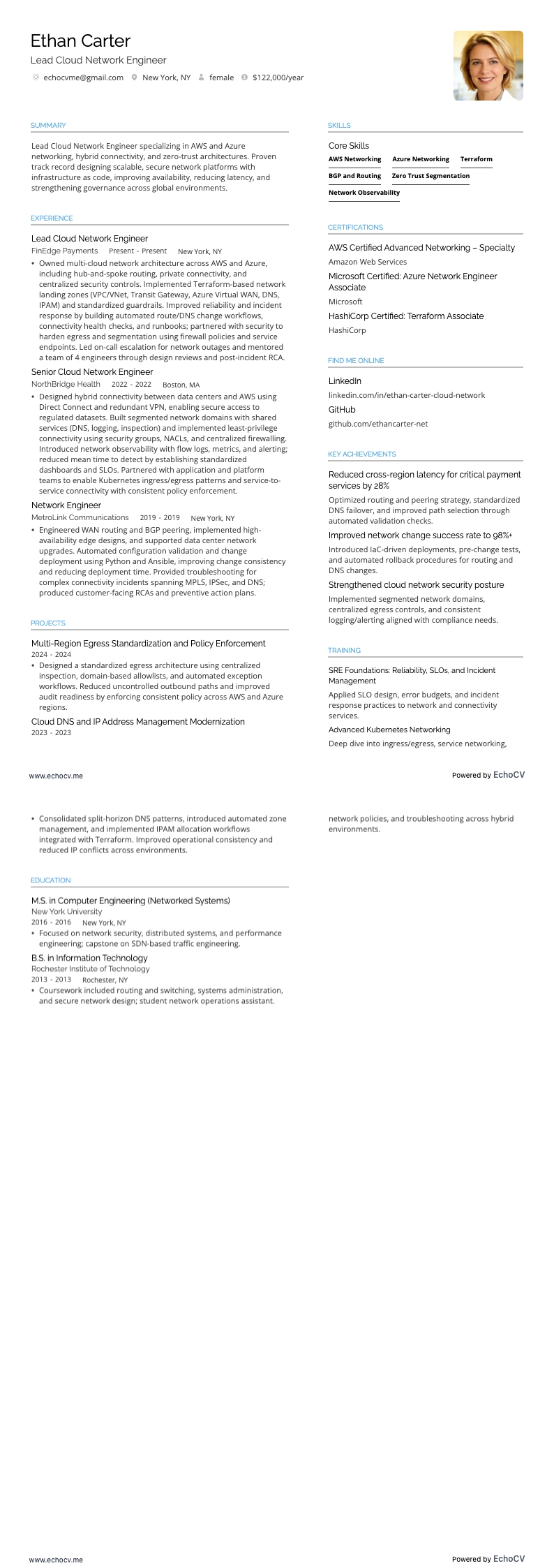
Lead Cloud Network Engineer full preview

10 Cloud Network Engineer Resume Examples

EchoCV

Written by The Echocv Team

Updated: 8/7/20248 min read

See all resume examples in this guide, or generate your own resume example with your personalized prompt

Lead Cloud Network Engineer example resume
Lead Cloud Network Engineer

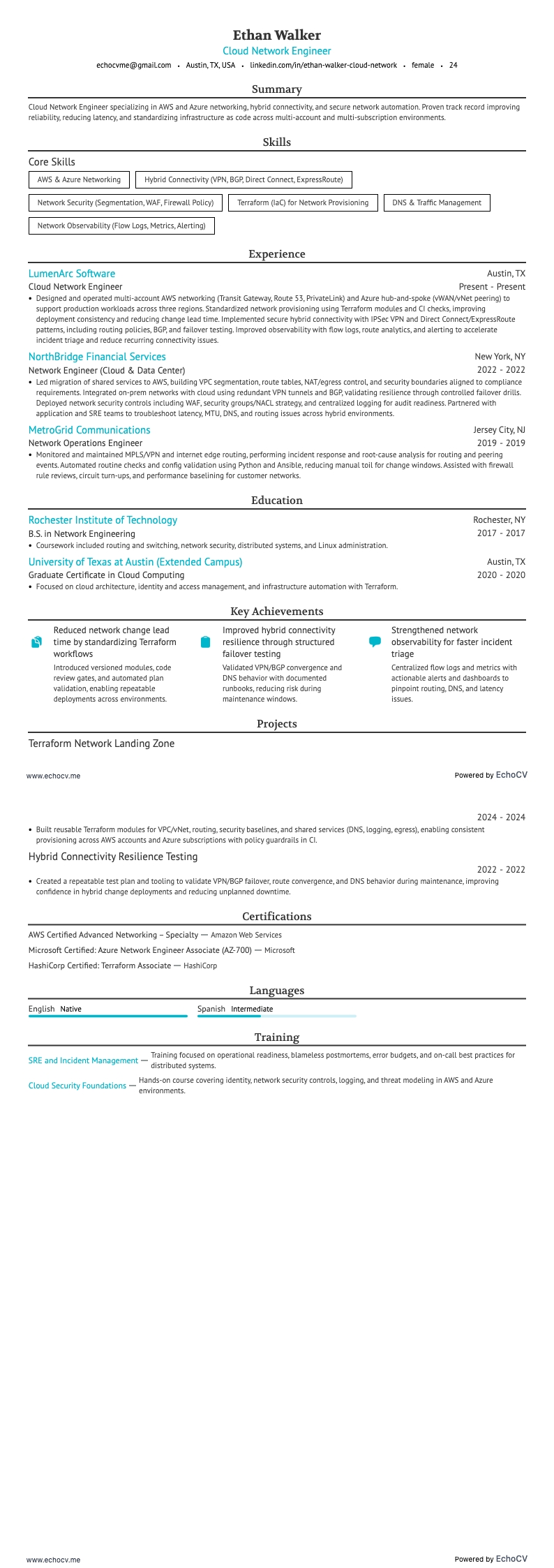
Cloud Network Engineer example resume
Cloud Network Engineer

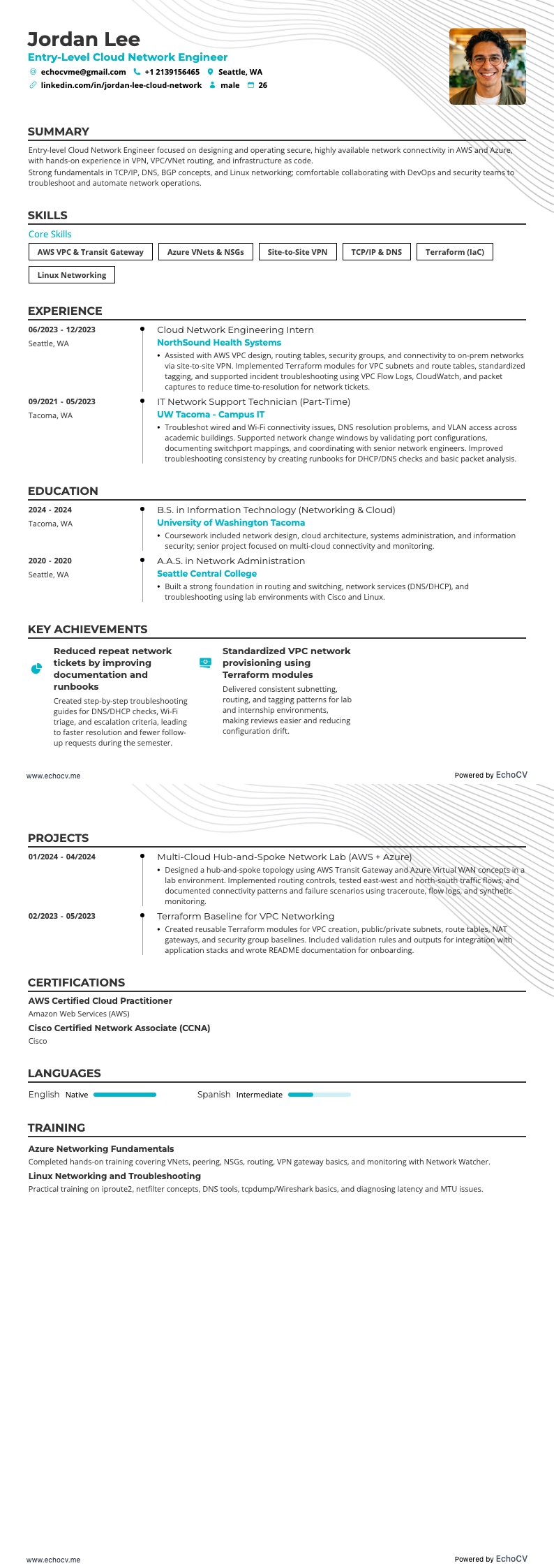
Entry-Level Cloud Network Engineer example resume
Entry-Level Cloud Network Engineer

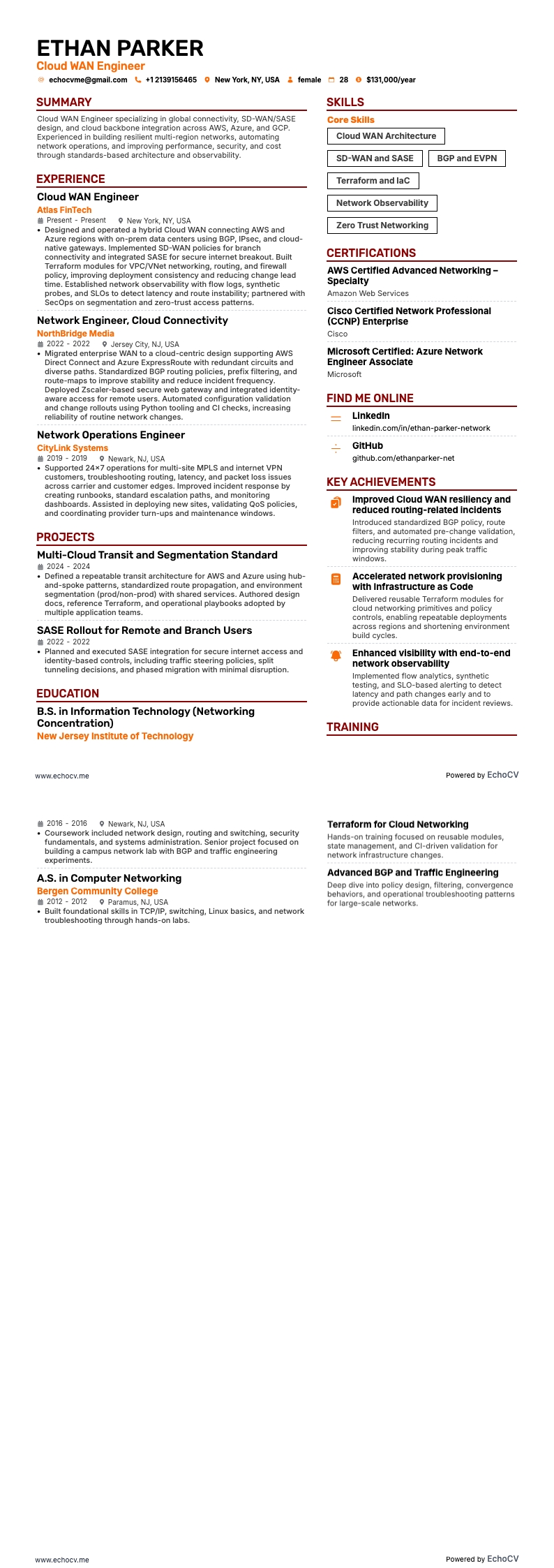
Cloud WAN Engineer example resume
Cloud WAN Engineer

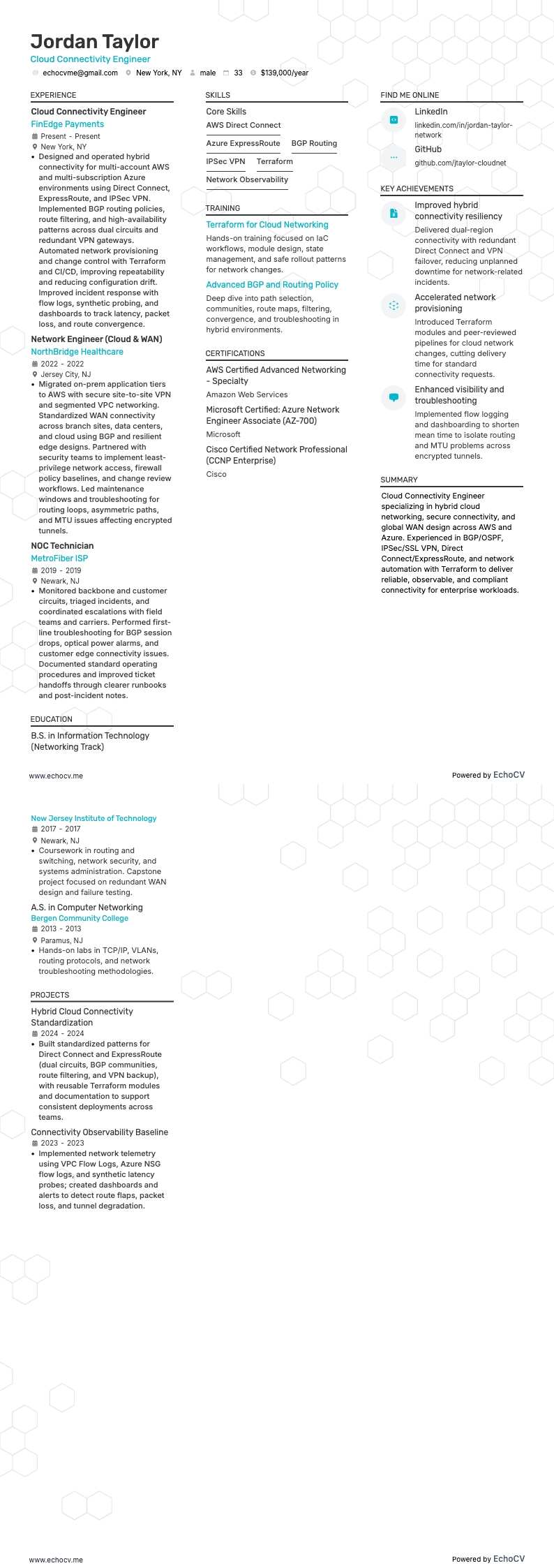
Cloud Connectivity Engineer example resume

Cloud Connectivity Engineer

Many cloud network engineer resume drafts fail because they list tools and duties but don't show network outcomes. That makes you easy to reject in ATS screening and rapid recruiter scans, especially when competition is high.

A strong resume shows what changed because of your work, not what you touched. Knowing how to make your resume stand out means you should quantify latency reduction, uptime gains, cost savings, and multi-region rollout scope, plus incident time-to-recovery, security posture improvements, and delivery speed.

Key takeaways

  • Quantify network outcomes like latency, uptime, and cost savings in every experience bullet.

  • Tailor resume keywords to match each job posting's platforms, tools, and protocols.

  • Use reverse-chronological format if experienced and hybrid format if switching careers.

  • Tie every listed skill to a specific action and measurable result.

  • Place certifications above education when they're required or highly relevant to the role.

  • Write a three- to four-line summary with your title, tools, and one quantified achievement.

  • Use Echocv to turn routine cloud networking tasks into measurable, recruiter-ready bullet points.

How to format a cloud network engineer resume

Recruiters evaluating cloud network engineer candidates prioritize hands-on experience with cloud platforms, network architecture design, and infrastructure automation—along with clear evidence of troubleshooting ability and security awareness. The right resume format ensures these technical signals surface quickly during both automated applicant tracking system (ATS) scans and the recruiter's initial review.

Summary

Use a reverse-chronological format to present your cloud networking expertise in a clear, progression-driven timeline. Do:

  • Lead each role entry with your scope of ownership—number of environments managed, cloud platforms supported (AWS, Azure, GCP), and the scale of networks you architected or maintained.
  • Highlight role-specific tools and domains such as VPC design, SD-WAN, Terraform, BGP/OSPF routing, firewall policy management, and cloud-native monitoring stacks like CloudWatch or Azure Network Watcher.
  • Quantify outcomes tied to reliability, cost, or performance—downtime reduction, latency improvements, migration completions, or cost savings from network optimization.
Example bullet: "Redesigned multi-region AWS VPC architecture across 12 production accounts, reducing inter-region latency by 34% and cutting monthly data transfer costs by $18,000."

Summary

A hybrid format works best, letting you lead with a focused skills section while still demonstrating hands-on experience through projects or prior roles. Do:

  • Place core cloud networking skills—such as TCP/IP, DNS, subnetting, VPN configuration, and IaC tools—in a prominent skills section near the top of your resume.
  • Include lab projects, cloud certifications (AWS Solutions Architect, Azure Network Engineer Associate), home lab environments, or transitional roles where you performed network troubleshooting or cloud provisioning tasks.
  • Connect every listed skill to a specific action and a measurable or observable result so recruiters can evaluate practical application.
Example scaffold: Terraform (skill) → automated deployment of VPC peering connections across three AWS regions (action) → reduced provisioning time from two days to 15 minutes per environment (result).

Summary

A functional format strips away the timeline and context that recruiters need to verify where and how you applied your cloud networking skills, making it harder to assess your real capability and easier for ATS software to misparse your experience.

  • Edge-case exception: A functional format may be acceptable if you're transitioning from a traditional network engineering role with no prior cloud titles, have a significant resume gap, or built your cloud networking skills entirely through certifications and personal lab projects—but even then, tie every listed skill to a specific project or outcome to maintain credibility.

Now that you've established a clean, readable structure, it's time to fill each part of your resume with the right content.

What sections should go on a cloud network engineer resume

Recruiters expect to see clear proof that you can design, secure, and operate cloud networking at scale. Understanding what to put on a resume helps you prioritize the right content for this role.

Use this structure for maximum clarity:

  • Header
  • Summary
  • Experience
  • Skills
  • Projects
  • Education
  • Certifications
  • Optional sections: Awards, open-source work, and leadership

Strong experience bullets should emphasize measurable impact, reliability and security outcomes, environment scope, and results you delivered across cloud network architecture and operations.

Once you’ve organized the key resume components, the next step is learning how to write your cloud network engineer resume experience so each section proves your impact.

How to write your cloud network engineer resume experience

Your work experience section should highlight cloud networking projects you've shipped, infrastructure you've built or optimized, and the measurable outcomes those efforts produced—think uptime improvements, latency reductions, or cost savings tied to specific platforms and protocols. Hiring managers prioritize demonstrated impact over descriptive task lists, so every bullet should prove you've delivered real results in cloud network environments.

Each entry should include:

  • Job title
  • Company and location (or remote)
  • Dates of employment (month and year)

Three to five concise bullet points showing what you owned, how you executed, and what outcomes you delivered:

  • Ownership scope: the cloud network architectures, virtual private clouds, multi-cloud or hybrid environments, routing domains, or infrastructure segments you were directly accountable for designing, deploying, or maintaining.
  • Execution approach: the platforms, services, and tools you used to deliver work—such as AWS, Azure, or GCP networking services, infrastructure-as-code frameworks, SD-WAN solutions, firewall policies, or network monitoring and observability stacks.
  • Value improved: the specific improvements you drove in network performance, availability, security posture, latency, throughput, disaster recovery readiness, or cloud infrastructure cost efficiency.
  • Collaboration context: how you partnered with security teams, DevOps engineers, site reliability engineers, architects, vendors, or compliance stakeholders to align network designs with broader organizational requirements.
  • Impact delivered: the tangible outcomes your work produced, expressed through business results, operational scale, or risk reduction rather than a list of daily responsibilities.

Summary

Action verb + technology + what you built/fixed + measurable result

A cloud network engineer experience example

✅ Right example - modern, quantified, specific.

Cloud Network Engineer

NorthBridge FinTech | Remote

2022–Present

Supported a multi-region payments platform serving five million users with strict uptime and compliance requirements.

  • Designed and deployed a dual-stack AWS network architecture using Amazon Virtual Private Cloud (VPC), Transit Gateway, and IPv6, cutting cross-region latency twenty-two percent and improving failover recovery time from twelve minutes to three minutes.
  • Automated network provisioning with Terraform and GitHub Actions, standardizing one hundred twenty-plus subnets, route tables, and security groups and reducing environment build time from two days to forty minutes.
  • Implemented zero-trust segmentation with AWS Network Firewall, security group policies, and Amazon Route 53 Resolver DNS Firewall, reducing high-severity findings thirty-five percent in partnership with security and compliance teams.
  • Optimized hybrid connectivity by tuning AWS Direct Connect and Border Gateway Protocol (BGP) routing, increasing throughput twenty-eight percent and eliminating recurring packet loss for three data center-to-cloud paths.
  • Built end-to-end observability with Amazon CloudWatch, VPC Flow Logs, and Grafana dashboards, cutting mean time to detect network incidents forty percent and aligning alert thresholds with site reliability engineers and application owners.

Now that you've seen how a strong experience section comes together, let's look at how to adjust yours to match the specific job you're targeting.

How to tailor your cloud network engineer resume experience

Recruiters evaluate your cloud network engineer resume through both applicant tracking systems and manual review. Tailoring your resume to the job description ensures your qualifications stand out in both screening rounds.

Ways to tailor your cloud network engineer experience:

  • Match cloud platforms like AWS Azure or GCP listed in the posting.
  • Mirror the exact networking protocols or standards the employer specifies.
  • Use the same terminology for infrastructure as code tools referenced.
  • Reflect specific network security or compliance frameworks the role requires.
  • Highlight experience with the monitoring or observability tools they name.
  • Align your metrics with the performance or uptime KPIs they prioritize.
  • Include relevant industry experience when the posting specifies a domain.
  • Reference the collaboration models or deployment workflows they describe.

Tailoring means aligning your real accomplishments with what the employer asks for, not forcing disconnected keywords into your experience bullets.

Resume tailoring examples for cloud network engineer

Job description excerptUntailoredTailored
Design and implement scalable VPC architectures across AWS multi-account environments using Transit Gateway and AWS CloudFormationHelped set up cloud networking infrastructure for the teamDesigned and deployed VPC architectures across 12 AWS accounts, leveraging Transit Gateway and CloudFormation templates to reduce inter-VPC latency by 35%
Monitor and troubleshoot hybrid cloud connectivity (AWS Direct Connect, Azure ExpressRoute) ensuring 99.99% uptime SLAsMonitored network connections and fixed issues when they came upMaintained 99.99% uptime across hybrid cloud links by troubleshooting AWS Direct Connect and Azure ExpressRoute circuits serving 3 data centers and 2 cloud regions
Automate network provisioning and firewall rule management using Terraform and Python across multi-cloud deployments (AWS, GCP)Wrote scripts to automate some network tasksAutomated provisioning of firewall rules and network resources across AWS and GCP using Terraform modules and Python, cutting manual configuration time by 60% for 200+ security policies

Once your experience aligns with the role’s priorities, the next step is to quantify your cloud network engineer achievements so hiring teams can quickly gauge your impact.

How to quantify your cloud network engineer achievements

Quantifying your achievements proves network impact beyond "kept things running." Focus on latency, availability, packet loss, cost, security risk reduction, and delivery speed across regions, virtual private clouds, and connectivity paths.

Quantifying examples for cloud network engineer

MetricExample
Latency"Reduced inter-region application latency from 85 ms to 42 ms by tuning AWS Transit Gateway routing and enabling ECMP across two Direct Connect links."
Availability"Improved network availability from 99.90% to 99.99% by deploying dual-hub design with Azure Virtual WAN and active-active VPN gateways."
Cost savings"Cut monthly egress costs by 18% ($14K) by re-architecting Cloudflare and AWS CloudFront paths and enforcing S3 prefix-based caching rules."
Security risk"Cut critical firewall policy violations by 70% by standardizing Palo Alto Panorama templates and adding Terraform policy checks in the CI pipeline."
Delivery speed"Reduced change lead time from eight days to two days by automating VPC, subnets, and route tables with Terraform and GitHub Actions."

Once you've crafted strong bullet points for your experience section, you'll want to apply that same precision to presenting your hard and soft skills effectively.

How to list your hard and soft skills on a cloud network engineer resume

Your skills section shows you can design, secure, and operate cloud connectivity at scale, and recruiters and an ATS (applicant tracking system) scan this section for keyword match and seniority signals—aim for a hard skills-heavy mix with targeted, role-specific soft skills. cloud network engineer roles require a blend of:

  • Product strategy and discovery skills.
  • Data, analytics, and experimentation skills.
  • Delivery, execution, and go-to-market discipline.
  • Soft skills.

Your skills section should be:

  • Scannable (bullet-style grouping).
  • Relevant to the job post.
  • Backed by proof in experience bullets.
  • Updated with current tools.

Place your skills section:

  • Above experience if you're junior or switching careers.
  • Below experience if you're mid/senior with strong achievements.

Hard skills

  • Amazon Web Services VPC, Transit Gateway
  • Microsoft Azure Virtual Network, ExpressRoute
  • Google Cloud Virtual Private Cloud, Cloud Router
  • Border Gateway Protocol, Open Shortest Path First
  • IPsec, site-to-site VPNs
  • Cloud load balancing, traffic management
  • Network security groups, cloud firewalls
  • Domain Name System, Transport Layer Security
  • Infrastructure as code: Terraform
  • Configuration management: Ansible
  • Network monitoring: Datadog, Prometheus
  • Packet capture: tcpdump, Wireshark

Soft skills

  • Translate app needs into network designs
  • Write clear runbooks and diagrams
  • Lead incident response and retrospectives
  • Triage issues with structured hypotheses
  • Partner with security on risk tradeoffs
  • Coordinate changes with minimal downtime
  • Communicate impact to nontechnical teams
  • Document decisions and assumptions
  • Prioritize work by customer impact
  • Own outcomes across teams and vendors
  • Review designs with constructive feedback
  • Escalate early with options and data

How to show your cloud network engineer skills in context

Skills shouldn't live only in a dedicated skills list. You can explore common resume skills to ensure you're not missing key competencies for cloud network engineer roles.

They should be demonstrated in:

  • Your summary (high-level professional identity)
  • Your experience (proof through outcomes)

Here's how that looks in practice.

Summary example

Senior cloud network engineer with 10 years designing multi-region AWS and Azure architectures for fintech platforms. Skilled in Terraform, BGP, and zero-trust frameworks. Reduced network downtime by 62% through automated failover orchestration and cross-team infrastructure planning.

  • Signals senior-level depth immediately
  • Names specific tools and protocols
  • Leads with a measurable outcome
  • Highlights cross-team collaboration
Experience example

Senior Cloud Network Engineer

Veridian Systems | Remote

March 2020–Present

  • Architected a multi-VPC transit gateway topology on AWS, cutting inter-region latency by 38% and saving $140K annually in data transfer costs.
  • Partnered with DevOps and security teams to deploy Palo Alto virtual firewalls across hybrid environments, achieving 99.99% uptime over 18 months.
  • Automated network provisioning workflows using Terraform and Ansible, reducing deployment time from five days to under four hours per environment.
  • Every bullet includes measurable proof.
  • Skills surface naturally through accomplishments.

Once you’ve tied your cloud networking abilities to real outcomes through projects and examples, the next step is applying that same approach to a cloud network engineer resume when you don’t have formal experience.

How do I write a cloud network engineer resume with no experience

Even without full-time experience, you can demonstrate readiness through projects and self-directed learning. If you're writing a resume without work experience, focus on these areas:

  • Home lab cloud network build
  • AWS or Azure networking projects
  • Infrastructure as code repositories
  • Network automation scripts and playbooks
  • Packet capture and troubleshooting labs
  • Security group and firewall rule design
  • Certification labs and capstones
  • Open-source networking contributions

Focus on:

  • Cloud VPC and subnet design
  • Routing, VPN, and peering
  • Infrastructure as code evidence
  • Monitoring, logs, and troubleshooting

Summary

Use a hybrid resume format because it highlights projects and skills first, while still showing education and any related work history. Do:

  • Lead with a projects section.
  • List tools beside each project.
  • Link to code repositories.
  • Quantify outcomes and scope.
  • Match keywords to the job post.
Example project bullet:
  • Built an AWS VPC with public and private subnets, NAT gateway, and site-to-site VPN in Terraform, cutting manual setup time by 70%.

Once you've structured your resume around transferable skills and relevant projects, presenting your education effectively becomes the next key step in reinforcing your qualifications.

How to list your education on a cloud network engineer resume

Your education section helps hiring teams confirm you have the foundational knowledge in networking, systems, and cloud technologies that a cloud network engineer role demands.

Include:

  • Degree name
  • Institution
  • Location
  • Graduation year
  • Relevant coursework (for juniors or entry-level candidates)
  • Honors & GPA (if 3.5 or higher)

Skip month and day details—list the graduation year only.

Here's a strong education entry tailored to the cloud network engineer role.

Example education entry

Bachelor of Science in Computer Networking

George Mason University, Fairfax, VA

Graduated 2021

GPA: 3.7/4.0

  • Relevant Coursework: Cloud Infrastructure, Network Security, TCP/IP Protocols, Virtualization Technologies, Distributed Systems
  • Honors: Magna Cum Laude, Dean's List (six semesters)

How to list your certifications on a cloud network engineer resume

Certifications on your resume show your commitment to learning, prove tool proficiency, and confirm industry relevance as a cloud network engineer. They also help recruiters quickly validate your skills for cloud networking roles.

Include:

  • Certificate name
  • Issuing organization
  • Year
  • Optional: credential ID or URL

  • Place certifications below education when your degree is recent and your certifications add supportive, secondary value.
  • Place certifications above education when they are recent, highly relevant, or required for the cloud network engineer role.

Best certifications for your cloud network engineer resume

  • AWS Certified Advanced Networking - Specialty
  • Cisco Certified Network Professional (CCNP) Enterprise
  • Microsoft Certified: Azure Network Engineer Associate
  • Google Cloud Professional Cloud Network Engineer
  • Cisco Certified Internetwork Expert (CCIE) Enterprise Infrastructure
  • HashiCorp Certified: Terraform Associate

Once you’ve highlighted the credentials that validate your cloud networking expertise, shift to crafting your cloud network engineer resume summary to quickly connect those qualifications to the role you’re targeting.

How to write your cloud network engineer resume summary

Your resume summary is the first thing a recruiter reads. A strong one instantly signals you have the right skills and experience for a cloud network engineer role.

Keep it to three to four lines, with:

  • Your title and relevant years of hands-on experience.
  • The domain or industry you've worked in, such as SaaS, fintech, or enterprise infrastructure.
  • Core tools and technologies like AWS VPC, Azure networking, Terraform, or BGP/OSPF.
  • One or two quantified achievements that show real impact.
  • Soft skills tied to outcomes, such as cross-team collaboration that reduced deployment time.

PRO TIP

At this level, focus on specific tools, certifications, and measurable contributions from recent roles. Highlight your ability to troubleshoot, automate, and support production environments. Avoid vague phrases like "passionate team player" or "motivated self-starter." Replace them with concrete results.

Example summary for a cloud network engineer

Cloud network engineer with three years of experience managing AWS and Azure network infrastructure. Reduced latency across multi-region VPCs by 30% using Terraform automation. Skilled in BGP, DNS, and firewall configuration within SaaS environments.

Now that your summary captures your strongest qualifications, make sure recruiters can actually reach you by setting up a clear, complete header.

What to include in a cloud network engineer resume header

A resume header is the top section with your key identifiers, and it boosts visibility, credibility, and recruiter screening for a cloud network engineer.

Essential resume header elements

  • Full name
  • Tailored job title and headline
  • Location
  • Phone number
  • Professional email
  • GitHub link
  • Portfolio link
  • LinkedIn

A LinkedIn link helps recruiters verify your experience quickly and supports screening.

Don't include photos on a cloud network engineer resume unless the role is explicitly front-facing or appearance-dependent.

Align your header job title with the posting and add a focused headline that matches the cloud network engineer role you want.

Example

Cloud network engineer resume header
Jordan Rivera

Cloud network engineer | AWS VPC, hybrid connectivity, and network automation

Austin, TX

(512) 555-01XX

[email protected]

github.com/jordanrivera

yourwebsite.com

linkedin.com/in/jordanrivera

Once your contact details and key identifiers are set at the top of your resume, add the additional sections that support and reinforce the rest of your cloud network engineer application.

Additional sections for cloud network engineer resumes

When your core qualifications match other applicants, well-chosen additional sections can set your cloud network engineer resume apart. For example, listing language skills on your resume can be a differentiator for roles supporting global infrastructure teams.

  • Languages
  • Certifications and continuous education
  • Publications and technical blog contributions
  • Conference presentations and speaking engagements
  • Open source networking projects
  • Professional memberships and associations
  • Hobbies and interests

Once you've strengthened your resume with relevant additional sections, the next step is pairing it with a cover letter that gives your application even more impact.

Do cloud network engineer resumes need a cover letter

A cover letter isn't required for a cloud network engineer, but it helps in competitive searches or teams that expect one. If you're unsure where to start, learn what a cover letter is and how it complements your resume. It can make a difference when your resume needs context, or when you want to show clear fit fast.

Use a cover letter to add detail your resume can't:

  • Explain role or team fit by matching your cloud network engineer experience to their stack, scale, and operating model.
  • Highlight one or two relevant projects with outcomes, such as latency reduction, cost savings, or improved reliability and incident response.
  • Show you understand the product, users, and business context, and how network choices affect performance, security, and delivery speed.
  • Address career transitions or non-obvious experience by connecting past work to cloud networking skills and the role's requirements.

Even if you choose to send a cover letter to add context, AI can help you strengthen your cloud network engineer resume so it stands on its own and aligns with the role.

Using AI to improve your cloud network engineer resume

AI can sharpen your resume's clarity, structure, and impact. It helps refine phrasing and highlight measurable results. But overuse strips authenticity. Once your content is clear and role-aligned, step away from AI. If you're curious about where to start, explore ChatGPT resume writing prompts for practical examples.

Here are 10 practical prompts to strengthen specific sections of your cloud network engineer resume:

Summary

Rewrite my resume summary to highlight my top cloud network engineer skills, years of experience, and one measurable career achievement.

Summary

Add specific metrics to each experience bullet on my cloud network engineer resume, focusing on uptime, latency, or cost savings.

Summary

Compare my skills section against this cloud network engineer job description and suggest missing technical keywords.

Summary

Shorten each project entry on my cloud network engineer resume to two concise sentences with clear outcomes.

Summary

Replace weak or repetitive verbs in my cloud network engineer experience section with stronger, more precise alternatives.

Summary

Reorder my certifications section to prioritize credentials most relevant to a cloud network engineer role.

Summary

Rewrite my education section to emphasize coursework and achievements directly applicable to cloud network engineer positions.

Summary

Identify and remove vague or redundant phrases throughout my cloud network engineer resume without losing meaning.

Summary

Adjust my cloud network engineer resume to include role-specific terminology that applicant tracking systems prioritize.

Summary

Rewrite my cloud network engineer experience bullets to emphasize infrastructure scalability, reliability improvements, and automation outcomes.

Conclusion

A strong cloud network engineer resume proves impact with numbers, shows role-specific skills, and stays easy to scan. Lead with measurable outcomes, then back them up with clear bullets on routing, security, automation, and cloud networking.

Keep sections consistent, dates clear, and achievements tied to business results. This structure shows you can deliver now and adapt as cloud platforms, security needs, and network automation keep evolving.

Cloud Network Engineer resume examples

Explore additional Cloud Network Engineer resume samples and guides and see what works for your level of experience or role.

By Experience

Lead Cloud Network Engineer

Lead Cloud Network Engineer resume preview

Cloud Network Engineer

Cloud Network Engineer resume preview

Entry-Level Cloud Network Engineer

Entry-Level Cloud Network Engineer resume preview

Cloud Network Engineer resume examples

Explore additional Cloud Network Engineer resume samples and guides and see what works for your level of experience or role.

By Role

Cloud WAN Engineer

Cloud WAN Engineer resume preview

Cloud Connectivity Engineer

Cloud Connectivity Engineer resume preview