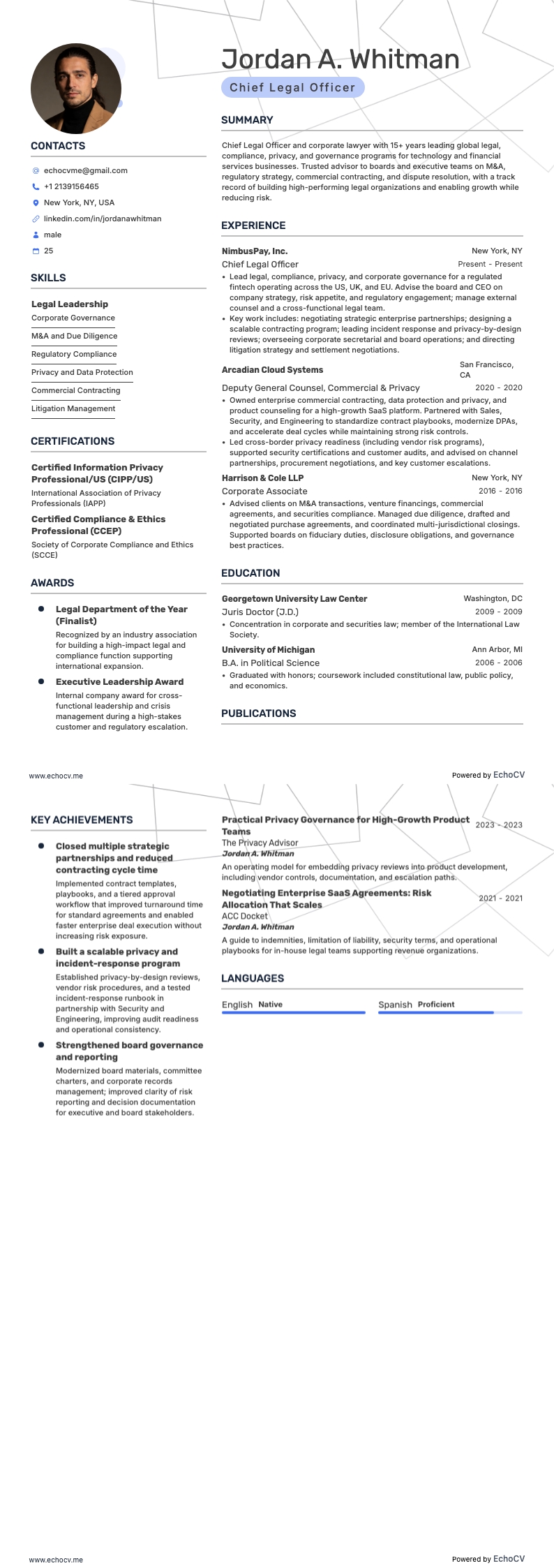
Chief Legal Officer full preview

25 Lawyer Resume Examples, Templates

EchoCV

Written by The Echocv Team

Updated: 9/1/20248 min read

See all resume examples in this guide, or generate your own resume example with your personalized prompt

Chief Legal Officer example resume
Chief Legal Officer

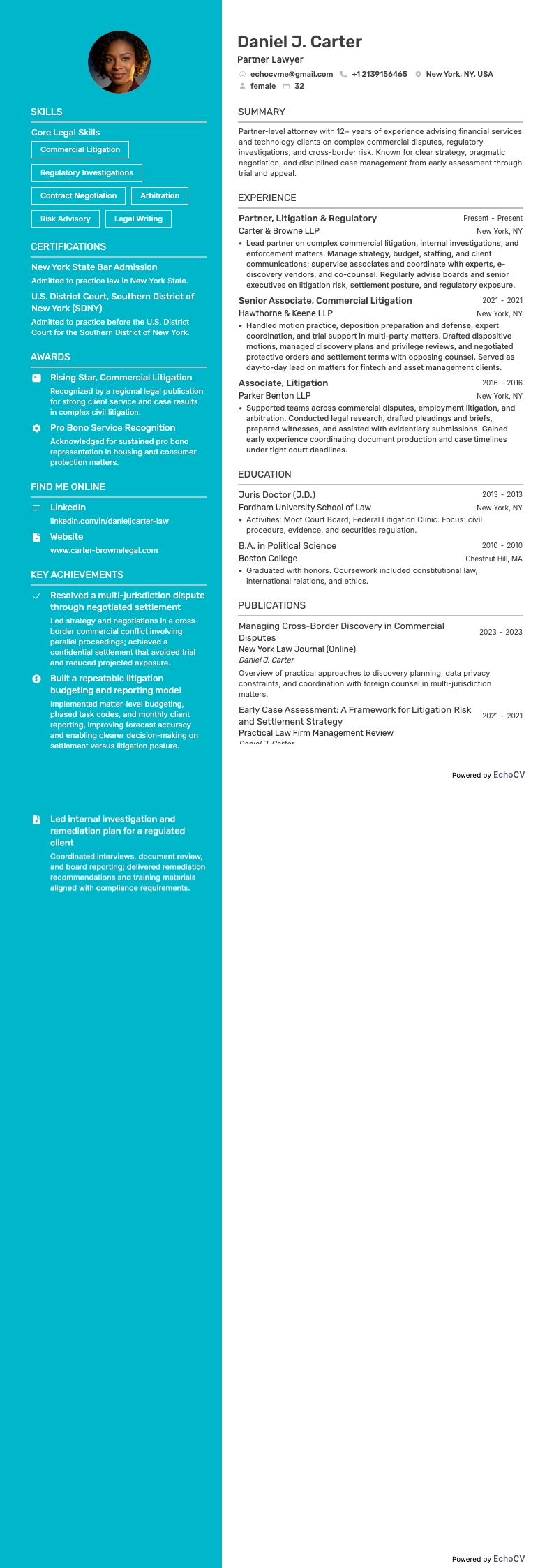
Partner Lawyer example resume

Partner Lawyer

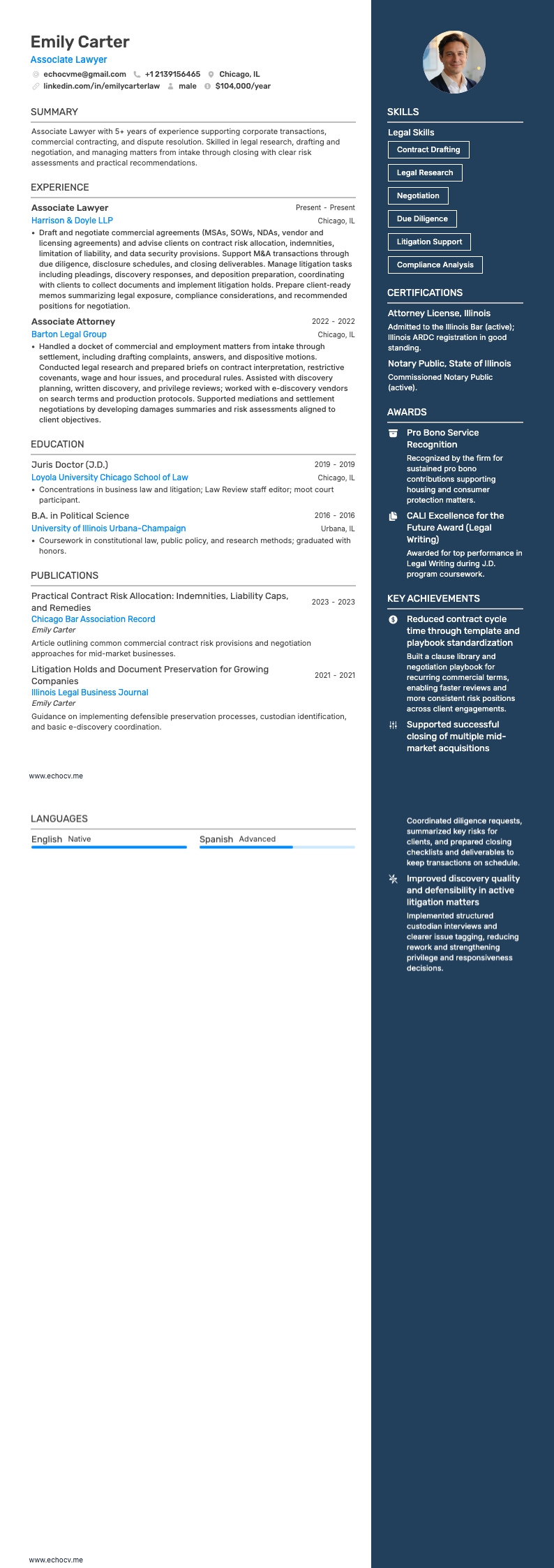
Associate Lawyer example resume

Associate Lawyer

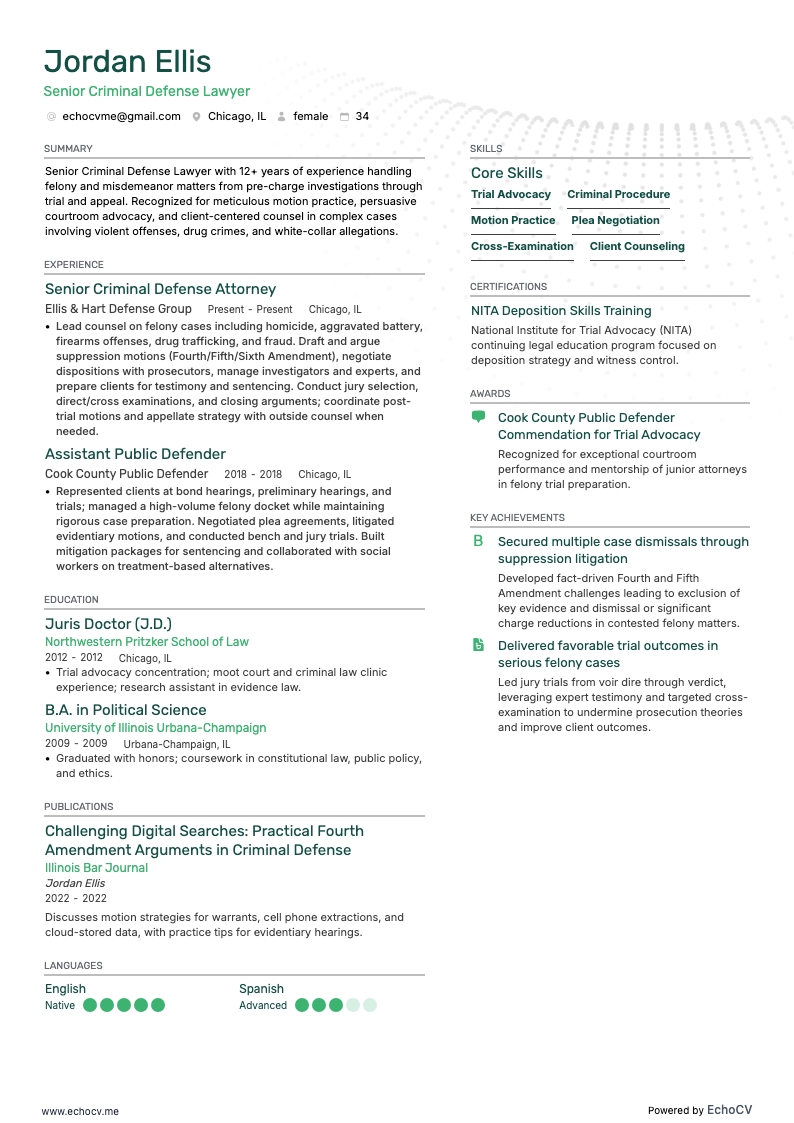
Senior Criminal Defense Lawyer example resume
Senior Criminal Defense Lawyer

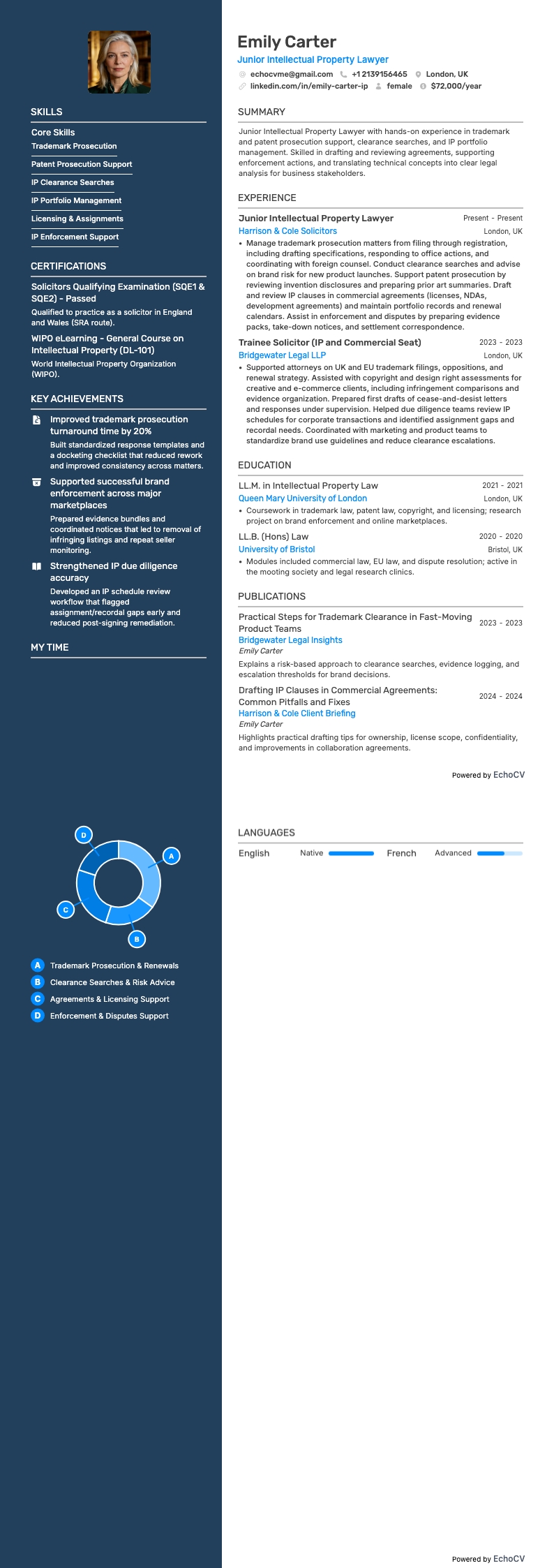
Junior Intellectual Property Lawyer example resume
Junior Intellectual Property Lawyer

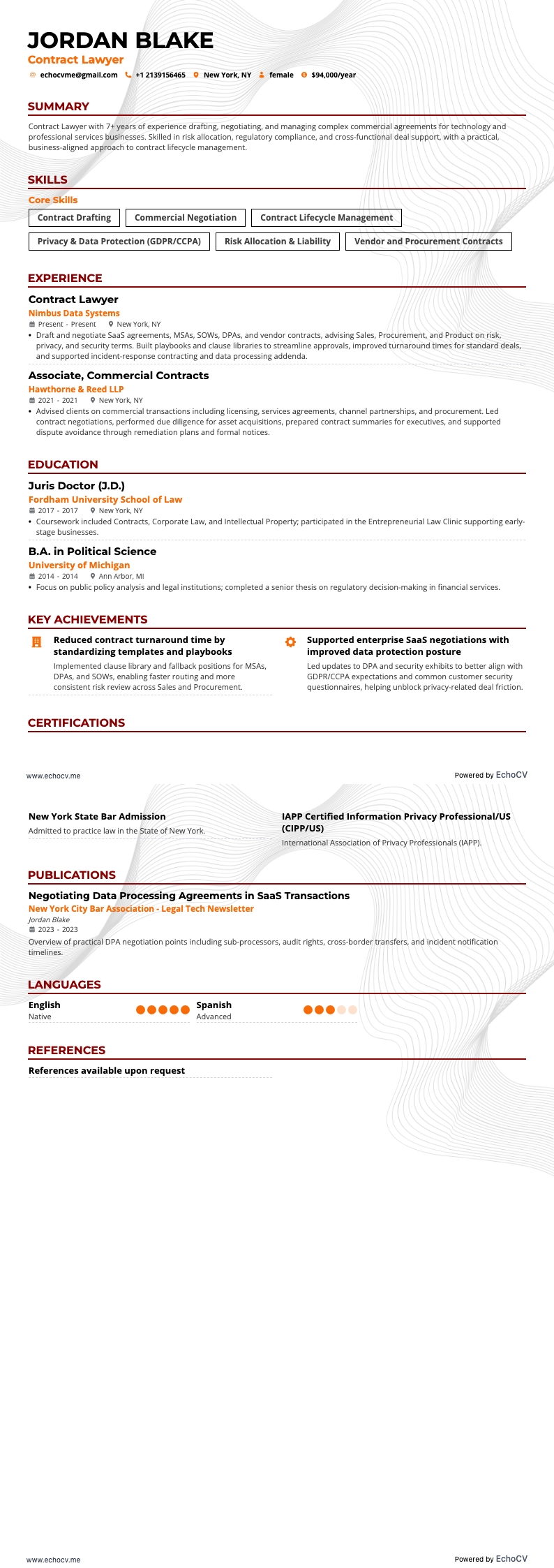
Contract Lawyer example resume
Contract Lawyer

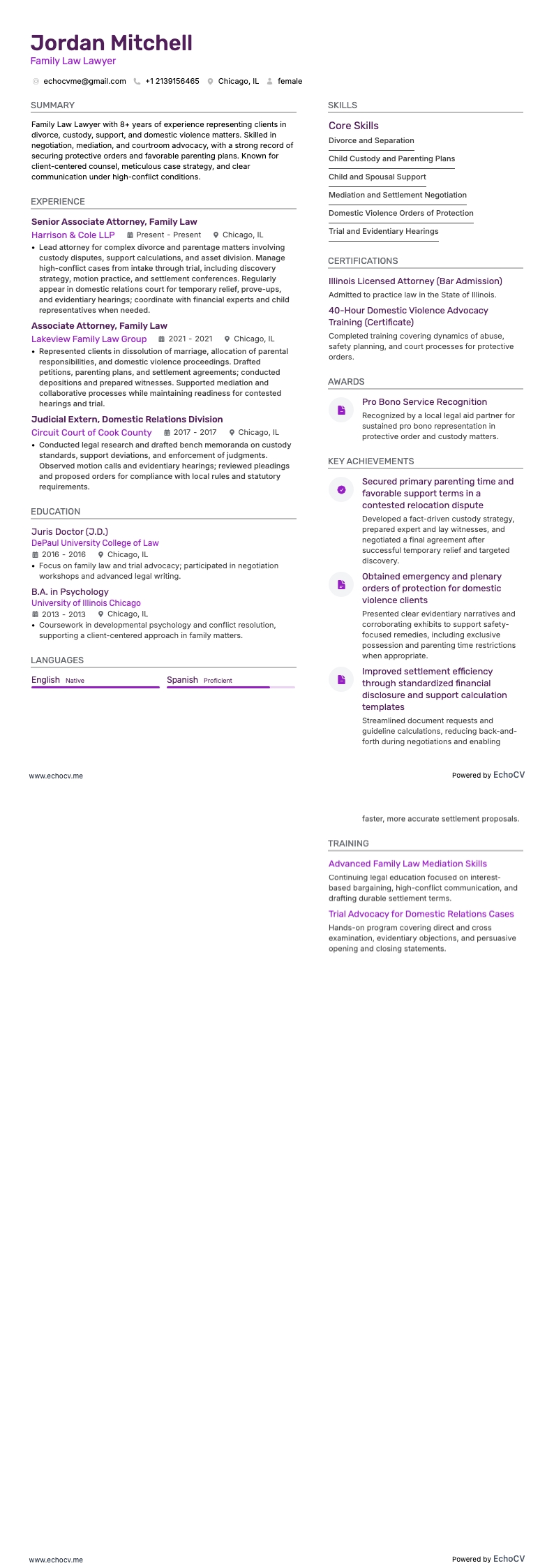
Family Law Lawyer example resume

Family Law Lawyer

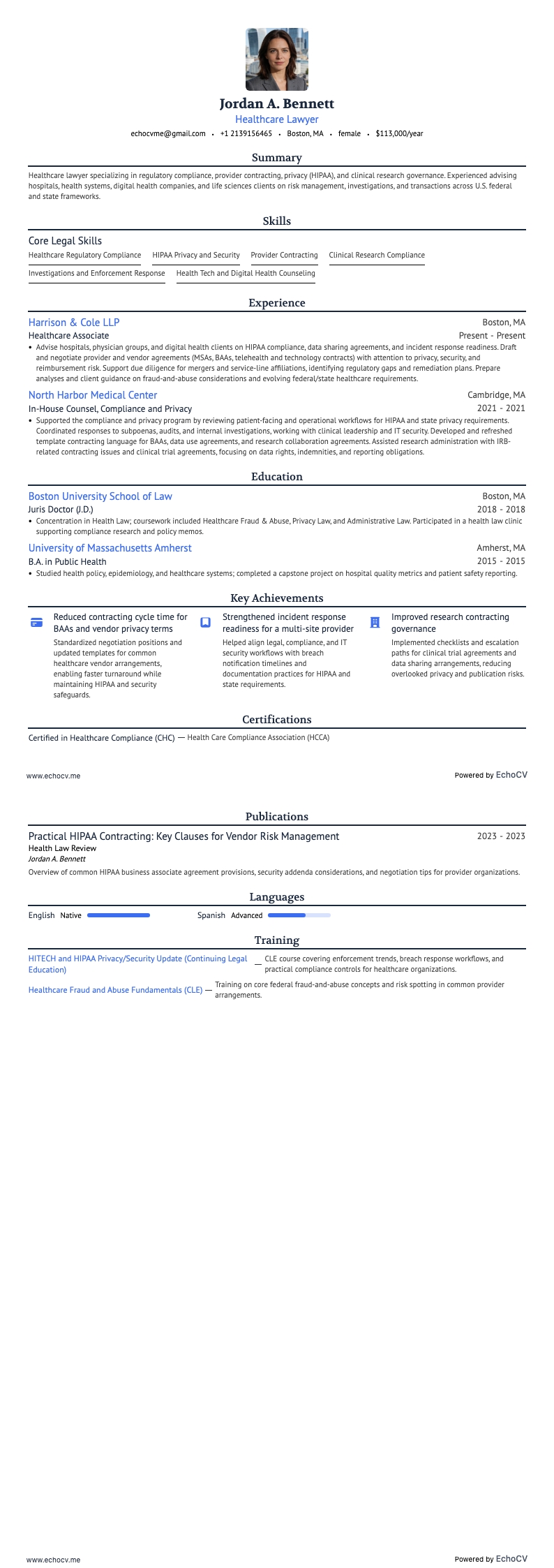
Healthcare Lawyer example resume

Healthcare Lawyer

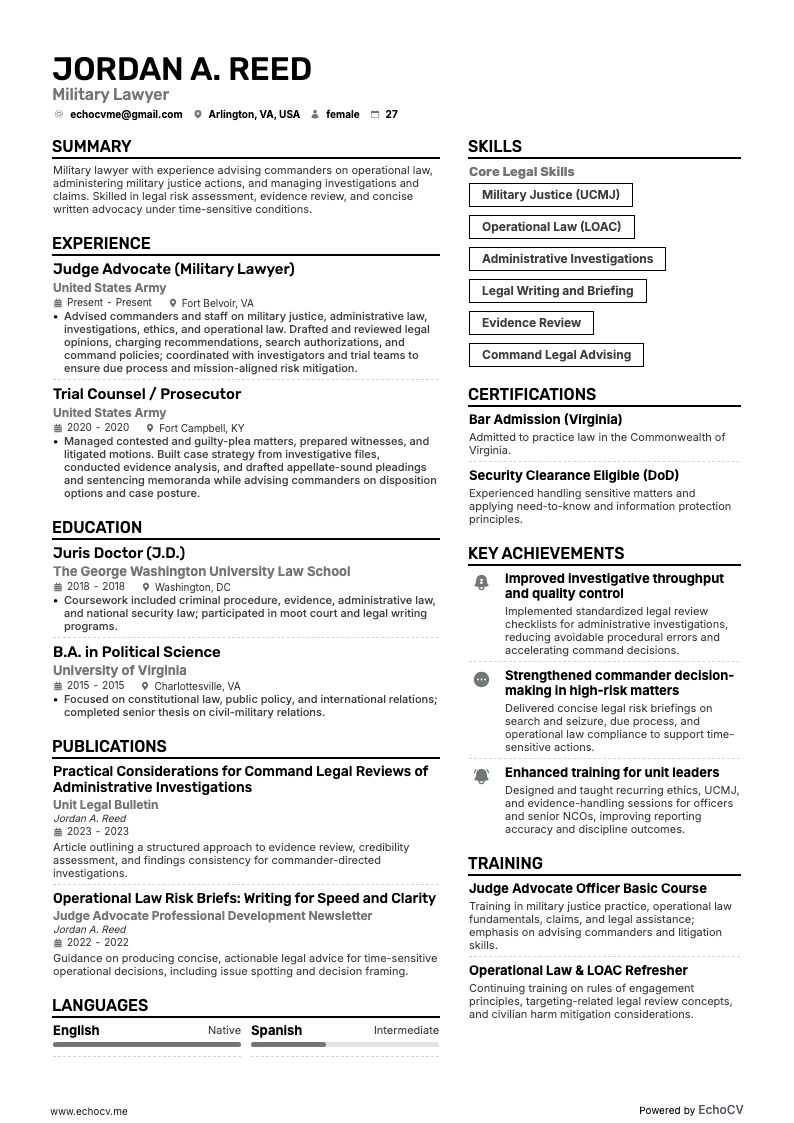
Military Lawyer example resume

Military Lawyer

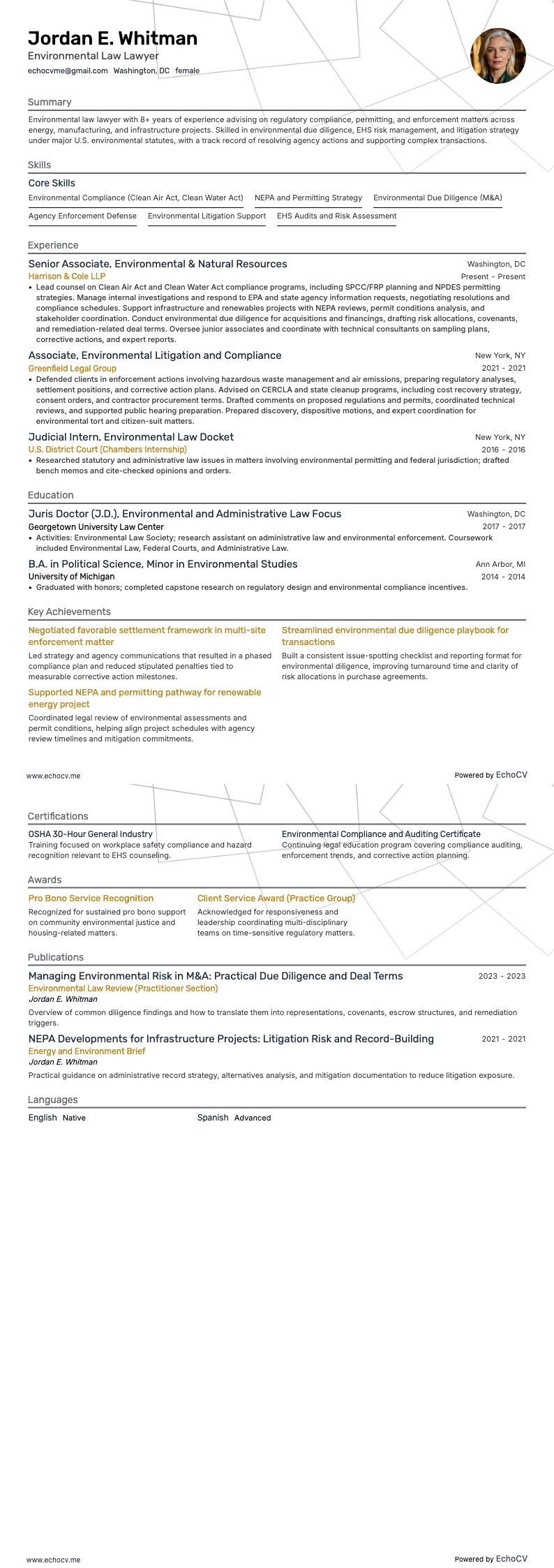
Environmental Law Lawyer example resume
Environmental Law Lawyer

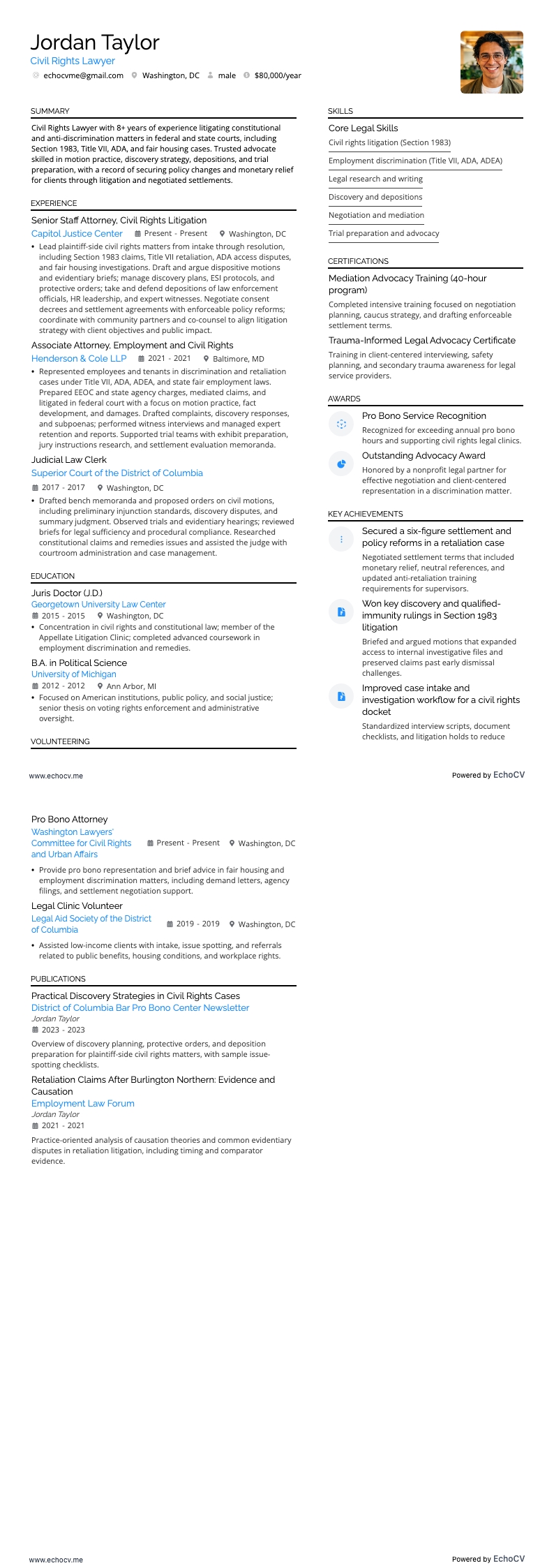
Civil Rights Lawyer example resume
Civil Rights Lawyer

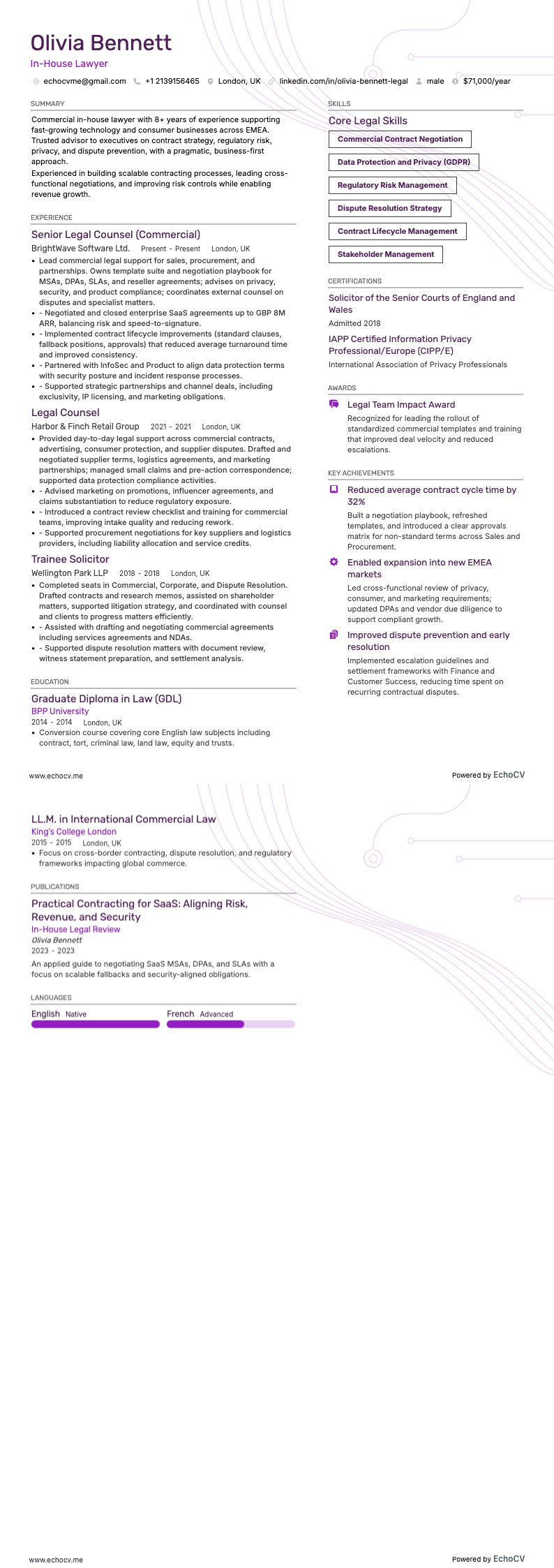
In-House Lawyer example resume

In-House Lawyer

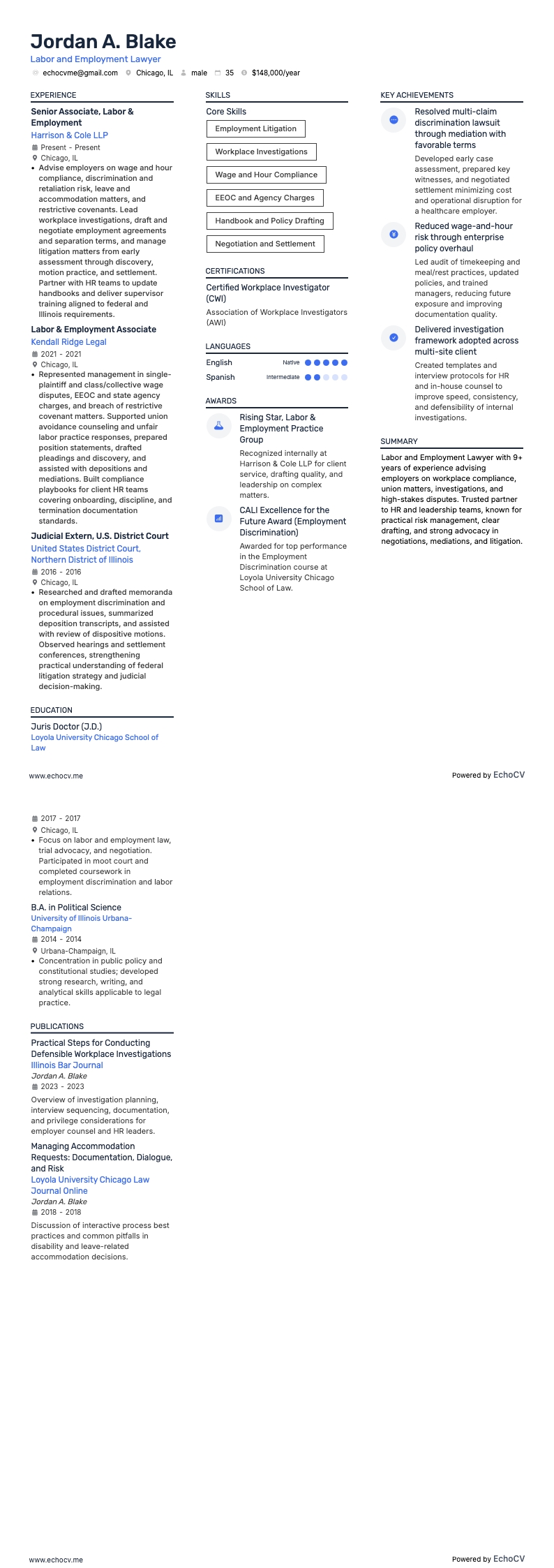
Labor and Employment Lawyer example resume
Labor and Employment Lawyer

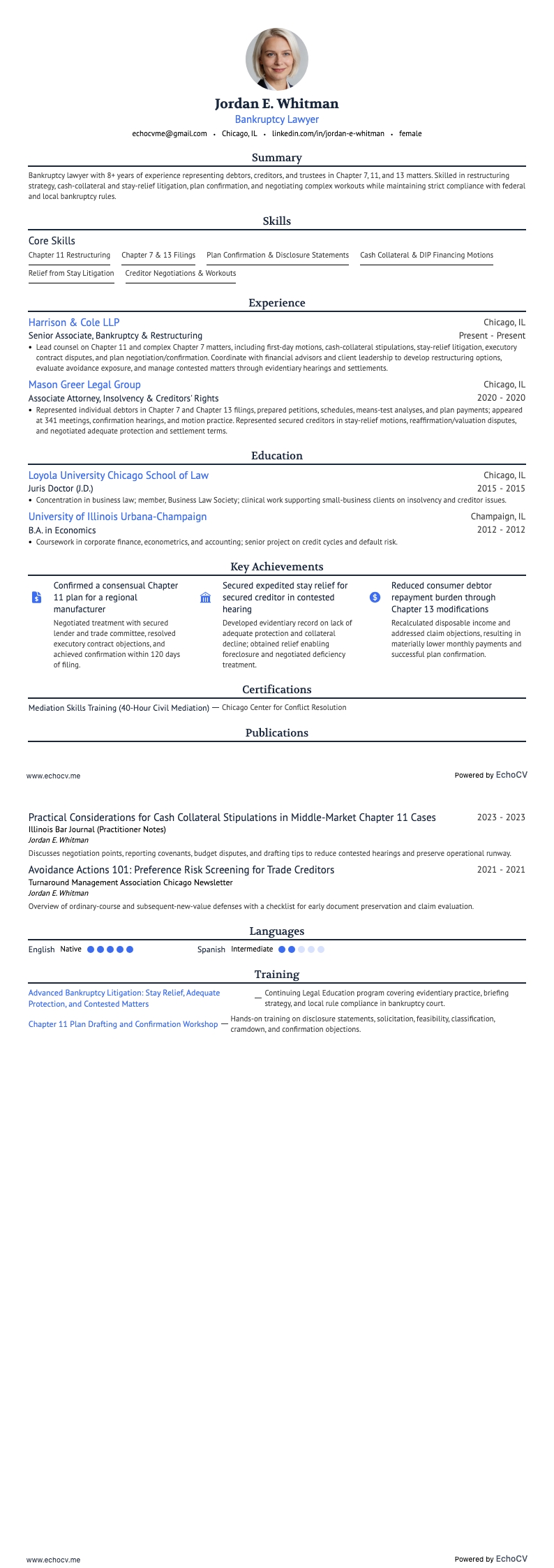
Bankruptcy Lawyer example resume
Bankruptcy Lawyer

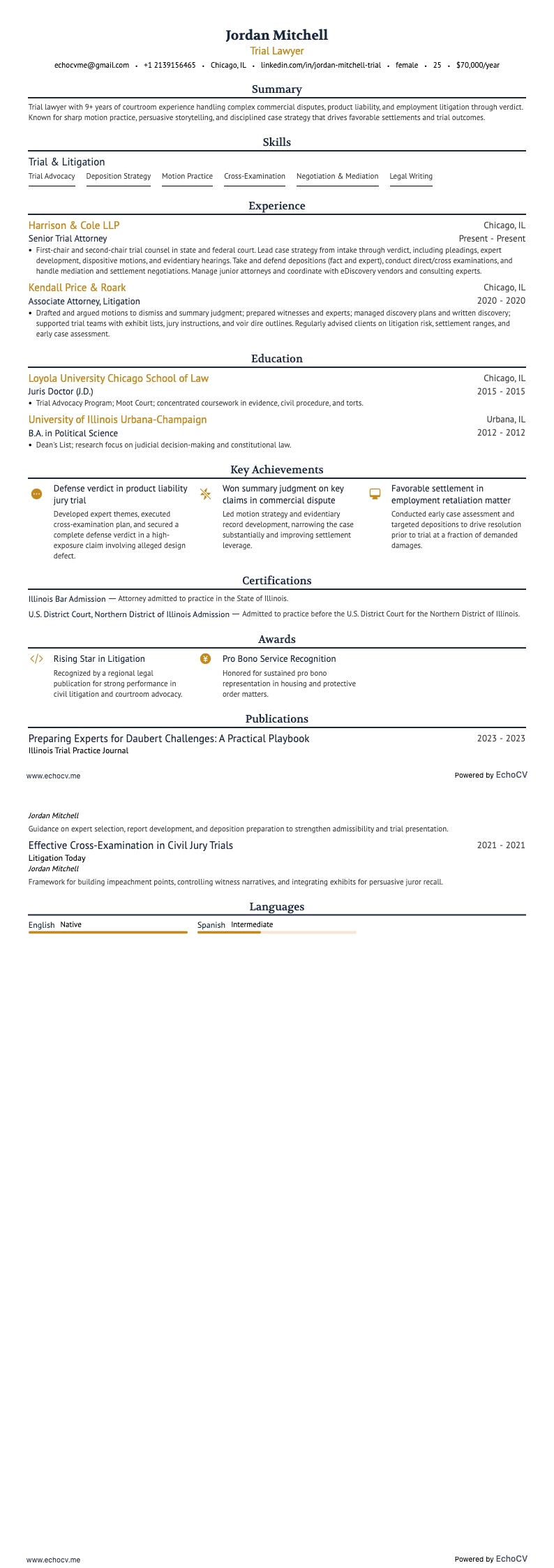
Trial Lawyer example resume

Trial Lawyer

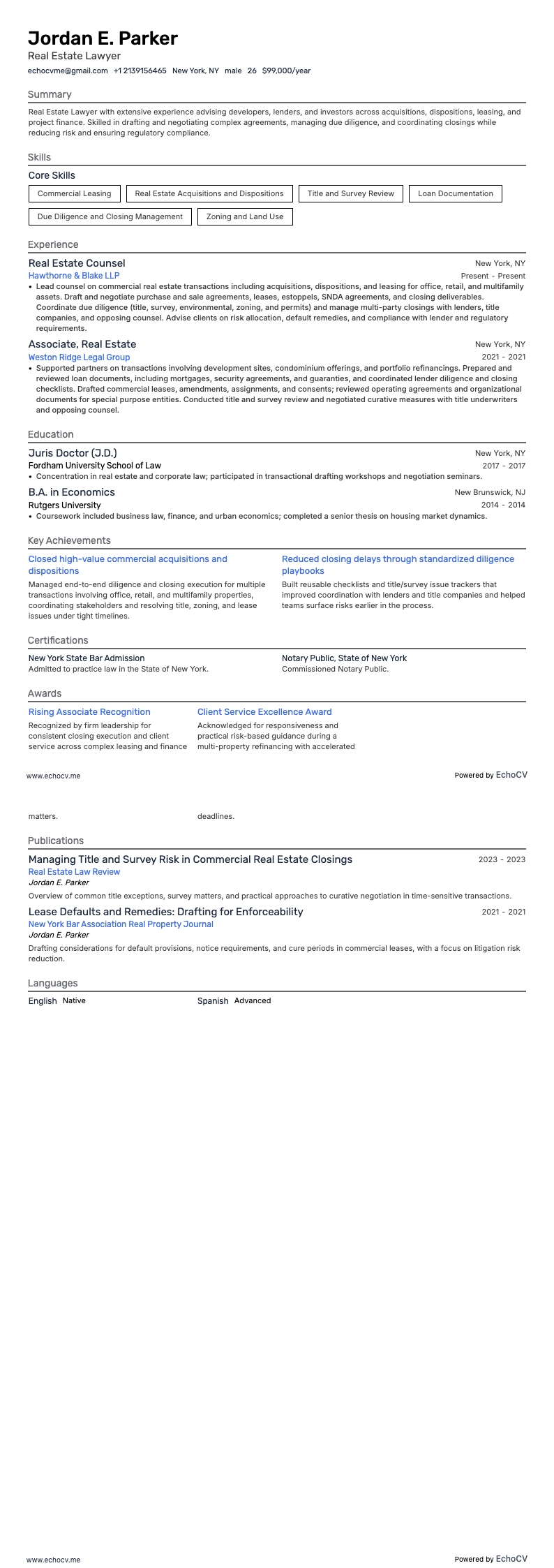
Real Estate Lawyer example resume

Real Estate Lawyer

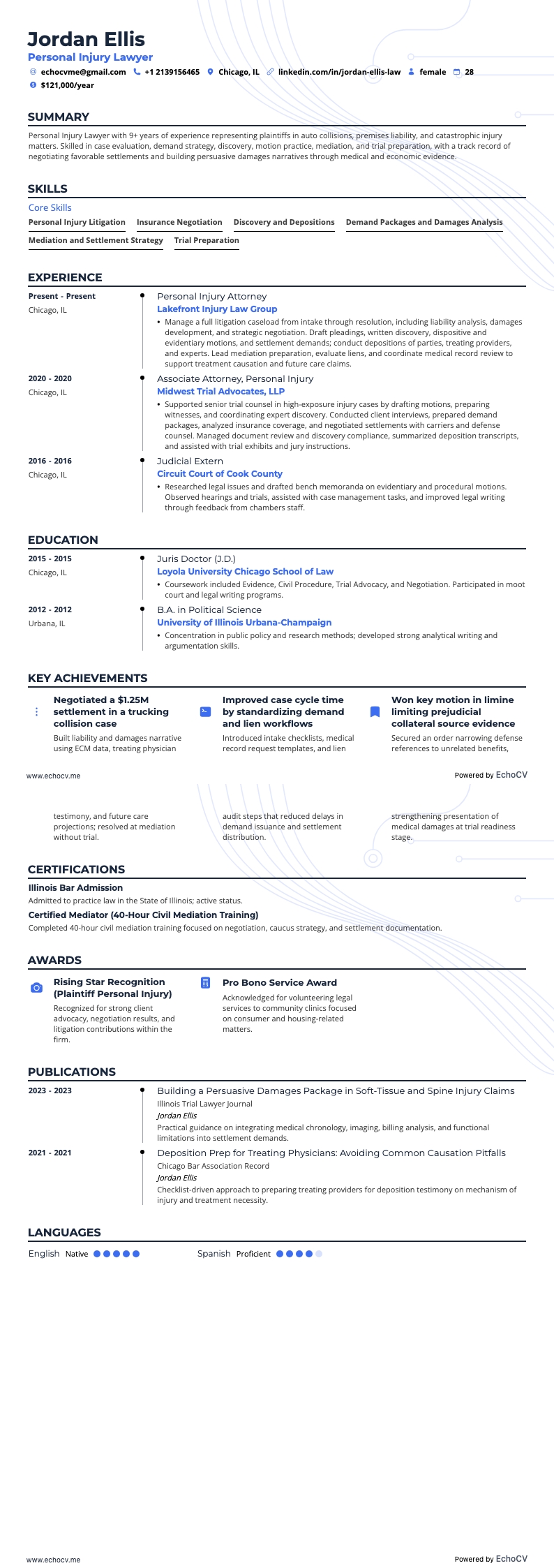
Personal Injury Lawyer example resume
Personal Injury Lawyer

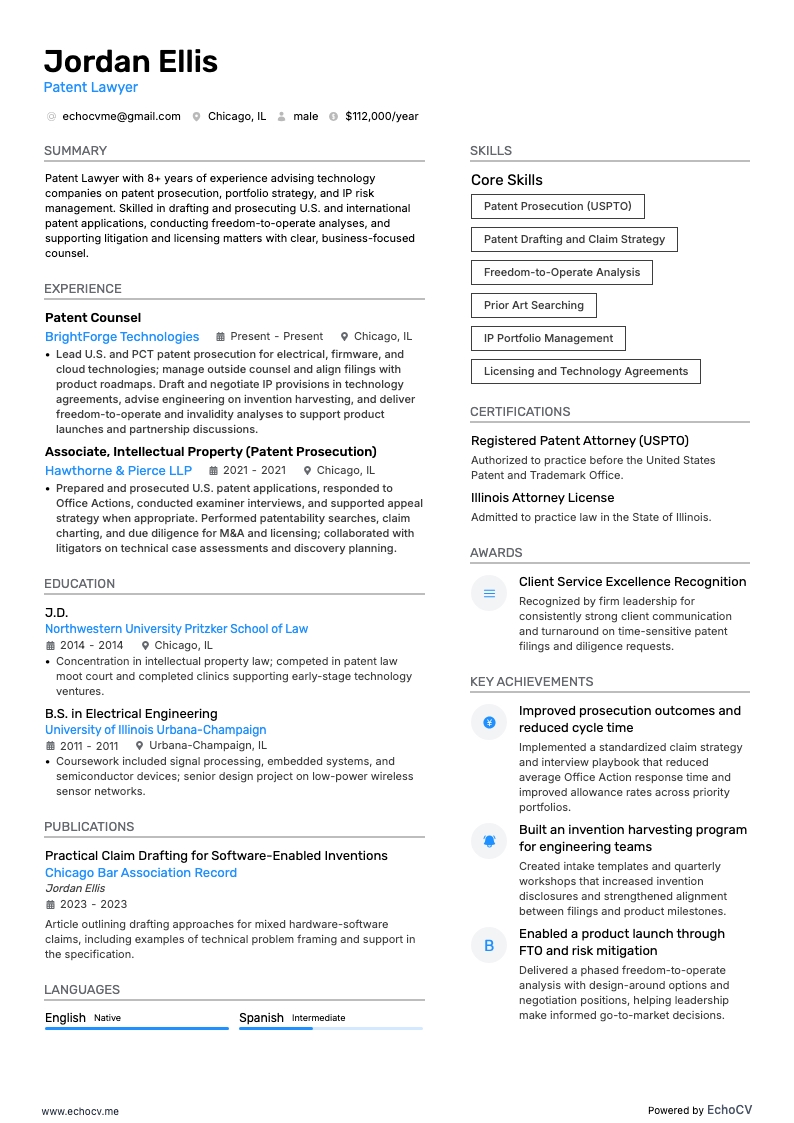
Patent Lawyer example resume
Patent Lawyer

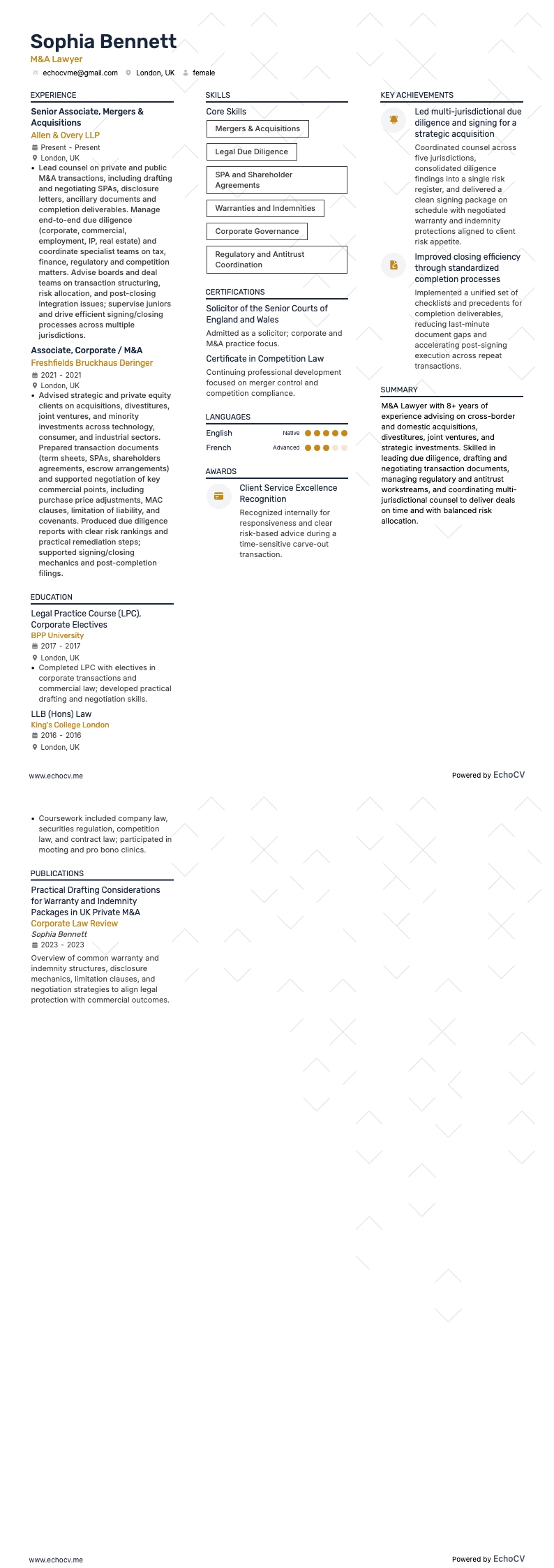
M&A Lawyer example resume

M&A Lawyer

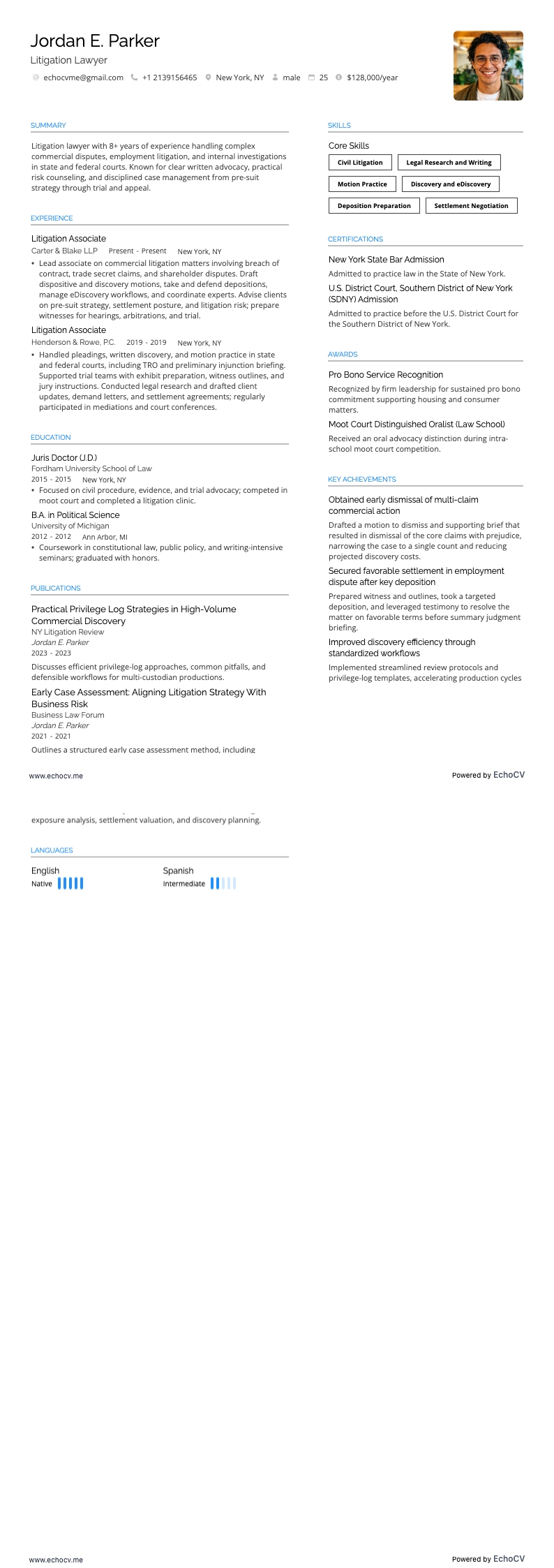
Litigation Lawyer example resume

Litigation Lawyer

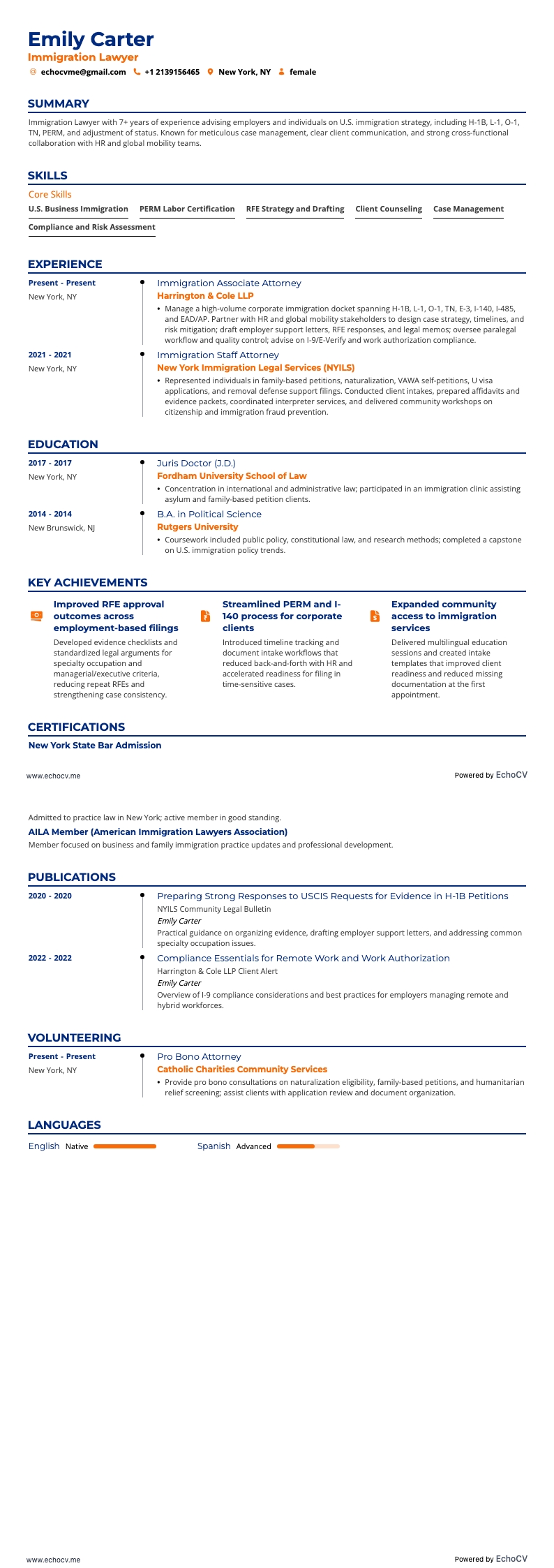
Immigration Lawyer example resume
Immigration Lawyer

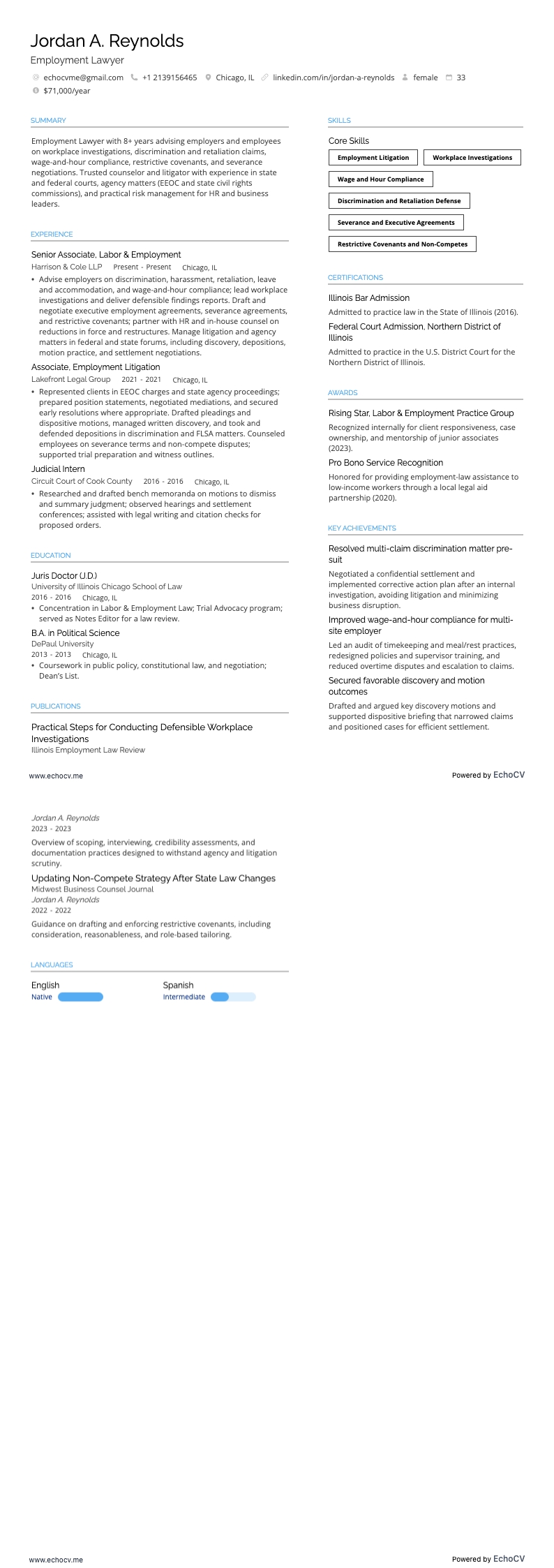
Employment Lawyer example resume
Employment Lawyer

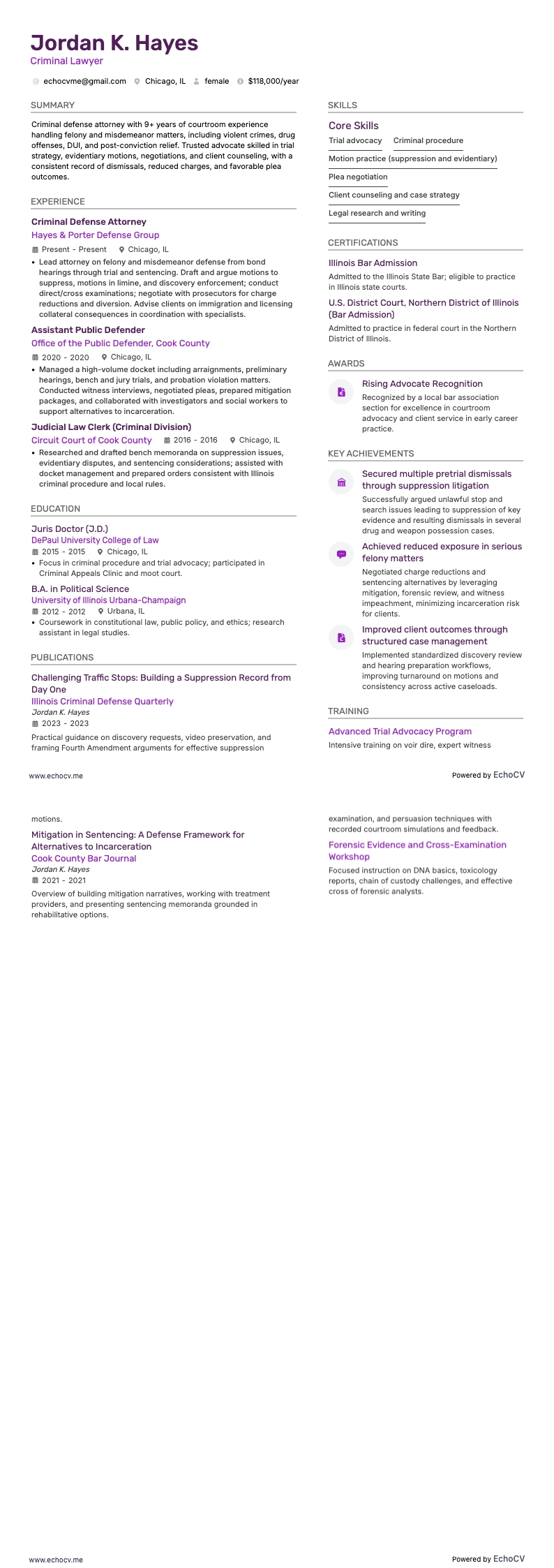
Criminal Lawyer example resume

Criminal Lawyer

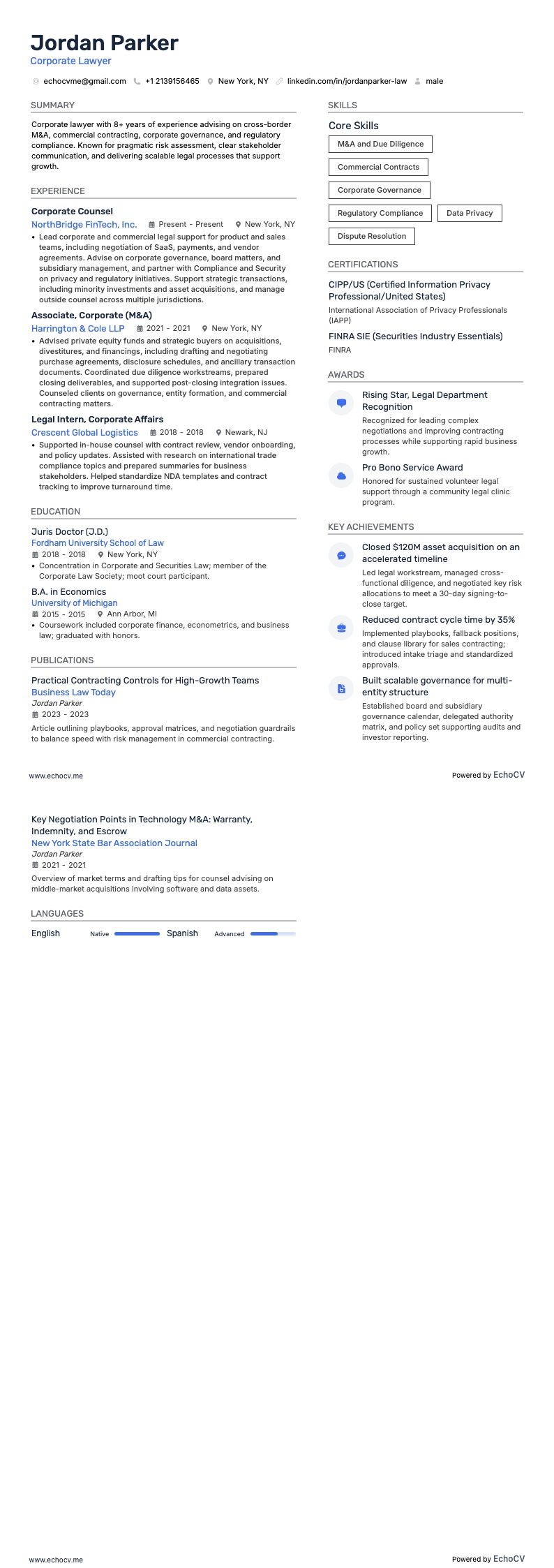
Corporate Lawyer example resume

Corporate Lawyer

Great lawyers turn complexity into clarity—but your resume has to prove impact fast. In 2026, recruiters skim for outcomes (wins, settlements, risk reduction), domain focus (litigation, finance, real estate, IP), and tools (Relativity, Westlaw, LexisNexis).

In this guide, you’ll get 25 lawyer resume examples, a format that surfaces results, and simple ways to tailor and quantify your achievements—so you get more interviews.

Key takeaways

  • Use reverse-chronological format unless changing practice areas—keep it one page if under ten years of experience.

  • Tailor bullets to the job description with the same entities, tools, and outcomes (e.g., “title examination,” “e-discovery”).

  • Quantify: settlements, case volume, cycle time, compliance/audit outcomes, money saved.

  • Place hard skills (Westlaw, LexisNexis, Relativity) and niche statutes where recruiters can scan them.

  • Use Echocv’s Resume Checker to surface applicant tracking systems (ATS) issues and missing proof points—then refine with one-click tailoring.

Let's begin with the essential guidelines for effective resume formatting.

What resume format works best for a lawyer resume

Which resume format should a lawyer use? Reverse-chronological. It shows progression (associate → senior → counsel) and ties work to results. Use a hybrid format only if you’re changing practice areas or returning after a long break.

Choosing a format is a signal to recruiters about seniority and accountability. Use this quick table to pick the safest option for legal roles.

Quick decision table

ProfileRecommended formatWhy it works
Experienced (2+ years)Reverse-chronologicalShows growth (associate → senior), matter scale ($/volume), and outcomes in context
Junior, practice pivot, or returningHybridSurface skills/tools first (Westlaw, Relativity, drafting) while keeping a visible, dated timeline for accountability
Considering a functional format (skills-only)Use hybrid insteadFunctional hides the timeline needed for conflicts, bar checks, and matter tracing

Risks & fixes: Hybrid can get skill-heavy → add micro-timelines under each engagement. Reverse-chronological needs proof → end bullet points with one metric + one timeframe.

With 2+ years in the same area, use reverse-chronological—it shows progression and context that partners expect.

Summary

Answer: Reverse-chronological.

Do:

  • Lead each role with scope (practice, jurisdiction, client type) and scale ($ values, volumes).
  • Use outcome bullets with one metric and one timeframe.

Example bullet:

  • “Closed 28 asset purchases in 2024; cut median cycle time to 32 days from LOI to close.”

Changing practice areas or coming back from a gap? Lead with skills but keep a visible timeline so conflicts, bar status, and scope are easy to assess.

Summary

Answer: Hybrid (skills + condensed, dated experience).

Do:

  • Put a focused Skills block above the Work Experience.
  • Map each key skill to one dated outcome from clinics, internships, pro bono, or projects.

Example scaffold:

  • “E-discovery (Relativity) → led QC pass; reduced dupes 18% in Q3 2024.”

Why we don’t recommend functional (skills-only) for legal roles:

Summary

Answer: It suppresses the timeline partners and recruiters need to assess conflicts, seniority, and impact.

Use instead: Keep a visible month/year timeline and prove skills with dated outcomes (i.e., Hybrid).

Your format sets the frame. These resume sections make it scannable for both applicant tracking systems (ATS) and hiring partners.

What sections should go on a lawyer’s resume?

  • Resume Header (contact info such as: name, practice headline, city/state, email address, phone, LinkedIn—optional publication/profile link)
  • Summary (three to four lines: practice area, scale, tools, quantified results)
  • Professional Experience (three to six bullets per role, each ending in a metric/timeframe)
  • Bar Admissions & Certifications (jurisdictions + year—CIPP/US, CCEP, LPMC, etc.)
  • Skills Section (tools/domains: Westlaw, LexisNexis, Relativity, drafting, title exams, deal rooms)
  • Education (J.D., B.A./B.S., honors, law review)
  • Optional: Pro Bono, Publications/Speaking, Honors/Awards, Projects/Clinics, Languages

Once your format and sections are set, run a quick check for readability and ATS parsing (standard section labels, real text, consistent dates).

With your format and sections set, make your experience do the heavy lifting. Partners and recruiters scan for practice area, timeline, scope, and outcomes—fast.

How to write your lawyer resume experience

Your experience section proves you can handle real matters with accountability. Show what you did, for whom, where, at what scale, and with what outcome.

Must-have fields (top of each role)

  • Job title & employer: Be precise (e.g., Litigation Associate, Energy Real Estate Lawyer, In-House Counsel).
  • Dates of employment: Consistent month/year format for conflict checks and seniority.
  • Location: Optional (city, state/country).

Three to six bullets should show

  • Matter scope & scale: Case type or deal type, dollar values, volumes, timelines, and jurisdictions.
  • Your role: Led drafting/negotiation, second-seated trial, and managed vendor/junior counsel.
  • Tools & procedures: Westlaw/LexisNexis, Relativity/e-discovery, Litera, VDRs (Intralinks/Datasite).
  • Stakeholders: Partners/GC, cross-functional teams (Compliance, Finance, Product).
  • Outcomes: wins, settlements, closings, risk/cost/time reductions.

(You’ll add deeper tailoring and quantification in the next two sections.)

Here’s what a tight, outcome-forward entry looks like.

Good example of a lawyer experience section

Litigation Associate

Keller & Finch LLP | New York, NY

Jan 2023-Sep 2025

  • Second-seated 2 federal trials (2023); drafted MSJs/Daubert motions that narrowed claims pre-trial.
  • Negotiated 3 settlements totaling mid-seven figures, cutting client exposure by ~30%.
  • Led Relativity review of 1.2M documents; implemented dedupe/QC that reduced hosting spend 18%.
  • Managed a 12-deposition schedule across 3 jurisdictions; coordinated experts and kept deadlines on track.
  • Mentored 2 junior associates; standardized brief templates to reduce turnaround time ~25%.

You’ve shown core experience—now make it look like this job. Tailoring aligns your matters, tools, and outcomes with the posting so reviewers see instant fit.

How to tailor your lawyer resume experience

Recruiters and ATS compare your resume to the JD. When your bullets mirror their matter types, tools, and outcomes, you surface as the obvious match.

Ways to tailor (use three to five per role):

  • Mirror the practice area keywords from the JD (e.g., commercial litigation, energy real estate, leveraged finance, privacy).
  • Name the tools/procedures they ask for (Westlaw/Lexis, Relativity, Litera—VDRs like Intralinks/Datasite).
  • Match scales they care about (deal sizes, case volumes, jurisdictions, timelines).
  • Align stakeholders (partners/GC, vendors, experts, cross-functional teams like Compliance or Finance).
  • Echo outcome metrics valued in the role (wins/settlements, closings, cost/time/risk reduction).

Tailoring your resume is one of the most important parts of the application process. Getting it right can be the difference between landing interviews or hearing nothing back. Partners compare your bullets to the job description line by line:

  • Matter types
  • Tools and procedures
  • Stakeholders
  • Outcomes

When you mirror those signals with clear metrics and dates, you look billable on day one.

Summary

Action + domain + tool/procedure + scale + dated outcome.

Example:

“Negotiated credit & security agreements using Litera clause libraries across $120M in financings (2024), reducing redlines 22%.”

Below, vague bullets become tailored, JD-matching achievements. No extra commentary—just the upgrade.

Resume tailoring examples for lawyers

Job description excerptUntailored bulletTailored bullet
E-discovery experience with Relativity; manage vendors and control hosting costs.Managed discovery across cases.Led Relativity review of 1.2M docs; negotiated vendor SLAs and dedupe/QC to cut hosting spend by 18% in 2024.
Energy real estate: title exams, easements, PSAs/ground leases; renewables focus.Worked on real estate matters.Completed 45+ title exams/easement reviews for wind/solar sites; drafted PSAs/ground leases that cleared permitting on schedule.
Finance transactions: draft/negotiation of credit & security agreements; multi-lender workouts.Assisted with financing deals.Drafted/negotiated 60+ credit & security agreements supporting $520M (2023–2024); co-led >$80M workouts reducing expected losses 14%.
In-house privacy/compliance: implement policies, reduce audit findings, partner with Product.Supported compliance work.Rolled out quarterly privacy reviews; cut audit findings by 40% YoY and shipped two Product changes to meet GDPR requirements.
Litigation: second-seat trials; draft MSJ/Daubert; secure settlements.Handled litigation tasks.Second-seated 2 federal trials (2023); drafted MSJ/Daubert narrowing claims; negotiated 3 settlements totaling mid-7 figures.

Tailoring proves you understand the role and strengthens your resume for both ATS and hiring partners. Instead of rewriting from scratch, use Echocv’s One-Click Tailoring Tool, paste the JD, and it updates your:

  • Bullets
  • Skills
  • Achievements
  • Summary and title

How to quantify your experience on a lawyer resume

Numbers turn legal work into visible value. They show the scale of your matters, the efficiency of your process, and the outcomes you delivered—so reviewers can benchmark you quickly.

Below are five reliable ways to quantify legal achievements, with plug-and-play bullets.

Wins/settlements (value avoided or recovered)
  • Negotiated 3 settlements totaling mid-7 figures in 2024, reducing client exposure by ~30%.
Throughput & cycle time (cases/deals closed, speed)
  • Closed 28 asset purchases in 2024; cut median diligence-to-close from 45 to 32 days.
Discovery efficiency & cost control
  • Led Relativity review of 1.2M docs; implemented dedupe/QC that lowered hosting costs 18% YoY (2024).
Risk/compliance impact (audits, policy rollouts)
  • Introduced quarterly privacy reviews; reduced audit findings 40% YoY and cleared two GDPR gaps by Q3 2024.
Negotiation & vendor savings (outside counsel/tech)
  • Renegotiated e-discovery vendor SLAs; saved $180K annually while maintaining 24-hr turnaround.

Want help turning your work into crisp, metric-led bullets? Use Echocv’s Bullet Point Generator to draft outcome-focused lines in seconds.

Keep resume skills scannable for ATS and hiring partners while your metrics carry the story.

How to list your hard and soft skills on your lawyer resume

The skills section show reviewers you can operate at the required level from day one. On legal resumes, they also help ATS align you to specific practice areas, procedures, and tools.

Hard vs. soft skills (and where they go):

  • Hard skills are domain-specific tools, procedures, and legal competencies. Place them in a skills section (scannable list) and reinforce them in experience bullets with dated outcomes.
  • Soft skills are behaviors that drive outcomes (e.g., how you lead matters, manage stakeholders, and make decisions). Don’t list them generically—prove them inside your Summary and Work Experience via actions and metrics.

Best hard skills for your lawyer resume

  • Legal research (Westlaw, LexisNexis)
  • Litigation drafting & motion practice (pleadings, MSJ/Daubert)
  • E-discovery & review management (Relativity)
  • Contract drafting & negotiation
  • Due diligence (transactions/investigations)
  • Regulatory/compliance research (GDPR, FCPA, AML)
  • Deal management & closings (VDRs: Intralinks, Datasite)
  • Deposition & trial preparation
  • Document automation & template management (Litera)
  • Risk assessment, policy rollout & audits

Here’s how to show, not tell, your soft skills—first in your resume summary, then inside the experience bullets.

Summary

    Litigation Associate (5+ years) focused on commercial disputes; second-seated two federal trials (2023) and negotiated three settlements totaling mid-7 figures. Known for cross-functional collaboration with experts/GC, tight stakeholder management, and rigorous prioritization & deadline management—compressed discovery timelines by 22% and kept <2% brief rework.

Good Example
  • Coordinated partners, experts, and a 6-member vendor team to deliver a Relativity review (1.2M docs) two weeks early, cutting hosting costs 18%.
  • Led weekly counsel–client checkpoints that surfaced risk early and avoided two potential sanctions; sustained 100% on-time filings over four quarters.
  • Mentored two junior associates through deposition prep and brief drafting, reducing revision cycles ~25% while meeting all court deadlines.

You’ve mapped the skills that drive your results—now confirm baseline eligibility. Education, bar admissions, and certifications show you’re placeable quickly and deepen your domain focus.

How to list your education, certifications & licensure (bar) on your lawyer resume

Your credentials do two jobs: prove eligibility to practice and show domain depth. Keep this block tight, scannable, and consistent so reviewers can green-light you fast.

Recommended order & placement

  • Header micro-line (recommended): add a short Bar line for instant visibility (e.g., Bar: NY (Active), CA (Active)).
  • Unified credentials section on the page: list Education → Certifications → Bar & Court Admissions.

PRO TIP

For space, your Bar can appear right after the summary—still repeat details in the unified section.

How to format each credential

  • Education: Degree, School, year, and brief honors/journals/clinics (omit month).
  • Certifications: Exact credential name, issuer, and year (or Active/Valid through 2027).
  • Bar & Court Admissions: Jurisdiction (Status), year, and courts if relevant (no license numbers on public copies).
Unified credentials block | Litigation track
Education

Juris Doctor (J.D.)

NYU School of Law | 2018

  • Law Review (Articles Editor); Moot Court

Bachelor of Arts (B.A.) in Political Science

Columbia University | 2015

  • Honors Thesis; Phi Beta Kappa
Certifications
  • Relativity Certified Administrator (RCA) | 2023
  • LPMC (Legal Project Management Certificate) | 2022
Bar & Court Admissions
  • New York (Active), 2018
  • California (Active), 2024
  • U.S. District Court, S.D.N.Y. & E.D.N.Y., 2022
Unified credentials block | In-house privacy/compliance track
Education

Juris Doctor (J.D.)

UCLA School of Law | 2019

  • Journal of Law & Technology; Privacy Clinic

Bachelor of Sciences in Information Systems

UC San Diego | 2016

Certifications
  • CIPP/US (IAPP)—2021
  • CIPM (IAPP)—2022
  • CCEP (SCCE)—2023
Bar & Court Admissions
  • Texas (Active), 2020
  • U.S. District Court, N.D. Tex., 2021

Bar & licensure notes (quick rules)

  • Put Bar in the header micro-line and repeat the details here.
  • Show status (Active/Good Standing/Pending) and the year only.
  • List most relevant jurisdiction first for the role.
  • Add court admissions if you’ll litigate there.
  • For in-progress: “New York | Admission Pending (Passed UBE 2025; MPRE passed; C&F submitted)”
  • International: “England & Wales | Solicitor (Active)” or “SQE1 passed 2025; SQE2 scheduled 2026; QWE 18/24 months.”

Best certifications for your lawyer resume

  • CIPP/US (Certified Information Privacy Professional—U.S.)
  • CIPM (Certified Information Privacy Manager)
  • CCEP (Certified Compliance & Ethics Professional)
  • RCA (Relativity Certified Administrator)
  • CAMS (Certified Anti-Money Laundering Specialist)

Dos & don’ts (scanline checklist)

  • Do keep formatting uniform and use year only.

  • Do prioritize job-relevant certifications—move the rest to LinkedIn.

  • Do repeat Bar in header + this section.

  • Don’t bury Bar under Education or list license numbers publicly.

  • Don’t overload with course lists—keep it outcome-oriented elsewhere.

With credentials verified, open with a summary that proves outcomes in the target practice.

How to write your lawyer resume summary

For mid- and senior-level lawyers, the summary is your first chance to signal practice fit, scale, and results. Partners and recruiters use it to decide if they should keep reading—so make every word carry proof.

A strong lawyer summary should:

  • Use first person (implied): write from your voice but omit “I”; keep it to 2–4 tight lines.
  • State role + experience: your current title and years (e.g., Litigation Associate, 5+ years).
  • Position your practice focus: industries/matter types (commercial litigation, energy real estate, leveraged finance, privacy).
  • Name key tools/procedures: Westlaw/Lexis, Relativity/e-discovery, Litera, VDRs, MSJ/Daubert, due diligence.
  • Quantify one to two outcomes: wins/settlements, deal volume/size, time/cost/risk reductions, cycle-time improvements.
  • Show collaboration/leadership signals: partners/GC, experts, cross-functional teams (Compliance/Finance/Product).
  • Align to the job description: echo one or two JD keywords (jurisdictions, regulations, deal types) and make it employer-centric.

Example summary:

Litigation Associate (5+ years) focused on commercial disputes; second-seated two federal trials (2023) and negotiated three settlements totaling mid-7 figures. Heavy Relativity user; coordinated experts across three jurisdictions to compress discovery timelines 22% and maintain <2% brief rework. Admitted NY & CA.

Why this works:

It states role + experience, names tools/procedures, quantifies impact with dates, shows collaboration scope, and confirms bar fit.

You’ve shaped a clear, first-person summary—now what about building an entry-level resume that proves you’re ready to practice, even without full-time lawyer experience?

How do I write a lawyer resume with no experience?

You can still show you’re practice-ready by foregrounding clinics, internships, research/writing, and measurable outcomes—then backing them with bar status and tools.

What to focus on

  • Format: Use a hybrid layout (skills + condensed, dated experience). Avoid purely functional—keep a visible timeline.
  • Header: Include a precise practice headline (e.g., Entry-Level Litigation or Energy Real Estate), plus Bar status (e.g., NY | Admission Pending, UBE 2025).
  • Summary (two to four lines): Practice focus + one to two proof points (e.g., trials/clinics, deal projects, research wins).
  • Skills (above work experience): Tools/procedures you can actually use (Westlaw/Lexis, basic Relativity, drafting, due diligence, title exams).
  • Experience (dated): Clinics/Externships (matter types, jurisdictions, outcomes) | Internships/Part-time (drafted motions/briefs, researched issues, supported closings) | Pro Bono/Volunteer (expungements, housing, immigration; show counts/results).
  • Projects (optional): Research memos, mock negotiations, briefs—each with a result/timeframe.
  • Education: J.D. + honors (Law Review/Moot Court).
  • Certifications (if relevant): CIPP/US, RCA (Relativity), LPMC, etc.

Outcome cues to include in bullets

  • Volumes and scope (e.g., “drafted 6 motions; supported 2 mediations in Spring 2025”).
  • Efficiency or quality (e.g., “cut cite-check time 20% with Bluebook checklist”).
  • Client or court impact (e.g., “secured TRO in housing matter”).
  • Tools (e.g., “structured review sets in Relativity; reduced dupes 15%”).

Summary

Use: Hybrid format (skills + condensed, dated experience).

Do:

  • Put Skills directly under the Summary (tools/domains you can prove).
  • Use micro-timelines for clinics/internships (Month/Year–Month/Year).
  • Map each key skill to one dated outcome (counts, %, decision/result).

Why use instead of a functional format? To keep a visible timeline and prove skills with dated outcomes under Clinics/Internships/Projects.

Now that your resume is structured and evidence-rich, these FAQs tackle the remaining details—formatting choices, cover letter guidance, credentials, and salary signals.

Frequently asked questions about lawyer resumes

Scan these quick answers and apply what fits your practice and seniority—each keeps timelines visible, outcomes quantified, and confidentiality intact.

What should your lawyer resume header include?

  • Full name + practice headline: e.g., “Avery J. Lee—Commercial Litigation” (keeps focus area obvious).
  • Target job title: Tailor to the role (e.g., Litigation Associate, Energy Real Estate Lawyer, In-House Counsel).
  • Location: City, State/Country (e.g., New York, NY). Add “Open to Remote/Relocation” if applicable.
  • Contact details: Professional email (firstname.lastname@), phone with country code if relevant.
  • LinkedIn: Custom slug (linkedin.com/in/yourname) matching resume details.

  • Bar micro-line (instant scan): Jurisdiction(s) + status (e.g., Bar: NY (Active), CA (Active)).
  • Optional single public link: Firm bio, SSRN, or publication—avoid multiple links in the header.
  • Formatting cues: One clean line under your name, left-aligned, no icons/photos, no license numbers.

Example:

Avery J. Lee

Commercial Litigation Lawyer

New York, NY • Open to Remote • (212) 555-0134 • [email protected]

linkedin.com/in/name • Bar: NY (Active), CA (Active) • firmbio.com/yourname

What design rules should you follow?

Keep the layout clean, scannable, and ATS-friendly. For most lawyers (under 10 years), a one-page, single-column, left-aligned resume is the safest choice. Use clear section headings (Experience, Education, Skills, Certifications, Bar Admissions) so both humans and ATS can parse your timeline and credentials quickly.

  • Length & layout: One page if you have <10 years of experience—two pages only when your matters and outcomes truly require it. Single-column beats multi-column for parsing reliability.
  • Typography: 10–12 pt body—14–16 pt headings. Pick one legible resume font, sans-serif (Inter, Lato, Roboto), and stick to it.
  • Color & emphasis: One subtle accent color max. Use bold sparingly for headings, employers, and key metrics.
  • Spacing & margins: ~1" margins—consistent line spacing (single or 1.15). Leave white space so bullets breathe.
  • Sections & order: Header → Summary → Experience → Bar Admissions → Certifications → Skills → Education (or Education before Skills if entry-level).
  • Dates & timeline: Month/Year ranges, aligned to the right or in a consistent column—never hide dates.
  • What to avoid: Photos, icons, dense two-column grids, and decorative graphics that disrupt parsing.

PRO TIP

End each experience bullet with one metric and one timeframe (e.g., “cut hosting costs 18% in 2024”)—it improves readability and shows measurable impact at a glance.

How should you save and name your resume file?

Use a recruiter-friendly filename, e.g., "Firstname_Lastname_Lawyer_Resume.pdf" (or add a practice: "…_Litigation_Resume.pdf").

Export to PDF (unless told otherwise). Real text only—no images of text, text boxes, or complex tables.

How do I show career progression on a lawyer resume?

Make growth obvious via titles (Associate → Senior → Counsel/In-House), larger matter/deal sizes, broader jurisdictions, and increased autonomy (drafting → leading negotiations; second seat → first chair). End bullets with one metric and one timeframe to create comparable evidence across roles.

Use the same metric family across roles (e.g., deal $ or case volume) to spotlight progression.

What additional sections work well?

Use extra sections to surface credibility fast—keep each one short, scannable, and relevant to the role.

  • Bar & Court Admissions (high on page): Jurisdictions, status, year—add key court admissions if you’ll litigate there.
  • Publications & Speaking (CLEs, law reviews): One to three items that show subject-matter expertise—link only to public pieces.
  • Pro Bono: Matter types and outcomes (e.g., expungements, housing TROs) with counts or brief results.
  • Honors & Awards: Chambers, law school awards, moot court—use the official name and year.
  • Clinics & Projects (entry-level): Clinics, externships, capstones—include a measurable outcome or scope.
  • Certifications: Only those relevant to the role (e.g., CIPP/US, RCA, CCEP)—issuer + year.
  • Languages: Professional proficiency and jurisdictions where it’s useful (e.g., cross-border matters).
  • Professional Memberships: Bar associations or groups tied to the practice area.
  • Presentations/Training Delivered: CLEs, firm trainings, or workshops you led—title + audience.
  • Community & Leadership: Board roles, mentoring, clinics coordinated—keep it outcome-oriented.

What should I include in a lawyer cover letter?

Open your cover letter with why the firm/company’s matters or regulatory context interests you. Then give one to two quantified results (wins, settlements, closings, risk/cost reductions).

Note how you’ll partner with partners/GC and cross-functional teams (Compliance, Finance, Product). Include a single relevant public link (publication, talk).

How technical should a lawyer resume be?

Be precise, not buzzwordy. Name the tools/procedures you actually use (Westlaw, Lexis, Relativity, Litera—MSJ/Daubert—VDRs like Intralinks/Datasite) and tie each to an outcome (cycle time, cost, exposure). Keep technological tool lists in your Skills section and prove them in your experience bullets.

How do salaries tie to my resume?

Compensation tracks scope + complexity + outcomes—make those three unmistakable in every role.

  • Market anchor: As of May 2024, the median annual wage for lawyers was $151,160 (May 2024), per the U.S. Bureau of Labor Statistics
  • Litigation: Show trial exposure, settlement amounts, docket scale, multi-jurisdiction work.
  • Transactional: Show deal sizes/volume, cross-border complexity, efficiency gains (cycle time, redlines).
  • In-house: Show risk reduction, policy rollouts, vendor savings, and cross-functional leadership.

How do I handle confidentiality and privilege on my resume?

Anonymize clients (“Fortune 100 fintech,” “AmLaw 50 bank client”), aggregate values (“>$500M closings in 2024”), and cite public matters by name where appropriate. Avoid sensitive terms and privileged strategies—focus on what you did and measurable outcomes.

If in doubt, generalize + aggregate + date.

In conclusion

A lawyer's resume that earns interviews is built on clarity and proof. Choose a format that highlights growth and practice fit, back every claim with dated and quantified outcomes, and mirror the job description’s matter types and tools.

Round it out with clean education, certifications, and bar details—and your resume will showcase the skills and credibility that move your legal career forward.

Lawyer resume examples

Explore additional Lawyer resume samples and guides and see what works for your level of experience or role.

By Experience

Chief Legal Officer

Chief Legal Officer resume preview

Partner Lawyer

Partner Lawyer resume preview

Associate Lawyer

Associate Lawyer resume preview

Senior Criminal Defense Lawyer

Senior Criminal Defense Lawyer resume preview

Junior Intellectual Property Lawyer

Junior Intellectual Property Lawyer resume preview

Lawyer resume examples

Explore additional Lawyer resume samples and guides and see what works for your level of experience or role.

By Role

Contract Lawyer

Contract Lawyer resume preview

Family Law Lawyer

Family Law Lawyer resume preview

Healthcare Lawyer

Healthcare Lawyer resume preview

Military Lawyer

Military Lawyer resume preview

Environmental Law Lawyer

Environmental Law Lawyer resume preview

Civil Rights Lawyer

Civil Rights Lawyer resume preview

In-House Lawyer

In-House Lawyer resume preview

Labor and Employment Lawyer

Labor and Employment Lawyer resume preview

Bankruptcy Lawyer

Bankruptcy Lawyer resume preview

Trial Lawyer

Trial Lawyer resume preview

Real Estate Lawyer

Real Estate Lawyer resume preview

Personal Injury Lawyer

Personal Injury Lawyer resume preview

Patent Lawyer

Patent Lawyer resume preview

M&A Lawyer

M&A Lawyer resume preview

Litigation Lawyer

Litigation Lawyer resume preview

Immigration Lawyer

Immigration Lawyer resume preview

Employment Lawyer

Employment Lawyer resume preview

Criminal Lawyer

Criminal Lawyer resume preview

Corporate Lawyer

Corporate Lawyer resume preview