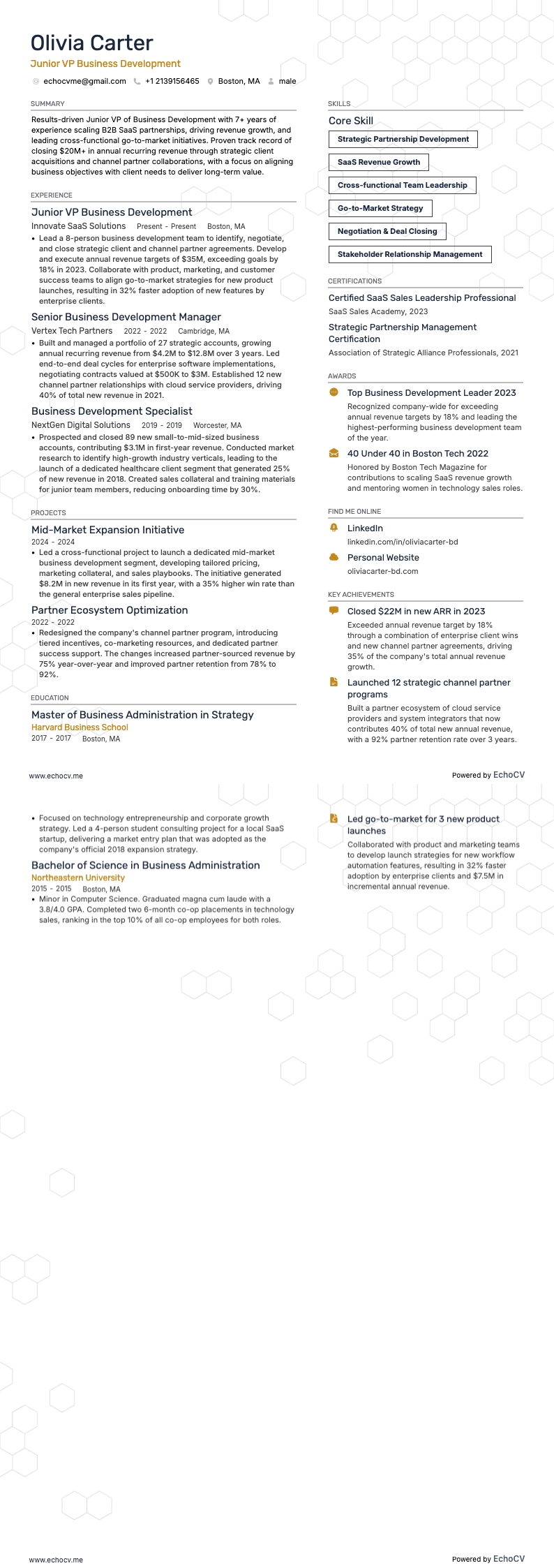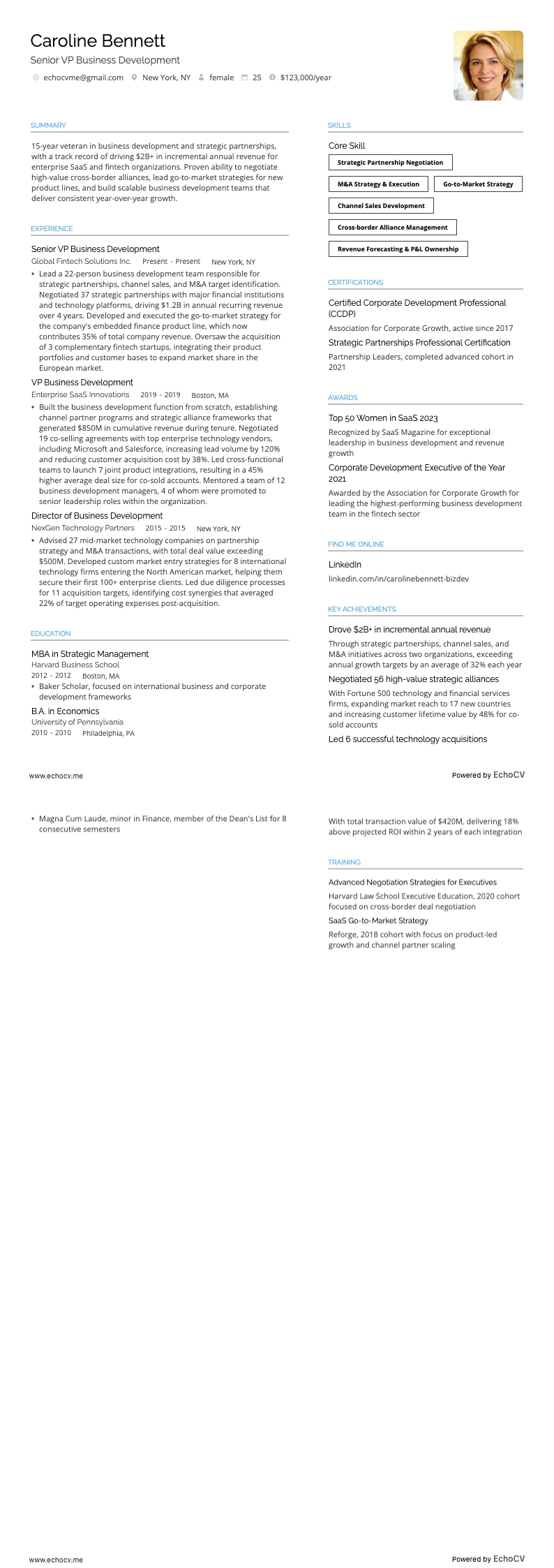
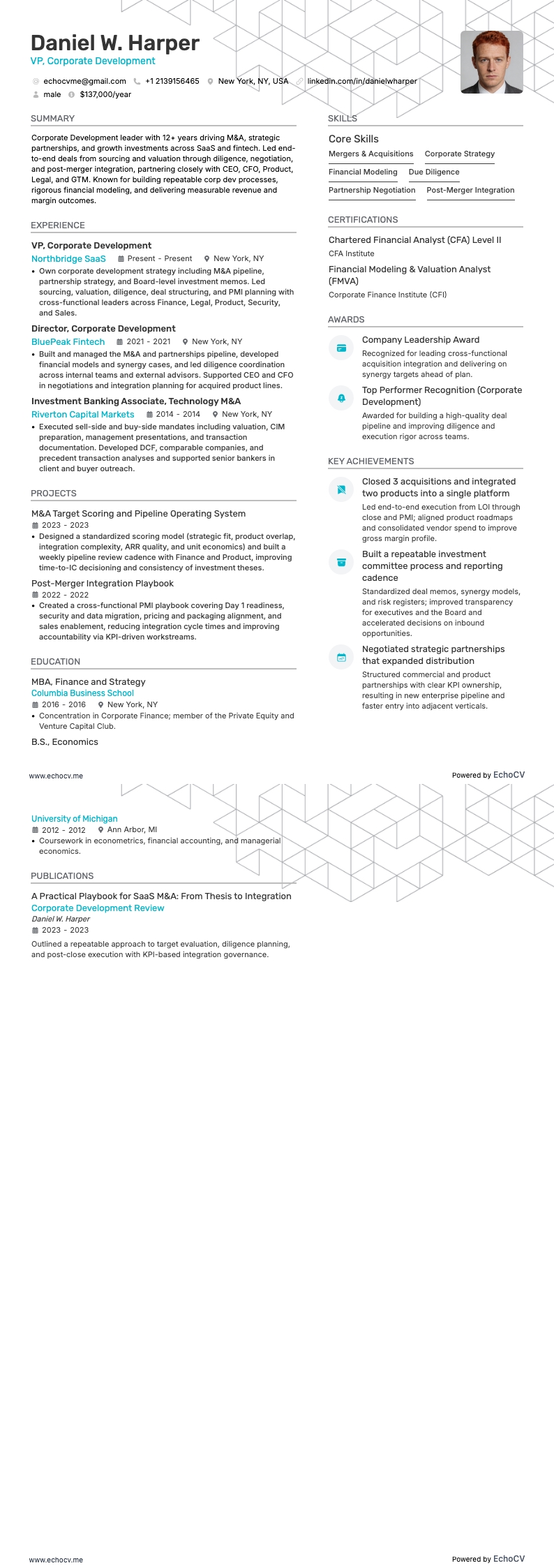
Much better, isn’t it? You get a clear picture of what the job is and how the applicant was able to increase revenue and reach a wider audience. It paints a clear picture of the company, what they do, and how their actions produced positive results.
The work experience uses data-driven examples, like “...distributing strategies to grow the whole line of 5000 SKUs while reducing overstock by 15%.” and “grew distribution to over 540 partners.”
This shows evidence of how they were able to save the company money while expanding its reach. When listing your past work experience, include precise details of all related tasks and how those duties created profitable results.
These brief examples show the importance of creating a detailed history of your related work experience when applying for a VP of business development position.
If you are searching for a VP of business development position in a similar industry, you can further tailor this section for a more targeted resume. And in this article we go over in-detail about how to make a Canada-specific resume
How to quantify impact on your resume
Recruiters and corporate headhunters want to see actionable results that they can point to and say, “This is the type of employee we want.”
When listing your past work experience, it is extremely important for you to show how your actions had a quantifying impact on the organization. Potential employers want to see how your actions have improved the overall company and increased sales and revenue.
Here are some ways to show a quantifying impact while detailing your past work experience:
- Include numbers and percentages of revenue growth – “Managed a global lead generation budget of $100M to drive 1.5x growth.”
- Detail the percentage increase in employee acquisition and retention - “Developed a team of 25 dedicated sales agents, growing territory revenues by over 20% in two years while creating a team focused on collaboration, teamwork, and inclusivity.”
- Quantify the size of closed deals and contracts - “Negotiated terms for business contracts that led to a 10% increase in ACV.”
- Mention the value of market expansion - “Led the expansion into bordering state markets that led to a 14% increase in revenue.”
- State the size of teams led and developed - “Managed six teams of sales agents of eight to ten agents per team in different locations across the region.”
- Provide figures on cost savings gained through initiatives to improve operational effectiveness - “Organized and implemented cost-cutting initiatives, such as identifying wasteful practices and implementing new work methods that led to an 8% decrease in cost while increasing productivity by 3%.”
- Indicate the scale of projects managed - “Pioneered new product development that resulted in a 60% increase in sales.”
Including actionable numbers on your resume is vital to show hiring staff that you know the job well and can produce impressive results.
In the next section, we will go over how to create a VP of business development resume for applicants who are looking for their first Vice Presidential role.
How to list your hard skills and soft skills on your resume
A resume should highlight your personal and professional experiences that are essential for becoming an effective VP of business development.
What are hard and soft skills?
Hard skills are those skills you learn in school and work. They include necessary skills like project management, contract management and negotiations, developing revenue growth strategies, account management, and many more.
Soft skills include more personal skills, like showing empathy and compassion, being an effective communicator, and time-management skills. These are the skills you pick up naturally through personal life experiences.
When including your hard and soft skills, study the job description closely and include any required hard or soft skills the company wants.
You can break your skillsets into separate relevant sections:
- Technical skills - list any experience with CRM and data analysis software along with standard office software like Microsoft Word, Excel, PowerPoint, and other business software.
- Interpersonal skills - Employers want to know you can effectively communicate with all levels of employees, from C-suite executives to entry-level employees.
- Industry-specific skills - This includes experience with account management, product development, new hire acquisitions, and other necessary skills.
A quick note about listing hard and soft skills and applicant tracking software. When listing your skills, they need to match what is in the job description.
For example, if the job description lists project management as a required skill and your resume says project managing, tracking software will not recognize it. This is why it is important to study the job description thoroughly.
Check out this guide for a list of hard skills by industry that you can include on your resume.