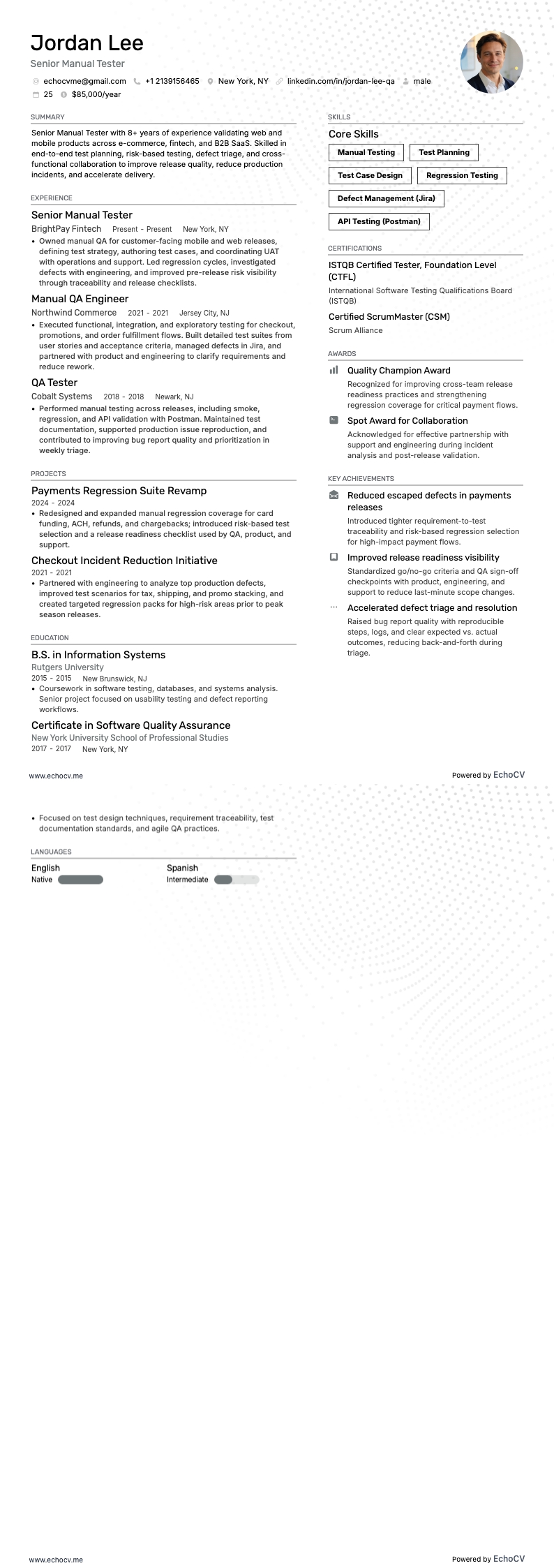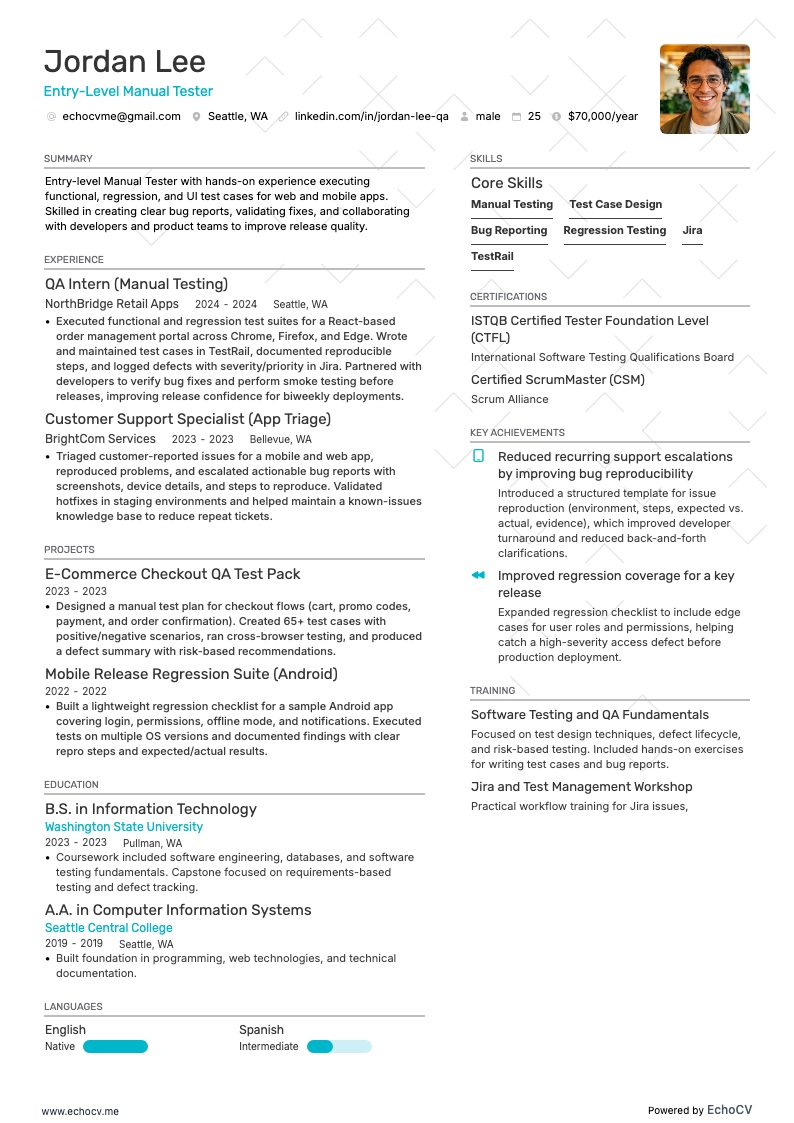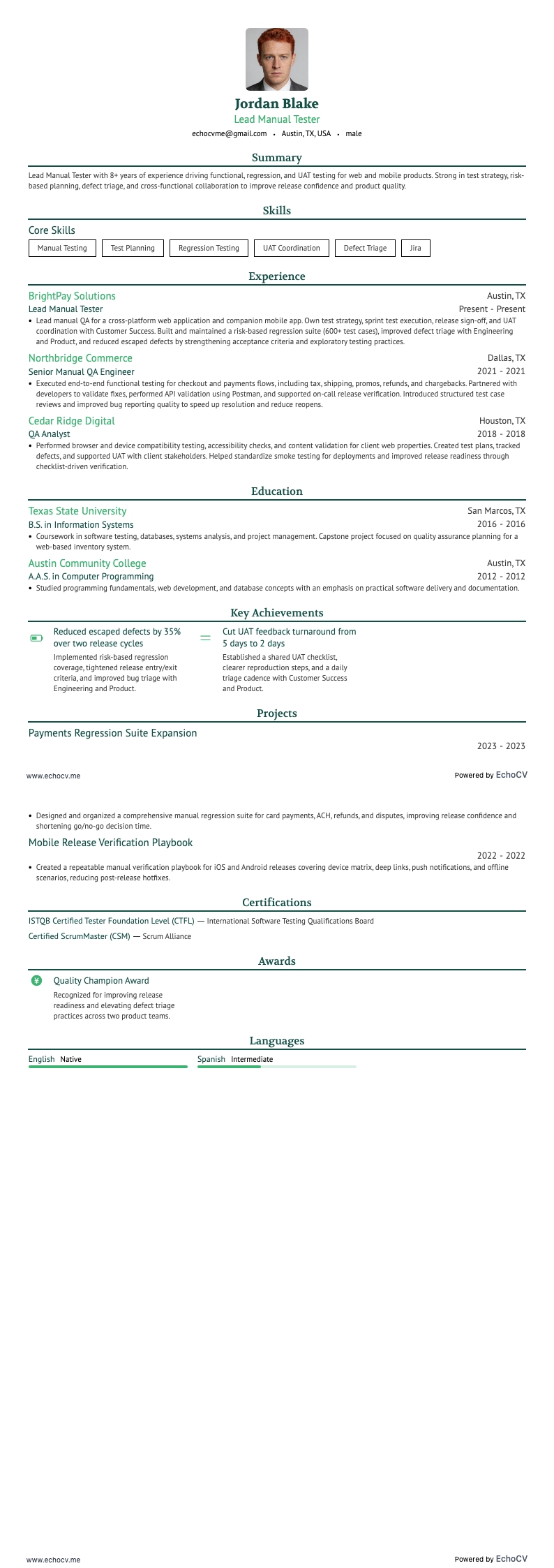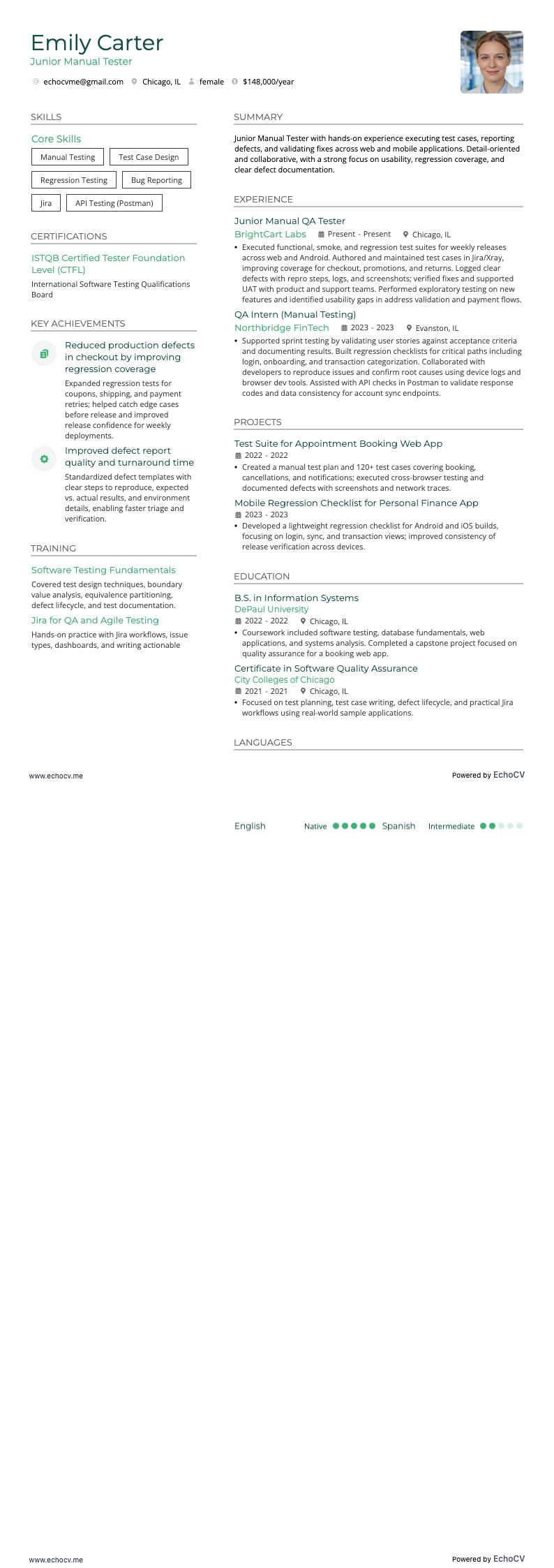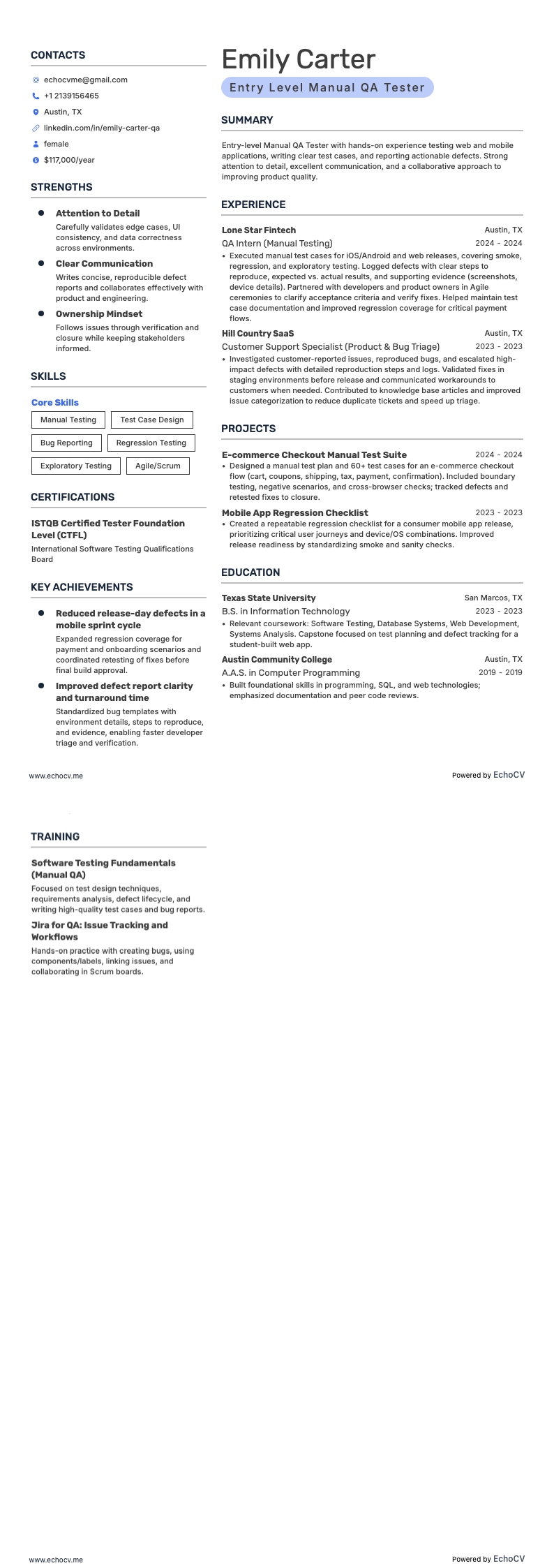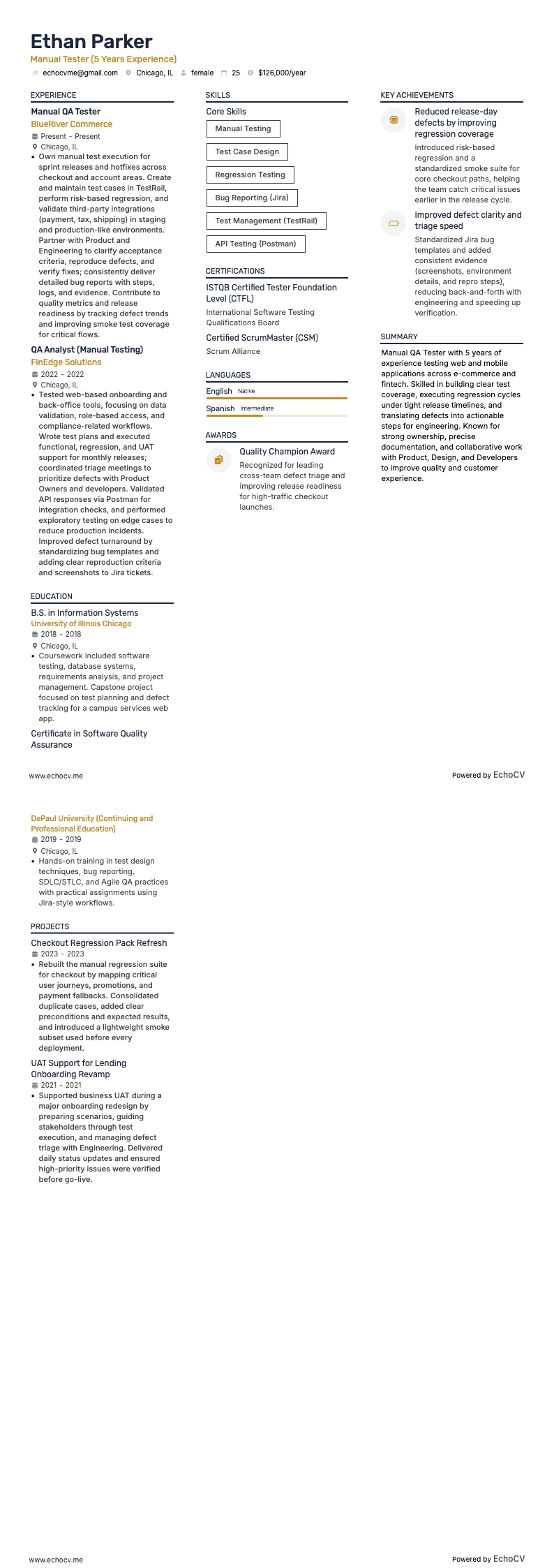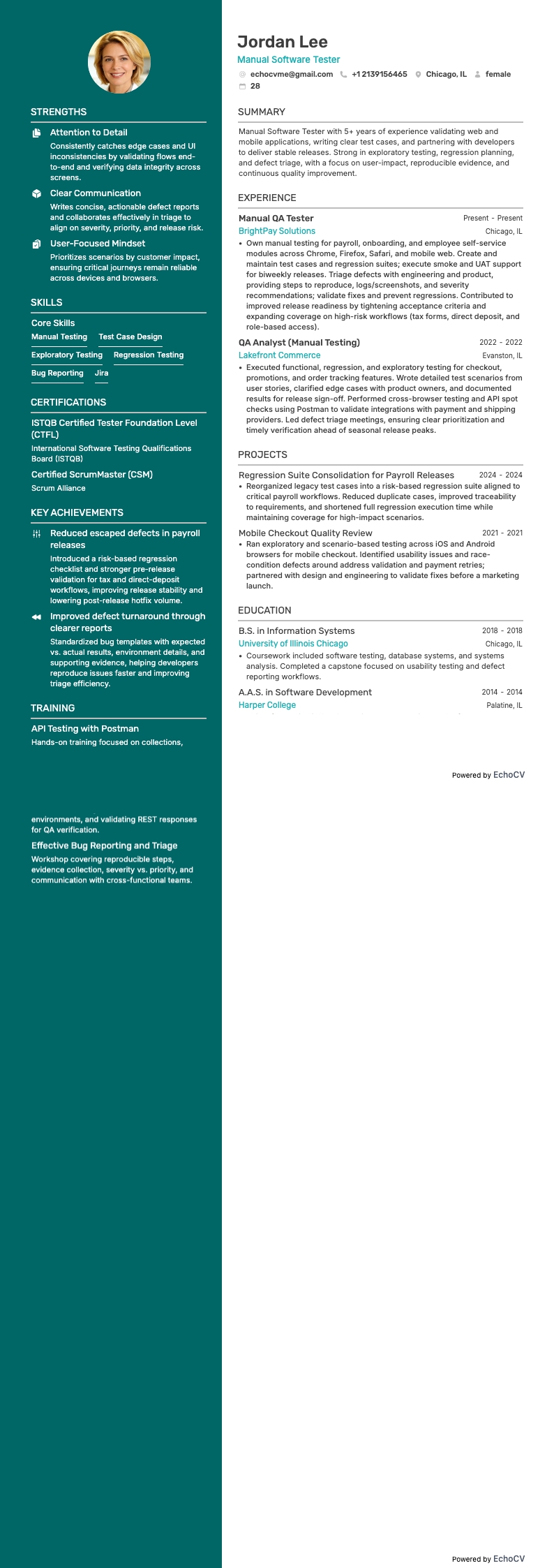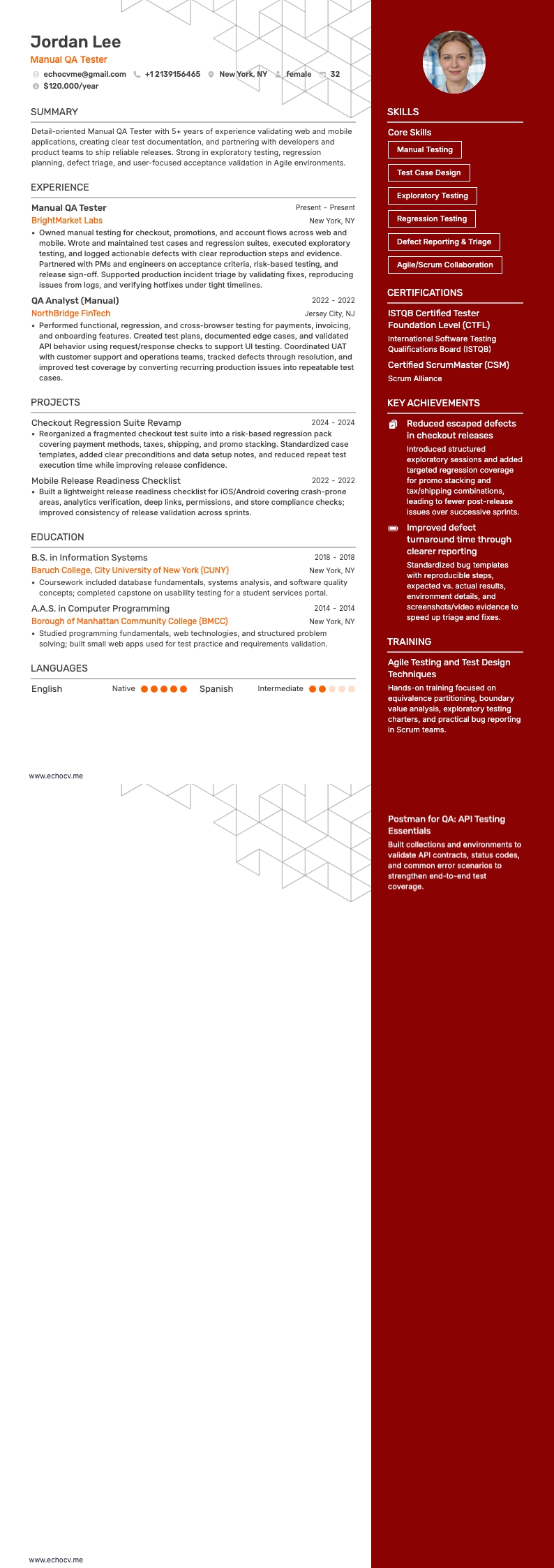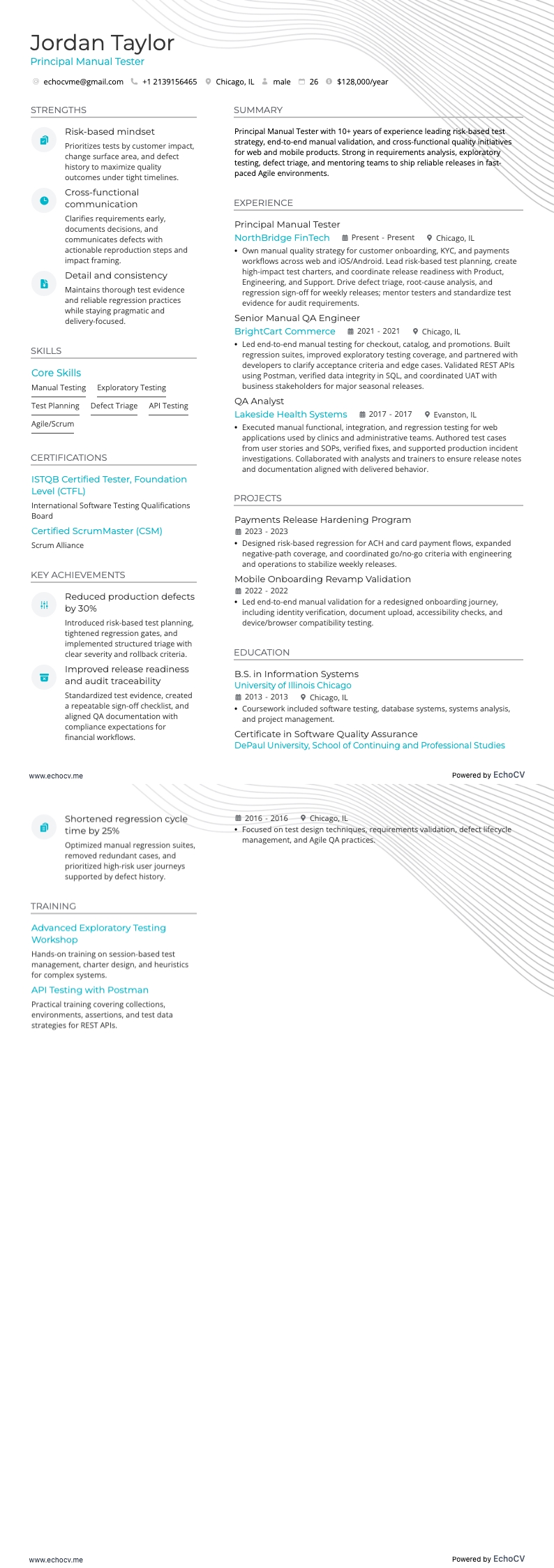
Getting noticed as a QA professional is tough. You must prove you’re the jack-of-all-trades recruiters have been searching for all along.
But how do you demonstrate a multifaceted background on your manual tester resume?
Skriven av EchoCV-teamet
Getting noticed as a QA professional is tough. You must prove you’re the jack-of-all-trades recruiters have been searching for all along.
But how do you demonstrate a multifaceted background on your manual tester resume?
How to outline your experience by showing you industry-tested resume examples
How to arrange each section, based on who the prospective employer is
Which technical skills for manual testers to list on your resume to leave a lasting impression
How to frame your work history, regardless of how much experience you have
Keep reading for tons of actionable tips, as well as manual tester resume samples!
Good manual testers are known for their critical thinking and analytical skills. Like good detectives, they have the investigative know-how and years of experience to uncover defects and guesstimate where bugs tend to go into hiding.
—Ruslan Desyatnikov, Founder and CEO of QA Mentor, Inc.
You may be a QA guru, but your expertise won’t mean anything unless your resume is properly formatted.
Among some of the most common reasons why a resume never reaches a recruiter’s desk is a wrong layout and poor design choices.
Correct formatting is critical to pass the Applicant Tracking System (ATS) checks and, later down the road, win you an interview.
When it comes to your manual QA tester resume, we recommend you:
Keep in mind the market you’re applying to – a Canadian resume, for instance, might have a unique layout.
Once you select the general layout of your resume, you must decide which sections to add.
Depending on how much practical experience you have, the arrangement of the sections will vary.
If you’re yet to make progress in the QA industry, list the education section near the top of your resume.
But if you’re a tenured professional, start with your work history in a reverse chronological order.
Generally, manual testing professionals aren’t required to have in-depth understanding of programming languages. As such, the industry has a low entry threshold.
What’s more, this makes most junior QA resumes look almost identical.
So, to stand out among other job candidates, reference tools and tech skills in the experience section whenever possible.
Don’t forget to share how you’ve applied them in practice and what goals you’ve reached in the process.
This will let recruiters determine the current scope of your expertise. And whether you’ll be able to assist with hybrid testing projects in the future.
Another way to ensure you’ve built a powerful resume is to include personal projects which showcase other relevant job skills.
Take a look at the sample experience section and think about what it says about the applicant.
It gives the impression of a very hastily made resume with not much thought put into the writing process. Some of the more glaring issues include:
Taking into account the above points, here is an improved version of the example:
When talking about your work history, you must be able to quantify your accomplishments.
As you’ve already seen in the example section above, data and numbers play a crucial role in supporting your claims.
Having this in mind, consider factors such as:
If you have a signed non-disclosure agreement (NDA), remember not to expose any sensitive information when referencing past projects in your resume.
If you’re switching careers or you’re fresh out of college, there are a few things you can do to build a foolproof resume:
You won’t always be able to completely align your talents with the job description. And you shouldn’t.
Hiring managers value applicants who are willing to admit when they don’t know something. Still further, they prefer candidates with an intense drive to learn new skills.
So, don’t get discouraged!
This is a good opportunity to balance out your resume skills section. Create a nice mix of your:
Remember, results and data are much more convincing than just empty words. So, for each of the skills you add to the section:
Compare the list of skills you have with the ones listed in the job description.
If you’ve already covered the must-have portion of the requirements, here are other key skills you can list:
As we mentioned in the beginning of this guide, if you’re aiming to win a corporate position, you must emphasize your academic background.
If you have more than five years of experience as a QA professional:
But if you’re switching careers or a college grad:
Have a look at the sample education section below for reference:
If you want to include a certificate on your resume, always check the date of validity before adding it.
With that in mind, if you’re just starting out as a QA specialist, any of the ASTQB(ISTQB) certifications will boost your chances of getting an interview.
Experienced manual testers should feature advanced-level qualifications, such as CSQA or CQE.
For other essential QA certificates, check out the table below:
Although the experience section is by far the most significant part of your resume, what really gets your foot in the door is the resume summary.
This is the small box at the top of your resume, where you highlight your best career milestones, strengths and qualifications.
If you have lots of QA experience, make sure to choose achievements which make sense for the role at hand. It’s important to show how your expertise will benefit potential employers.
By contrast, if you’re a novice manual tester, write a compelling resume objective.
How is it different from the resume?
Technically, they are very similar in terms of content and format.
But the focus of the resume objective falls mainly on how you will apply your current skills to the benefit of your future employer.
Have a look at the following sample manual tester objective. Do you think it’ll impress hiring managers?
This example doesn’t say much about the candidate, apart from information that could be found elsewhere in the resume.
As a result, Lucas has wasted the opportunity to stand out with a unique talent or an accomplishment. He also hasn’t hinted at how his talents could work in favor of the company.
And while he has listed quite a few skills, there is no mention of how they were applied in practice.
Let’s revise it:
This version is cleaner and provides an excellent overview of Lucas’ abilities and how they were acquired. Plus, the focus is not only on his tech skills, but also social skills necessary for the role.
Last but not least, Lucas shows that he is a competitive individual who adheres to current industry standards and practices.
You can always add extra sections with relevant information about your professional growth.
These segments include, but are not limited to:
As with any other tech-related job, personal projects and case studies is what catches the eye of both recruiters and team managers.
When listing a project on your resume, make sure you:
In the end, your entry should resemble the one below:
Take into account your experience before choosing an appropriate resume format;
Link to a portfolio with case studies in the header;
Emphasize how you can contribute to the company’s goals in the summary;
Lead each experience section bullet point with an action verb;
List your academic qualifications and relevant certificates;
Present a well-rounded skills section;
Feature a personal project which highlights other job-related talents you have.
Utforska fler Manuell testare-CV-exempel och guider och se vad som fungerar för din erfarenhetsnivå eller roll.