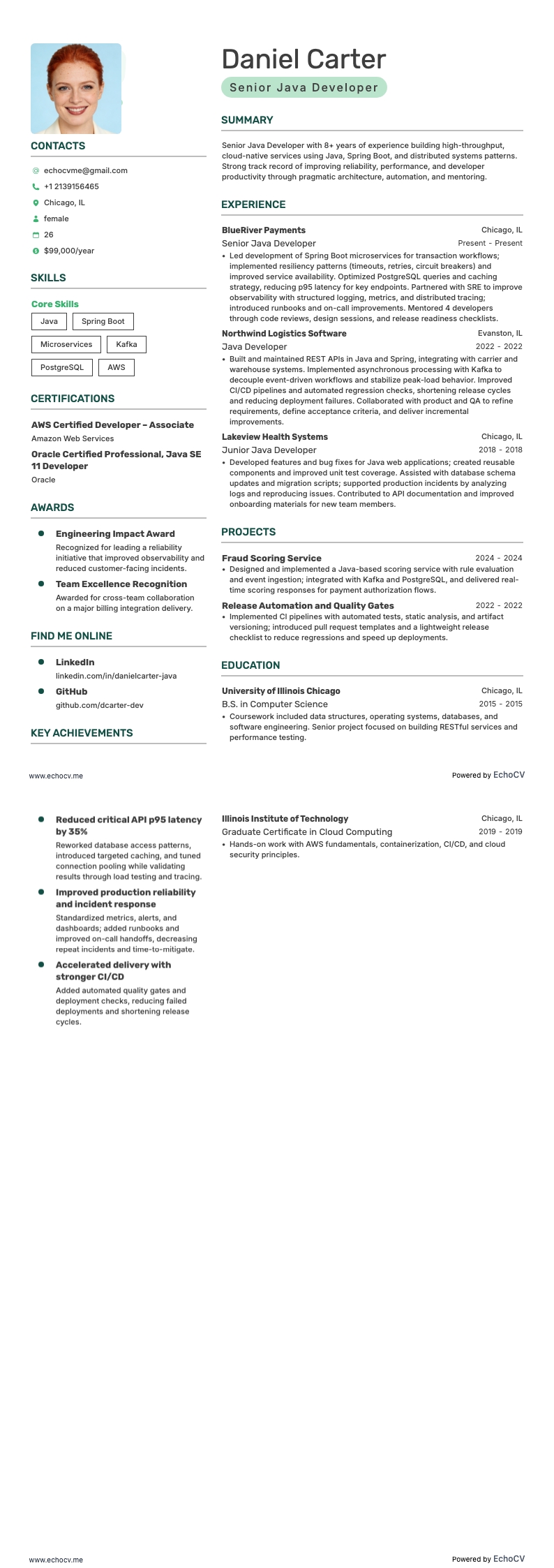
What’s right here:
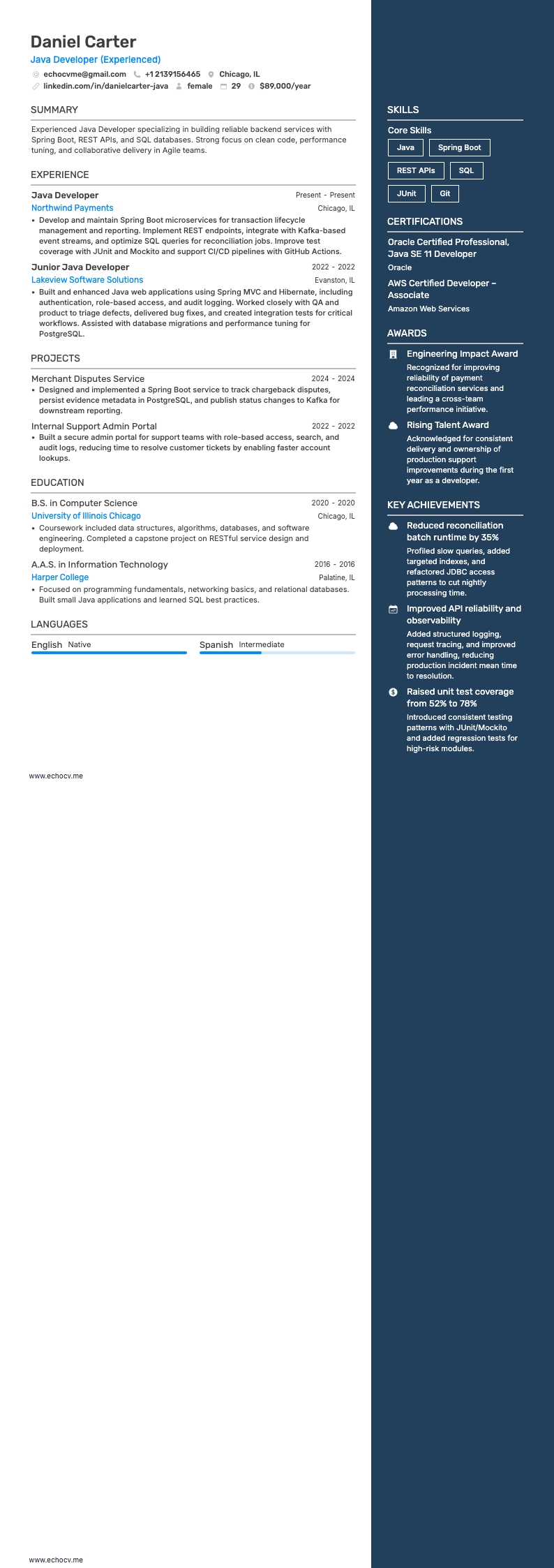
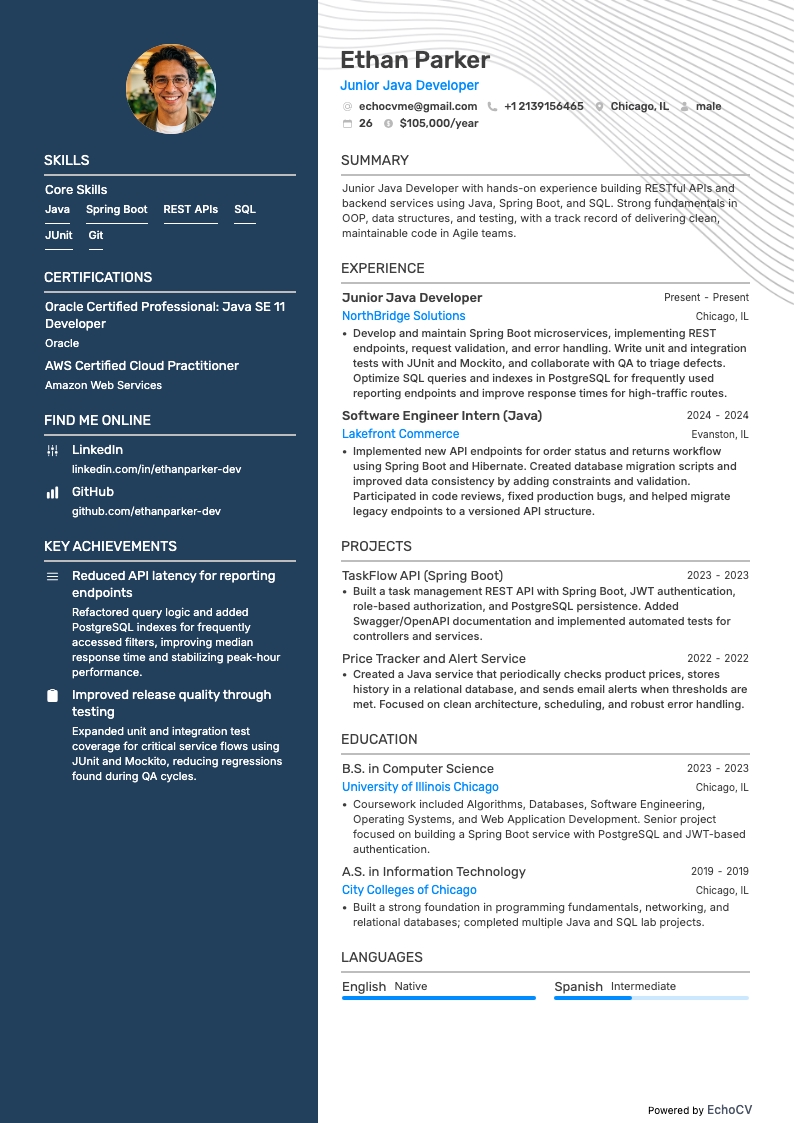
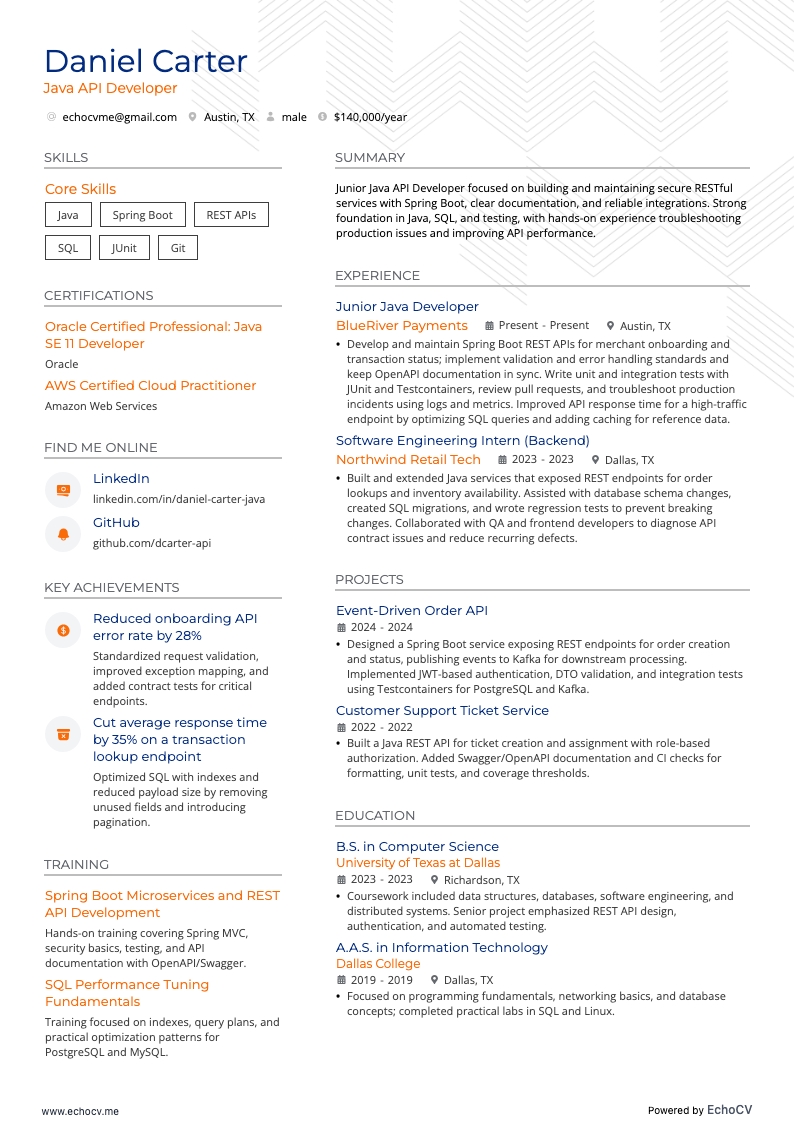
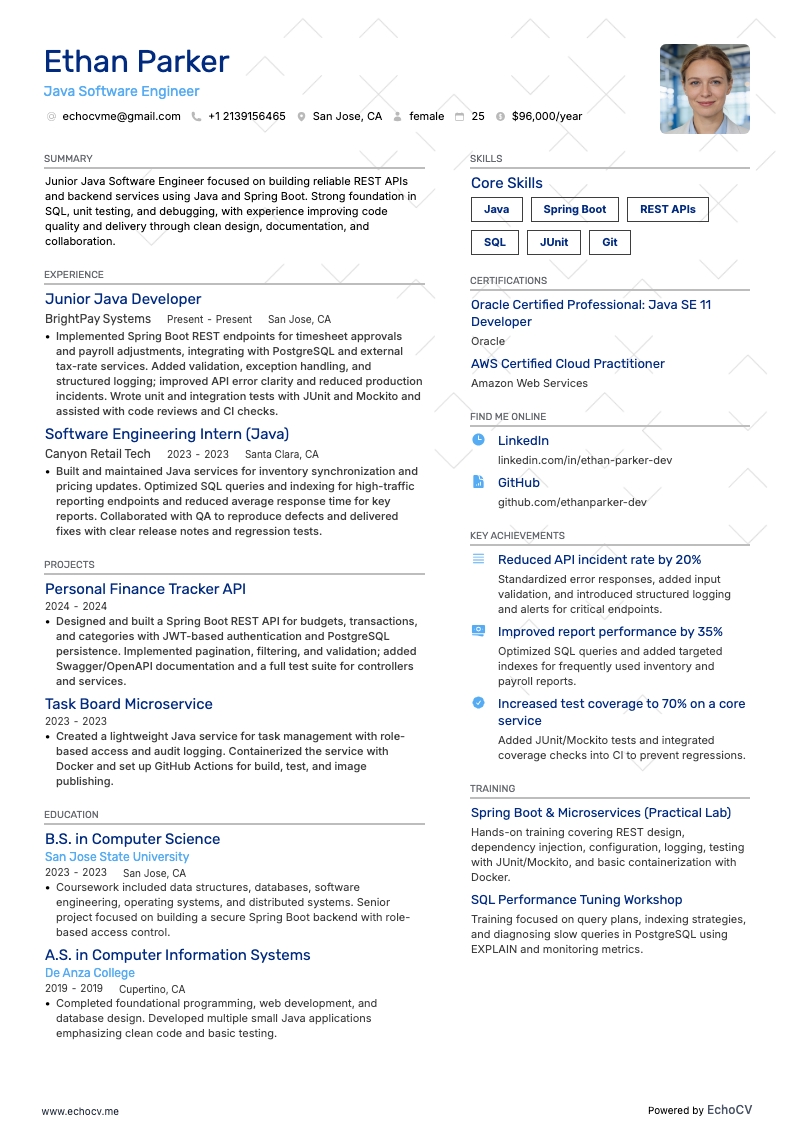
- The candidate gives specific information on what their work was focused on.
- They name the technologies they’ve worked with most.
- To each completed task or project mentioned, they add context and impact: “increasing customer satisfaction by 52%”, “cutting new code commit timeframes in half”, and “raising deliverable code quality by 23%”.
- This example shows the difference between:
- “Wrote Java code” (wrong) and “worked on high-impact Java applications, using Java EE 8 and Spring Boot” (right).
- “Worked on e-commerce project” (wrong) and “developed custom e-commerce payment method, increasing customer satisfaction by 52%” (right).
- “Participated in the debugging process, using AI” (wrong) and “implemented changes to bug-finding AI algorithm, raising deliverable code quality by 23%” (right).
How to quantify impact on your resume
A common mistake people make is just listing their job responsibilities.
Hiring managers and even non-technical recruiters already know what a job as a Java developer entails.
So instead, focus on your accomplishments at each job.
Before writing a bullet point under your job entry, ask yourself two questions:
1. What did I contribute?
2. What special acknowledgments was I given?
Did you add key new features to the app you were part of developing?
Were you put in charge of database integrations due to you being especially skilled at Big Data and SQL?
Were you promoted to junior Java developer after spending only two months as an intern as opposed to the regular six?
Did you excel at learning about and creating cloud microservices and APIs?
List out everything that makes you stand out from every other person with the same job title of Java developer.
Such as…
- Highlight coding projects: Emphasize any coding projects or tasks, indicating the number of lines of code written or the percentage improvement in efficiency. This demonstrates your hands-on coding skills and your ability to contribute tangibly to software development.
- Quantify problem-solving skills: Include specific instances where you used Java to solve problems, noting the scale of the problem and the effectiveness of the solution. This shows your practical application of Java in real-world scenarios.
- Mention collaborative work: Specify the number of team members in projects you've been part of, highlighting your teamwork and ability to work in diverse groups. This reflects your interpersonal skills and adaptability in a team environment.
- Detail your educational background: List relevant Java courses or certifications, including the number of hours spent or specific achievements. This provides insight into your dedication and formal knowledge in Java.
- Include performance metrics: If applicable, mention any metrics or KPIs you helped improve in past roles or projects. This illustrates your ability to drive results and contribute to business objectives.
- Showcase your testing experience: Detail any experience in testing Java applications, including the number of tests written or bugs found and fixed. This highlights your attention to quality and detail.
- Specify tools and technologies: List Java frameworks and tools you're proficient in, quantifying your experience level or the duration of use. This demonstrates your technical skills and readiness to contribute effectively.
- Discuss continuous learning: Mention any ongoing learning or upskilling efforts in Java, quantifying the number of courses taken or hours spent. This shows your commitment to staying current in the field.
Make sure to add quantifiable data to support your accomplishments whenever possible.
Use expressions like “Raised X by X%.”, “Completed Y in half the expected timeframe.”, and “Implemented new code debugging feature, raising team productivity by X%, and cutting project costs by X%.”
How do I write a junior Java developer resume with no experience
You want to kick-start your career as a Java developer without previous dev experience?
No worries, you can still create a killer resume tailored to the junior Java developer position, that will get you calls from recruiters.
Here’s how:
- Focus on your transferable skills
List your work experience, even if it’s not as a Java developer. But phrase it in a way that emphasizes what skills and achievements from those experiences will be useful in your future career as a Java developer.
These are your transferable skills.
Emphasize any project or task that had you tinkering with code, working with developers, using complex software, or anything else even remotely related to software engineering.
For example, say you have experience as a tech recruiter. You may not have written any code yourself, but all you’ve learned about tech while working at a tech company and talking to developers on a daily basis is exactly the transferable skills and knowledge employers want to see.
- Emphasize classes, courses, bootcamps, internships
Did you spend a summer in an engaging full-time Java bootcamp?
Did you complete any in-person or online courses in software engineering or computer science (Coursera, Udacity, etc.)?
List them all, while focusing on what skills you gained along the way, what complex projects you worked on, and any impressive achievement.
- Showcase your certificates
If you’ve received certificates in tech, computer science, programming, Java, or similar through courses, classes, bootcamps, etc., list them in their own Certificates section.
This way they will stand out and it tells the recruiter you’ve put in the extra work to get these certificates and the skills that come with them.
- Focus on your Java projects
Create a separate Projects section and list every and any project you’ve ever done with Java.
These can be projects from school, university, online courses, bootcamps, internships, or just things you’ve done for fun or practice in your spare time.
List them by name, link to them if you can (GitHub, etc.), and describe what each one was about in one-two short sentences.
Make it clear what technologies you’ve used on each project, i.e. “Java SE 9”, “Spring”, “Azure”, etc.
- Highlight your skills
In a separate Skills section list all your Java dev related skills that you already have.
For example: Java SE 11, Java SE 17, Azure, Oracle, Git, Jira, Spring, Python, Agile Methodologies, REST APIs.
And speaking of skills…
How to list your hard and soft skills on your resume
Here’s what you need to know about your junior Java developer skills resume section…
There are two types of skills:
- Hard skills: specific, tangible, evidence-based skills, usually in terms of some kind of software proficiency or knowledge in a specific field.
- Soft skills: people skills, things you are good at that are more general, like leadership and time management.
The best way to list your skills on your junior Java resume is…
- Create a separate Skills section
- List your hard and soft skills one by one
- Phrase them like nouns as opposed to verbs: “time management” vs. “managing my time”.
- Focus on your hard skills more. Hard skills are more relevant for junior Java developer job seekers. Do mention the soft skills you excel at, but list more of your hard, technical skills.
- Add skills you’re actually good at. Don’t add anything that you just think you might get good at eventually. You will be expected to back up your listed skills at an interview and at the job itself.
- Center around skills that are most relevant to Java development. Apart from the obvious ones, focus on other OOP languages you know and software/environments, in which Java is used.
- Tailor your Skills resume section to the junior Java job ad you’re applying to. Check out what skills and knowledge they’ve listed in their requirements section. They do vary a bit from one Java job to another. If the job ad says Spring, add Spring. If the job ad says RESTful APIs, add RESTful APIs. That is, if you do have those as a skill, of course.
It’s also important to keep your resume ATS-friendly. Lots of big companies use ATS (applicant tracking software) to read your resume, having it sort you closer to the ideal candidate profile.
So you want your resume to match as closely as possible in keywords to the junior Java developer job ad you’re applying for. If the skill listed as a requirement in the job ad is spelled like “project management”, then you should also spell it as “project management”, as opposed to “project managing”, “managing projects”, etc.
Now here are the best hard and soft skills you can add to your resume as a junior Java developer: