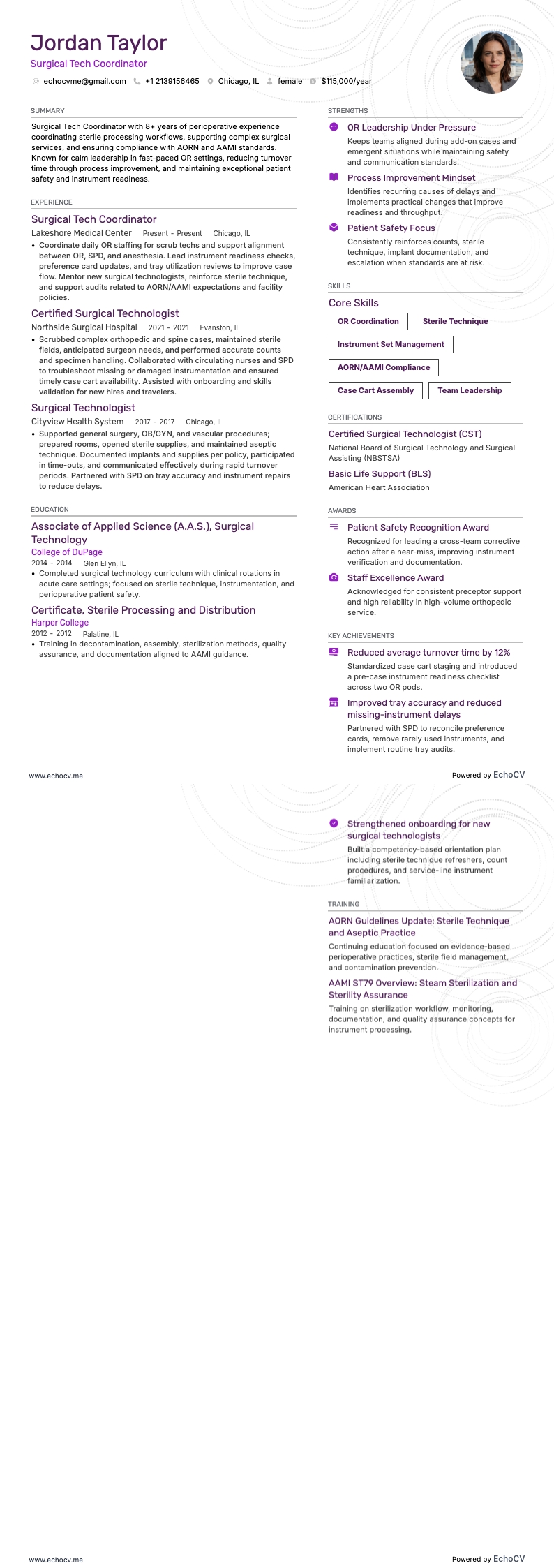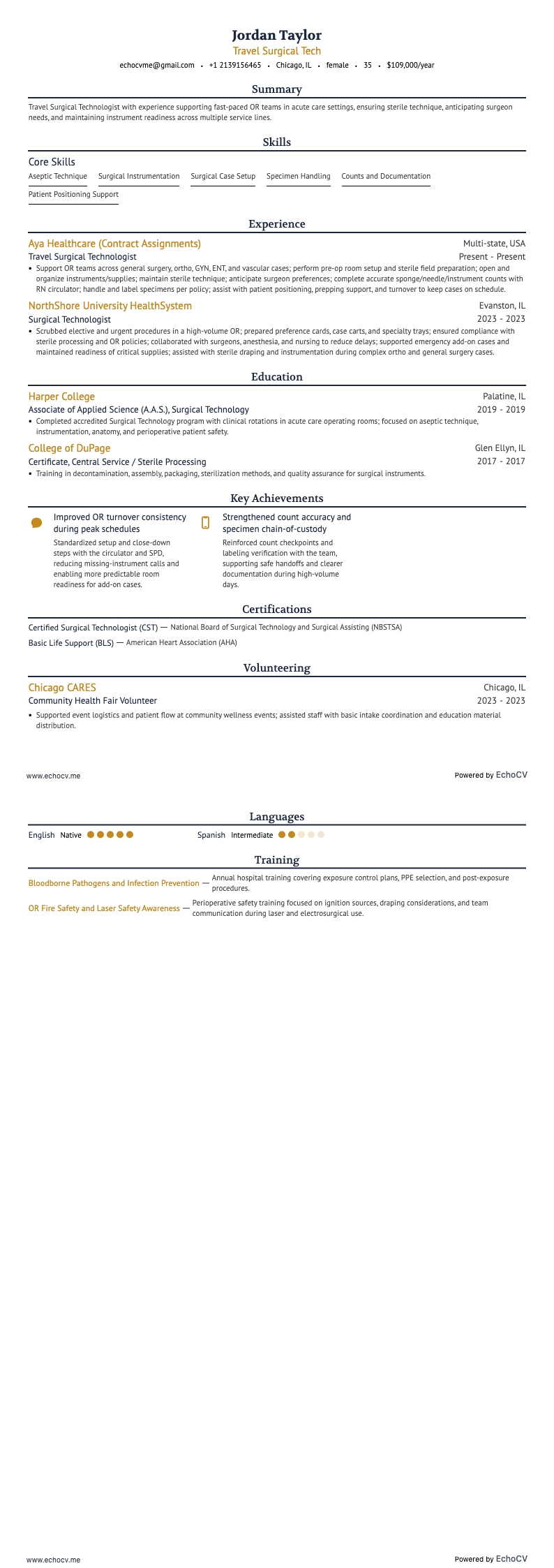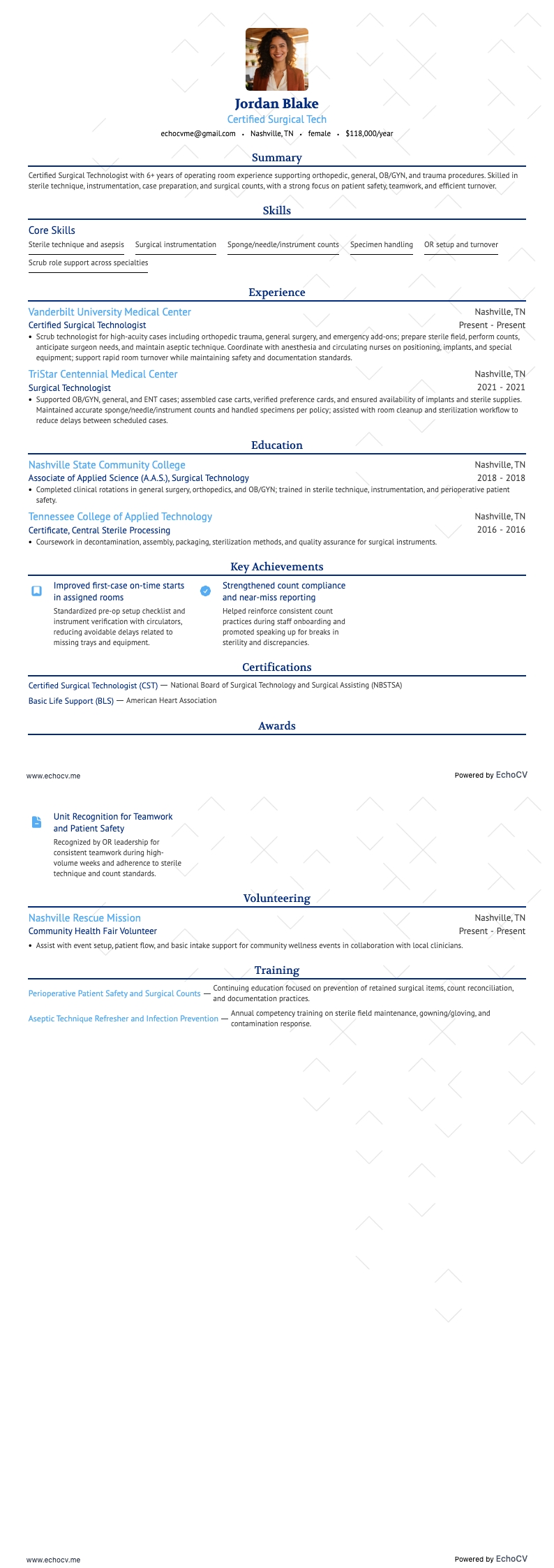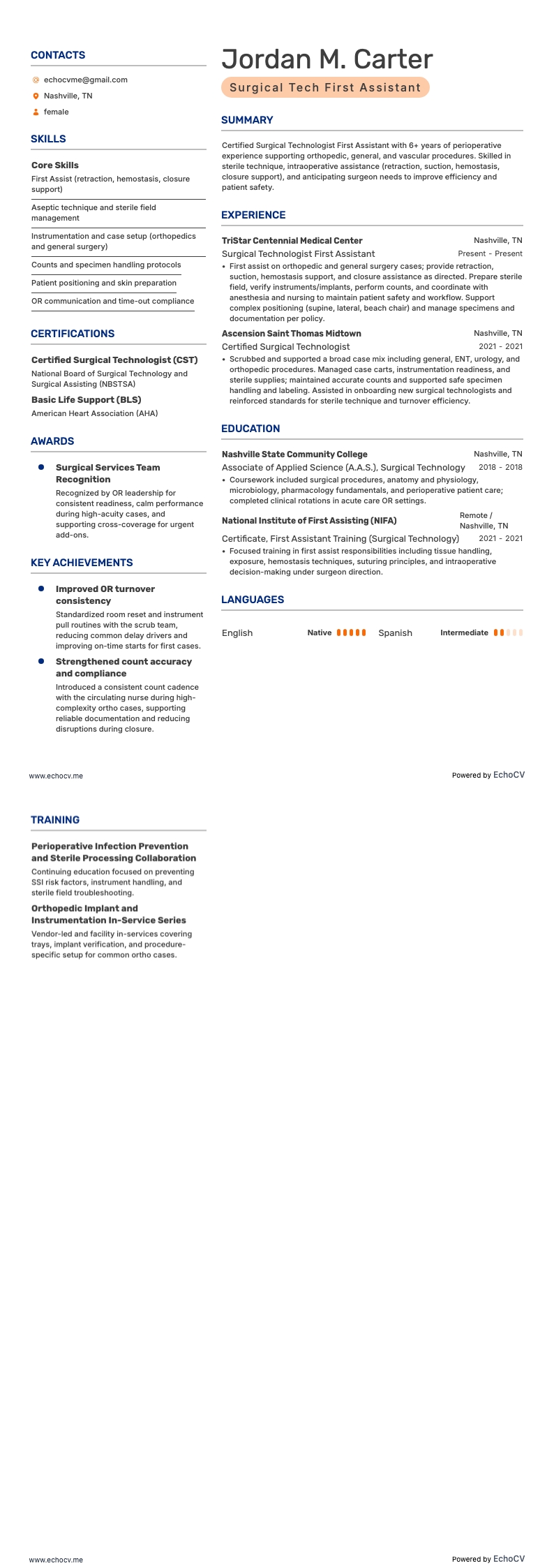
外科手術技師第一助手 完整預覽

14 個外科手術技術員履歷範例

EchoCV

由 EchoCV 團隊撰寫

更新: 5/27/20248 min read

查看本指南中的所有履歷範例,或依照你的個人化提示生成專屬履歷範例

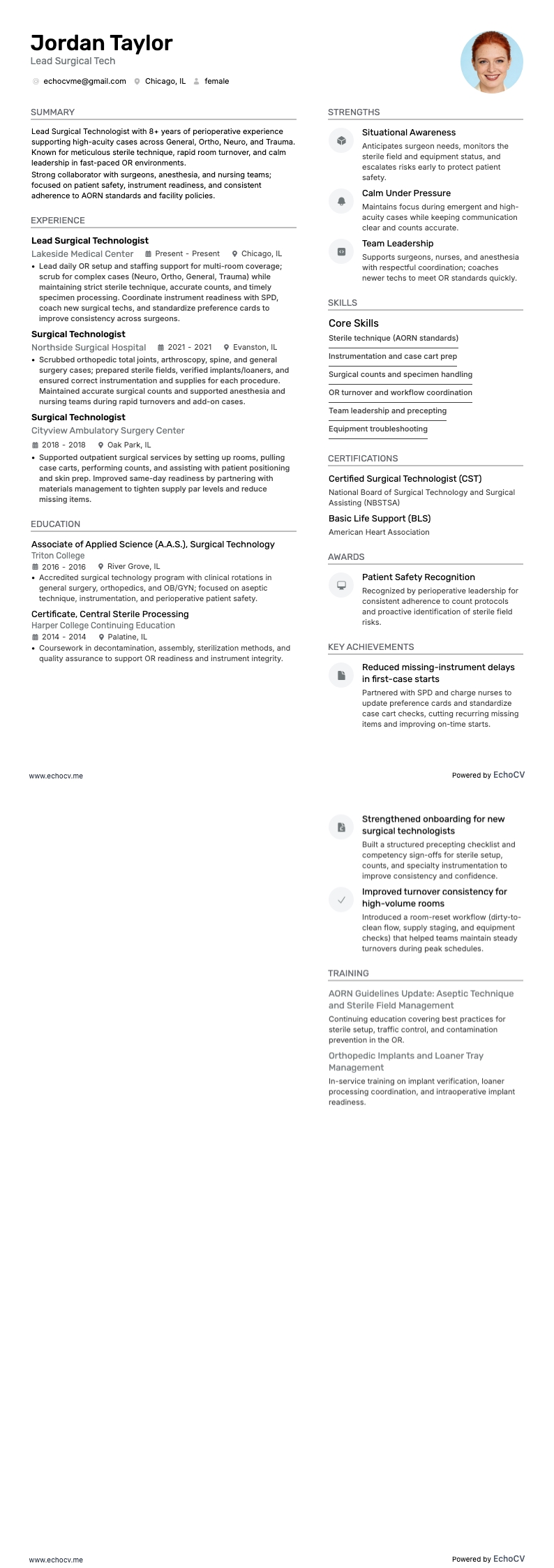
外科手術技師第一助手 example resume
外科手術技師第一助手

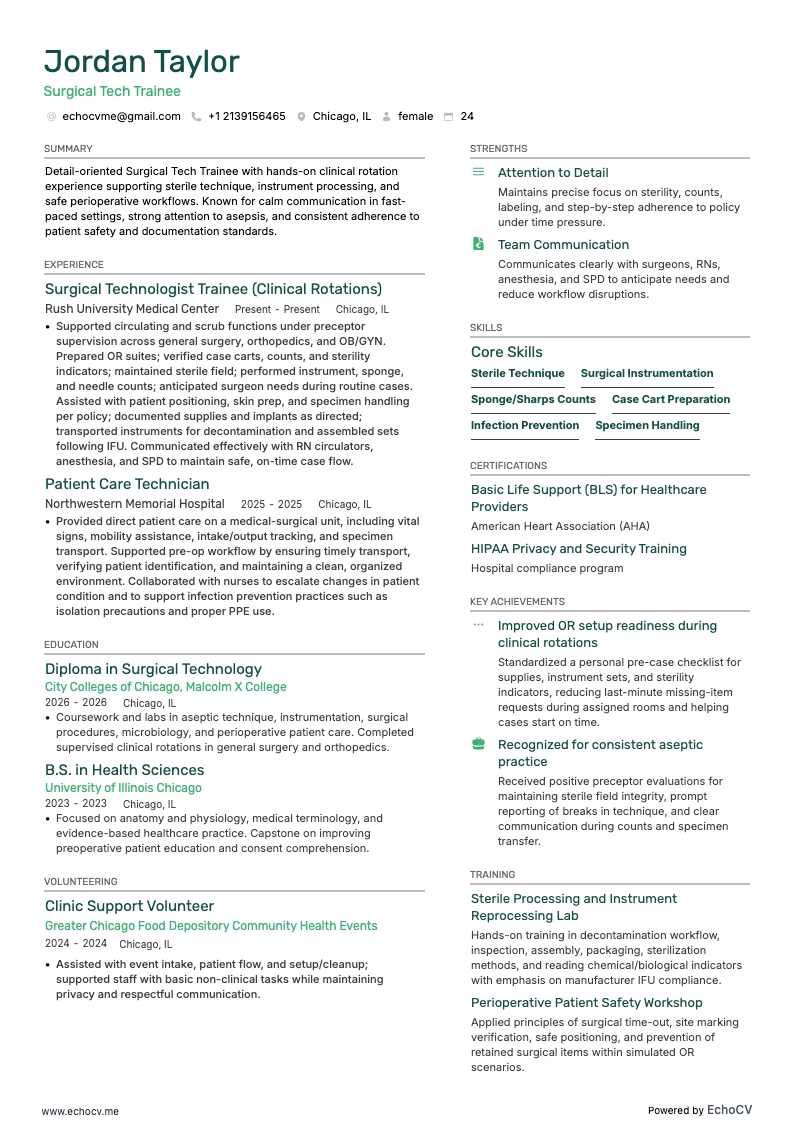
外科技術員培訓生 example resume

外科技術員培訓生

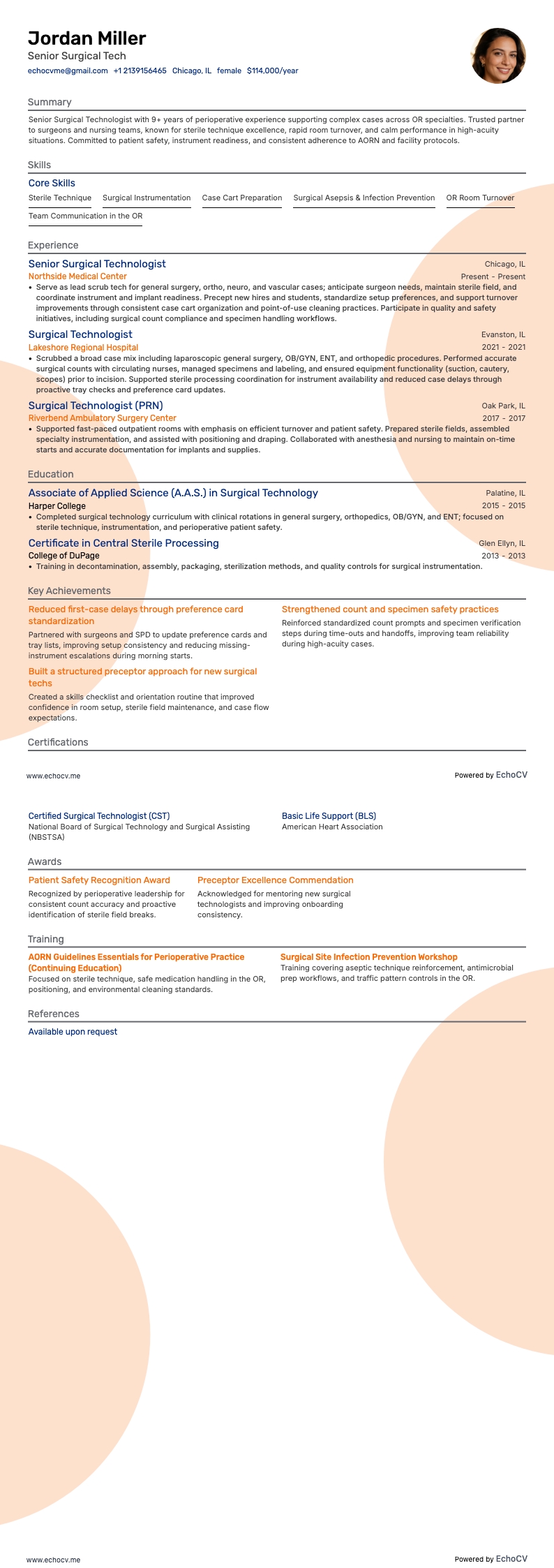
資深外科手術技師 example resume

資深外科手術技師

資深外科技術員 example resume

資深外科技術員

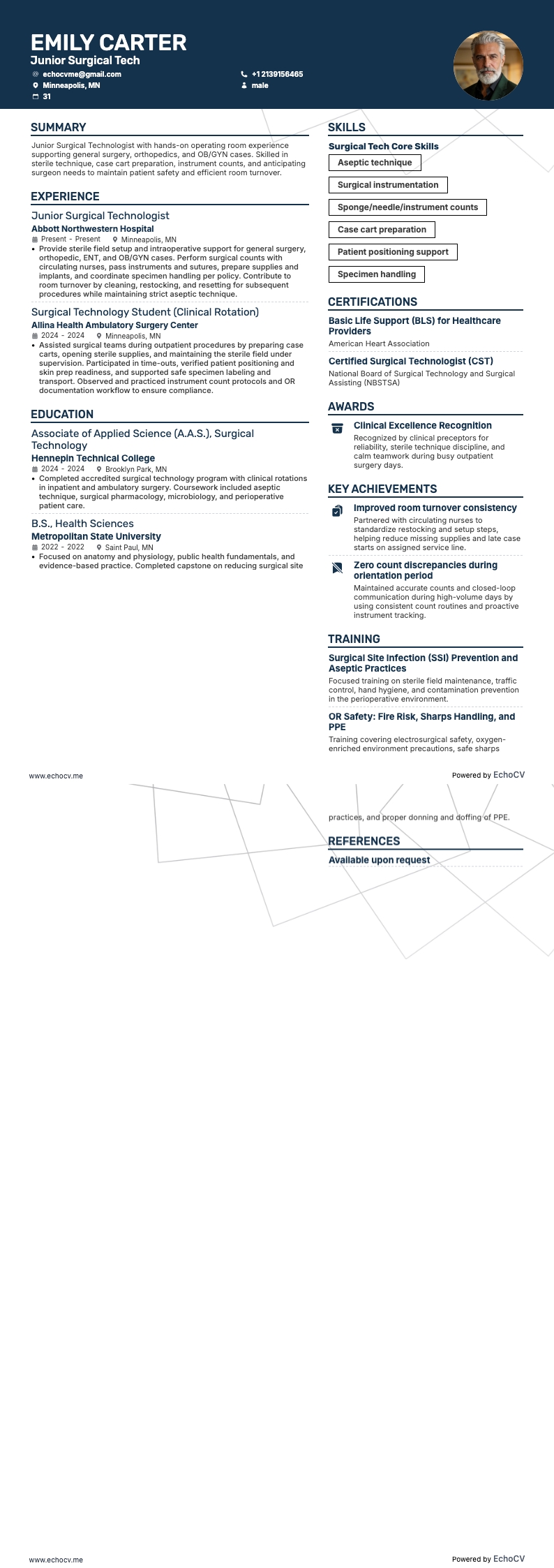
初級手術技師 example resume

初級手術技師

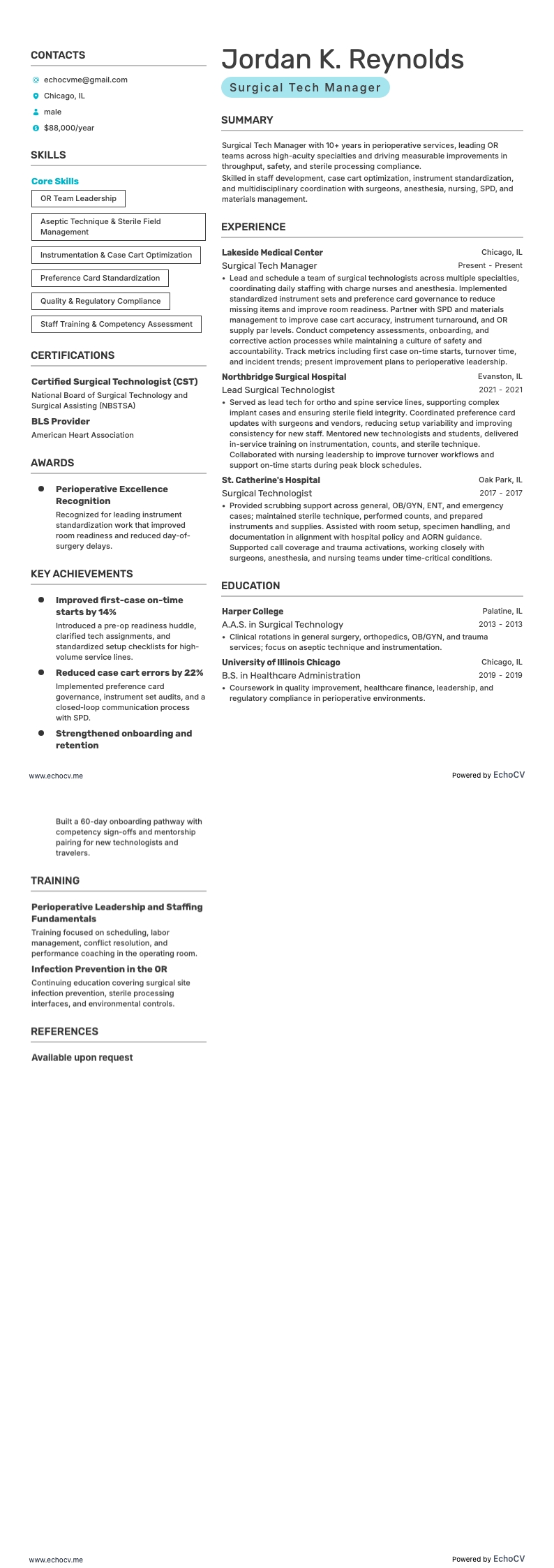
外科技術經理 example resume

外科技術經理

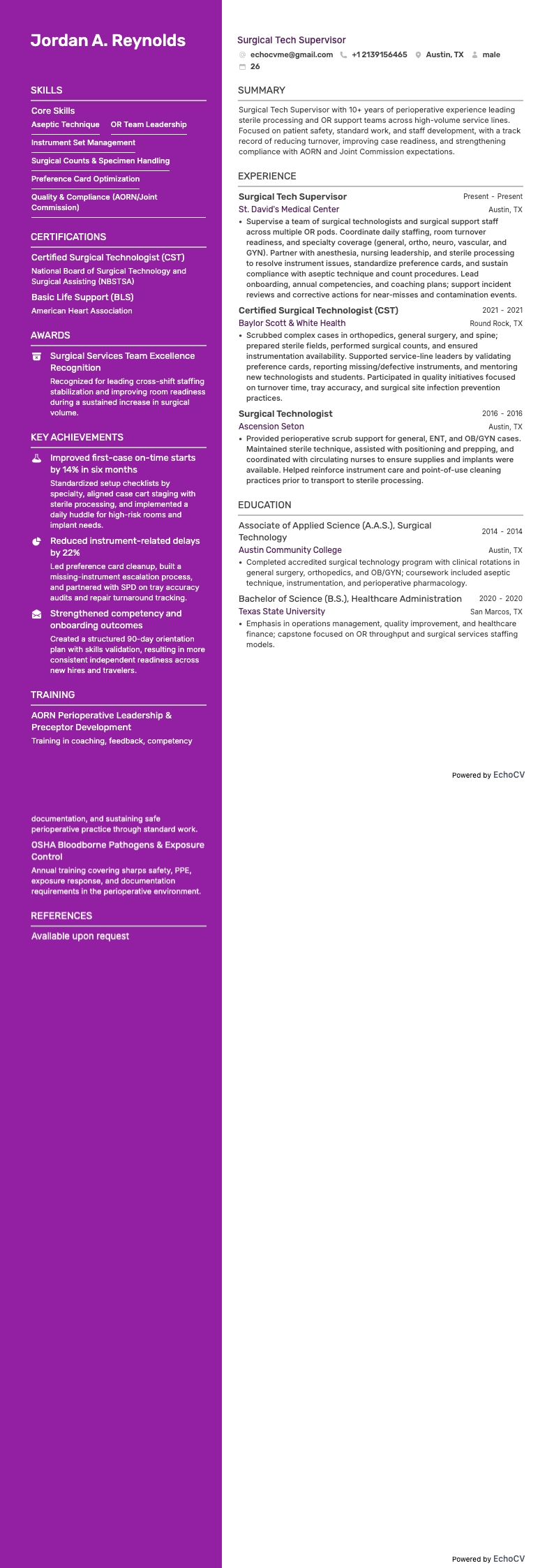
手術技術主管 example resume

手術技術主管

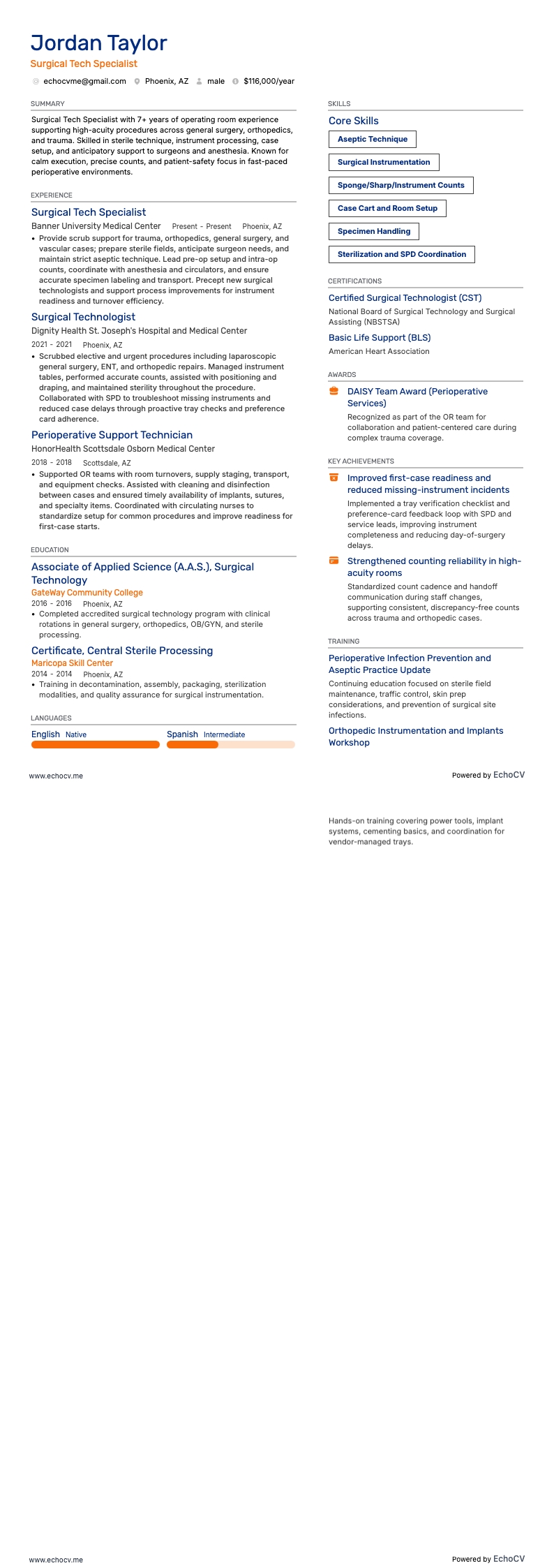
外科技術專員 example resume

外科技術專員

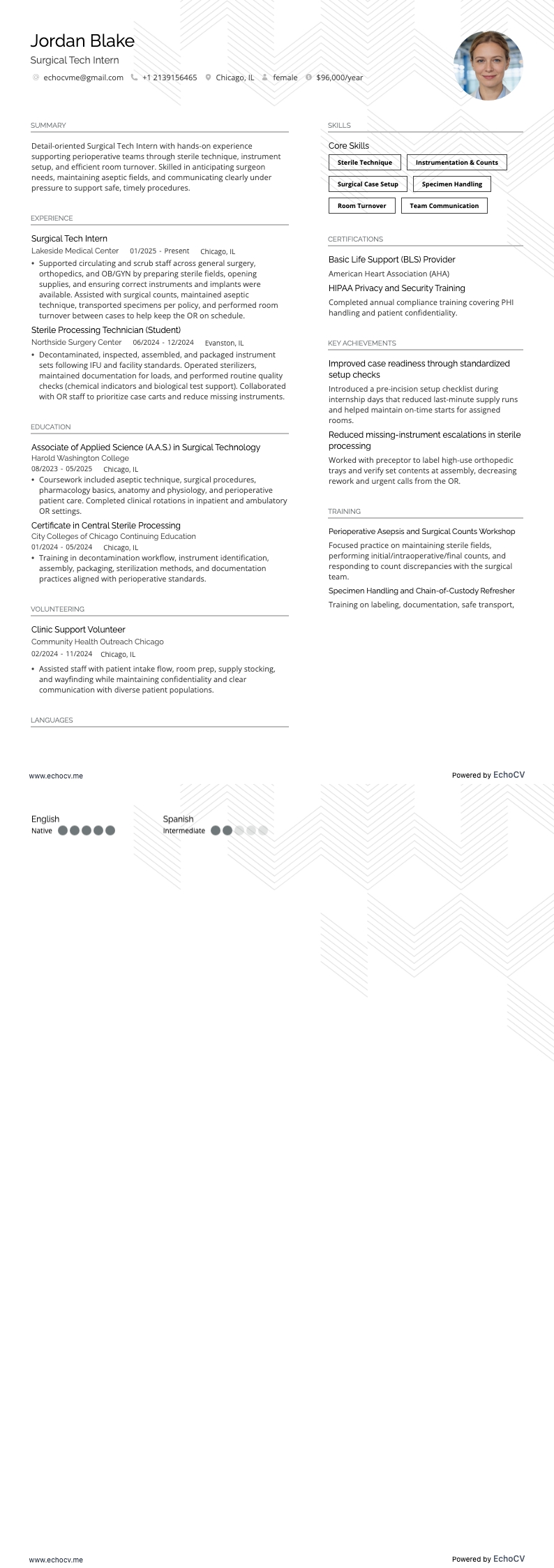
外科技術員實習生 example resume

外科技術員實習生

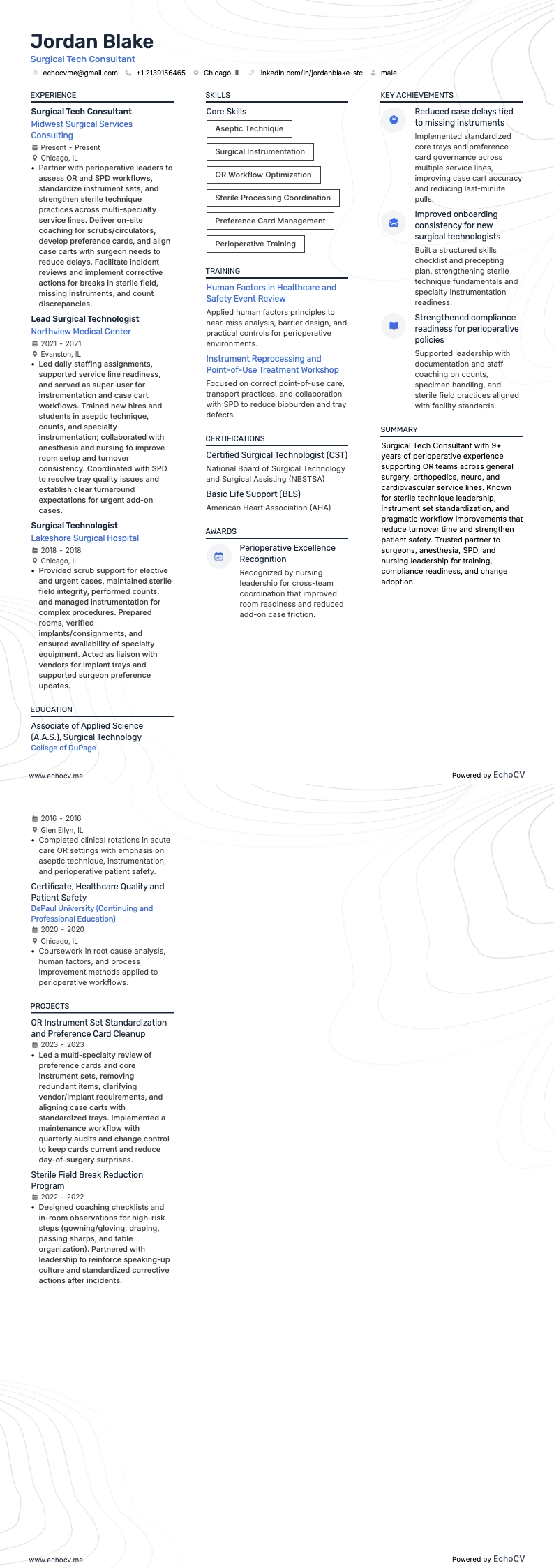
手術技術顧問 example resume

手術技術顧問

手術技術協調員 example resume

手術技術協調員

巡迴手術技術員 example resume

巡迴手術技術員

認證外科手術技師 example resume

認證外科手術技師

Demand for surgical technologists is rising, with jobs projected to grow 6% from 2023 to 2033. But with more opportunities comes more competition—so how do you make a strong impression? A well-crafted resume can give you an edge.

This guide features 14 examples to help you present your skills, certifications, and experience in a way that captures employers' attention.

Key takeaways

  • Use a structured format: A double-column layout keeps your resume organized and easy to read.

  • Tailor your resume to the job: Match your experience, skills, and certifications to the job posting for better results.

  • Quantify your achievements: Use numbers to show impact, such as procedures assisted or efficiency improvements.

  • List relevant certifications: CST and BLS are essential, while ACLS or TS-C can further strengthen your application.

  • Incorporate hard and soft skills: Technical expertise is crucial, but teamwork, adaptability, and communication matter just as much.

  • Optimize for ATS: Use clear section headings, job-related keywords, and a PDF format to ensure your resume passes applicant tracking systems.

To better understand what makes a strong surgical tech resume, let’s look at an example.

Surgical tech resume sample

This resume example is structured to match the key qualifications for a Certified Surgical Technician (CST) role, focusing on relevant experience, certifications, and skills.

Liam Johnson

Certified Surgical Technician (CST)

(317) 555-0XXX | [email protected] | @LinkedIn | Indianapolis, IN


Summary

Certified Surgical Technician (CST) with 5+ years of experience in fast-paced surgical environments. Skilled in maintaining sterile operating rooms, assisting in complex procedures, and managing surgical supplies with precision. Proven ability to collaborate with surgical teams, handle high-pressure situations, and ensure optimal patient outcomes. Dedicated to continuous learning and advancing surgical techniques.


Experience

Surgical Technician

Methodist Hospital, Indianapolis, IN

July 2019 – Present

  • Prepared and maintained sterile operating rooms for over 1,000 surgical procedures, ensuring compliance with safety standards.
  • Assisted surgeons during various surgeries by passing instruments, handling specimens, and anticipating surgical needs.
  • Monitored and managed surgical supplies, ensuring accurate counts before and after procedures.
  • Collaborated with surgical teams to streamline operations, improving efficiency by 15%.

Surgical Technologist Intern

Eskenazi Health, Indianapolis, IN

January 2018 – June 2019

  • Supported surgical teams during procedures, ensuring adherence to aseptic techniques.
  • Prepared patients for surgery, including sterilization of incision sites and proper positioning.
  • Assisted in post-operative care, including specimen handling and room sterilization.

Education

Associate of Applied Science in Surgical Technology

Ivy Tech Community College, Indianapolis, IN

Graduated: May 2018

  • Coursework in Surgical Procedures, Aseptic Techniques, and Operating Room Protocols.
  • Completed over 500 clinical hours in surgical environments.
Certifications
  • Certified Surgical Technologist (CST) – National Board of Surgical Technology and Surgical Assisting (NBSTSA), 2021
  • Basic Life Support (BLS) – American Heart Association, 2019

Skills
  • Aseptic Techniques and Sterilization
  • Surgical Instrumentation and Supply Management
  • Operating Room Protocols
  • Patient Preparation and Post-Operative Care
  • Team Collaboration and Communication
  • Surgical Technology and Medical Terminology

Languages
  • English (Fluent)
  • Spanish (Conversational)

Next, let's explore how you can achieve an equally effective CST resume by following the right structure.

How to format a surgical tech resume

A clear, well-structured resume helps your qualifications easy to review and optimized for applicant tracking systems (ATS). Many hospitals and surgical centers use ATS software to scan resumes for key skills, certifications, and experience before a hiring manager sees them. If your resume isn’t optimized, it might not reach it to the next stage.

Best resume format for surgical techs

A double-column layout is ideal for surgical tech resumes, allowing key details to be easily reviewed. Place contact information, skills, and credentials in a narrow left column, while allocating a wider section for experience and education. This approach keeps your clinical training and job history clear and structured.

Professional resume design for the OR setting

  • Margins: Adjust the margins to 0.5–1 inch for clarity and balance.
  • Font choice: Use clean, professional fonts such as Rubik, Arial, or Calibri. Set body text at 10–12 pt and section headings at 14–16 pt.
  • Color scheme: Stick to black or dark gray for the content with one subtle accent color for section headings. Avoid excessive color use in a medical resume.
  • Length: Limit it to one page unless you have 10+ years of surgical experience—then a two-page resume may be warranted.

How to list contact information

To improve your ATS score, use standard section headings like “Experience” and “Certifications," and avoid tables, images, or charts that may not parse correctly.
Despite common myths, ATS doesn’t reject resumes for fonts, colors, or columns. Focus on job-specific language, consistent date formatting, and structured bullet points to ensure your resume is both ATS-friendly and easy for recruiters to read.

Save and name your resume correctly

Save as a PDF to maintain formatting unless a job posting requests a Word document.

Use a clear, professional file name such as “Liam_Johnson_Surgical_Tech_Resume.pdf” to keep it organized and easy to find.

Essential resume sections for surgical techs

A strong surgical tech resume is structured with these key sections:

  • Summary: A concise overview of experience and core skills.
  • Experience: Surgical roles, clinical rotations, and primary responsibilities.
  • Education: Degree or certificate in surgical technology.
  • Certifications: CST, BLS, and any state-required credentials.
  • Skills: Sterile field setup, instrumentation, patient preparation, and teamwork.
  • Languages: If applicable, especially in diverse hospital environments.

Using these formatting guidelines creates a clear, structured, and ATS-optimized surgical tech resume that hiring managers can review quickly—helping you secure more interviews.

Already have a resume? Run it through our AI resume checker to see how well it stacks up and get instant feedback for improvement!

Before submitting your application, let's break down how to write an effective surgical tech resume experience.

How to write your surgical tech resume experience

Your experience section should reflect your surgical expertise, knowledge of sterile techniques, and teamwork in the operating room. Use bullet points to outline your responsibilities and achievements, keeping each one concise and results-driven.

What to include

Each role should have:

  • Job title, employer, location
  • Dates of employment
  • Bullet points focusing on skills and quantifiable results

When writing your bullet points, highlight your accomplishments with specific details that add depth to your job duties. Instead of saying "Assisted in surgeries," specify how many procedures you supported weekly, how you improved efficiency, or how you ensured compliance with safety protocols.

Why tailoring your resume matters

Recruiters spend only a few seconds reviewing resumes, so make sure yours:

  • Matches the job posting requirements.
  • Emphasizes relevant surgical skills.
  • Uses keywords to pass ATS scans.
  • Shows attention to detail.

These elements make up a strong, targeted resume. See them in action below as we align an experience section with a real-life job ad.

摘要

About the role:

Are you a detail-oriented professional passionate about patient care and surgical excellence? We’re looking for a Certified Surgical Technician (CST) to join our dynamic team. In this role, you’ll play a key part in preparing for surgeries, supporting surgical teams, and maintaining the highest standards of patient safety and care.

Key responsibilities:

  • Prepare sterile operating rooms, ensuring all instruments and equipment meet safety standards.
  • Assist surgeons during procedures by passing instruments, anticipating needs, and maintaining a sterile environment.
  • Monitor and track surgical supplies, verifying accurate counts before, during, and after procedures.
  • Support patient care by preparing patients for surgery, handling specimens, and assisting with post-operative care.
  • Collaborate with surgical teams, nurses, and anesthesiologists to maintain smooth and efficient operations.
  • Stay current on surgical technology, medical terminology, and procedures to continuously improve performance.

Qualifications:

  • Associate degree or certificate in Surgical Technology from an accredited program required.
  • Certified Surgical Technician (CST) credential required.
  • Basic Life Support (BLS) certification required.
  • 1+ year of experience in surgical environments preferred (new graduates welcome to apply).
  • Strong knowledge of aseptic techniques and operating room protocols.
  • Ability to work well under pressure and maintain focus during complex procedures.
  • Excellent communication and teamwork skills.

Now, look for specific skills, procedures, and certifications mentioned in the posting that match your experience. Ensure those keywords appear naturally in your resume rather than simply copying and pasting them.

Below is a good example of an experience section on a CST resume tailored to the provided job ad.

Professional Experience
Certified Surgical Technician (CST)
Methodist Hospital
Indianapolis, IN
  • Prepare and maintain sterile operating rooms for an average of 200+ surgeries per month, ensuring all instruments and equipment meet safety standards.
  • Assist surgeons in 10+ procedures weekly by passing instruments, anticipating needs, and maintaining a sterile environment.
  • Monitor and track over 1,000 surgical instruments and supplies monthly, ensuring accurate counts before, during, and after procedures to maintain compliance and patient safety.
正確

This experience section aligns with the Certified Surgical Technician (CST) job description capturing the highlighted key responsibilities and skills.

By tailoring your resume to each role, you increase the likelihood of passing both ATS scans and recruiter reviews—helping you land more interviews.

How to quantify your experience on a resume

Adding measurable results helps employers see your contributions more clearly. Numbers make your impact tangible, whether in efficiency, accuracy, or surgical support.

Examples of quantified surgical tech experience:

  • Assisted in 500+ surgeries across various specialties, ensuring sterile field maintenance.
  • Maintained 100% compliance with surgical safety protocols and aseptic techniques.
  • Reduced instrument setup time by 15%, improving OR efficiency.
  • Tracked and managed 1,000+ surgical instruments per month with zero discrepancies.
  • Trained 5 new surgical techs, improving team performance and workflow.

Employers value measurable results, but they also look for career growth, whether through expanded responsibilities, advanced skills, or promotions in surgical settings.

How do I write a surgical tech resume with no experience

Landing a surgical tech job without prior experience is possible with the right resume strategy. Instead of focusing on work history, emphasize education, certifications, clinical training, and transferable skills that prove your ability to thrive in the operating room.

You can also:

  • Leverage clinical rotations and externships: Treat your hands-on training as work experience by listing specific tasks like preparing surgical instruments, assisting in procedures, and maintaining a sterile field.
  • Highlight key surgical tech skills: Describe both technical and soft skills such as sterile processing, patient preparation, teamwork, and adaptability to show you’re ready for the OR.
  • Write a compelling resume objective: Start with a concise, enthusiastic statement that spotlights your certification, clinical training, and eagerness to contribute to a surgical team.

Example of a strong surgical tech resume objective:

Objective
Certified Surgical Technologist (CST) with 500+ hours of clinical training in sterile techniques, surgical instrumentation, and patient preparation. Assisted in 200+ procedures, ensuring optimal operating room efficiency and patient safety. Seeking to apply skills in a high-volume surgical environment handling 10+ cases per shift.
正確

Starting out as a surgical tech is the first step toward long-term career development. Let’s look at how to reflect growth and advancement on your resume.

How to show career progression on a surgical tech resume

Career growth as a surgical tech means taking on more responsibilities, refining reliability skills, and gaining leadership experience. Higher-level roles require a stronger focus on certifications and expertise in complex procedures.

Tips for showing career progression

  • List promotions: Indicate title changes or expanded responsibilities within the same workplace.

  • Show leadership: Experience training new techs or assisting in team coordination can set you apart.

  • Detail specialized know-how: Expertise in complex procedures, advanced surgical techniques, or specialized equipment adds value.

  • Obtain certifications: CST is required, but credentials like Advanced Cardiac Life Support (ACLS) can strengthen an application .

  • Use metrics: Numbers help show growth, such as assisting in more procedures or improving OR efficiency.

  • Prove adaptability: Familiarity across different specialties (orthopedics, neurosurgery, cardiovascular, etc.) reflects a well-rounded background.

  • Mention previous roles: Positions like Surgical Tech Intern, OR Assistant, or Sterile Processing Technician build a strong foundation for advancement.

As you advance in your surgical tech career, balancing technical expertise and interpersonal skills on your resume is key to staying competitive.

How to list your hard and soft skills on your resume

Surgical techs need both technical expertise for procedures and strong communication skills to collaborate effectively in the operating room.

Hard skills should be organized in a dedicated section, while soft skills can be woven into different parts of your resume. Reviewing job postings helps identify key core competencies, allowing you to align your resume with employer expectations.

Below is a list of technical abilities ensuring efficiency in the operating room and compliance with medical standards.

Best hard skills for your surgical tech resume

  • Aseptic techniques
  • Infection control
  • Surgical instrumentation
  • Sterile field setup
  • Equipment sterilization
  • Operating room protocols
  • Patient positioning
  • Preoperative preparation
  • Assisting in specialized surgeries (orthopedic, cardiovascular, etc.)
  • Surgical supply management
  • Specimen handling
  • Wound closure assistance
  • Anesthesia support
  • Endoscopic procedures
  • Robotic surgery assistance
  • Emergency response in surgery
  • Surgical draping techniques
  • Medical terminology
  • Electronic health records (EHR)
  • Compliance with OSHA and HIPAA regulations

Soft skills help you collaborate with surgical teams and stay focused under pressure. Employers look for well-rounded candidates with strong interpersonal abilities, critical thinking, and the ability to perform efficiently in demanding environments.

Choosing the right skills to feature on your resume ensures that employers quickly recognize your qualifications. A well-balanced mix of technical expertise, relevant certifications, and formal training helps demonstrate your readiness for the role.

How to list your certifications and education on your resume

Certifications and education confirm your formal training, assuring you meet industry standards. Employers expect to see a Certified Surgical Technician (CST) credential along with relevant coursework that prepares candidates for operating room procedures, sterile techniques, and patient care.

What to include in your education section

  • Degree or certification: Specify your diploma or degree in surgical technology.
  • Institution name and location: Clearly state where you received your training.
  • Graduation year: Only the year is needed, as the exact month isn’t essential.
  • Relevant coursework or clinical training (optional): If early in your career, adding coursework in surgical procedures, aseptic techniques, and medical terminology can provide extra context.

Below is a well-structured education section tailored to the job posting.

Education
Associate of Applied Science in Surgical Technology
Ivy Tech Community College
Indianapolis, IN
  • Completed extensive clinical rotations in hospital operating rooms, focusing on sterile techniques, surgical instrumentation, and patient preparation.
  • Studied surgical procedures, medical terminology, and aseptic techniques to ensure compliance with OR protocols.
正確

This example is concise, relevant, and targeted to the job requirements. Employers will immediately notice the candidate’s associate degree in a related field, giving their application an extra edge.

For surgical technologists, certifications often hold as much weight as formal education, making the right credentials essential for meeting industry standards and ensuring patient safety.

Your education and certifications establish your qualifications, but a well-crafted summary is what grabs an employer’s attention first.

How to write your surgical tech resume summary

A resume summary provides a quick snapshot of your experience, key skills, and certifications to capture employer interest immediately. For surgical techs, this section should emphasize technical expertise, efficiency in the operating room, and commitment to patient care.

A well-written summary helps recruiters immediately see your qualifications.

摘要

  1. Years of experience in surgical technology or related roles.
  2. Key skills such as sterile field maintenance, surgical instrumentation, and teamwork.
  3. Crucial credentials like CST and BLS can further strengthen your professional profile.
  4. Measurable achievements that show efficiency, accuracy, or improvements in surgical procedures.

Below is a strong example tailored to the job posting:

Summary
Certified Surgical Technologist (CST) with 5+ years of experience assisting in 1,500+ surgical procedures across multiple specialties, ensuring sterile field maintenance and managing over 500 surgical instruments per case. Skilled in anticipating surgeon needs, reducing setup time by 20%, and optimizing OR efficiency. Maintains 100% compliance with aseptic protocols and safety regulations. Proven ability to collaborate with multidisciplinary teams and support patient care in high-pressure environments.
正確

While the summary provides a strong introduction, additional sections such as can further strengthen your resume.

Additional sections for a surgical tech resume

Additional sections help showcase qualifications that go beyond work experience and education, making you a more well-rounded and competitive candidate.

Here’s what you can add if relevant to the job you’re applying for:

Best additional sections for a surgical tech resume

  • Clinical rotations: If newly certified, listing specialized surgical rotations can show hands-on experience.
  • Specialized skills: Experience with robotic-assisted surgery or endoscopic procedures adds value.
  • Professional memberships: Associations and affiliations such as AST (Association of Surgical Technologists) show industry involvement.
  • Volunteer experience: Experience in volunteering, like assisting in medical mission trips or community health events can demonstrate dedication to patient care.
  • Awards and recognitions: Any hospital or academic awards related to surgical excellence or patient safety.
  • Languages: Being fluent in more than one language, especially Spanish, can be an asset in diverse healthcare settings.

In conclusion

A surgical tech resume isn’t just a list of qualifications—it’s a reflection of your ability to work in high-pressure environments, maintain sterile conditions, and support life-saving procedures. With the right structure, job-specific skills, and quantifiable achievements, your resume can stand out in a competitive field and increase your chances of landing interviews. Whether you're entering the field or advancing your career, a well-crafted resume helps demonstrate your readiness to step into the operating room with confidence.

手術技師 履歷範例

探索更多 手術技師 履歷範例與指南,找出最適合你經驗層級或職務方向的內容。

依經驗

外科手術技師第一助手

外科手術技師第一助手 履歷預覽

外科技術員培訓生

外科技術員培訓生 履歷預覽

資深外科手術技師

資深外科手術技師 履歷預覽

資深外科技術員

資深外科技術員 履歷預覽

初級手術技師

初級手術技師 履歷預覽

手術技師 履歷範例

探索更多 手術技師 履歷範例與指南,找出最適合你經驗層級或職務方向的內容。

依職務

外科技術經理

外科技術經理 履歷預覽

手術技術主管

手術技術主管 履歷預覽

外科技術專員

外科技術專員 履歷預覽

外科技術員實習生

外科技術員實習生 履歷預覽

手術技術顧問

手術技術顧問 履歷預覽

手術技術協調員

手術技術協調員 履歷預覽

巡迴手術技術員

巡迴手術技術員 履歷預覽

認證外科手術技師

認證外科手術技師 履歷預覽