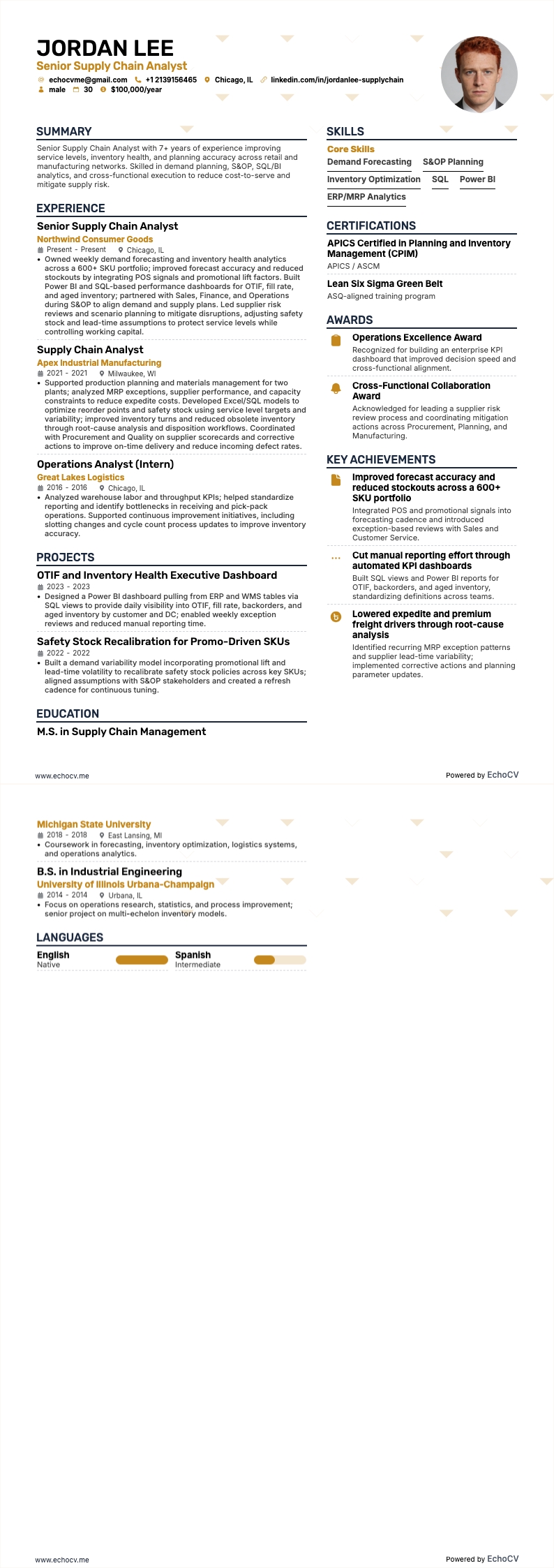
Aperçu complet de Analyste senior en chaîne d’approvisionnement

18 exemples de CV d’analyste supply chain

EchoCV

Rédigé par l'équipe EchoCV

Mise à jour : 3/9/20248 min read

Consultez tous les exemples de CV de ce guide, ou générez votre propre exemple de CV avec votre prompt personnalisé

Analyste senior en chaîne d’approvisionnement example resume
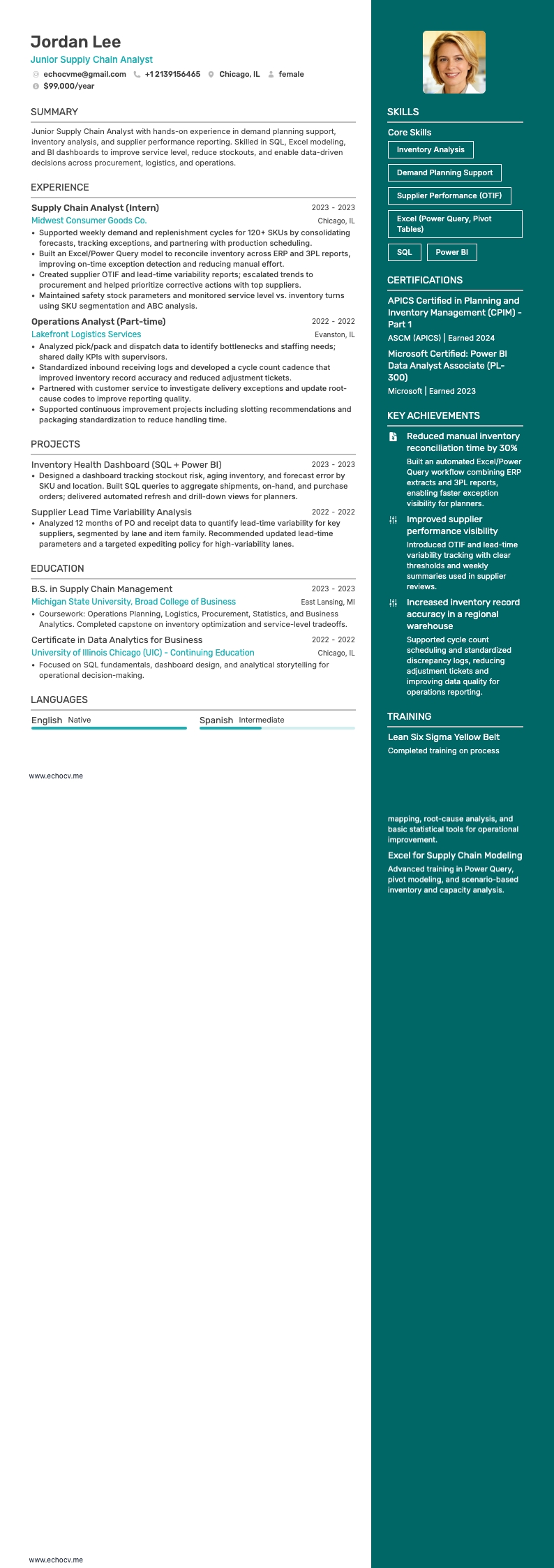
Analyste senior en chaîne d’approvisionnement

Analyste junior de la chaîne logistique example resume
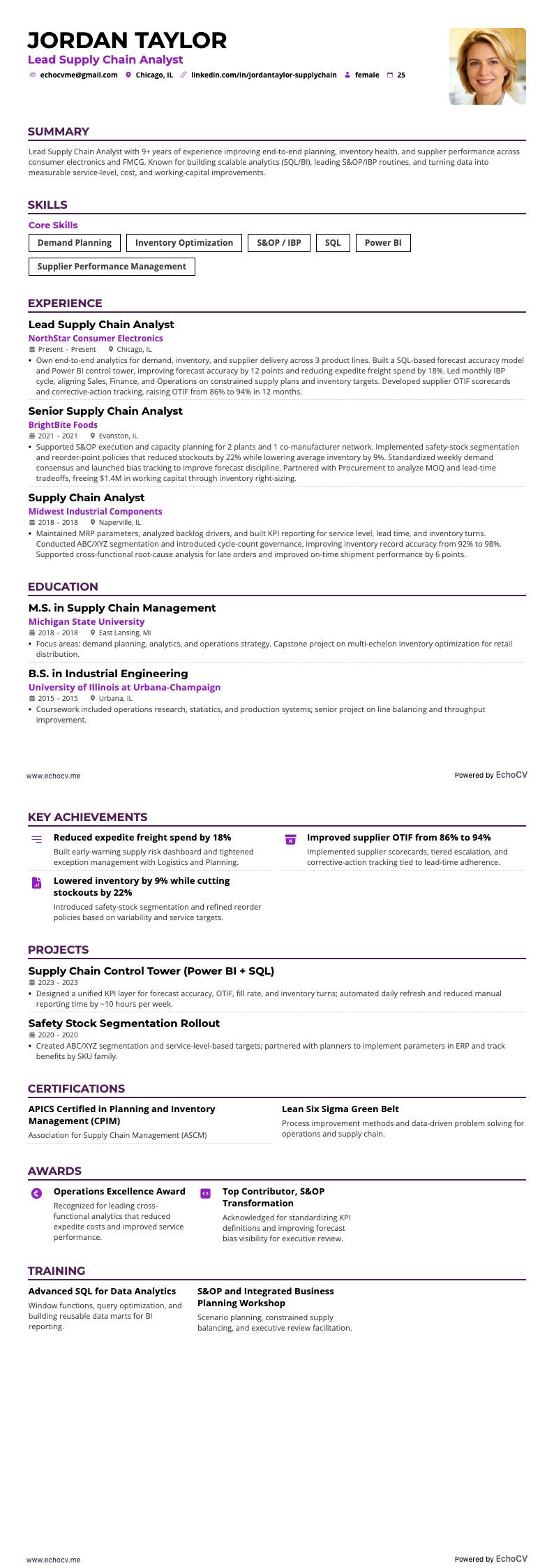
Analyste junior de la chaîne logistique

Analyste principal de la chaîne logistique example resume
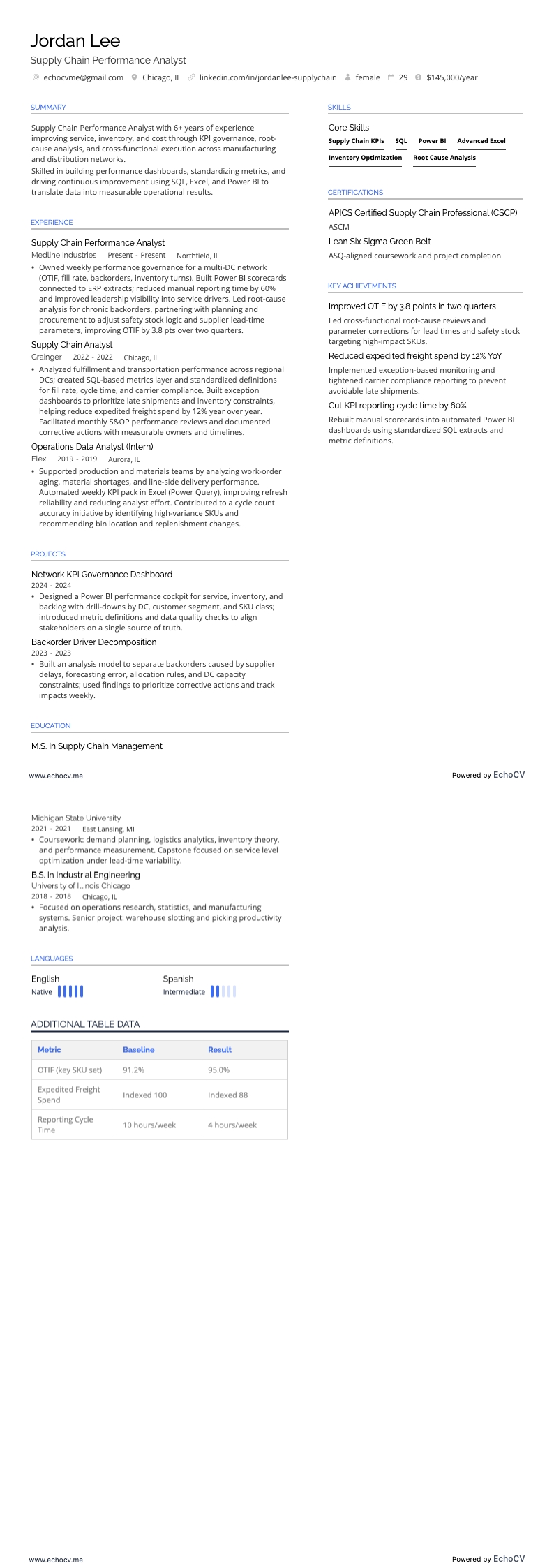
Analyste principal de la chaîne logistique

Analyste de la performance de la chaîne logistique example resume
Analyste de la performance de la chaîne logistique

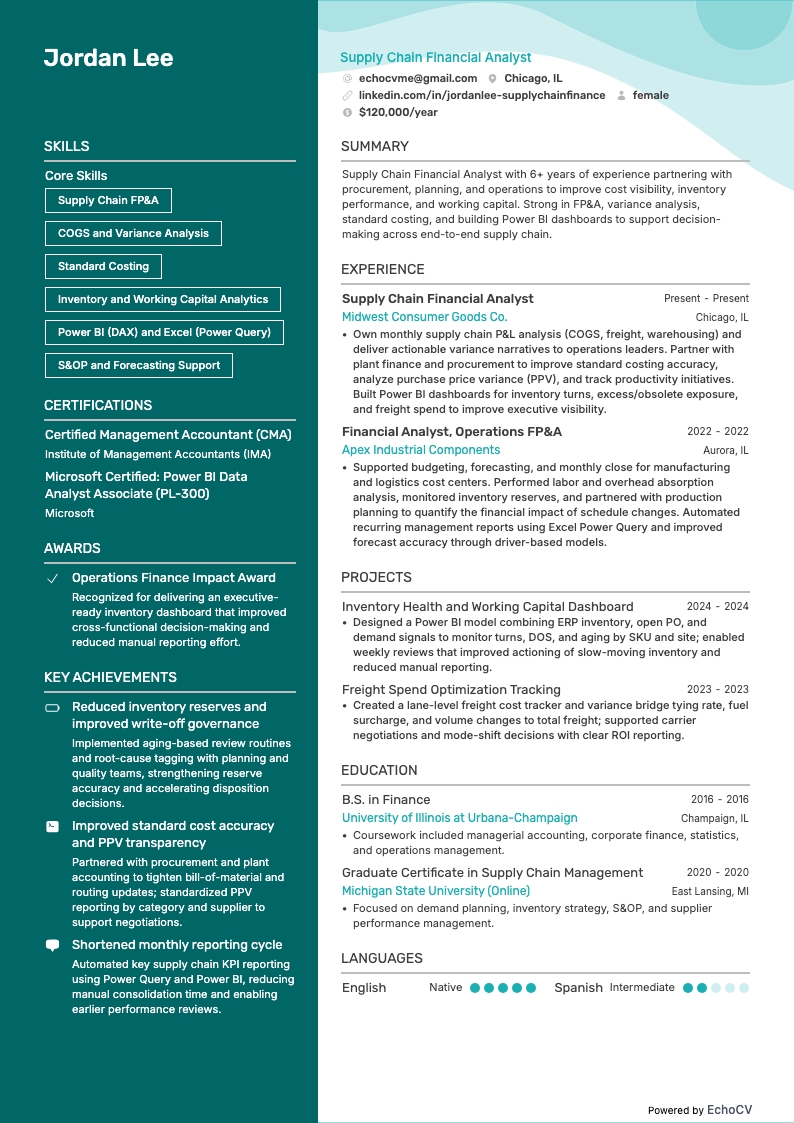
Analyste financier supply chain example resume
Analyste financier supply chain

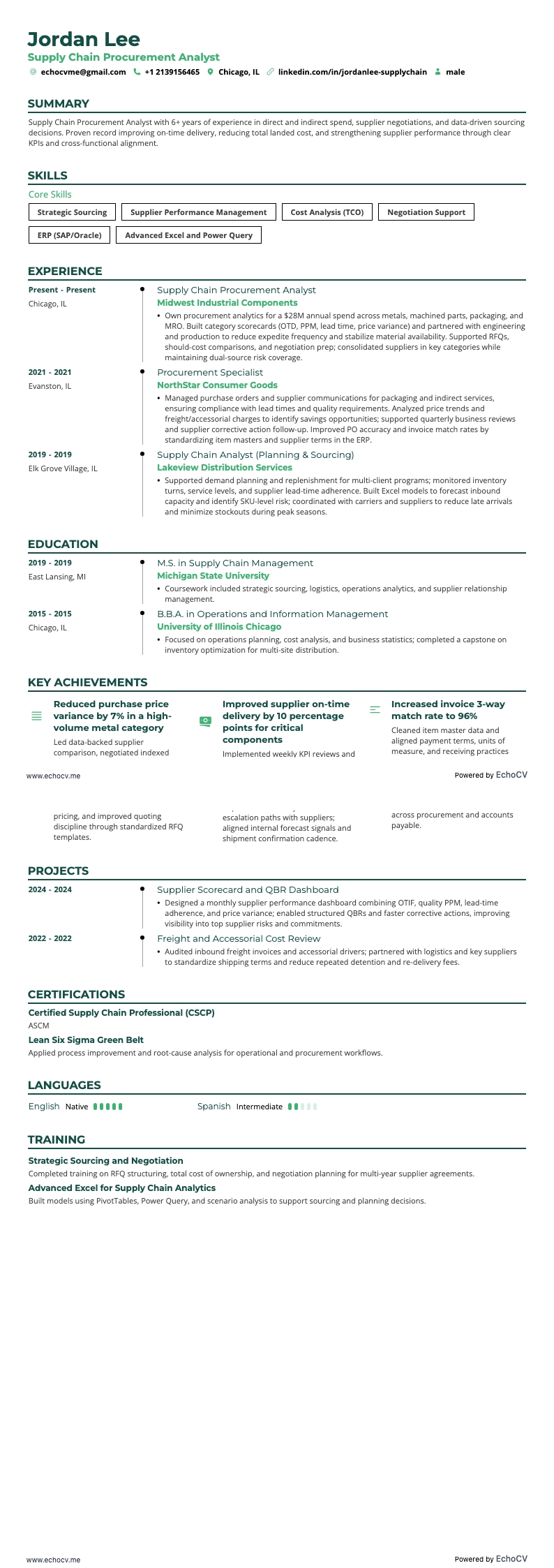
Analyste achats de la chaîne logistique example resume
Analyste achats de la chaîne logistique

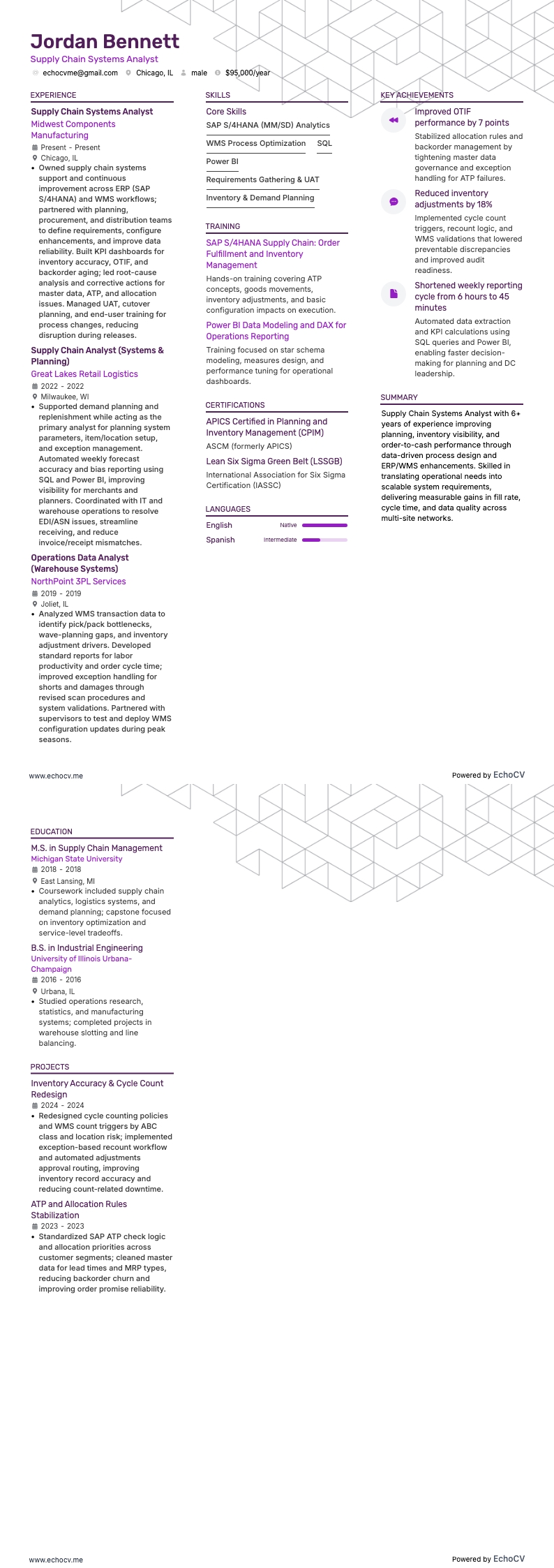
Analyste des systèmes de chaîne logistique example resume
Analyste des systèmes de chaîne logistique

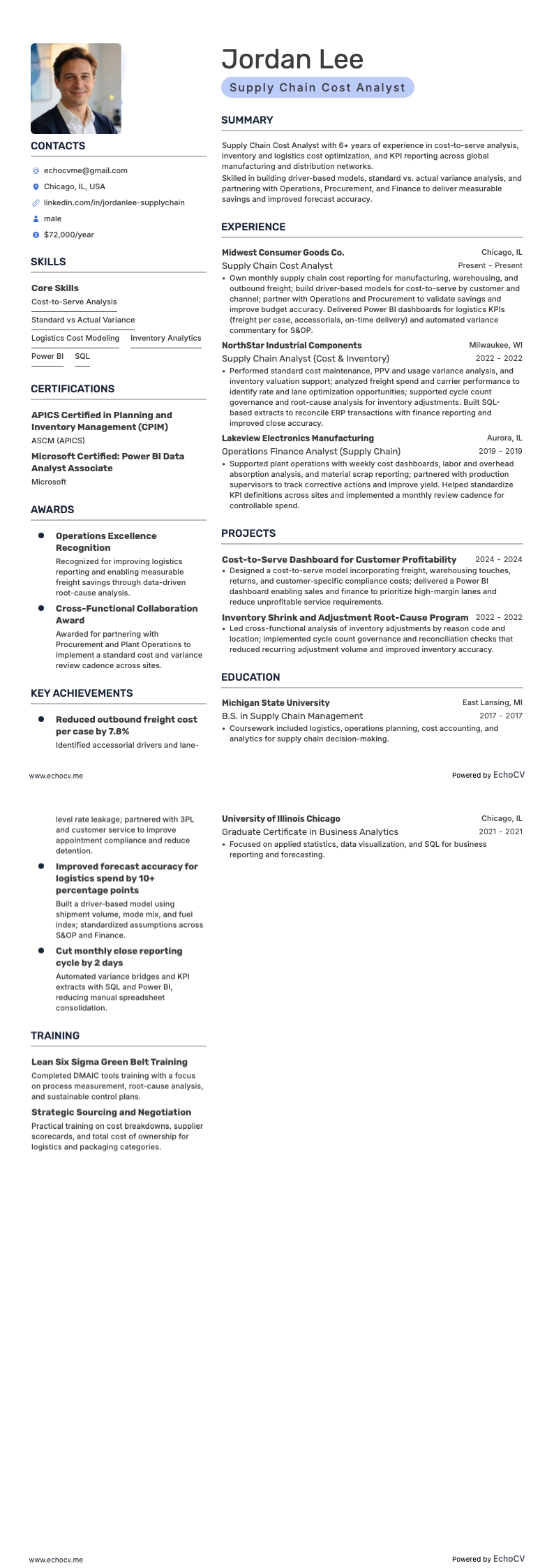
Analyste des coûts de la chaîne logistique example resume

Analyste des coûts de la chaîne logistique

Analyste des stocks de la chaîne d’approvisionnement example resume
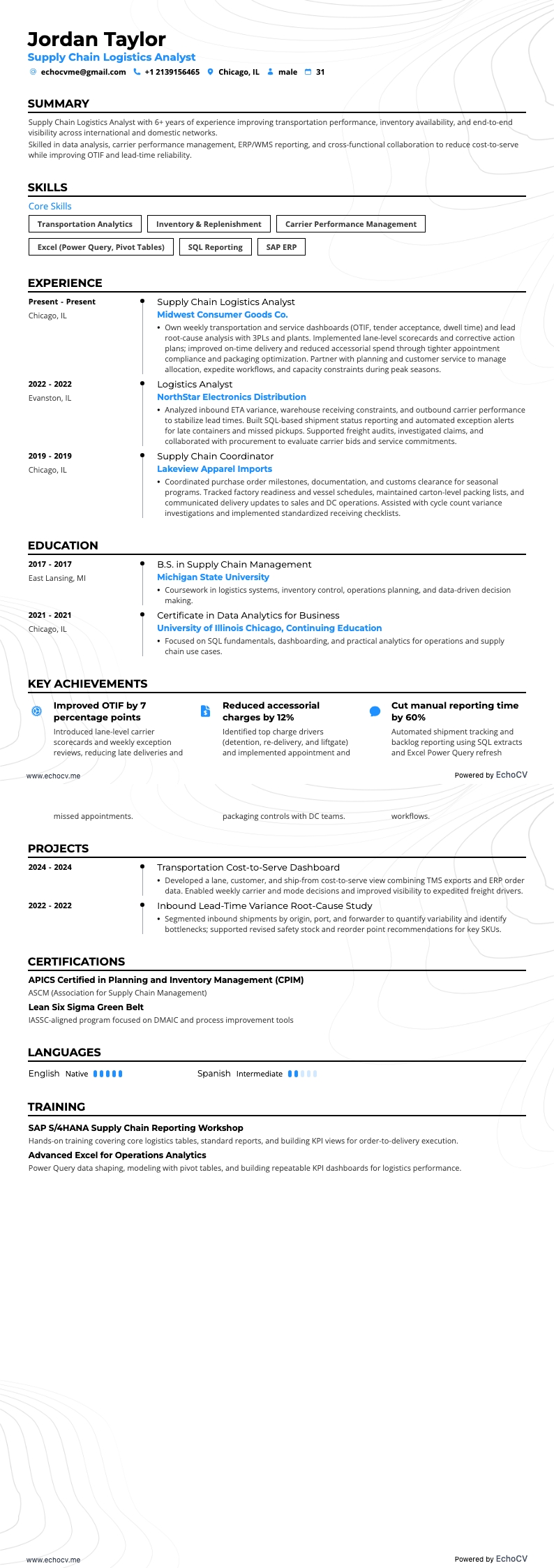
Analyste des stocks de la chaîne d’approvisionnement

Analyste logistique de la chaîne d’approvisionnement example resume

Analyste logistique de la chaîne d’approvisionnement

Analyste de données de la chaîne logistique example resume

Analyste de données de la chaîne logistique

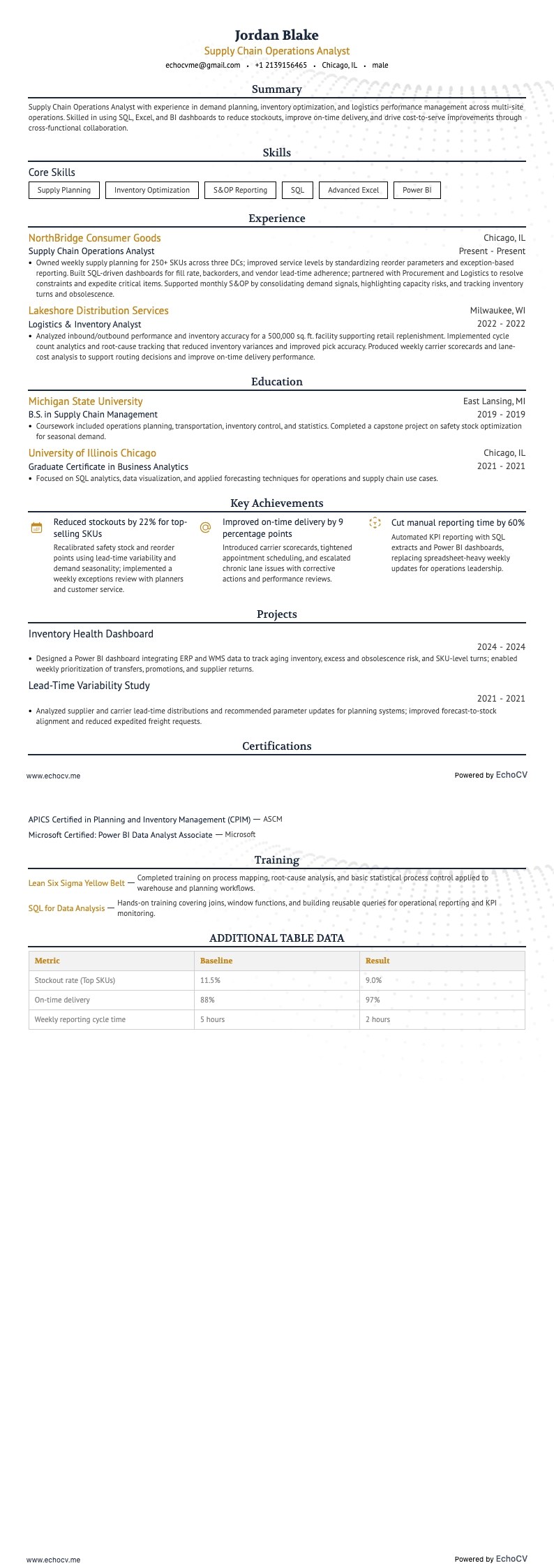
Analyste des opérations de la chaîne logistique example resume

Analyste des opérations de la chaîne logistique

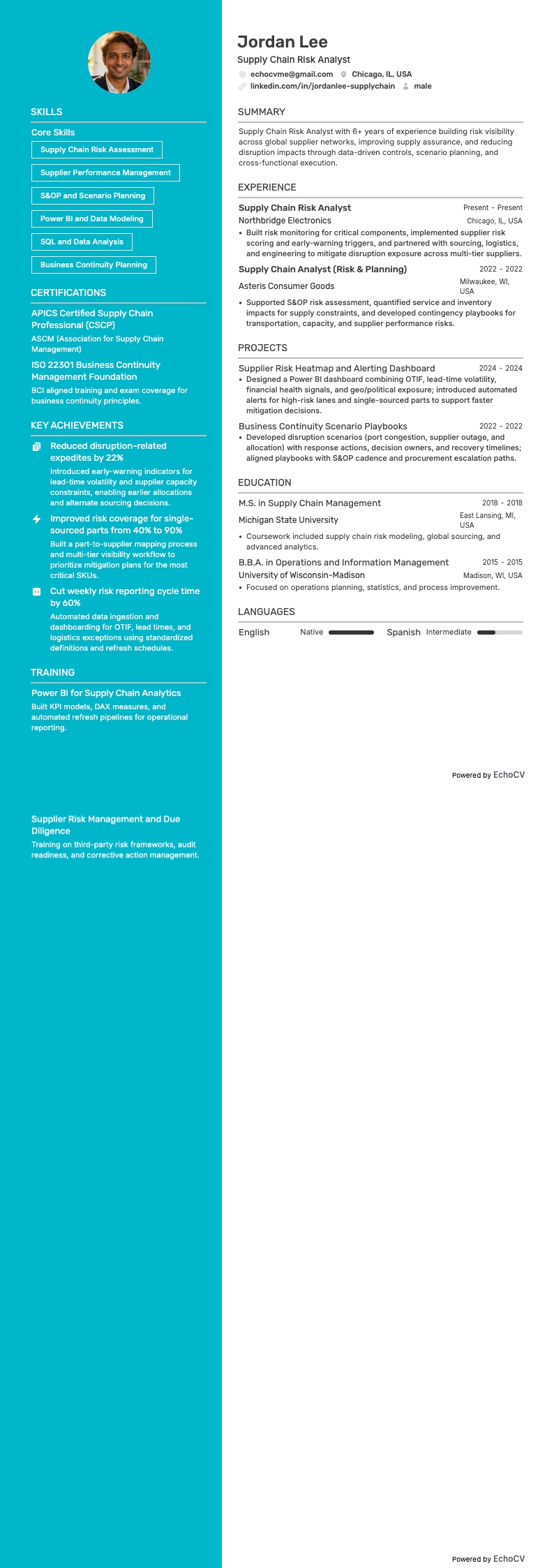
Analyste des risques de la chaîne logistique example resume

Analyste des risques de la chaîne logistique

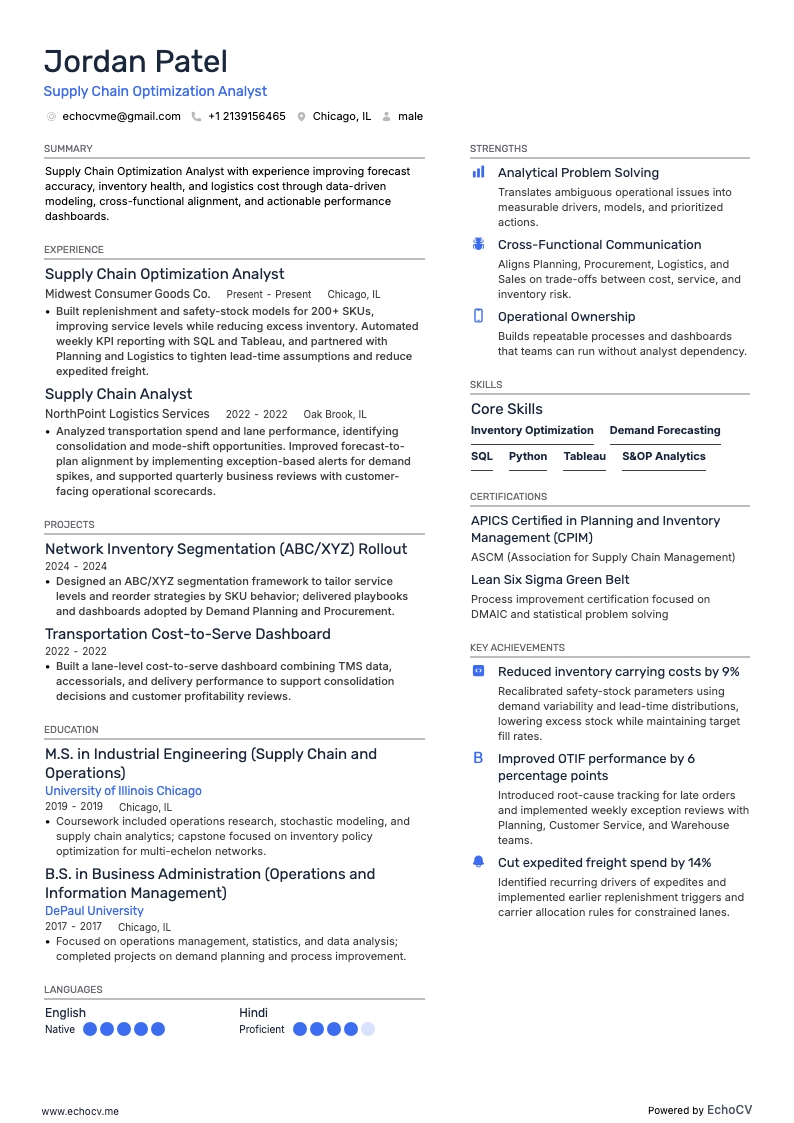
Analyste en optimisation de la chaîne d’approvisionnement example resume

Analyste en optimisation de la chaîne d’approvisionnement

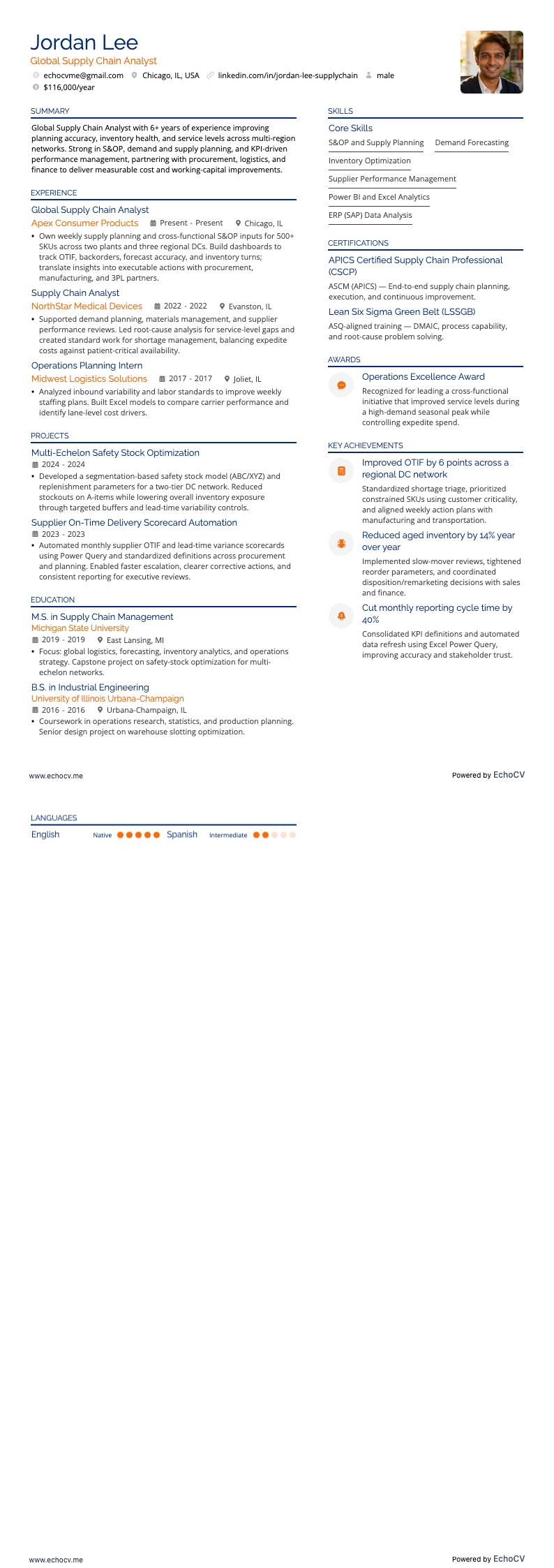
Analyste de la chaîne d’approvisionnement mondiale example resume

Analyste de la chaîne d’approvisionnement mondiale

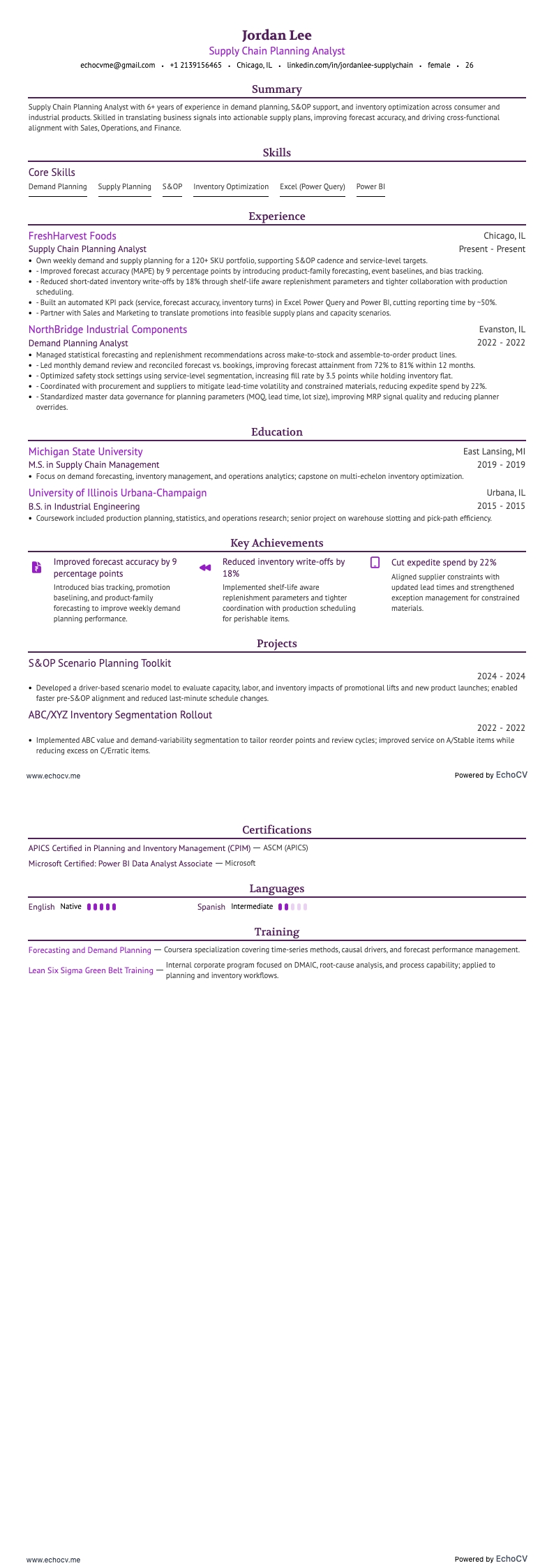
Analyste en planification de la chaîne logistique example resume

Analyste en planification de la chaîne logistique

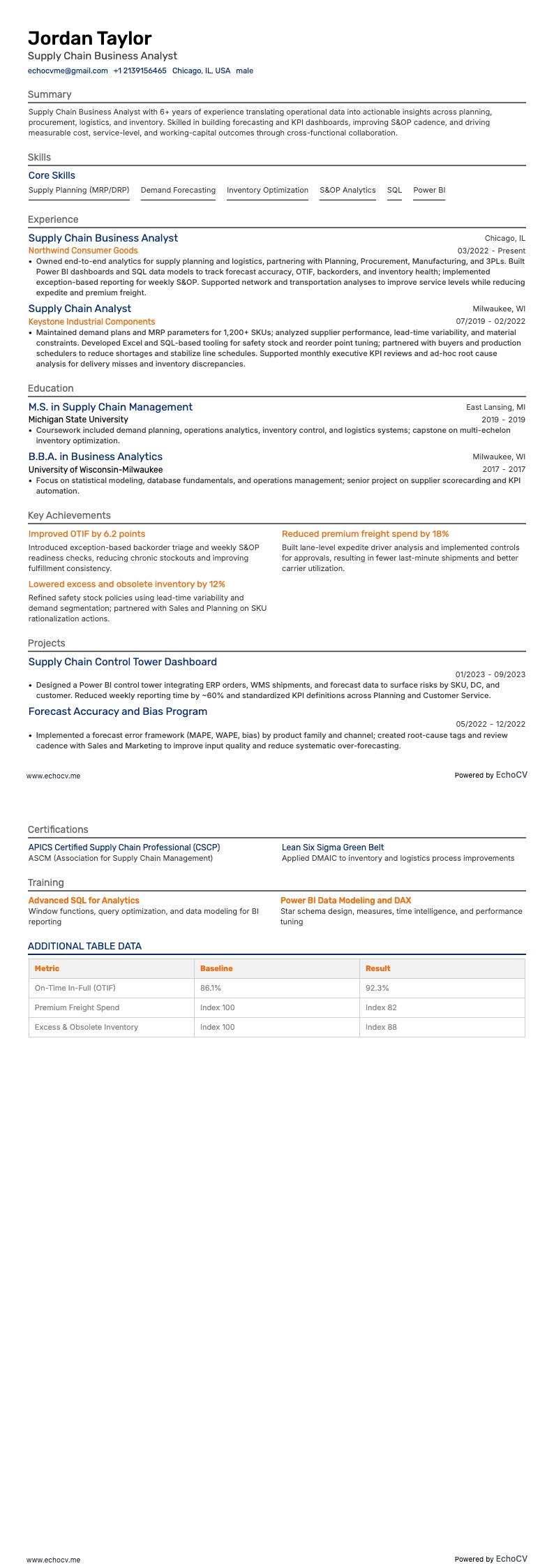
Analyste métier Supply Chain example resume

Analyste métier Supply Chain

Think of your resume as your own logistics network—every word should move the recruiter closer to saying “yes.”

Each section needs to flow with purpose, every skill should add value, and your achievements should arrive right on time. This guide shows you how to design a resume that runs as smoothly and efficiently as the supply chains you help optimize.

As Certified Professional Résumé Writers (CPRWs) and career experts who’ve helped thousands of people land interviews at global companies, we’ll walk you through proven strategies and real examples—so you can create a resume that serves your needs.

Key takeaways

  • Use a professional reverse-chronological format—recruiters value precision and organization.

  • Start with a results-focused summary that quantifies achievements.

  • Highlight data, forecasting, and ERP skills—these drive hiring decisions.

  • Include certifications like APICS CSCP or Lean Six Sigma for credibility.

  • Spotlight projects and coursework if you’re entry-level or changing careers.

  • Keep design clean, numbers visible, and your impact unmistakable.

Let’s explore a few supply chain analyst examples to get the feel of your preferred layout and tone.

How to choose the best supply chain analyst resume format

The right format will communicate your strengths to the employer quickly and efficiently.

The industry standard for supply chain analysts is a reverse-chronological format. It highlights your most recent data-driven achievements first, so it’s ideal for showing career growth and operational impact.

If you’re transitioning into supply chain from another field (like finance or operations), a combination format also works well—allowing you to emphasize transferable skills before diving into your work history.

What sections should go on a supply chain analyst resume?

With your format in place, let’s see what the essential sections for a supply chain analyst resume are:

  • Header (Name, Contact Info, LinkedIn)
  • Professional summary
  • Experience
  • Education
  • Skills
  • Certifications
  • Achievements or Projects (optional but highly effective for showcasing data-driven work)

If you already have a resume, check how it performs against Echocv’s free AI Checker.

How to write your supply chain analyst resume experience

In supply chain roles, execution is everything. Your experience section should read like a record of process improvements. Day-to-day tasks are fine but you should focus on results and ownership. Try to frame your outcomes clearly and consistently.

When listing your experience, include:

  • Job title, company, and dates: State your position and how long you held it.
  • Key responsibilities: Center on core supply chain tasks like forecasting and logistics.
  • Technical tools: Mention the software or systems you’ve used (SAP, Excel, Tableau).
  • Impact metrics: Quantify savings, efficiencies, or performance gains.

Let’s look at how all of this comes together in a strong experience entry.

Good example of a supply chain analyst experience section

Supply Chain Analyst
Siemens Energy, Atlanta, GA | Feb 2020-Present

  • Consolidated supplier data from four regional hubs into a single reporting model, improving visibility and cutting lead-time reporting errors by 25%.
  • Partnered with logistics to identify slow-moving inventory, freeing up $480K in working capital.
  • Built SQL-based dashboards to monitor on-time delivery performance and track vendor KPIs across 120+ suppliers.
  • Collaborated with procurement to renegotiate contracts, lowering annual material costs by 7%.
  • Automated recurring weekly reports, reducing manual workload from 6 hours to 45 minutes per cycle.

How to tailor your supply chain analyst resume experience

Tailoring your resume is one of the fastest ways to show that you understand what the company needs. It’s also a great way to demonstrate you’ve done similar work before.

Recruiters and ATS systems compare your resume against the job description—so try to match its language to better your chances of landing an interview.

Here are several ways to make your experience section feel tailored:

  • Focus on core functions: Forecasting, procurement, logistics, and inventory management.
  • Mention relevant tools and systems: SAP, Oracle, Power BI, Tableau, SQL, and Excel.
  • Mirror key metrics: On-time delivery, cost reduction, lead time, and forecast accuracy.
  • Show teamwork: Highlight collaboration with finance, production, and logistics teams.
  • Align your impact: Emphasize global or high-volume experience when relevant.

A targeted resume is one of the surest strategies to ensure your resume ends up in the “Approved” pile. Let’s look at some examples we created with Echocv’s One-Click Tailoring Tool.

Resume tailoring examples for supply chain analysts

Job description excerptUntailored bulletTailored bullet
Experience with SAP and supplier performance tracking.Tracked supplier data to monitor order accuracy.Used SAP to track supplier performance metrics, improving on-time delivery by 14%.
Proven ability to analyze demand forecasts and optimize inventory levels.Helped with inventory control.Analyzed demand forecasts to balance stock across 3 regions, cutting excess inventory by 10%.
Strong background in logistics cost reduction and process improvement.Supported logistics team with shipment data.Identified logistics cost inefficiencies, optimizing routes and saving $220K annually.

Timing matters

  • Once your resume is tailored, submit it early. According to Echocv’s newest study , 52% of hiring professionals said applying early increases your chances of being seen—shortlists often fill before the posting closes

How to quantify your experience on a supply chain analyst resume

Your impact as a supply chain analyst lives in the data and numbers on your resume make your results visible. Almost every optimization—lower costs, higher accuracy, faster processes—can (and should) be backed by numbers. Proof of performance stands out in both human and applicant tracking system reviews.

Here are several ways to put measurable results behind your work as a supply chain analyst:

Examples of how to quantify supply chain analyst achievements on your resume

How to quantifyExample bullet point
Show how much money you saved or recovered through process improvements.“Reduced annual logistics expenses by $250K through route optimization and carrier renegotiation.”
Highlight improvements in forecast accuracy or demand planning.“Increased forecast accuracy by 18% using advanced Power BI models and historical trend analysis.”
Point out time or efficiency gains from automation or workflow changes.“Automated reporting dashboards, cutting manual data processing time by 70%.”
Mention reductions in inventory waste or stockouts.“Decreased excess inventory by 12% while maintaining 98% on-time order fulfillment.”
Include supplier or logistics performance metrics.“Improved supplier on-time delivery from 82% to 94% through KPI monitoring and process alignment.”

If you’re struggling to phrase your metrics, try Echocv’s Resume Bullet Point Generator. It helps you write accomplishment-focused bullets that highlight your results professionally.

How to list your hard and soft skills on your supply chain analyst resume

Your skills section helps recruiters confirm you have the technical knowledge and interpersonal strengths needed to manage complex supply chain operations. For analysts, this balance is essential—you’re expected to interpret data, use advanced tools, and collaborate across departments to solve operational challenges.

Hard skills are your technical abilities—the systems, software, and analytical methods you use to optimize performance. Include them in a dedicated section for better visibility.

Soft skills are indispensable. They show how you apply your technical know-how. Employers want to see you can communicate insights clearly and solve problems. These make most sense when weaved into your summary and experience bullets.

Best hard skills for your supply chain analyst resume

  • SAP ERP and Oracle ERP Systems
  • Power BI andTableau for data visualization
  • Microsoft Excel (pivot tables, macros, advanced formulas)
  • SQL and database querying
  • Forecasting and demand planning
  • Procurement and vendor management
  • Inventory optimization
  • Logistics and distribution analysis
  • Supply chain modeling and simulation
  • Cost analysis and performance reporting

Once you’ve chosen your key skills, show them in action. The examples below demonstrate how to weave soft skills into real resume sections.

How to list your certifications and education on your supply chain analyst resume

There’s no single path to becoming a supply chain analyst, but your education should develop key competencies in operations systems, strategic planning, and quantitative analysis—the core building blocks of an efficient supply chain career.

When well-structured, your education section builds trust in your expertise. Here’s how to do it:

  • Include your highest relevant degree, along with your major, school name, and graduation year.
  • List degrees in reverse-chronological order, with the most recent first.
  • Add multiple degrees if they’re from different fields. For example, a bachelor’s in economics and a master’s in supply chain management complement each other and show the breadth of your expertise.

CONSEIL PRO

Highlight honors, key coursework, or academic projects if you’re early in your career or want to emphasize specialized knowledge.

Education entry sample

B.S. in Supply Chain Management

Arizona State University | Tempe, AZ

Graduated: 2020

Certifications add extra credibility to your qualifications and prove you’re continuously improving your expertise.

Follow these tips when drafting your certifications section:

  • Include the full certification name, issuing organization, and year earned.
  • Add only certifications that are recognized and relevant to the role—focus on logistics, planning, and process optimization.
  • Mention certifications that are in progress to show initiative and continuous learning.
  • Avoid including every short course. Opt for the most valuable or career-aligned credentials.

How to write your supply chain analyst resume summary

A strong resume summary should quickly show that you can turn data into action and make smarter business decisions. This short section sets the tone for your whole resume.

In just a few lines (or three to five sentences), highlight how you analyze information, improve processes, and deliver measurable results across operations. Tricky, but you can do it following these tips:

  • State your current job title and years of experience to establish credibility right away.
  • Mention the industries or markets you’ve worked in (e.g., retail, manufacturing, logistics, consumer goods).
  • Highlight core strengths and tools—forecasting, demand planning, procurement, SAP, Power BI, Excel, or SQL.
  • Include one to two quantified achievements showing clear impact (e.g., cost reductions, process improvements, or efficiency gains).
  • Show alignment with the company’s goals, focusing on how your insights drive results rather than just listing responsibilities.

Here’s how it plays out.

Example summary:

Data-driven Supply Chain Analyst with 5+ years of experience optimizing global logistics and inventory operations. Skilled in SAP, Power BI, and SQL, with a proven record of improving forecast accuracy by 18% and reducing logistics costs by $250K annually. Adept at translating data into actionable insights that enhance efficiency and support business growth.

This summary instantly communicates credibility, quantifiable impact, and a clear focus on data-driven decision-making.

Use Echocv’s Summary Generatorto make sure your opening lines catch the attention they need.

How do I write a supply chain analyst resume with no experience?

Even if you’re new to the field, you can still show that you think like a supply chain analyst. Emphasize your transferable skills, education, and extra projects that reflect your attention to detail, process-oriented thinking, and comfort with data.

What to include in place of work experience

  • Relevant coursework or academic projects: Highlight assignments involving data analysis, logistics planning, or process optimization.
  • Internships or part-time roles: Even if they’re outside supply chain, mention any work that involves reporting, Excel modeling, or coordinating between teams.
  • Volunteer or extracurricular experience: Leadership in clubs, case competitions, or university operations projects all show initiative and collaboration.
  • Additional sections: Add “Projects,” “Achievements,” or “Technical Skills” to emphasize results and tools you know instead of job titles.

Frequently asked questions about supply chain analysts resumes and job applications

We saved these questions for last because they go beyond the basics of writing your resume. These FAQs cover the extra details—from formatting and cover letters to salaries and certifications—that can make a real difference once you’ve nailed your content and structure.

What should your supply chain analyst resume header include?

Your resume header should make it easy for recruiters to contact you and see your professional identity right away.

Include your full name, title, professional email, and your LinkedIn profile. If you have a portfolio or data dashboard showcase (e.g., Tableau Public, GitHub), include that too—it’s a great way to stand out.

What design and formatting rules should I follow for a supply chain analyst resume?

Keep it clean, structured, and data-friendly — a clear layout signals analytical thinking. Use:

How should I save and name my supply chain analyst resume?

Name your file in a professional, recruiter-friendly way, such as: FirstnameLastnameSupplyChainAnalyst_Resume.pdf

This ensures your application looks organized and easily searchable.

Do I need a cover letter for a supply chain analyst job?

Yes—especially if you’re early in your career or switching industries. A cover letter gives you space to explain why you’re interested in supply chain work, and to give context to your background and skills. Keep it up to one page and align with the company’s focus.

Remember to not repeat your resume here. Use our Cover Letter Generator to draft a letter that adds unique value.

What are good additional sections to include on a supply chain analyst resume?

Besides the essentials (Experience, Skills, Education, Certifications), consider adding:

  • Projects: Highlight data analyses, process audits, or optimization studies.
  • Achievements: Quantify impact (e.g., “Reduced supplier delays by 10%”).
  • Technical Proficiency: ERP systems, data tools, and analytics software.
  • Languages: Valuable in global logistics environments.

How do I show career progression on a supply chain analyst resume?

Show it through increasing responsibility and impact. Mention when you’ve:

  • Transitioned from reporting to leading analyses.
  • Influenced decision-making or implemented new systems.
  • Achieved measurable results (e.g., cost savings, process improvements).

Do I need industry-specific experience to land a supply chain analyst job?

Not necessarily. Skills like data analysis, process improvement, and vendor coordination transfer well between industries. However, tailoring your resume with industry-relevant tools helps you stand out faster.

How much do supply chain analysts earn, and how does salary relate to skills?

Salaries for supply chain analysts vary widely based on experience, industry, and region. In the U.S., many capable mid-level analysts earn in the $60,000 to $90,000 range, while experienced or senior analysts commonly exceed $100,000, with top roles reaching $120,000+.

Proficiency in major ERP/data systems, advanced analytics and forecasting skills, recognized certifications, and global supply-chain experience all help boost compensation.

How can I stay organized while applying for supply chain analyst jobs?

Job hunting can feel like managing your own logistics network. To stay on top of it all, use Echocv’s AI Job Application Tracker—it helps you monitor every application, follow up at the right time, and see which versions of your resume perform best.

To bring it all together

If you’ve come this far, congrats! You now have everything you need to create a supply chain analyst resume that’s sharp, data-driven, and truly yours. Remember, every great supply chain starts with solid organization, and your resume is no different.

When you’re ready to bring it to life, build your document with Echocv’s Resume Builder—it’s quick, easy, and helps your best achievements take center stage.

You’ve got this—and the next great role is closer than you think.

Exemples de CV Analyste supply chain

Explorez d'autres exemples et guides de CV Analyste supply chain et découvrez ce qui fonctionne selon votre niveau d'expérience ou votre rôle.

Par expérience

Analyste senior en chaîne d’approvisionnement

Aperçu du CV Analyste senior en chaîne d’approvisionnement

Analyste junior de la chaîne logistique

Aperçu du CV Analyste junior de la chaîne logistique

Analyste principal de la chaîne logistique

Aperçu du CV Analyste principal de la chaîne logistique

Exemples de CV Analyste supply chain

Explorez d'autres exemples et guides de CV Analyste supply chain et découvrez ce qui fonctionne selon votre niveau d'expérience ou votre rôle.

Par rôle

Analyste de la performance de la chaîne logistique

Aperçu du CV Analyste de la performance de la chaîne logistique

Analyste financier supply chain

Aperçu du CV Analyste financier supply chain

Analyste achats de la chaîne logistique

Aperçu du CV Analyste achats de la chaîne logistique

Analyste des systèmes de chaîne logistique

Aperçu du CV Analyste des systèmes de chaîne logistique

Analyste des coûts de la chaîne logistique

Aperçu du CV Analyste des coûts de la chaîne logistique

Analyste des stocks de la chaîne d’approvisionnement

Aperçu du CV Analyste des stocks de la chaîne d’approvisionnement

Analyste logistique de la chaîne d’approvisionnement
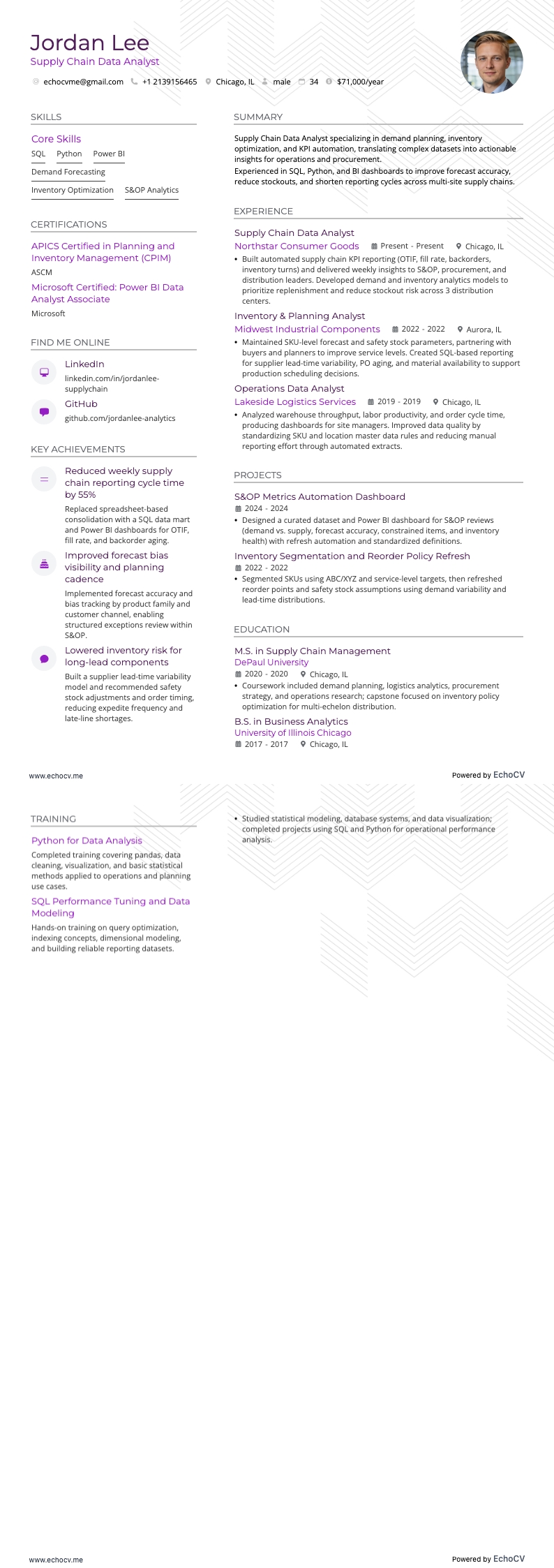
Aperçu du CV Analyste logistique de la chaîne d’approvisionnement

Analyste de données de la chaîne logistique
Aperçu du CV Analyste de données de la chaîne logistique

Analyste des opérations de la chaîne logistique
Aperçu du CV Analyste des opérations de la chaîne logistique

Analyste des risques de la chaîne logistique
Aperçu du CV Analyste des risques de la chaîne logistique

Analyste en optimisation de la chaîne d’approvisionnement
Aperçu du CV Analyste en optimisation de la chaîne d’approvisionnement

Analyste de la chaîne d’approvisionnement mondiale
Aperçu du CV Analyste de la chaîne d’approvisionnement mondiale

Analyste en planification de la chaîne logistique
Aperçu du CV Analyste en planification de la chaîne logistique

Analyste métier Supply Chain

Aperçu du CV Analyste métier Supply Chain