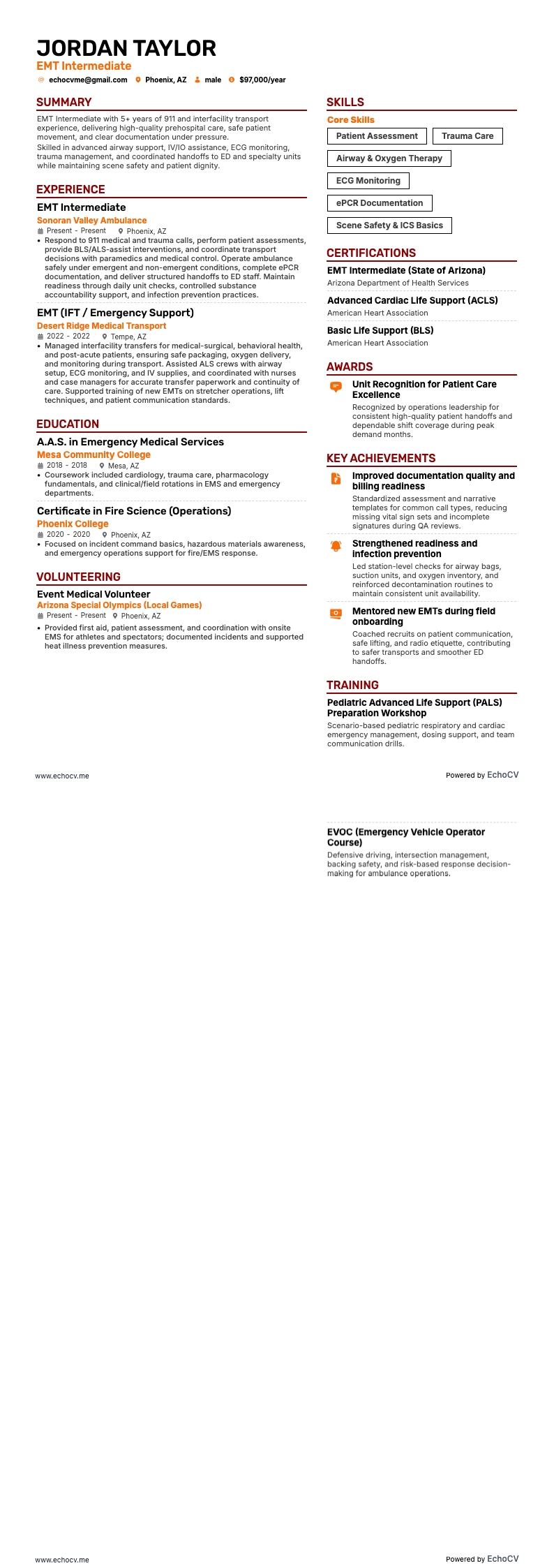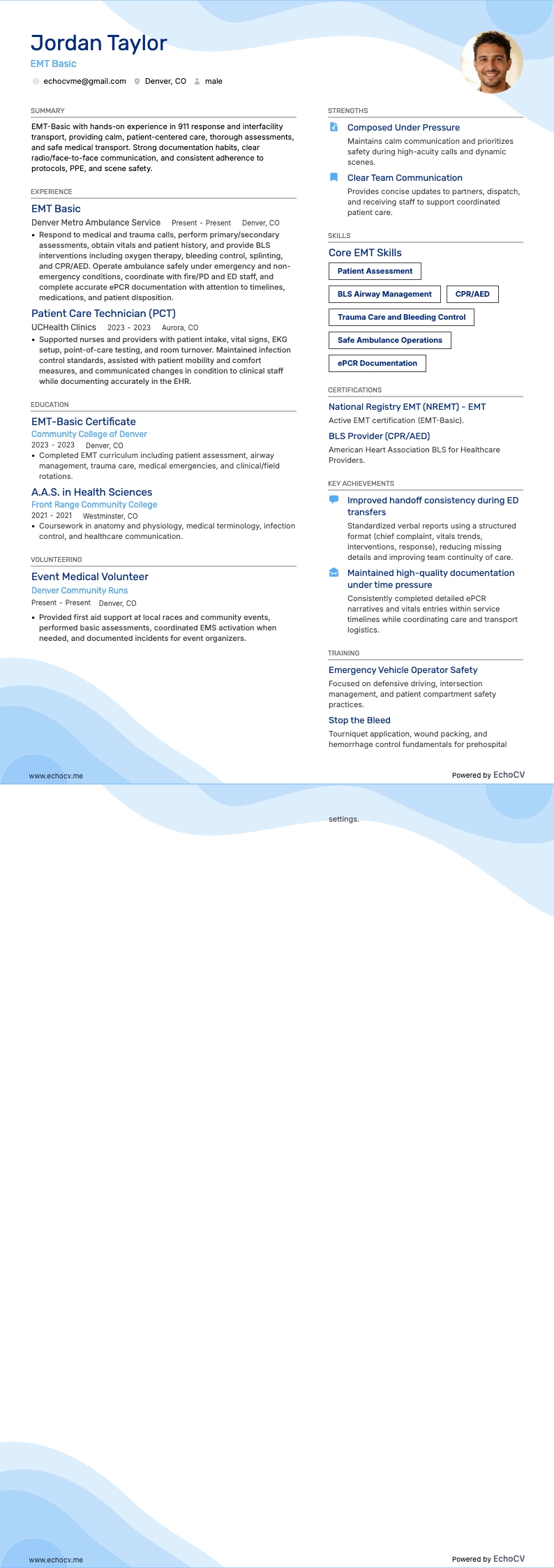
EMT Basis volledige voorbeeldweergave

23 cv-voorbeelden voor ambulancehulpverlener (Spoedeisendehulpverlener)

EchoCV

Geschreven door het EchoCV-team

Bijgewerkt: 2/14/20248 min read

Bekijk alle cv-voorbeelden in deze gids, of genereer je eigen cv-voorbeeld met je gepersonaliseerde prompt

EMT Basis example resume

EMT Basis

EMT-paramedicus example resume

EMT-paramedicus

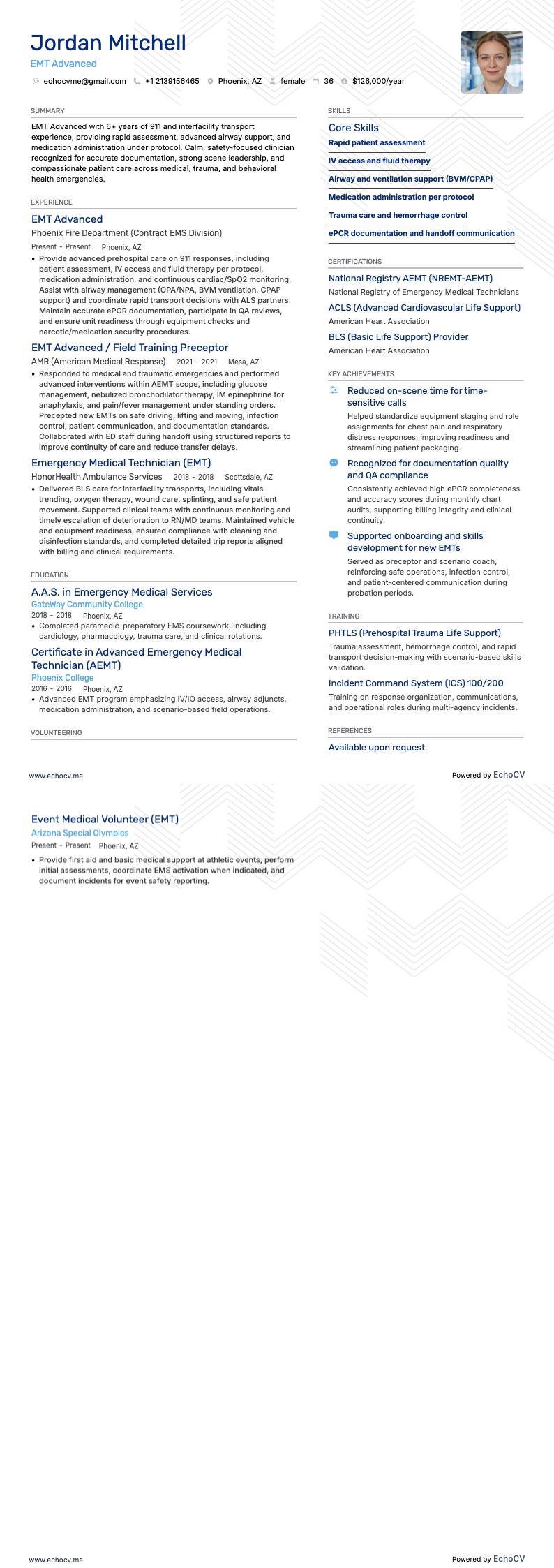
EMT gevorderd example resume

EMT gevorderd

EMT Gevorderd example resume

EMT Gevorderd

EMT op instapniveau example resume

EMT op instapniveau

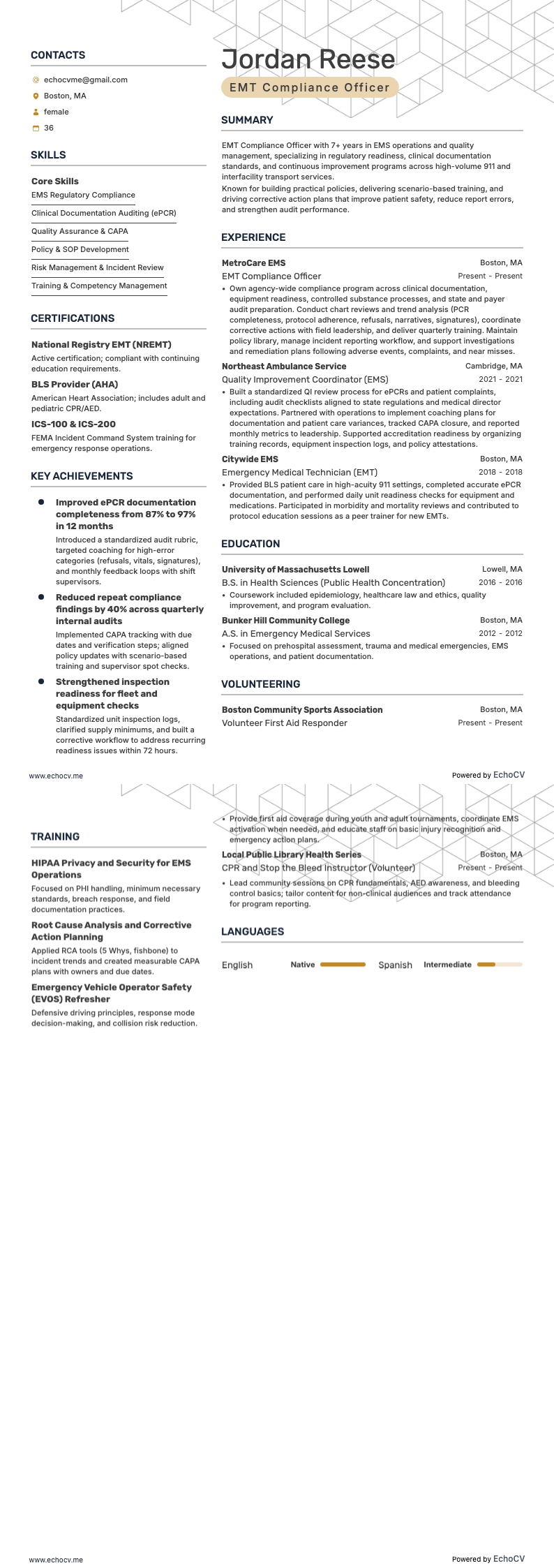
EMT-compliancefunctionaris example resume
EMT-compliancefunctionaris

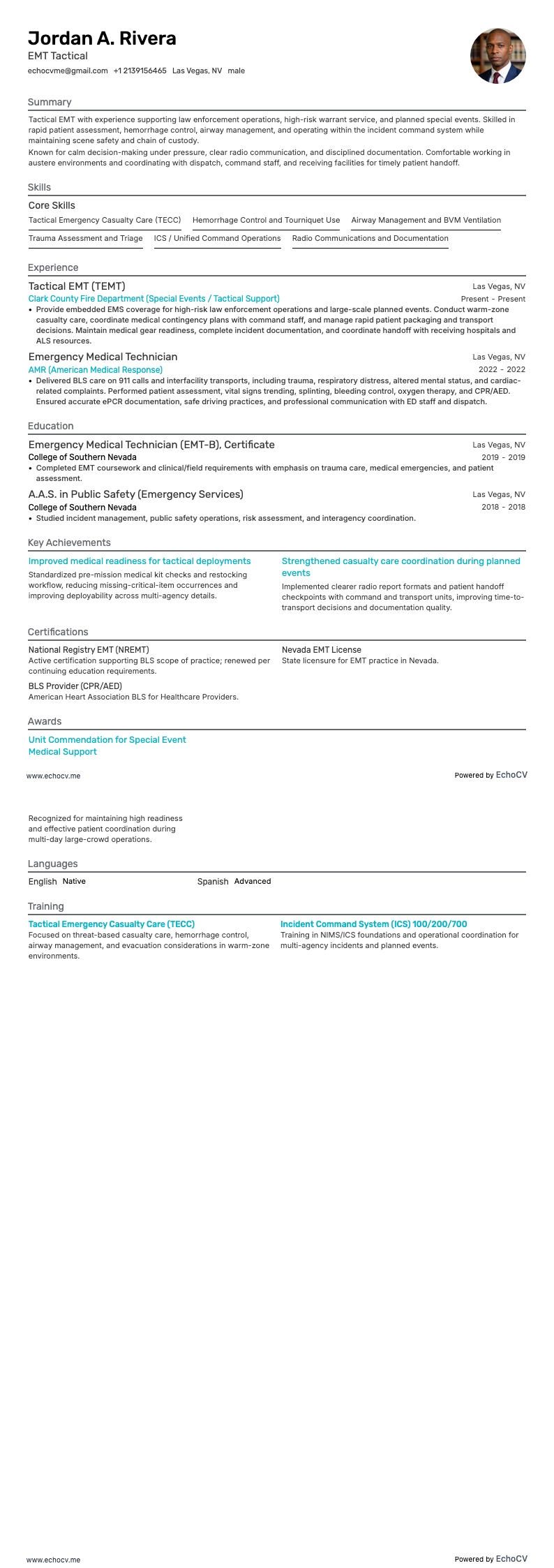
Tactische EMT example resume
Tactische EMT

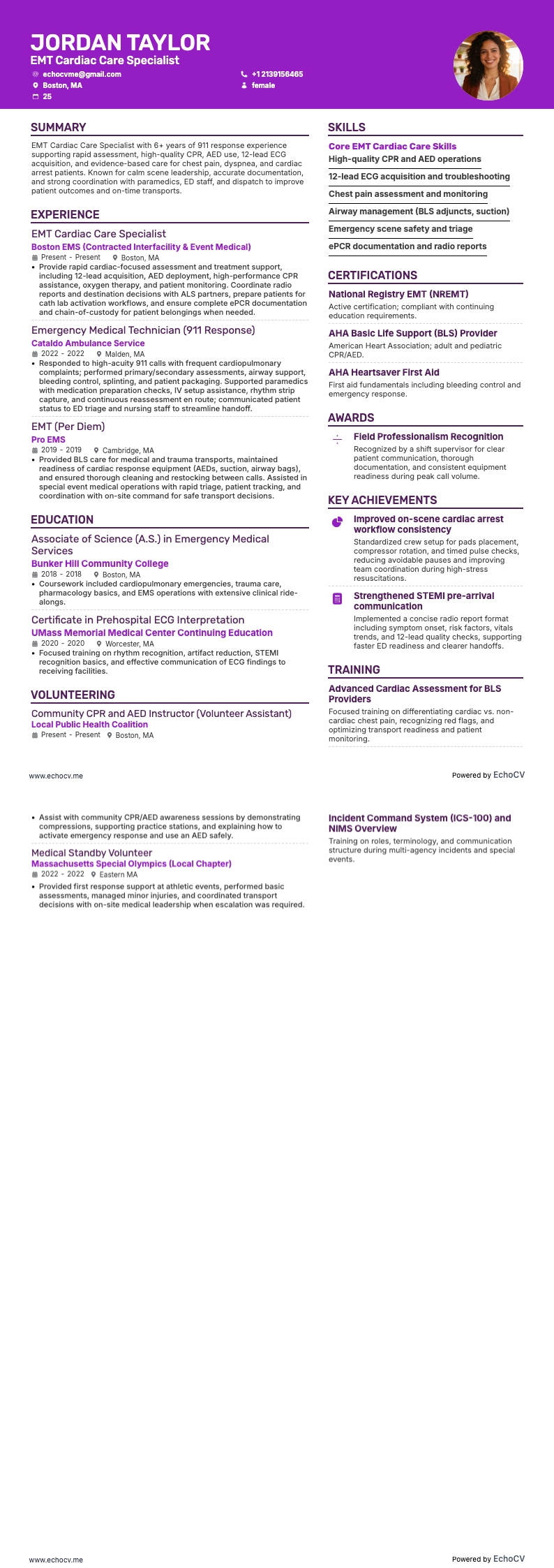
EMT-specialist hartzorg example resume
EMT-specialist hartzorg

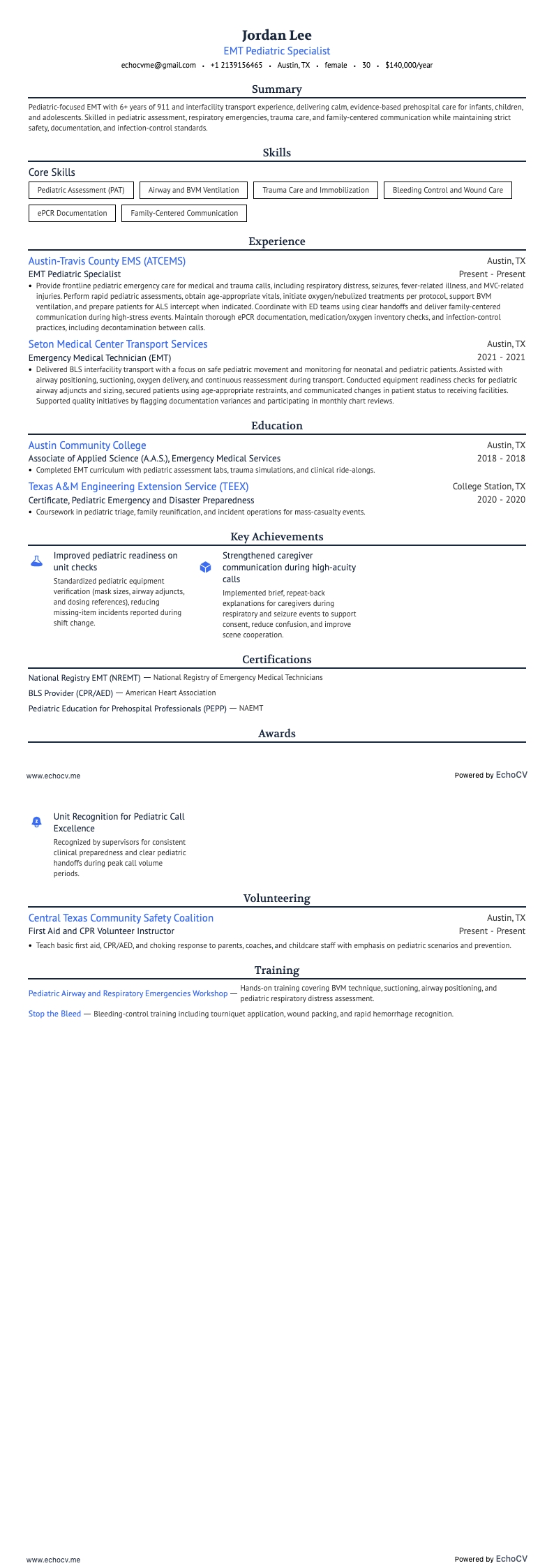
Pediatrisch EMT-specialist example resume
Pediatrisch EMT-specialist

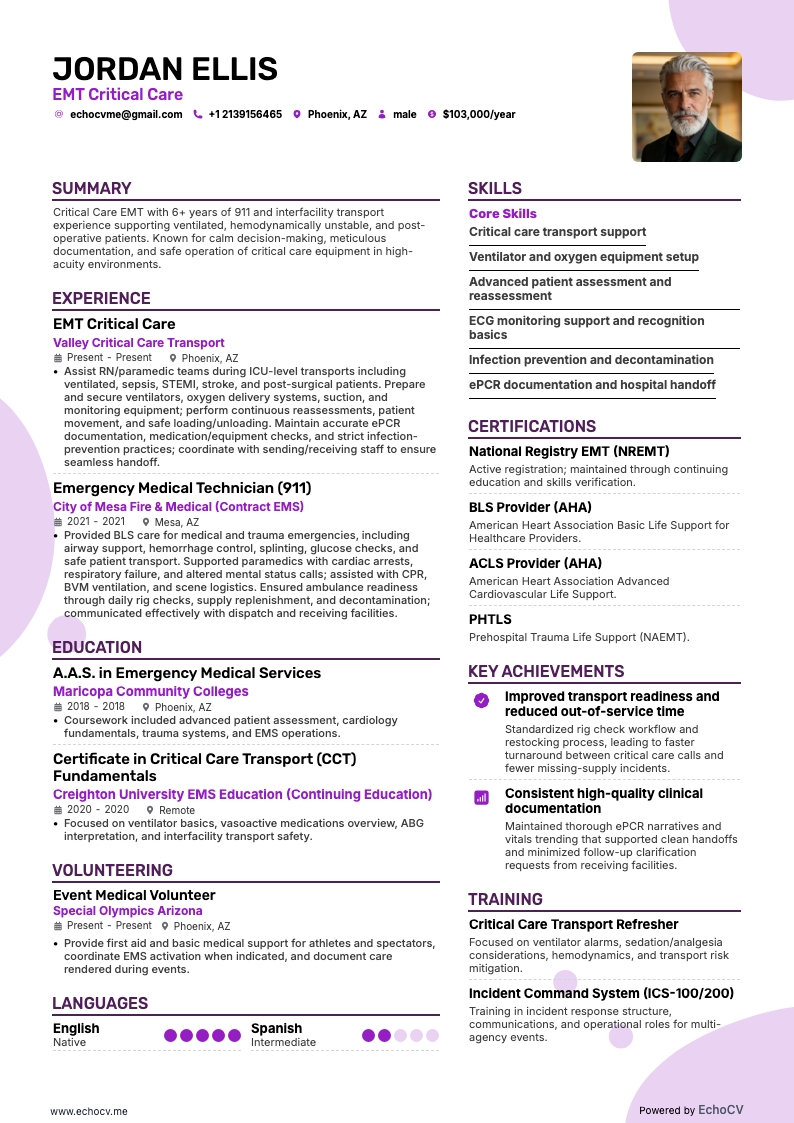
EMT kritieke zorg example resume
EMT kritieke zorg

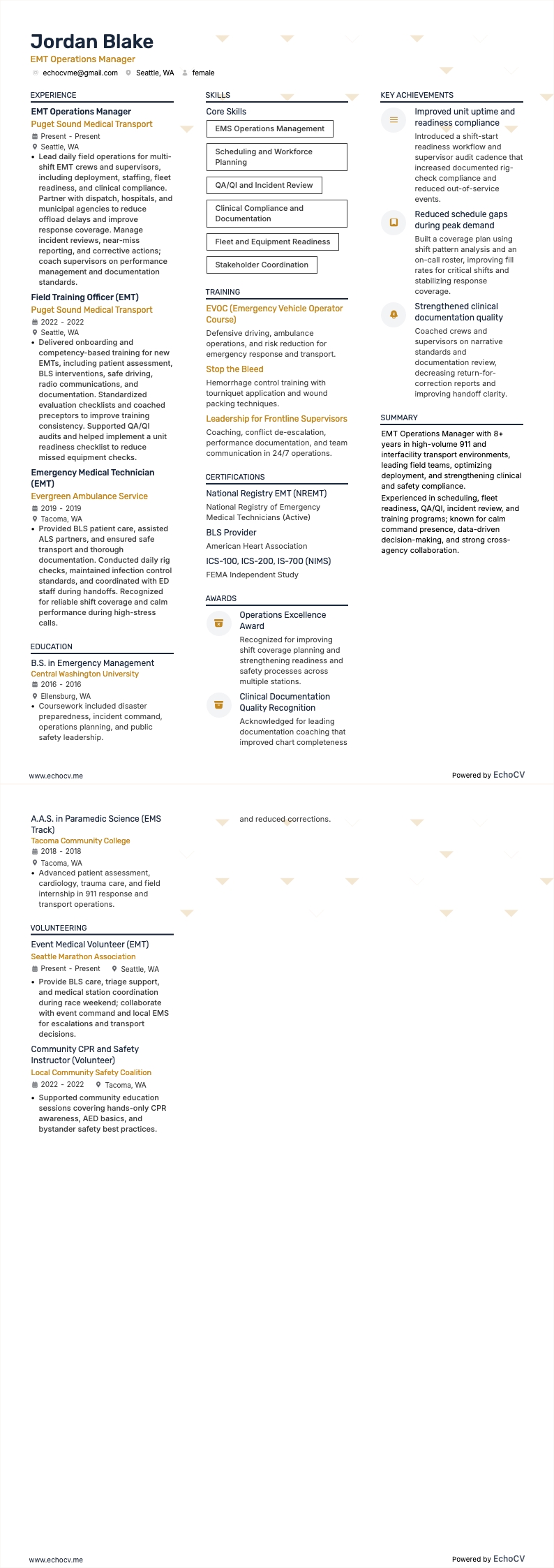
EMT Operations Manager example resume
EMT Operations Manager

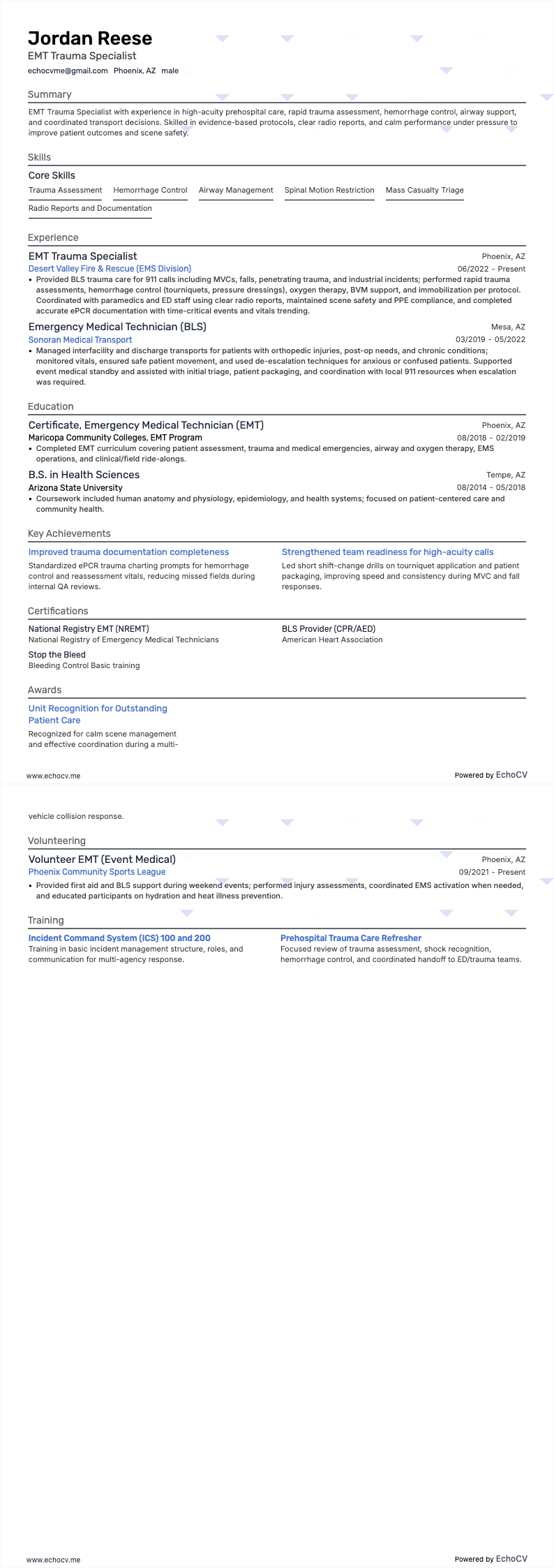
EMT-traumaspecialist example resume
EMT-traumaspecialist

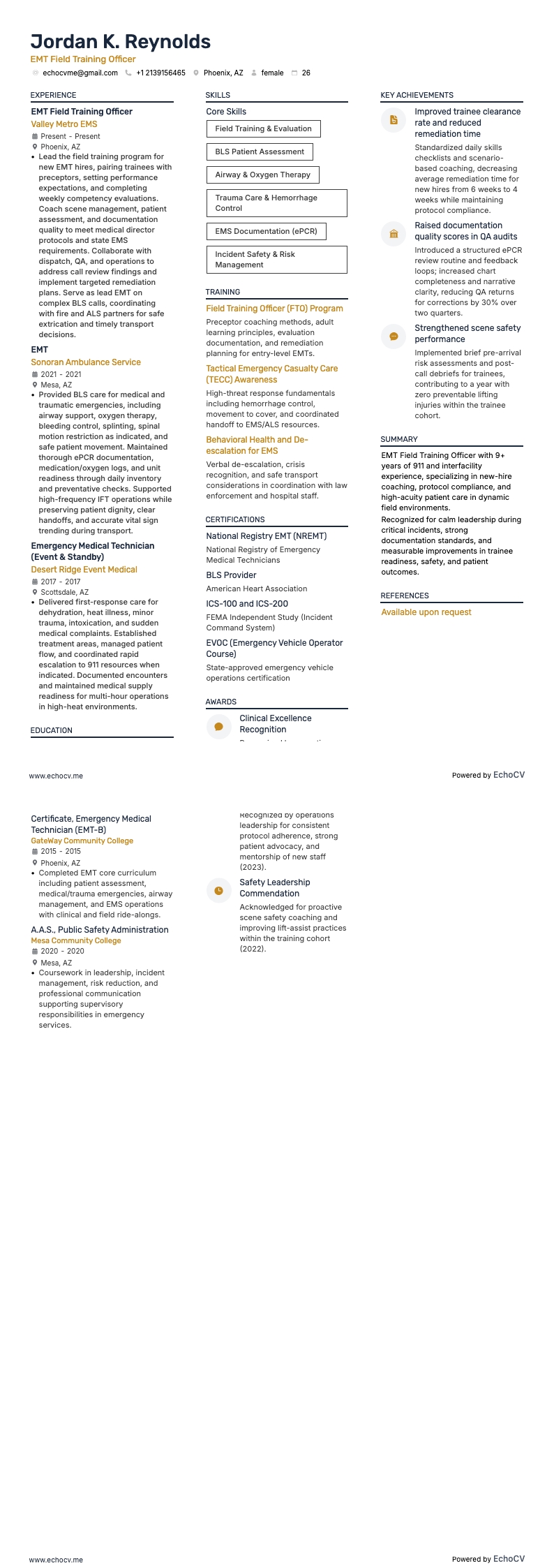
EMT-veldopleidingsfunctionaris example resume
EMT-veldopleidingsfunctionaris

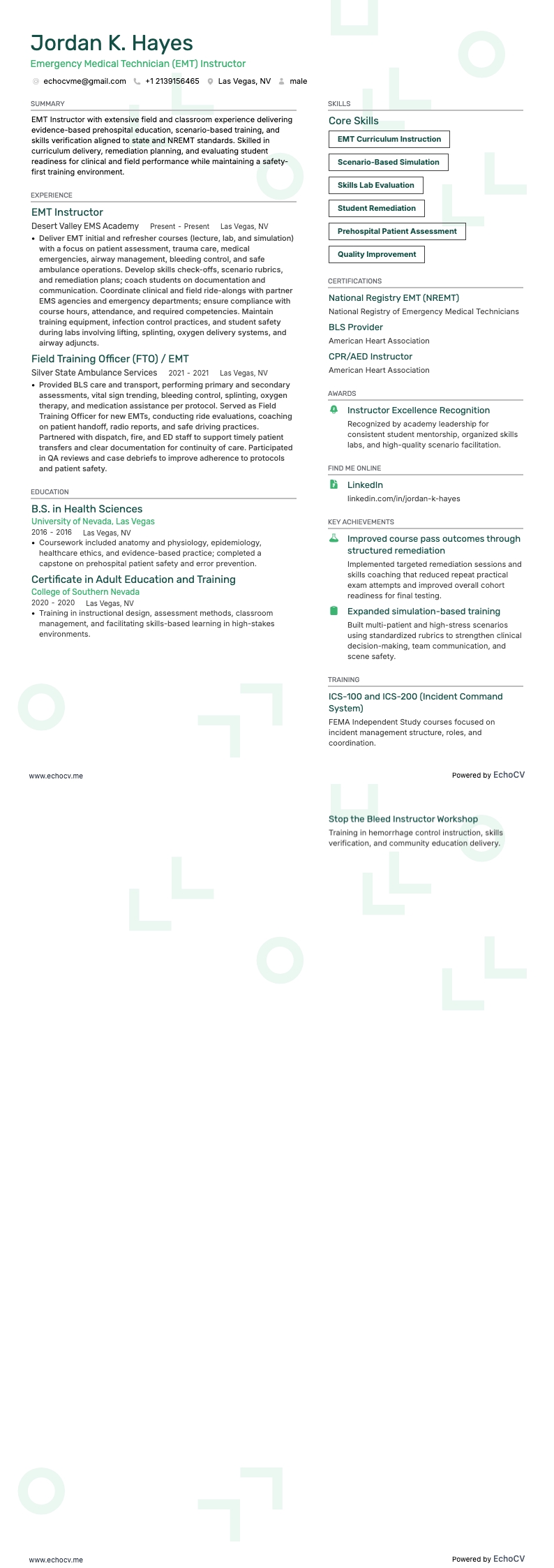
Instructeur spoedeisende medische hulpverlener (EMT) example resume
Instructeur spoedeisende medische hulpverlener (EMT)

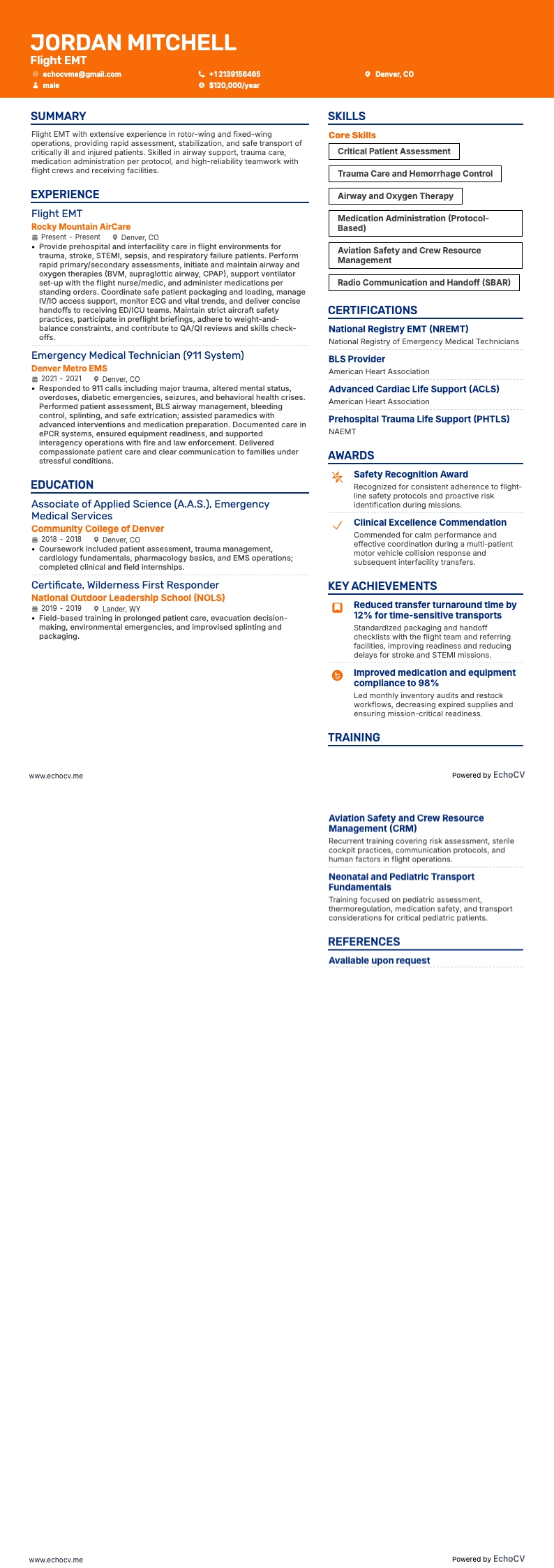
Luchtambulance-EMT example resume
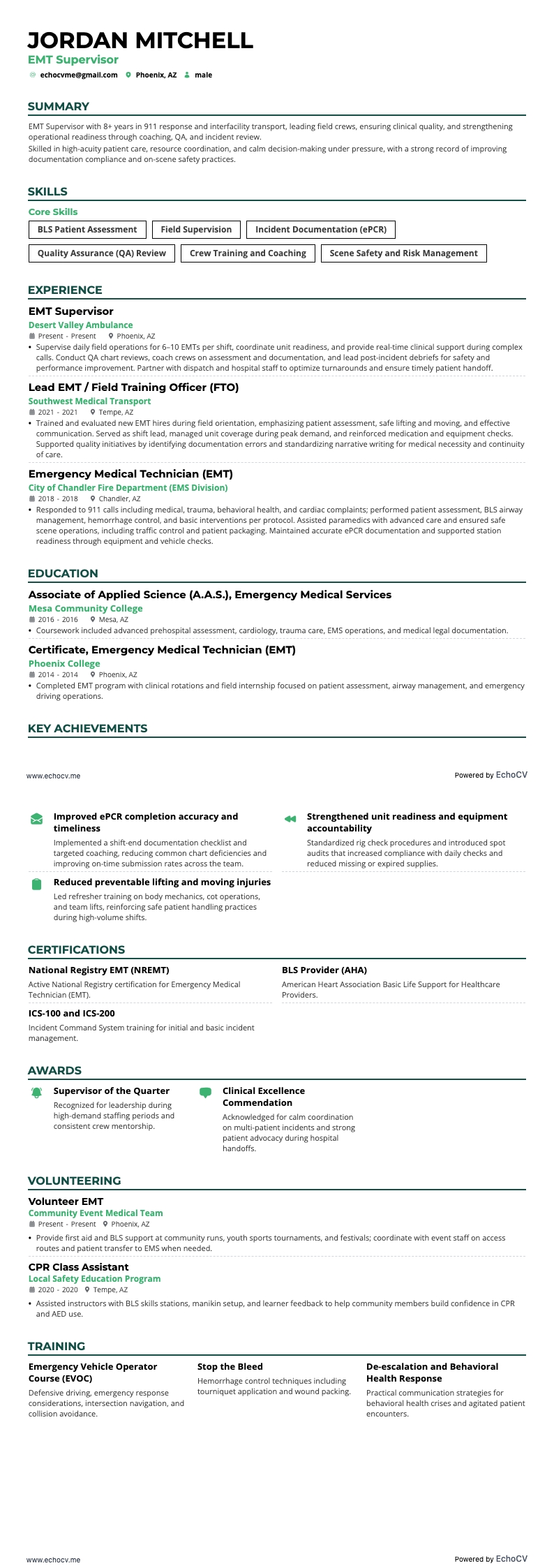
Luchtambulance-EMT

EMT-supervisor example resume

EMT-supervisor

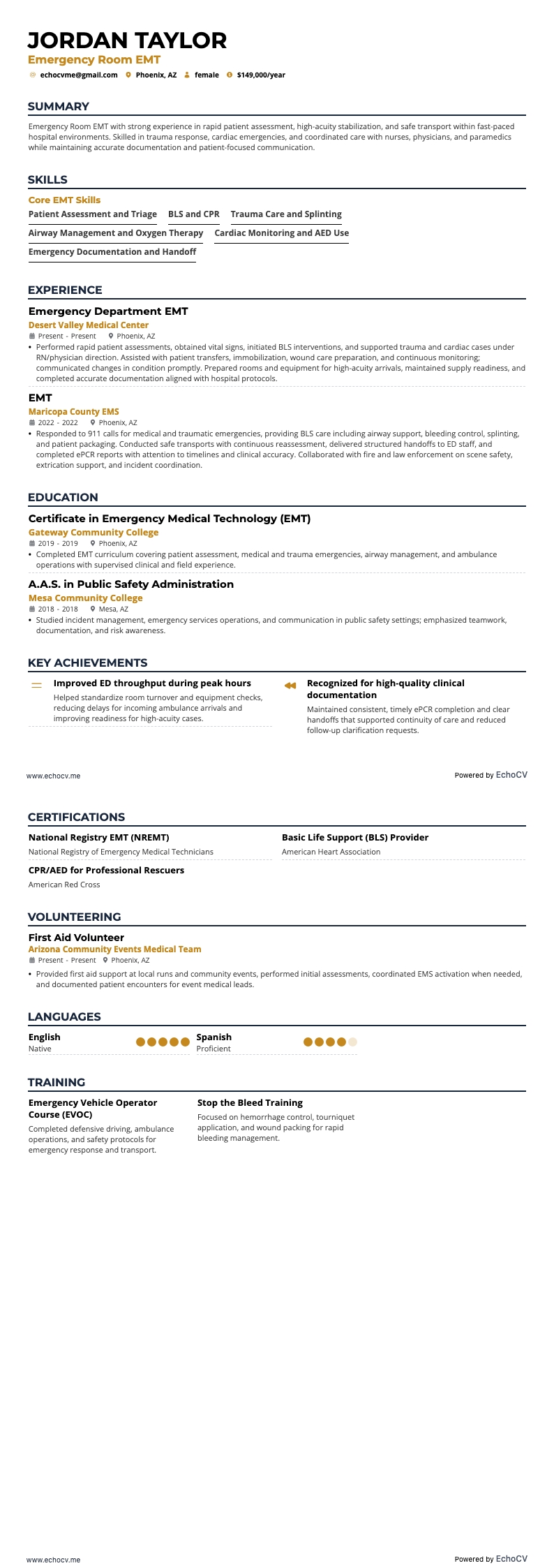
SEH-EMT example resume

SEH-EMT

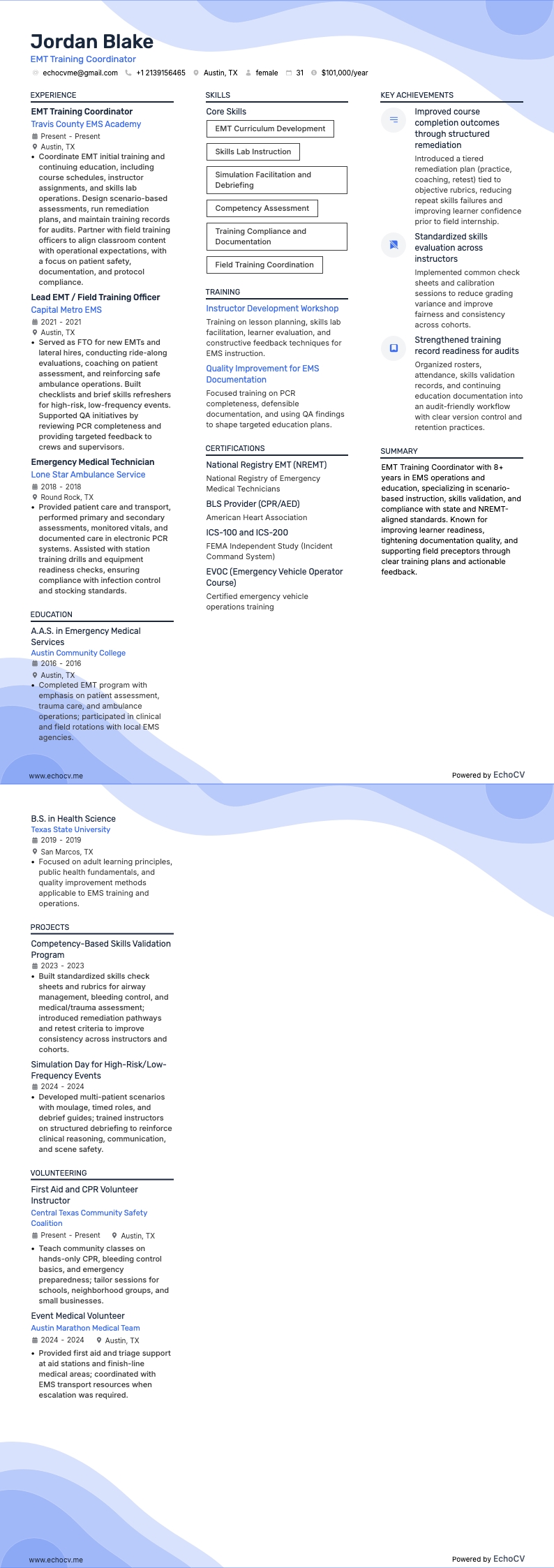
EMT-opleidingscoördinator example resume

EMT-opleidingscoördinator

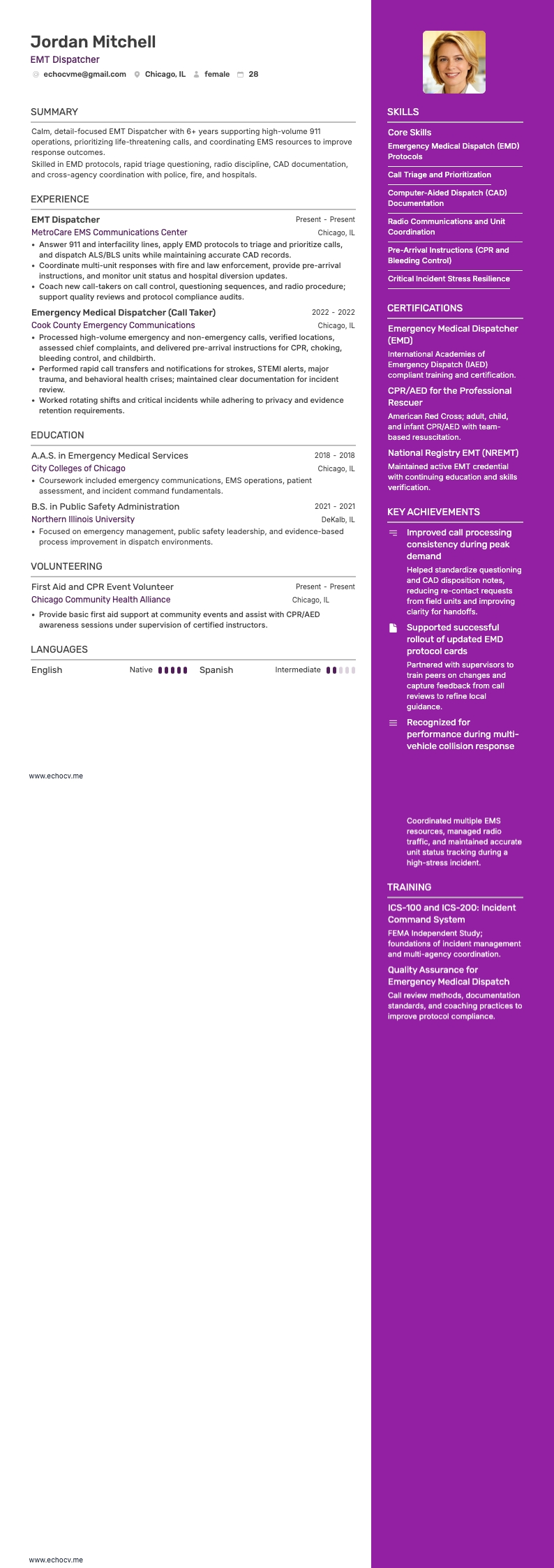
EMT-centralist example resume
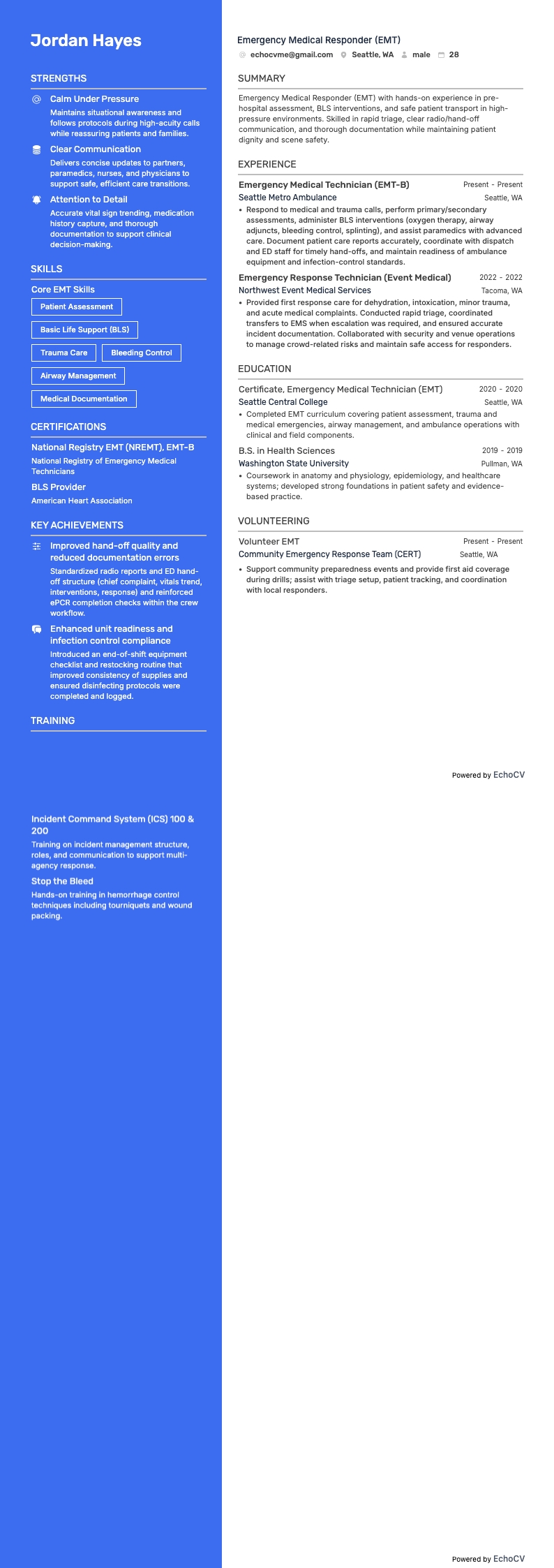
EMT-centralist

Medisch hulpverlener spoedzorg example resume
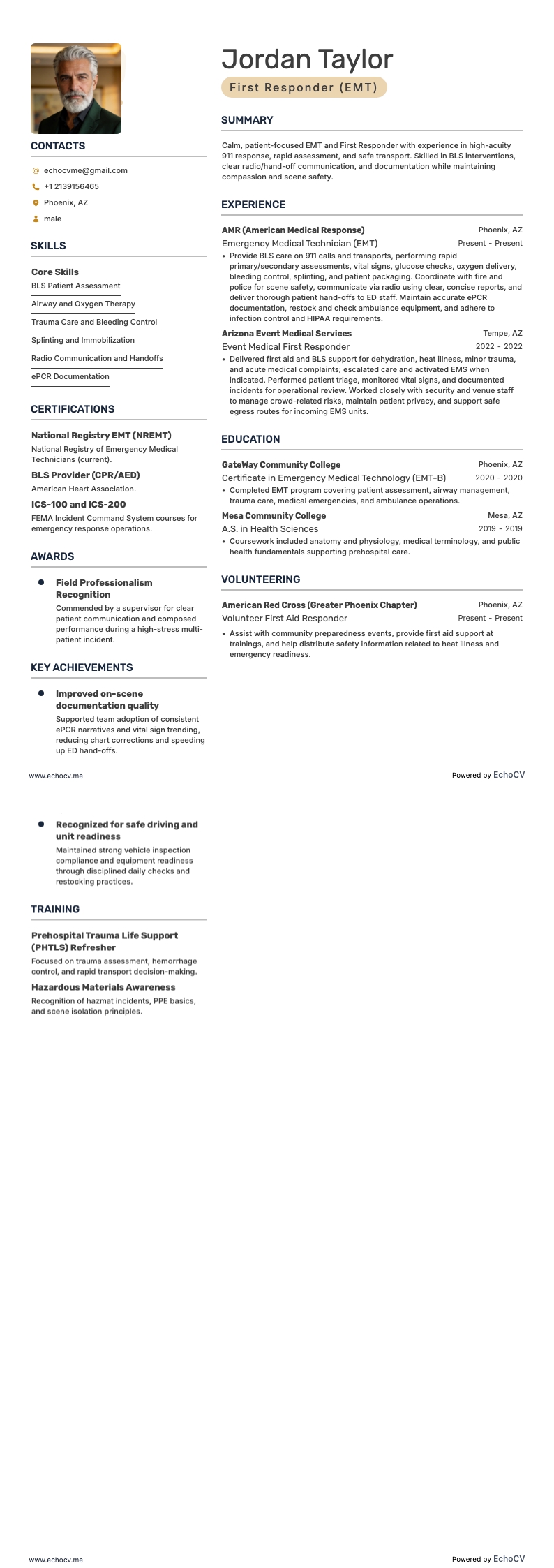
Medisch hulpverlener spoedzorg

Eerstehulpverlener example resume
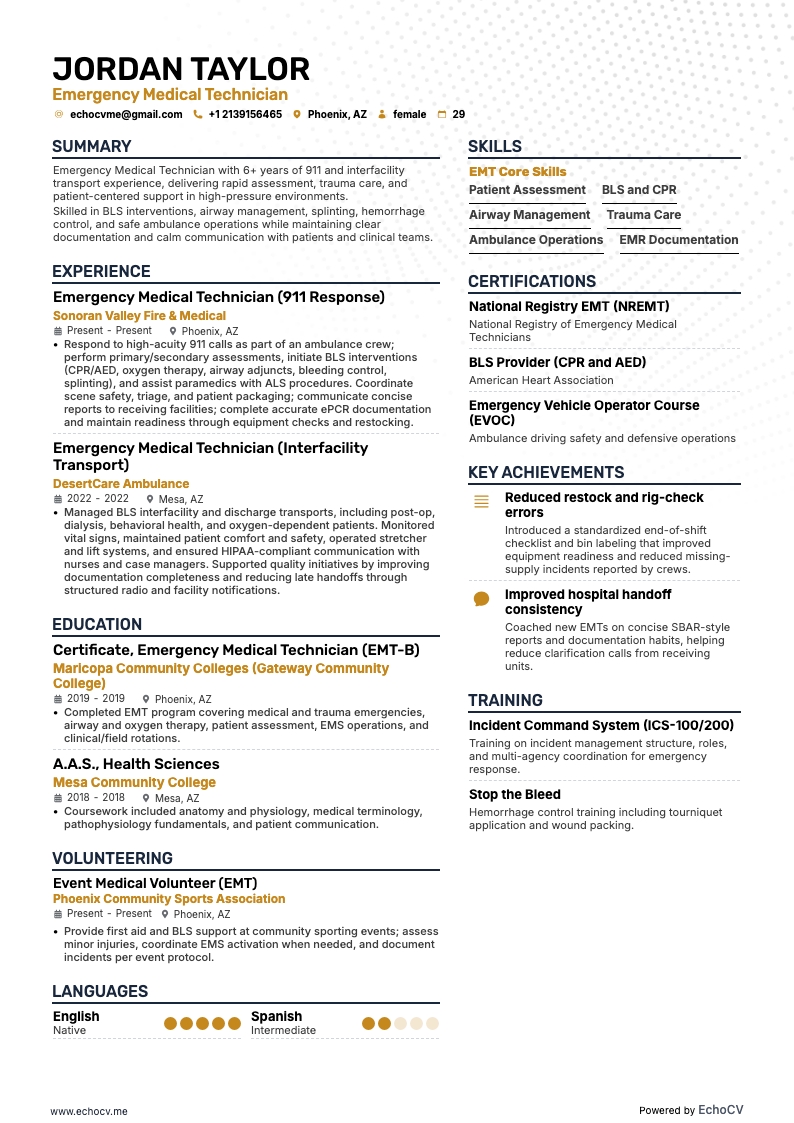
Eerstehulpverlener

Spoedeisendehulpverlener example resume

Spoedeisendehulpverlener

As an EMT, your resume needs to highlight real-world, on-the-job experience in high-stress situations.

Your emergency medical technician (EMT) resume also needs to showcase skills in med-tech equipment, tools, and techniques.

It can be difficult to accurately capture the dynamic role of an EMT considering the intangible nature of relevant skills and the respect for patient privacy.

We’ve created a guide that takes the guesswork out of the process so you can create an effective EMT resume with ease and start looking for your next role.

In this guide, you’ll learn:

  • How to format your EMT resume so recruiters can find the information they’re looking for quickly and easily
  • How to demonstrate expertise in intangible skills like crisis management and decision-making under pressure
  • How to present the appropriate certifications so hiring managers know that you meet the necessary requirements for the job
  • How to highlight top industry achievements and show potential employers how you will impact success at their organization

If you’re looking for something a little different than an emergency medical technician (EMT) resume, explore our guides for similar roles:

Emergency medical technician (emt) resume example

EMT Basis cv-voorbeeld

Here’s what this applicant does well in their resume:

  • Highlighting relevant certifications and skills. The resume effectively showcases certifications like Advanced Cardiac Life Support (ACLS) and Pediatric Advanced Life Support (PALS), which are crucial for an EMT role. It also lists skills directly relevant to emergency medical services, such as CPR certification and triage.
  • Demonstrating leadership and crisis management. The experience section emphasizes leadership roles and crisis management skills, which are key in emergency medical situations. This is shown through roles like leading a team of EMTs and directing emergency response operations.
  • Quantifiable achievements in professional experience. The resume includes specific, quantifiable achievements, such as improving patient processing efficiency by 35% and increasing patient survival rates by 25%. This approach effectively demonstrates the impact of the applicant's work.
  • Relevant education and continuous learning. The inclusion of a Master’s degree in Emergency Health Services and ongoing professional courses like Advanced Prehospital Trauma Life Support highlights the applicant's commitment to continuous learning and staying updated in their field.

How to format an emergency medical technician (emt) resume

Format is the first thing recruiters notice when they look at a resume. Make a good impression and demonstrate your organizational skills with a format that’s clear and easy to read.

EMTs work in high-stress environments and have to make decisions quickly. Show recruiters that you can communicate information efficientlyand effectively with every section of your resume.

Consider these key elements for an emergency medical technician (EMT) resume format that catches recruiters' attention:

  • Professional header - Include a header at the top of your resume that clearly states your title and professional contact information. Make a good introduction by including a certification or specialization associated with your role.
  • Single page - Emergency medical personnel need to meet specific requirements. Save hiring managers time by limiting your EMT resume to your relevant skills and experience.
  • ATS optimized - Select fonts and file formats that are optimized for Applicant Tracking Systems, especially if you are submitting your EMT resume through online job sites for emergency medical services personnel like EMS1 Jobs or JEMS Connect.

Use Echocv’s resume builder to accomplish all of the above and give your emergency medical technician’s resume the best chance of making it to a human recruiter.

The top sections on a emergency medical technician (EMT) resume:

  • Objective statement: Clearly defining the purpose and targets can help recruiters understand your expectations from the job.
  • Certifications and training: EMT jobs demand certain critical certifications, so recruiters would want to see them.
  • Professional experience: This includes your past work details such as where you have worked, your roles and responsibilities, and any unique cases you have handled.
  • Skills and abilities: You should mention skills like quick problem-solving, excellent physical endurance, experience with medical equipment, or interpersonal communication skills.
  • References: Including this section can help recruiters verify your professional track record and work ethics from previous employers or educators.

What recruiters want to see on your resume:

  • Proper certifications: Recruiters prioritize this as it reassures them that you have formal training and can legally perform your duties.
  • Previous experience as an EMT: This signals to recruiters that you have practical exposure and understand the demands and interventions required in real-life emergencies.
  • Physical endurance and stamina: Due to the physically demanding nature of the job, physical fitness is prioritized to ensure you can effectively handle the workload.
  • Crisis management skill: Recruiters prioritize this to ensure you possess the ability to stay calm, make critical decisions swiftly, and efficiently manage situations during emergencies.
  • Interpersonal skills: Since EMTs frequently engage with patients, their families, and other healthcare professionals, recruiters prioritize excellent communication skills for effective teamwork and assured patient care.

How to write your emergency medical technician (emt) resume experience

The experience section of your resume lists your work history along with 3-4 bullets highlighting your top accomplishments in the role. Show potential employers what you’ve achieved as an EMT while gaining real-world, hands-on experience.

Don’t just write a list of generic roles and responsibilities. Highlight specific instances where your skills were put to use and achieved results.

Let’s look at an example of an EMT’s resume experience section.

Experience
Emergency Medical Technician
Baltimore Emergency Services
Baltimore, MD
  • Responded to calls and provided emergency medical care
  • Managed medical equipment
  • Provided critical care in high-pressure environments
FOUT

What doesn’t work in this example:

  • No numbers - "Responded to calls and provided emergency medical care" doesn’t include any numbers that quantify the number of calls or patients. Be specific in your achievements.
  • No industry skills - "Managed medical equipment" doesn’t mention any specific equipment or techniques required for the job. Show your competency in the role by highlighting specific tools and skills.
  • Generic claims - "Provided critical care in high-pressure environments" is a general statement that can be open to interpretation. Be specific in your accomplishments so potential employers can see what you will achieve at their company.

Let’s make a few changes and take another look at this EMT experience section.

Experience
Emergency Medical Technician
Baltimore Emergency Services
Baltimore, MD
  • Responded to 300 calls and provided emergency medical care, improved response efficiency by 25%
  • Managed inventory and care of medical equipment, trained 20 EMTs on new automated external defibrillators (AEDs)
  • Provided critical care in high-pressure environments, improved patient survival rate by 15%
GOED

What works in this example:

  • Quantifies impact - “Responded to 300 calls” and “trained 20 EMTs” gives hiring managers a clear idea of the candidate’s experience and scope of work.
  • Industry skills - "Managed inventory and care of medical equipment, trained 20 EMTs on new automated external defibrillators (AEDs)" shows knowledge of industry-specific tools and skills.
  • Measurable success - "Provided critical care in high-pressure environments, improved patient survival rate by 15%" provides evidence of measurable results so potential employers can see exactly what the candidate is capable of.

How to quantify impact on your resume

It’s important to quantify impact on your EMT resume so potential employers can see exactly what you have achieved in previous roles.

Don’t generalize with basic job duties. Provide real metrics that show measured success or the scope of your work.

Here are a few areas to consider when quantifying impact on your EMT resume:

  • Include the number of emergency calls you've handled: This shows your experience and capability in handling high-pressure situations.
  • List the number of specific emergency cases managed (like heart attacks, trauma, etc.): It indicates your specialized experience.
  • Mention the amount of equipment or types of technology you're proficient in: This indicates your versatility in managing various emergency tools.
  • Indicate the size of teams you've worked within prior jobs: This showcases your teamwork skills and adaptability.
  • Specify your years of experience in the field: This shows your commitment to the profession and comprehensive understanding of the job.
  • Mention the number of training or certifications you've completed: This validates your commitment to keeping up to date with industry standards.
  • Reference your average response times: Your response time reveals your ability to think quickly and handle stressful situations efficiently.
  • Highlight how many 24-hour shifts you've worked: This indicates your resilience and ability to work long hours, an important aspect of EMT work.

How do I write an emergency medical technician (EMT) resume with no experience

If you’re just breaking into the emergency medical services industry or are making a career change, you face the challenge of writing an EMT resume with no experience.

The best approach is to write a functional resume that focuses on transferable skills rather than experience.

Highlighting transferable skills shows potential employers how you’ve developed the skills necessary for the role outside of work experience.

Follow these steps to write an effective entry-level emergency medical technician (EMT) resume:

  • Choose a functional resume layout
  • Focus on transferable skills
  • Present credentials and licenses clearly
  • Tailor every section to fit your target job

Don’t pad your experience section with irrelevant jobs just to fill space. Only include roles that are relevant to your target position and focus on transferable skills.

Other jobs in healthcare or emergency medical services can be a great way to show relevant skills. Even service and administrative roles can be an opportunity to highlight experience in high-stress situations and patient confidentiality.

How to list your hard skills and soft skills on your resume

EMTs use a range of med-tech equipment and record-keeping software. While technical proficiencies are crucial, soft skills like crisis management, decision making under pressure, and emotional stability are equally important.

Your emergency medical technician (EMT) resume will present your skills in two major categories.

Hard skills are the technical knowledge and abilities needed to perform job duties, whereas soft skills are the interpersonal and communication skills needed to interact with others.

Hard skills tend to be straightforward and can appear in a simple list form. Here is an example of hard skills on an EMT’s resume.

Skills
Advanced Cardiovascular Life Support (ACLS)
Cardio-Pulmonary Resuscitation (CPR)
Critical Care
Patient Assessment
Pediatric Advanced Life Support (PALS)
GOED

Only include hard skills that you’re confident in as hiring managers will assume that you’re proficient. Never lie on your resume by including skills you don’t have.

Here are a few more hard skills to consider for your EMT resume.

Best hard skills for your emergency medical technician (EMT) resume

  • Basic Life Support (BLS)
  • Advanced Cardiovascular Life Support (ACLS)
  • Emergency Medical Technology
  • Patient Assessment
  • Critical Care
  • Cardio-Pulmonary Resuscitation (CPR)
  • Emergency Vehicle Operation
  • Pediatric Advanced Life Support (PALS)
  • Pre-hospital Trauma Life Support (PHTLS)
  • Use of Automated External Defibrillators (AED)
  • Medication Administration
  • Trauma Care
  • Intravenous Therapy
  • Vital Signs Monitoring
  • Wound Care and Bandaging
  • Medical Protocols Compliance
  • Oxygen Therapy Administration
  • Emergency Response
  • Bloodborne Pathogen Training
  • Disaster Response Techniques

Emergency medical technicians work directly with patients and must communicate in high-stress situations. Your EMT resume should demonstrate competency in relevant soft skills.

Here are some of the top soft skills to consider for your EMT resume.

Best soft skills for your emergency medical technician (EMT) resume

  • Communication
  • Empathy
  • Stress Management
  • Physical Stamina
  • Adaptability
  • Teamwork
  • Problem-Solving
  • Attention to Detail
  • Decision-Making
  • Patience
  • Leadership
  • Cultural Competency
  • Time Management
  • Resilience
  • Professionalism
  • Active Listening
  • Compassion
  • Confidence
  • Dependability
  • Crisis Management

Adding important certifications to your EMT resume can boost your skills, helping you stand out to employers.

How to list education and certifications on your resume

Education requirements for emergency medical technicians vary by state. This will usually be a certification course and a high school diploma or equivalent.

There are typically no degree requirements to become an EMT, though many have a bachelor’s in biology, public health, or emergency management.

Let’s look at an example of an EMT’s resume education section.

Education
BS in Biology
University of Maryland
GOED

Your education section should include:

  • Name of institution
  • Name of degree
  • Years attended

Only include your high school diploma if it is your highest level of education. If you have earned a higher degree in a relevant field, include it instead of your high school diploma.

Your EMT certification section only needs to include the name of the certificate and the issuing institution. Be sure to research certification requirements in your state.

Here is an example of a certification section on an EMT’s resume.

Certifications
Maryland EMT Certification
Maryland Institute for Emergency Medical System
GOED

Continuing your education and gaining additional certificates in emergency medical services is a great way to keep your resume relevant and increase your employability.

Here are a few more certifications to consider for your EMT resume.

How to write your emergency medical technician (emt) resume summary or objective

A summary or objective is an opportunity to introduce yourself and your value in the industry as an emergency medical technician. It captures your career history and top accomplishments in 3-4 sentences.

Though the terms are often used interchangeably, there is a slight difference between a summary and an objective.

A summary is a brief introduction that summarizes your career and top achievements. An objective looks to the future and captures what you are hoping to achieve in your new position.

A summary is more suitable for candidates with experience in the field. Entry-level candidates are more likely to focus on an objective.

If you have at least some EMT experience, combine them by writing an introduction, a career highlight, and a goal you share with your target employer.

First, let’s take a look at an EMT resume summary example that is less effective.

Summary
Experienced Emergency Medical Technician with strong crisis management skills. Proven track record of quick and efficient response time. Seeking opportunity as Senior Emergency Medical Technician.
FOUT

What doesn’t work in this example:

  • No numbers - “Experienced Emergency Medical technician with strong crisis management skills” doesn’t quantify this person’s experience or how they’ve used their skills. Quantify impact with clear examples and measurable results.
  • No achievements - “Proven track record of quick and efficient response time” claims success but doesn’t provide any examples from the candidate’s track record. Support claims of success with specific achievements.
  • Generic goal - “Seeking opportunity as Senior Emergency Medical Technician” is a generic goal that doesn’t show why the candidate is applying to work at this particular organization. Show your interest by tailoring your resume to your target job.

Let’s make a few changes and take another look.

Summary
Emergency Medical Technician with 12 years of experience in critical care and crisis management. Implemented an EMS communication process that improved response time by 15%. Seeking opportunity to improve patient handover efficiency as Senior Emergency Medical Technician at Baltimore EMS.
GOED

What works in this example:

  • Specific experience - "Emergency Medical Technician with 12 years of experience in critical care and crisis management” tells hiring managers exactly how much experience this candidate has and their strengths.
  • Quantifies success - “Implemented an EMS communication process that improved response time by 15%” provides a specific example of success and shows potential employers what this candidate will achieve in their role.
  • Tailored to target job - “Seeking opportunity to improve patient handover efficiency as Senior Emergency Medical Technician at Baltimore EMS” shows potential employers how this candidate’s specific experience will provide solutions at their company.

Additional sections for an emergency medical technician (emt) resume

  • Languages - Speaking more than one language can be a great skill for an EMT, especially if your service area covers a population where multiple languages are spoken.

  • Continuing education - Continuously developing your skills as an EMT is a great way to keep your resume relevant and increase your employability. Be sure to keep your EMT resume up-to-date and show commitment to your role by always updating it to reflect your current skill set.

  • Volunteer work - Volunteering is a great way to develop soft skills necessary for emergency medical technicians like crisis management, communication, and decision-making under pressure.

  • Format your EMT resume with a reverse-chronological layout to show commitment to your career and a timeline of real-world, hands-on experience.

  • Quantify impact with specific examples of success to show potential employers what you will achieve in your role at their company.

  • Research certification requirements in your state and prominently display them on your EMT resume so hiring managers know that you’re qualified to do the job.

  • Tailor every section of your EMT resume to fit your target job so recruiters can get the information they need quickly and efficiently.

Spoedeisendehulpverlener cv-voorbeelden

Bekijk meer Spoedeisendehulpverlener-cv-voorbeelden en gidsen en ontdek wat werkt voor jouw ervaringsniveau of rol.

Op ervaring

EMT Basis

EMT Basis cv-voorbeeld

EMT-paramedicus

EMT-paramedicus cv-voorbeeld

EMT gevorderd

EMT gevorderd cv-voorbeeld

EMT Gevorderd

EMT Gevorderd cv-voorbeeld

EMT op instapniveau

EMT op instapniveau cv-voorbeeld

Spoedeisendehulpverlener cv-voorbeelden

Bekijk meer Spoedeisendehulpverlener-cv-voorbeelden en gidsen en ontdek wat werkt voor jouw ervaringsniveau of rol.

Op rol

EMT-compliancefunctionaris

EMT-compliancefunctionaris cv-voorbeeld

Tactische EMT

Tactische EMT cv-voorbeeld

EMT-specialist hartzorg

EMT-specialist hartzorg cv-voorbeeld

Pediatrisch EMT-specialist

Pediatrisch EMT-specialist cv-voorbeeld

EMT kritieke zorg

EMT kritieke zorg cv-voorbeeld

EMT Operations Manager

EMT Operations Manager cv-voorbeeld

EMT-traumaspecialist

EMT-traumaspecialist cv-voorbeeld

EMT-veldopleidingsfunctionaris

EMT-veldopleidingsfunctionaris cv-voorbeeld

Instructeur spoedeisende medische hulpverlener (EMT)

Instructeur spoedeisende medische hulpverlener (EMT) cv-voorbeeld

Luchtambulance-EMT

Luchtambulance-EMT cv-voorbeeld

EMT-supervisor

EMT-supervisor cv-voorbeeld

SEH-EMT

SEH-EMT cv-voorbeeld

EMT-opleidingscoördinator

EMT-opleidingscoördinator cv-voorbeeld

EMT-centralist

EMT-centralist cv-voorbeeld

Medisch hulpverlener spoedzorg

Medisch hulpverlener spoedzorg cv-voorbeeld

Eerstehulpverlener

Eerstehulpverlener cv-voorbeeld

Spoedeisendehulpverlener

Spoedeisendehulpverlener cv-voorbeeld