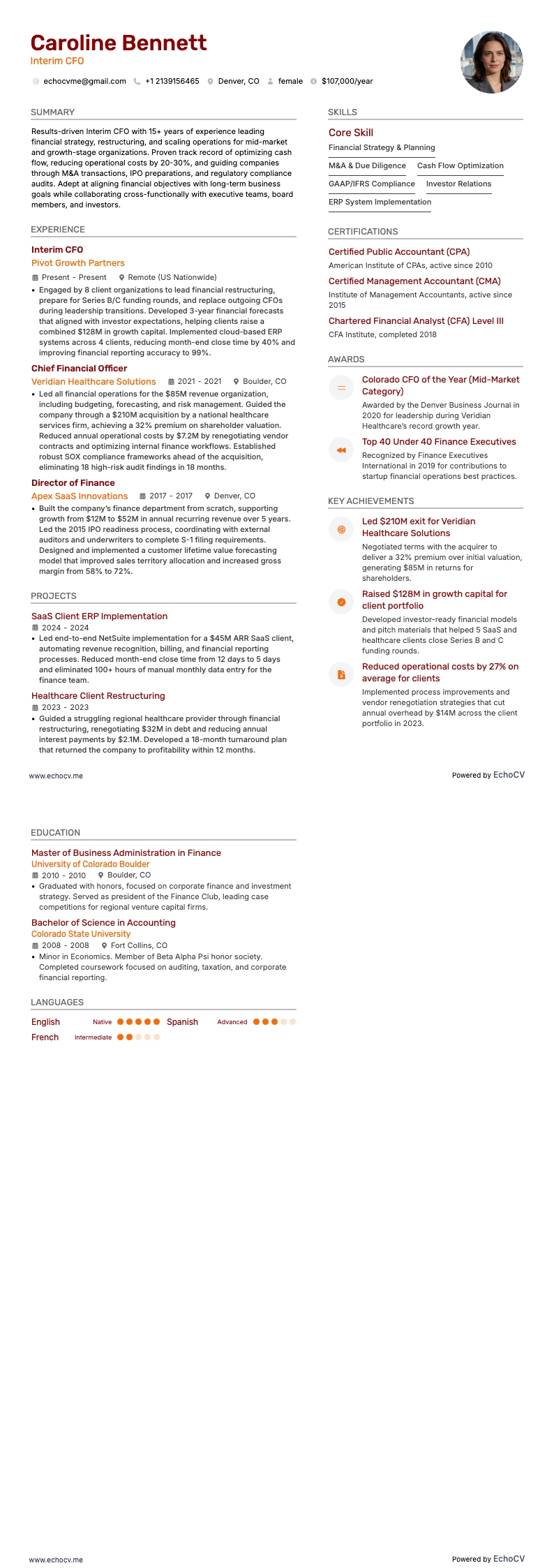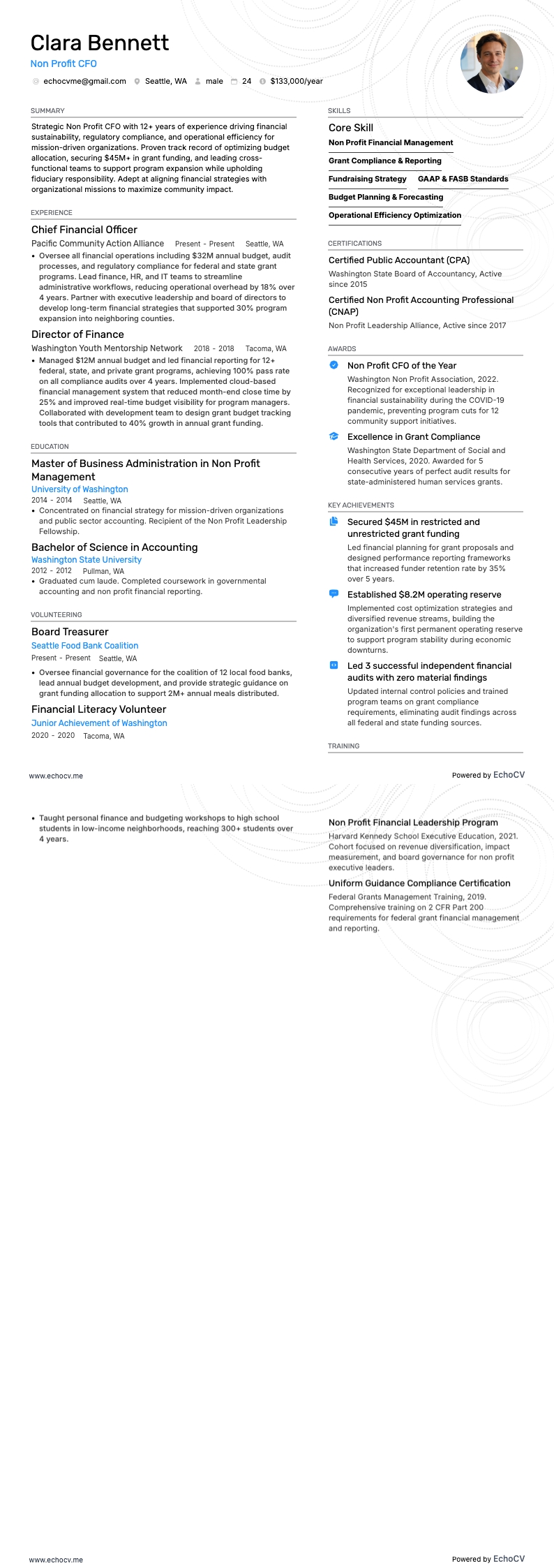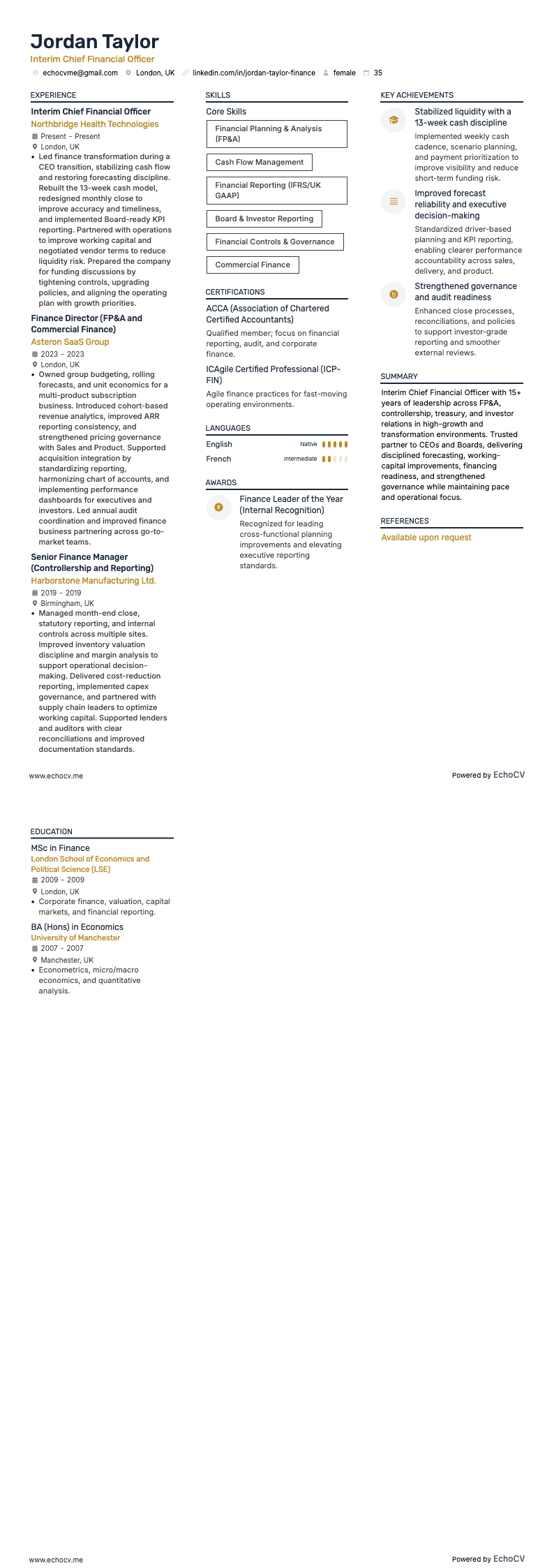
Tillförordnad finanschef full förhandsvisning

11 exempel på CFO-CV

EchoCV

Skriven av EchoCV-teamet

Uppdaterad: 9/12/20258 min read

Se alla CV-exempel i den här guiden, eller skapa ditt eget CV-exempel med din personliga prompt

Tillförordnad finanschef example resume
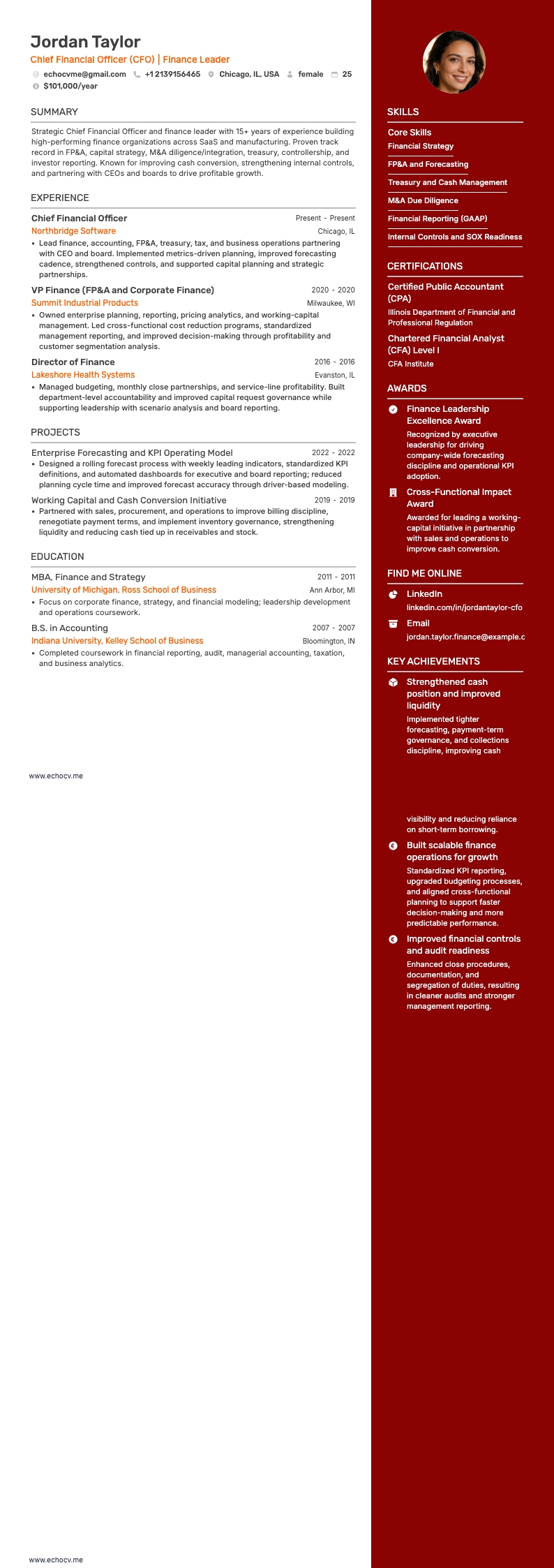
Tillförordnad finanschef

Finansdirektör, Finansledare example resume
Finansdirektör, Finansledare

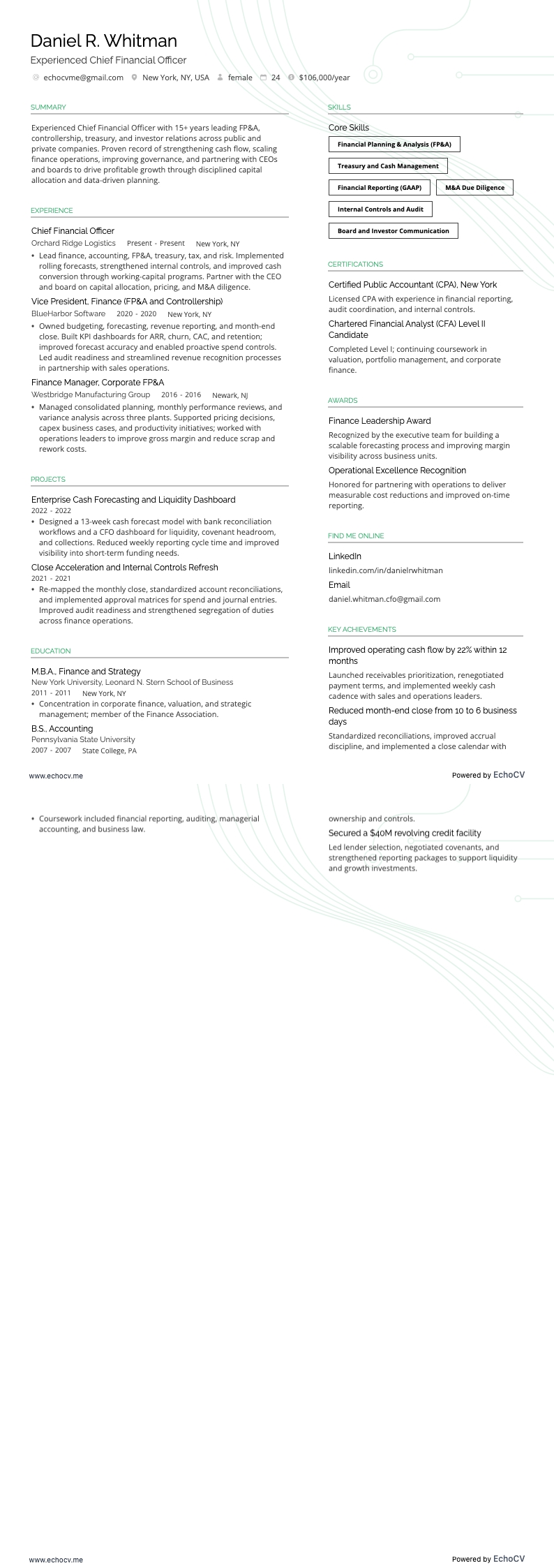
Erfaren Chief Financial Officer example resume
Erfaren Chief Financial Officer

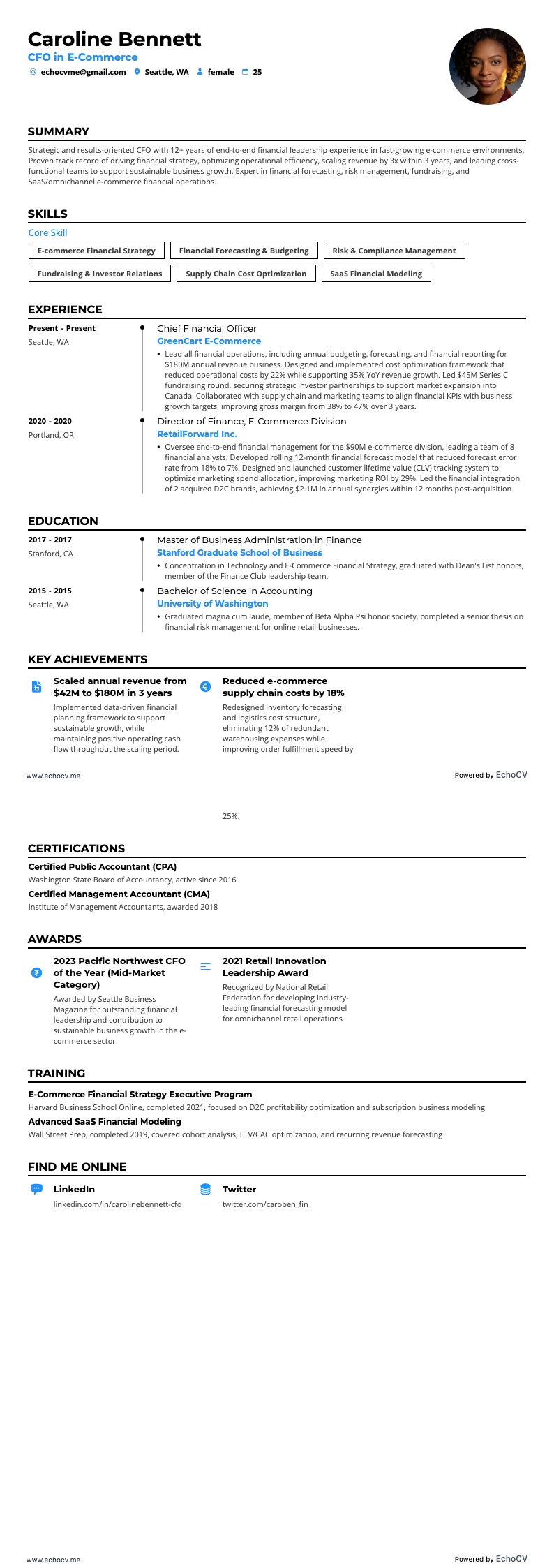
CFO inom e-handel example resume
CFO inom e-handel

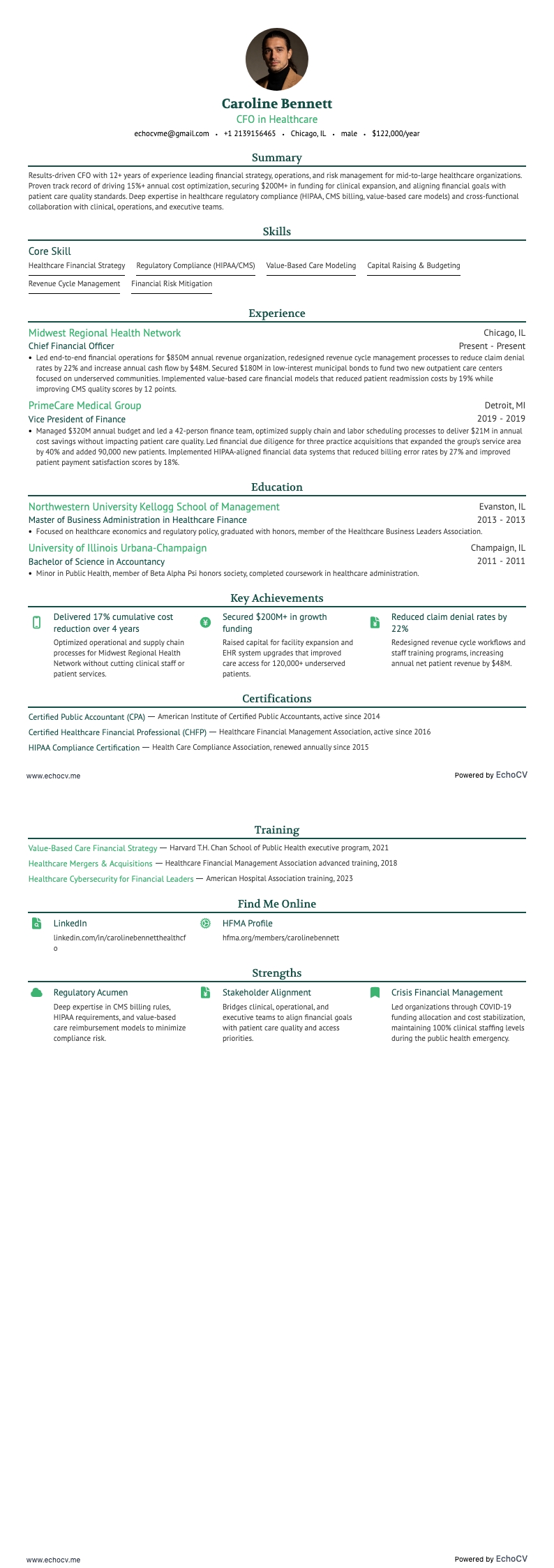
CFO inom hälso- och sjukvård example resume
CFO inom hälso- och sjukvård

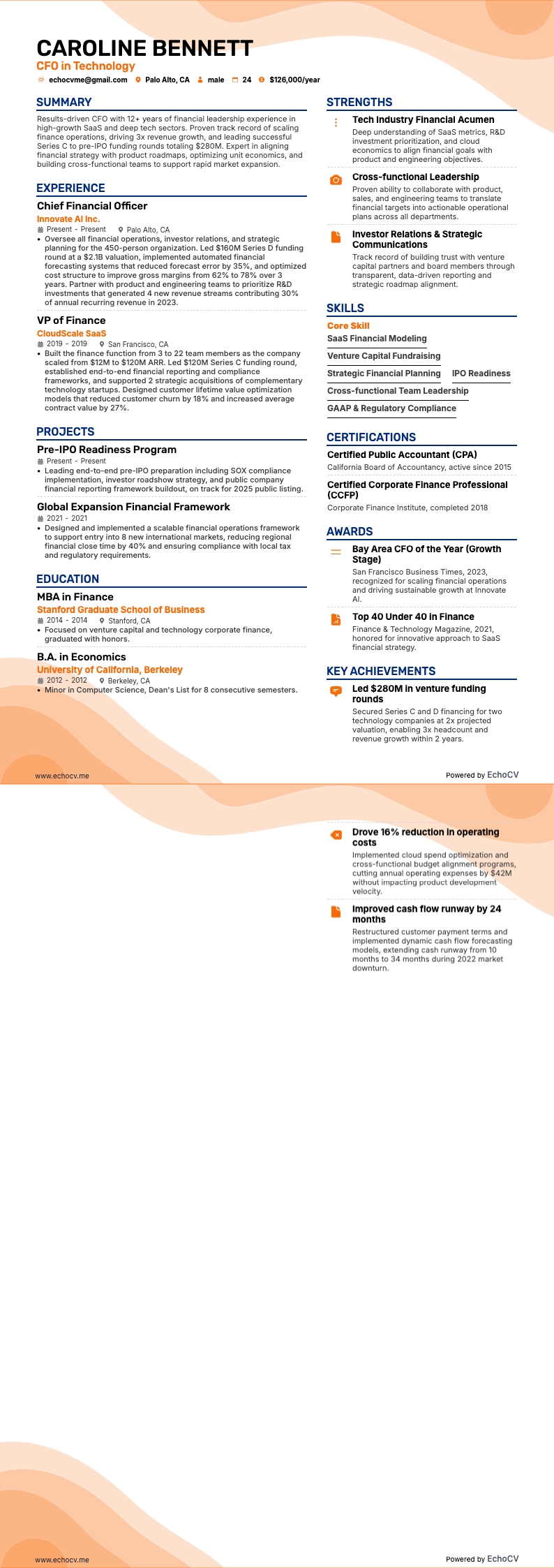
CFO inom teknik example resume
CFO inom teknik

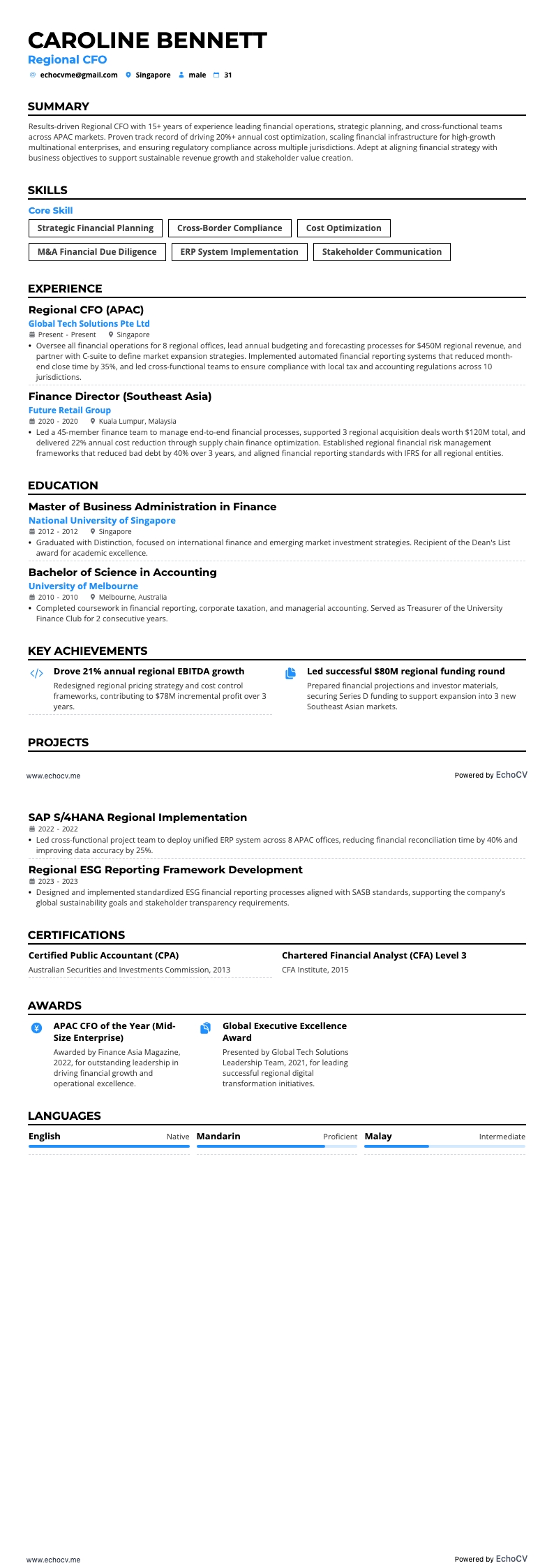
Regional CFO example resume

Regional CFO

Interims-CFO example resume

Interims-CFO

CFO för ideell organisation example resume
CFO för ideell organisation

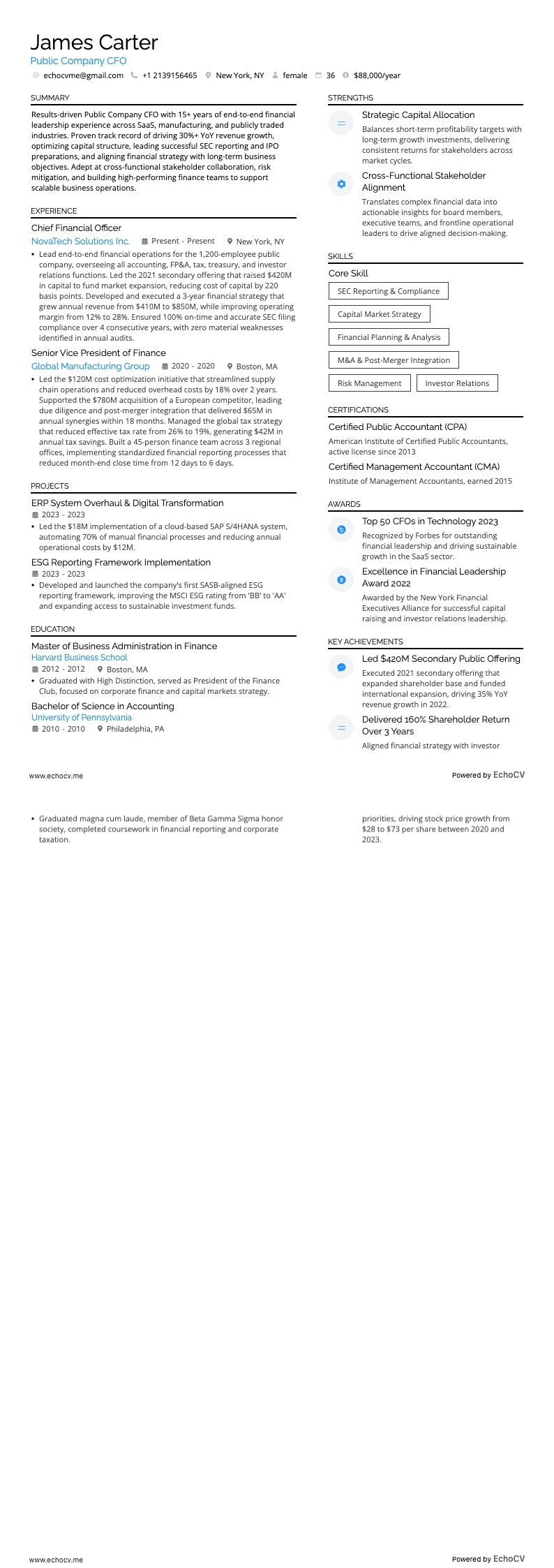
CFO för börsnoterat företag example resume
CFO för börsnoterat företag

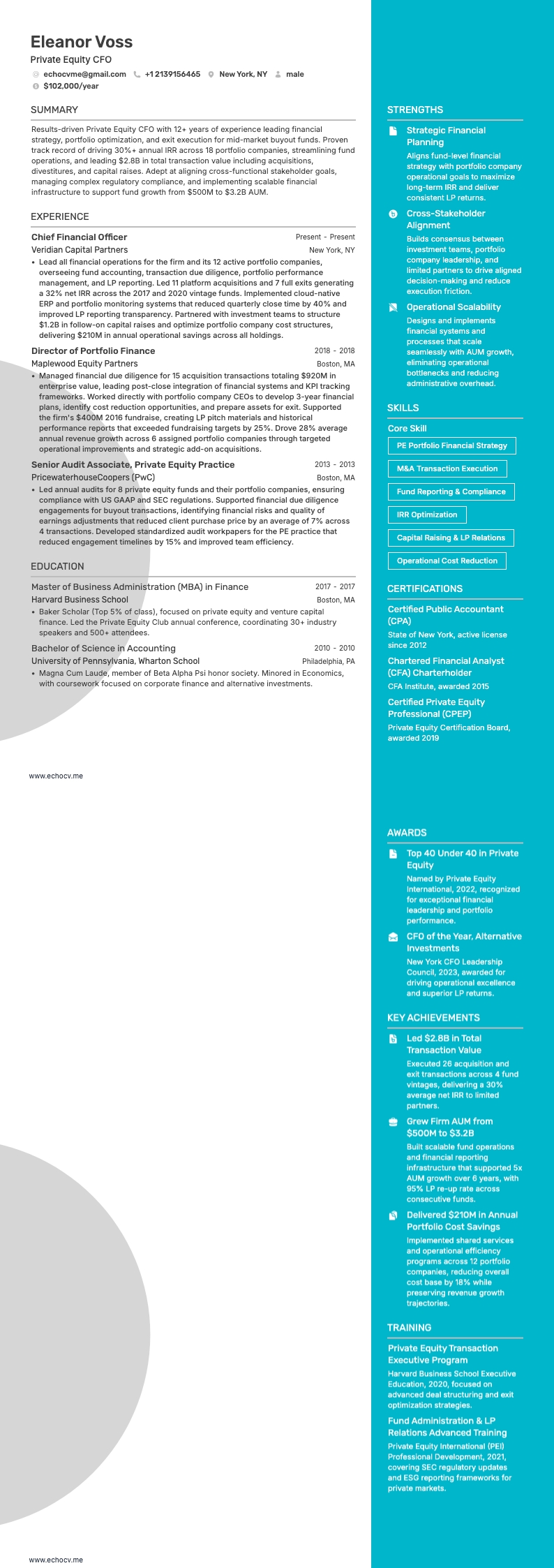
CFO inom private equity example resume
CFO inom private equity

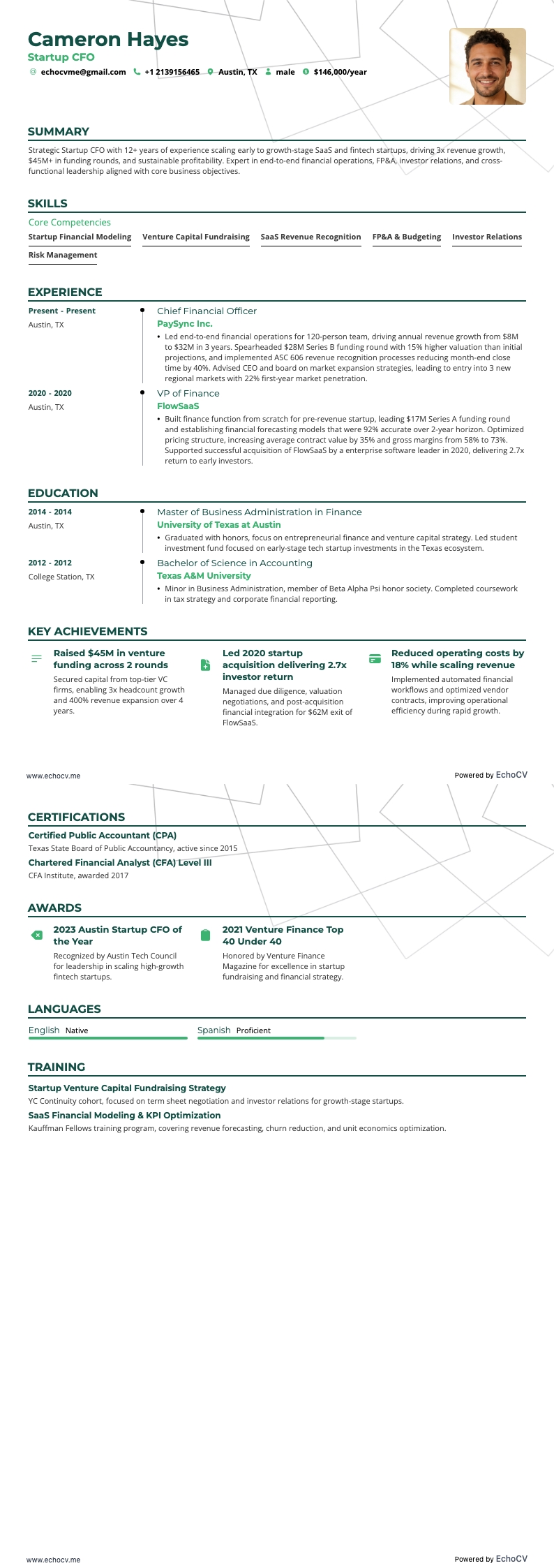
CFO för startup example resume
CFO för startup

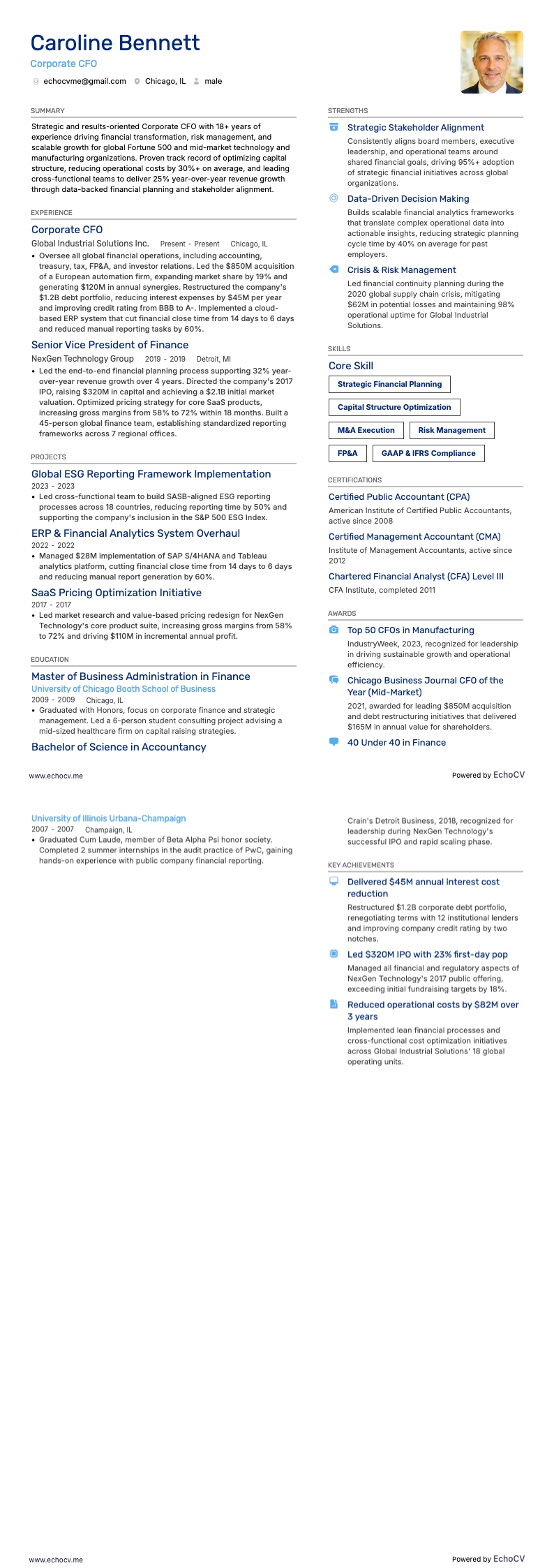
Företags-CFO example resume

Företags-CFO

Even seasoned CFOs dread updating their resumes. You’re used to managing multi-million-dollar budgets, not condensing decades of strategic impact into two pages. But in today’s market, even the most accomplished finance leaders need a resume that shows how their decisions move the bottom line.

The problem is that most CFO resumes read like ledgers—accurate but lifeless. Recruiters aren’t just scanning for financial stewardship anymore. They’re looking for evidence of vision, digital transformation, and leadership that drives sustainable growth.

At Echocv, we’ve helped hundreds of finance executives turn their career stories into compelling proof of results. In this guide, you’ll see CFO resume examples and expert tips on how to highlight your influence, quantify your impact, and stand out as a trusted business partner ready for your next boardroom opportunity.

Key takeaways

  • Lead with strategy and measurable impact, not just responsibilities. Your results are your best proof of excellence.

  • Keep your resume focused and concise—two pages are enough to show scope, growth, and results without excess detail.

  • Use quantifiable data to demonstrate influence: revenue growth, margin gains, cost savings, or capital raised.

  • Strengthen your personal brand through consistent tone and formatting that reflect precision and executive maturity.

  • Use Echocv’s tools—from the Resume Checker to the Summary and Bullet Point Generators—to refine your message and present your leadership story with clarity and confidence.

Below, you’ll find CFO resume examples tailored for different industries—from tech to e-commerce—showing how executives can adapt their experience to fit any business landscape.

How to choose the best CFO resume format

Just like a balance sheet, your CFO resume should present a clear picture of where you’ve created value—assets up front, liabilities minimized. The best format is always about clarity. For executives, that means using a structure that highlights long-term impact, strategic vision, and financial stewardship at a glance.

The strategy is simple: lead with results, organize by influence, and make it effortless for a recruiter or board member to trace your trajectory from oversight to outcomes.

Which resume format should a CFO use?

A reverse-chronological format is the best choice for a chief financial officer. It immediately shows your most recent executive roles and career progression—exactly what recruiters and boards want to see first.

This format also helps keep your professional story easy to follow.

PROFFSTIPS

For most CFOs, a two-page resume works best. Echocv’s latest resume survey shows that 55% of senior professionals prefer it because it allows space for results without overwhelming detail.

The first page should carry your most compelling information—headline achievements, executive summary, and core competencies—while the second can expand on your earlier leadership roles and major projects.

What sections should go on a CFO's resume?

With your structure in place, it’s time to decide what belongs on the page and how each section can strengthen your financial narrative.

For finance executives, the preferred order is as follows:

  • Header and Contact Information: Include your name, title (Chief Financial Officer or equivalent), phone, email, and LinkedIn profile.
  • Professional Summary: A concise snapshot of your influence scope, industry expertise, and top achievements.
  • Core Competencies or Key Skills: Underscore executive-level skills such as financial strategy, capital allocation, risk management, M&A, and stakeholder relations.
  • Professional Experience: Detail your executive roles in reverse-chronological order, focusing on quantifiable results and strategic impact.
  • Education: List relevant executive programs or MBAs.
  • Certifications: Include credentials like CPA, CMA, CFA, or other finance-related executive certifications.
  • Achievements or Selected Highlights: Optional, but useful for spotlighting board memberships, thought leadership, or high-impact initiatives.

Before you start building each section, take a moment to see how your current resume performs. Upload it to our Resume Checker for an instant, data-driven assessment.

How to write your CFO resume experience

Your experience section is the backbone of your resume—it’s where your financial foresight comes to life. Every entry should demonstrate how your decisions shaped performance and long-term value.

Because your background is likely extensive, this section will take center stage. You can structure it under a traditional heading like “Professional Experience,” “Executive Experience,” or even “Leadership Highlights” if you prefer a more selective, board-facing presentation. The right choice depends on what you want to focus on: continuous growth or curated milestones.

Each experience entry should include:

  • Job title and company: Make it immediately clear whether you served as CFO, VP of Finance, or another executive title.
  • Dates of employment: Keep formatting consistent and focus on tenure that reflects stability and growth.
  • Scope of role:A one-line context about company size, revenue, or team span helps readers grasp the scale you operated at.
  • Three to six bullet points that show: successful IPOs or M&A deals, improved forecasting accuracy, and leading finance teams.

PROFFSTIPS

For CFOs with experience across industries, consider grouping achievements by sector or specialty under subheadings like “Selected Financial Leadership Across Industries” or “Private Equity & Growth Experience.” This structure leans toward a hybrid resume format, allowing you to highlight the most relevant results without repeating responsibilities.

This approach works especially well if your career spans multiple companies with overlapping responsibilities or consulting-style engagements.

Above all, make this section easy to scan. Recruiters and board members will naturally gravitate toward metrics, scope, and outcomes. Keep the narrative clean, the numbers visible, and the story unmistakable.

Here’s how this can look on a resume:

Good example of a CFO experience section

Financial Leadership in Manufacturing

Chief Financial Officer

Parker Hannifin Corporation | Cleveland, OH
2022 – Present

Global manufacturer of motion and control technologies | $15B annual revenue | 300+ finance professionals

  • Led enterprise-wide cost optimization strategy that improved gross margins by 8% over three years.
  • Directed capital structure redesign, refinancing $2.4B in debt and reducing interest expenses by 12% annually.
  • Partnered with operations to implement lean accounting practices across 20 plants, cutting reporting cycle time from 10 to 4 days.
  • Oversaw two strategic acquisitions totaling $1.1B, integrating finance and ERP systems within six months.

Vice President, Finance

Illinois Tool Works (ITW) | Glenview, IL
2017 – 2022

Diversified industrial manufacturer | $14B revenue

  • Drove 5-year financial roadmap that delivered consistent EBITDA growth above industry average.
  • Automated FP&A reporting, improving forecasting accuracy by 20% and reducing manual workload by half.
  • Partnered with the CEO to launch a performance-based budgeting framework later adopted company-wide.

How to tailor your CFO resume experience

Even at the executive level, tailoring your resume is what turns a good application into a strategic one. Recruiters and boards compare your experience directly against their organization’s needs—and the closer your language, metrics, and achievements align, the faster you’ll stand out as the right fit.

Here’s how to tailor your CFO experience effectively:

  • Mirror the strategic priorities mentioned in the job ad: If they emphasize operational efficiency or expansion, highlight similar outcomes you’ve delivered.
  • Match industry context and scale: Mention company size, global operations, or public/private structure that reflects their environment.
  • Use terminology that fits their world: “Capital allocation,” “FP&A transformation,” or “stakeholder governance” resonate differently in corporate vs. private equity settings.
  • Quantify results using metrics that matter: EBITDA growth, margin improvement, or cost reductions signal measurable influence.
  • Highlight leadership scope that fits the role: Board reporting, investor relations, or cross-functional transformation.

Tailoring shows you understand what success looks like in their organization, and that you’ve achieved it before. Often, tweaking your bullets to include keywords and priorities from the job ad is a great place to start.

Look at some resume-ready examples below or use Echocv’s AI Tailoring tool to align better with your next role.

Resume tailoring examples for chief financial officers

Job description excerptUntailored bulletTailored bullet
Seeking a CFO to lead strategic financial planning, optimize capital allocation, and support growth initiatives across global markets.Responsible for financial planning and budgeting for multiple regions.Directed global financial strategy across 12 markets, optimizing capital allocation and supporting 18% revenue growth year over year.
Looking for an executive experienced in digital transformation and ERP implementation to improve reporting accuracy and operational efficiency.Oversaw technology upgrades and process improvements.Led ERP transformation across five divisions, cutting monthly close time by 40% and improving forecasting accuracy by 25%.
Private equity portfolio company hiring CFO to drive margin expansion and cash flow optimization post-acquisition.Managed finance operations and reviewed budgets.Partnered with PE stakeholders to deliver $32M EBITDA improvement and 15% cash flow growth within first year post-acquisition.

How to quantify your CFO experience on a resume

Numbers are already the language of your profession—but on a resume, they become your most persuasive storytelling tool. Recruiters and boards want to see how your decisions affected the bottom line, improved efficiency, or strengthened financial performance across the organization.

Below are examples of how CFOs can turn broad responsibilities into quantifiable

statements that underline scale, precision, and measurable success.

Examples of how to quantify CFO achievements on a resume

How to quantifyExample bullet point
Show how your financial leadership drove profitability or cost optimization.Delivered $42M in annual cost savings by restructuring vendor contracts and implementing zero-based budgeting.
Quantify revenue growth or market expansion under your strategic oversight.Guided financial strategy that increased annual revenue from $1.2B to $1.8B within three years through targeted acquisitions.
Highlight capital raised or financing secured to fuel company growth.Secured $250M in private equity funding and renegotiated debt facilities to lower borrowing costs by 15%.
Measure efficiency gains from systems, automation, or process improvements.Implemented ERP and BI platforms across 10 subsidiaries, reducing reporting cycle from 12 to 5 days.

If you’re tight on time, try Echocv’s Bullet Point Generator that turns your results into powerful, recruiter-ready statements.

How to list skills on your CFO resume

At the executive level, skills are less about checklists and more about credibility. A CFO’s resume should reflect a balance between technical financial expertise and business acumen.

Hard skills prove your command of complex financial operations, while soft skills demonstrate the executive presence behind those results—your ability to communicate with boards, guide cross-functional teams, and influence at the highest levels.

To keep your resume skills focused and easy to scan:

  • Place your key competenciesnear the top or alongside your summary.
  • Use grouped categories such as Financial Strategy, Corporate Governance, and Operational Excellence rather than long, unordered lists.
  • Mirror the language used in the job description—recruiters will look for alignment in phrasing and focus areas.
  • Keep only the most relevant and high-level skills—anything foundational (Excel, GAAP) is assumed at this stage.

Below are examples of the most relevant technical chops for modern CFOs.

Best hard skills for your CFO resume

  • Financial planning & analysis (FP&A)
  • Strategic financial management
  • Budgeting and forecasting
  • Capital allocation and treasury management
  • Mergers and acquisitions (M&A)
  • Financial reporting and compliance (GAAP, IFRS, SOX)
  • Risk management and internal controls
  • Investor relations and shareholder reporting
  • Corporate governance and board communication
  • Cost optimization and profitability analysis
  • Cash flow management
  • ERP and business intelligence systems (SAP, Oracle, Workday, Power BI)
  • Audit and assurance oversight
  • Tax strategy and regulatory compliance
  • Debt and equity financing

While these strengths anchor your credibility, it’s your soft skills that reveal how you lead, influence, and drive alignment across the organization.

Look at some must-have soft skills to include in your resume:

Here’s a brief, resume-ready example showing how soft skills can be naturally embedded within a CFO summary without sounding forced or generic:

PROFFSTIPS

Even at the executive level, your resume still passes through applicant tracking systems (ATS). While human recruiters make the final call, missing a few key terms, like FP&A, capital allocation, or stakeholder reporting, can still cause your application to be filtered out.

Review the job description carefully and make sure your wording reflects the same core competencies and language.

How to list your certifications and education on your CFO resume

At the CFO level, education supports your authority, but it doesn’t define it. Keep this section focused, selective, and easy to scan.

Key guidelines for a CFO’s education section:

  • List only your most relevant and recent degrees. Early education (e.g., bachelor’s) is enough if it’s finance-related.
  • If you hold an MBAor a finance-focused master’s, list it first—it signals authority.
  • Include the institution name, degree, and year of completion.
  • If you graduated from a prestigious university, feature it prominently. Name recognition carries weight in executive searches.
  • Add academic honors, club memberships, or awards that show initiative and leadership—e.g., Beta Gamma Sigma Honor Society, Finance Club President, Dean’s List.

Look at a neat example:

Education entry sample

MBA, Finance

University of Chicago Booth School of Business

2012

B.S., Accounting

Indiana University Bloomington

2010

Typically, Education comes before Certifications to establish your foundational credibility. However, if your CPA, CMA, or CFA is both current and central to the target role, you can place your certifications sectionfirst.

Here’s a list of the most common credentials on finance resumes:

With your credentials reinforcing your financial authority, the next step is to craft a summary that captures the full story behind the numbers.

How to write your CFO resume summary

If you’ve made it to the C-suite, you already know how to tell a story through numbers. Your resume summary is where you translate that story into operational value—the part that convinces boards, CEOs, and investors that you’re not just managing capital, you’re shaping the organization’s direction.

You have three to five sentences to make it clear what kind of results you deliver and how you do it.

To make it work:

  • Open with your title and scope—how large your teams, budgets, or global operations are.
  • Include industry context—SaaS, IT, private equity, healthcare—whatever defines your domain.
  • Add quantifiable achievements that matter at your level, like capital raised, EBITDA growth, cost reductions, or successful exits.
  • Close with a line on leadership or management philosophy—how you partner with CEOs, boards, or investors to drive transformation.

PROFFSTIPS

Use powerful, specific verbsspearheaded, restructured, optimized, accelerated—and refined adjectives like strategic, data-driven, growth-oriented. They convey authority without exaggeration and help your summary read like the confident statement of a proven leader.

Below is an example of a good summary you can adapt to your needs:

Example summary:

Strategic Chief Financial Officer with two decades of experience guiding global finance in public and PE-backed environments. Known for driving $600M in capital raises, $150M in operational efficiencies, and sustainable double-digit EBITDA growth. A trusted board advisor who combines analytical precision with business empathy, empowering teams and executives to make data-driven, forward-looking decisions.

This example works because it balances credibility and clarity. Every word serves a purpose, showcasing measurable impact and executive presence without slipping into cliché.

If you’d like help shaping your own opening statement, try Echocv’s Summary Generator—it turns your experience and achievements into a polished professional profile in seconds.

Good additional sections for a CFO resume

Once you’ve covered your core experience and credentials, additional sections can reinforce your executive brand and highlight what sets you apart from other finance leaders. Think of these as strategic proof points rather than filler.

Consider adding:

  • Board Memberships & Advisory Roles: Underscores governance experience and strategic influence beyond your company.
  • Professional Affiliations: Include memberships like AICPA, FEI, or NACD to show commitment to executive standards.
  • Awards & Recognitions: Spotlight honors that validate performance (CFO of the Year, Financial Leadership Award).
  • Speaking Engagements & Publications: Demonstrates thought leadership and visibility in your field.
  • Languages & International Experience: Adds weight if you’ve managed global operations or investor relations.
  • Volunteer or Nonprofit Involvement: Shows values-driven collaboration and community impact.

Each section should serve a purpose: strengthening your credibility or differentiating you in competitive executive searches.

Frequently asked questions about CFO resumes and job applications

Even seasoned CFOs wonder how to balance detail with strategy on their resumes.

Here are the answers to their most common questions:

What’s the best resume template for a CFO?

Choose a professional, minimalist layout that mirrors the clarity you bring to financial reporting. A clean, two-column design works best—it lets you balance concise data (KPIs, metrics, results) on one side with a well-structured career narrative on the other.

Avoid overly stylized templates—your value lies in precision and strategic substance, not decoration. Echocv’s Modern or Compact templates are ideal for senior roles like CFO.

Should my CFO resume include every executive role I’ve held?

Not necessarily. Focus on the past 10–15 years, or the roles that best illustrate your professional evolution. Earlier positions can be summarized briefly under a section like Previous Experience if they still add context.

How can I tailor my resume for private equity or startup CFO roles?

PE-backed companies value transformation and exit readiness, so highlight debt restructuring, EBITDA improvement, and cash flow optimization.

Startups want growth mindset—emphasize capital raising, scaling finance functions, and strategic partnerships. Adjust the tone to match the company’s pace and structure.

Should I include salary or compensation history?

No. Keep that for later-stage conversations. However, you can imply value by quantifying impact—showing, for example, revenue growth or ROI driven under your guidance.

What’s the best format to save and submit a CFO resume?

Use a PDF to preserve design and formatting consistency. Name your file professionally: FirstnameLastnameCFO_Resume.pdf. Avoid editable formats like Word unless the recruiter specifically requests it.

Do CFOs still need cover letters?

Yes. A strong CFO cover letter doesn’t rehash your resume—it connects your financial stewardship to the company’s next phase (expansion, turnaround, or IPO). Think of it as your “executive brief” rather than a formality.

How can I show career progression if I’ve stayed long at one company?

Use sub-roles or internal promotions (e.g., VP Finance → CFO) and emphasize evolving responsibilities, such as moving from operational finance to strategic leadership. Pair each phase with metrics that reflect growth in scope or impact.

How can I use my resume to strengthen my personal brand as a CFO?

Think beyond credentials—your resume should communicate your professional identity. The way you present achievements, language choices, and even your summary tone all reinforce how you’re perceived as an executive.

Use consistent phrasing across your resume, LinkedIn profile, and board bio to show a unified professional story. Spotlight what differentiates you, whether it’s leading digital transformation or building investor trust. The goal is to make your name synonymous with a specific type of business impact.

In conclusion

Your CFO resume should do more than account for your past—it should forecast your leadership potential. Every metric, decision, and accomplishment you include should point to how you drive growth, inspire trust, and guide organizations through change.

Whether you’re preparing for your next executive move or a board appointment, think of your resume as your most strategic financial report—one that clearly shows where you’ve created value and where you’re ready to create more.

Finansdirektör CV-exempel

Utforska fler Finansdirektör-CV-exempel och guider och se vad som fungerar för din erfarenhetsnivå eller roll.

Efter erfarenhet

Tillförordnad finanschef

Tillförordnad finanschef CV-förhandsvisning

Finansdirektör, Finansledare

Finansdirektör, Finansledare CV-förhandsvisning

Erfaren Chief Financial Officer

Erfaren Chief Financial Officer CV-förhandsvisning

Finansdirektör CV-exempel

Utforska fler Finansdirektör-CV-exempel och guider och se vad som fungerar för din erfarenhetsnivå eller roll.

Efter roll

CFO inom e-handel

CFO inom e-handel CV-förhandsvisning

CFO inom hälso- och sjukvård

CFO inom hälso- och sjukvård CV-förhandsvisning

CFO inom teknik

CFO inom teknik CV-förhandsvisning

Regional CFO

Regional CFO CV-förhandsvisning

Interims-CFO

Interims-CFO CV-förhandsvisning

CFO för ideell organisation

CFO för ideell organisation CV-förhandsvisning

CFO för börsnoterat företag

CFO för börsnoterat företag CV-förhandsvisning

CFO inom private equity

CFO inom private equity CV-förhandsvisning

CFO för startup

CFO för startup CV-förhandsvisning

Företags-CFO

Företags-CFO CV-förhandsvisning