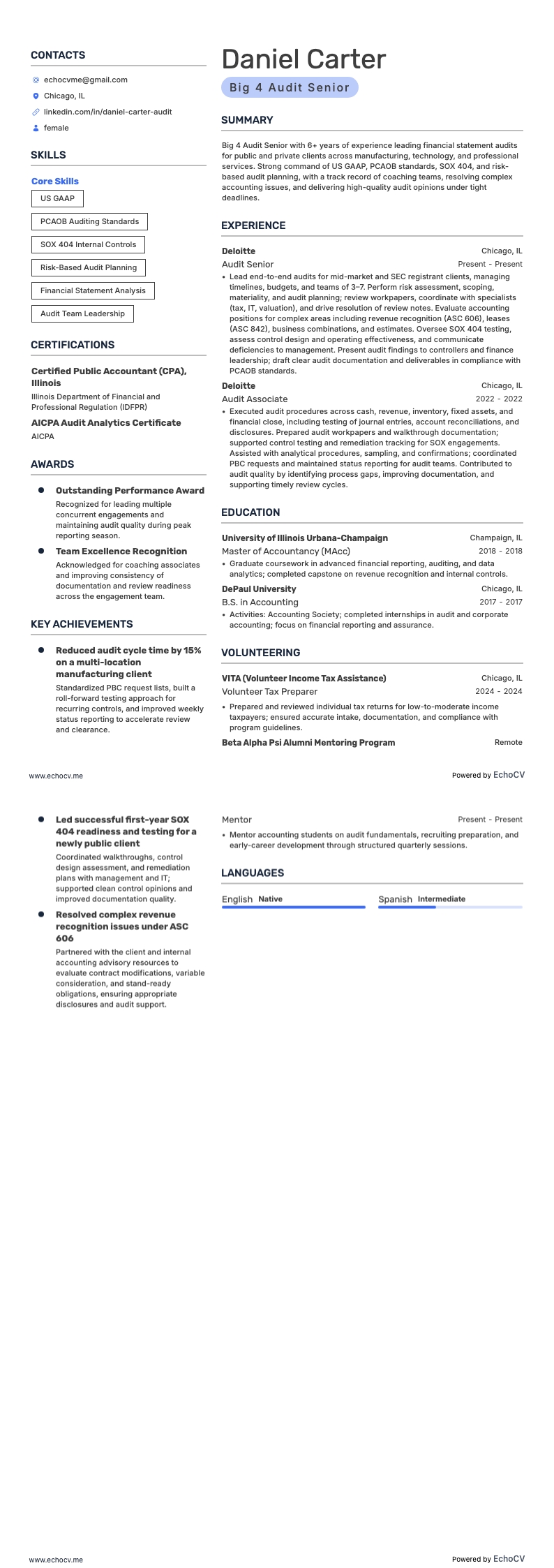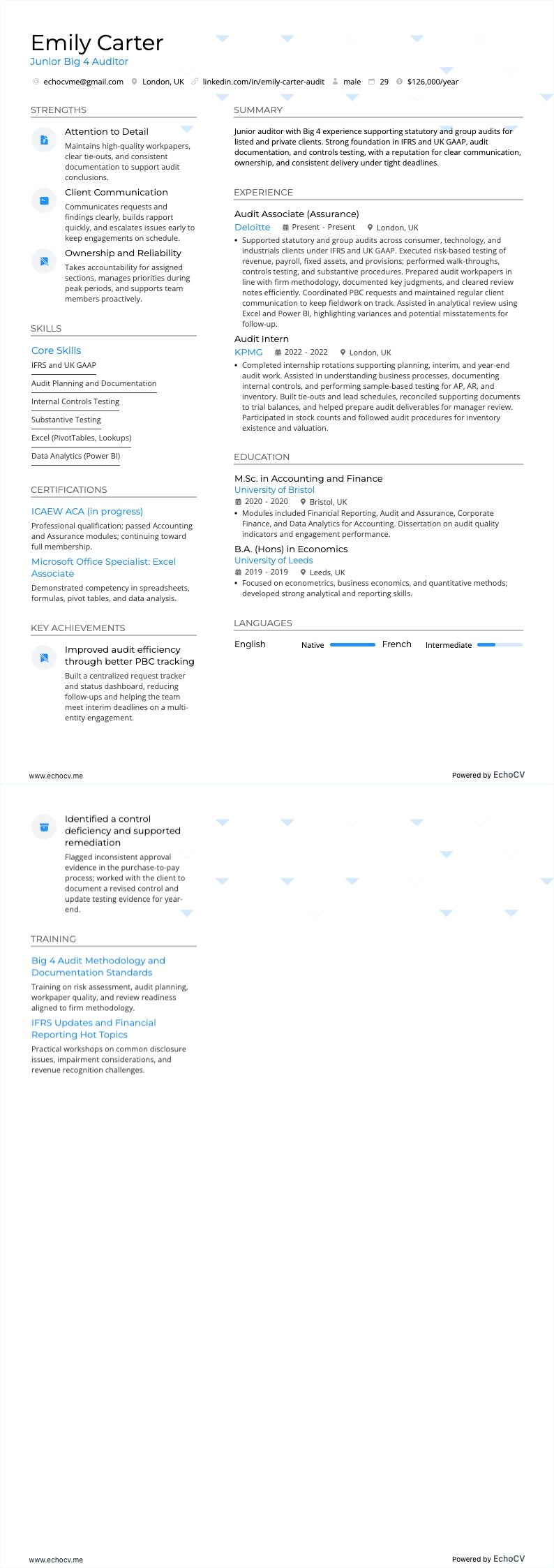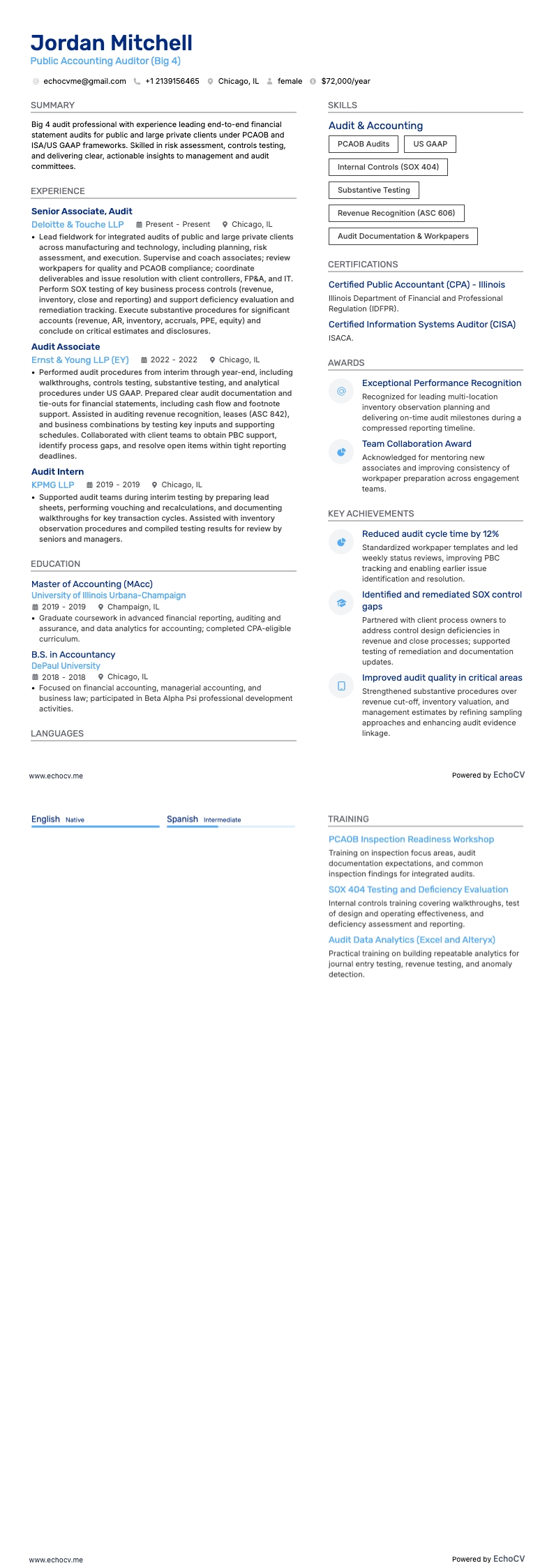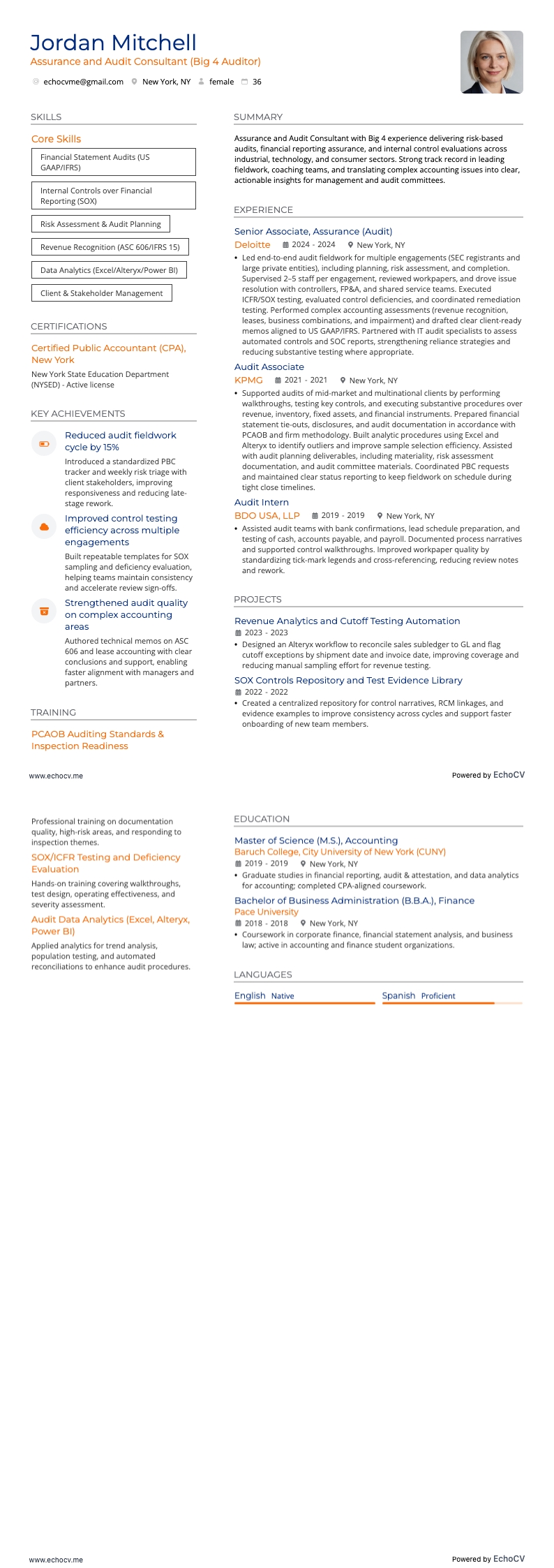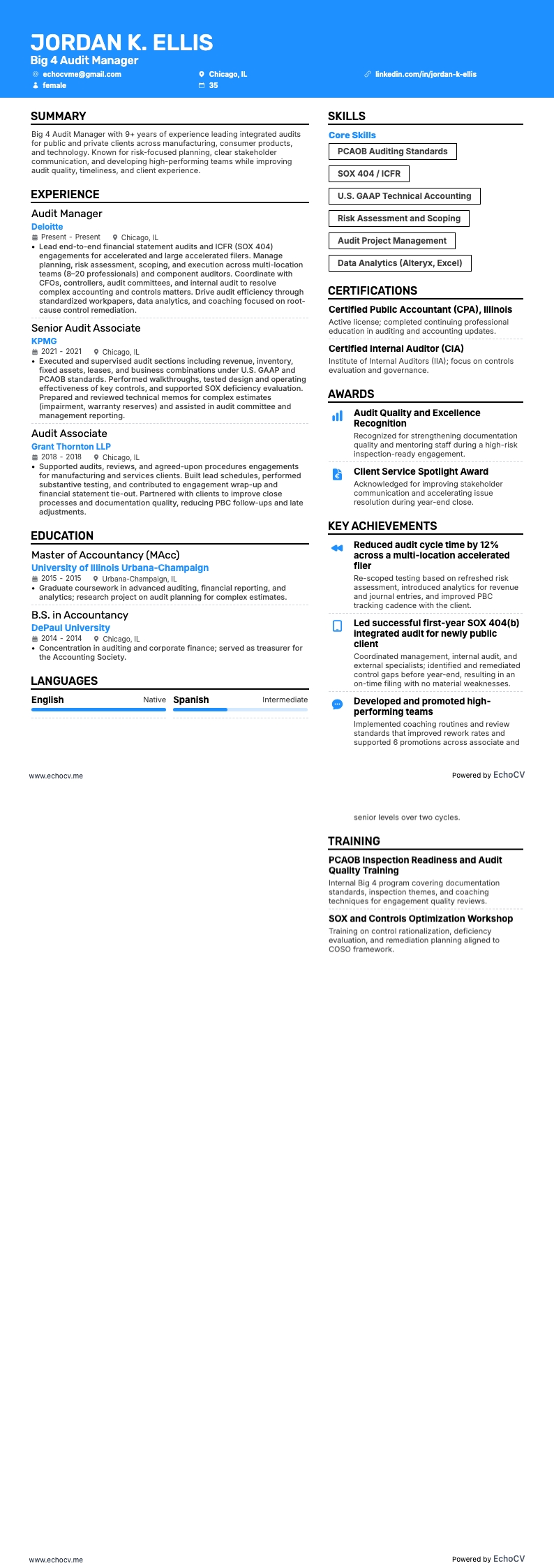
As a big 4 auditor, articulating your complex auditing experiences into a concise resume that stands out can be a significant challenge. Our guide provides you with targeted strategies and language tips that will help you distill your achievements into a compelling narrative that resonates with hiring managers.
- Format your big 4 auditor resume to ensure that it balances professionalism with creativity, and follows the best practices.
- Match the big 4 auditor job requirements by including industry keywords on your resume.
- Use various resume sections to showcase your skills and achievements to answer why you're the best candidate for the big 4 auditor role.
Take inspiration from leading big 4 auditor resume examples to learn how to tailor your experience.
The importance of format and layout in your big 4 auditor resume
Consider you're an HR professional at company X, evaluating two big 4 auditor candidate resumes. John Smith presents a simple, traditional, and easy-to-read resume. Edward Price, however, uses a non-conventional, often illegible format. Whose resume would you spend more time on to understand their experience? This scenario underscores the importance of your big 4 auditor resume’s design. It should be simply formatted and clearly communicate why you are the ideal candidate for the role.
Achieve this balance by:
- Listing your experience, beginning with the most recent and relevant, in reverse chronological order;
- Ensuring your header contains essential information, such as contact details, a headline, and a portfolio link. Include a professional photo in the big 4 auditor resume header if you have one;
- Including only the most important and relevant resume sections to showcase your expertise and stand out from other candidates;
- Editing your big 4 auditor resume to be no longer than two pages if you have extensive relevant experience. Use your limited resume space judiciously.
Also, remember that your big 4 auditor resume might initially be scanned by an Applicant Tracker System (ATS).
When it comes to ATS:
- Opt for simple and legible fonts like Raleway, Rubik, Lato, etc., making your experience easy for the ATS to scan;
- Use serif and sans-serif fonts, both of which are ATS-friendly;
- Avoid overused options like Arial and Times New Roman, which, while suitable, may lack personality.
Contrary to a common myth, our recent study shows that the ATS can effectively process both one-column and two-column resumes. Learn more about this in the ATS myths guide.
Finally, when submitting your big 4 auditor resume, always export it as a PDF to ensure all information remains intact, making the document easier to print, read, and scan.
Adjust your resume layout based on the market – Canadian resumes, for example, may follow a unique format.