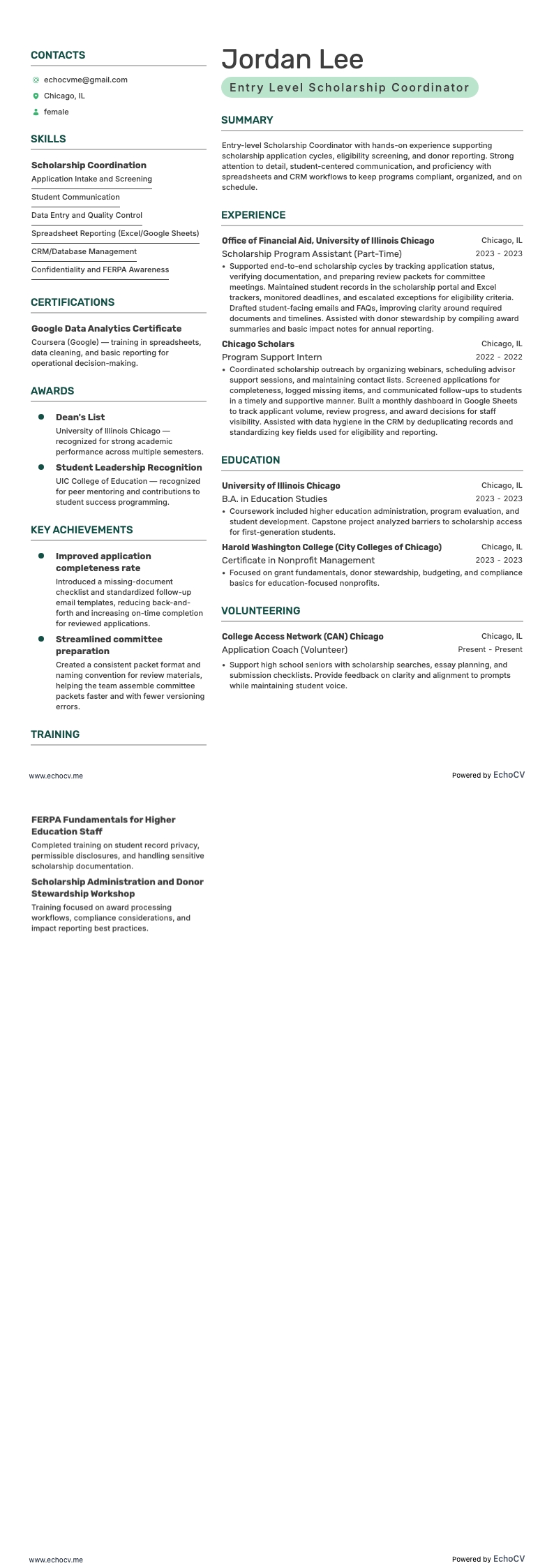
Xem trước đầy đủ Điều phối viên học bổng mới vào nghề

19 mẫu sơ yếu lý lịch xin học bổng

EchoCV

Được viết bởi đội ngũ EchoCV

Cập nhật: 4/20/20248 min read

Xem tất cả ví dụ CV trong hướng dẫn này hoặc tạo ví dụ CV của riêng bạn với prompt cá nhân hóa

Điều phối viên học bổng mới vào nghề example resume
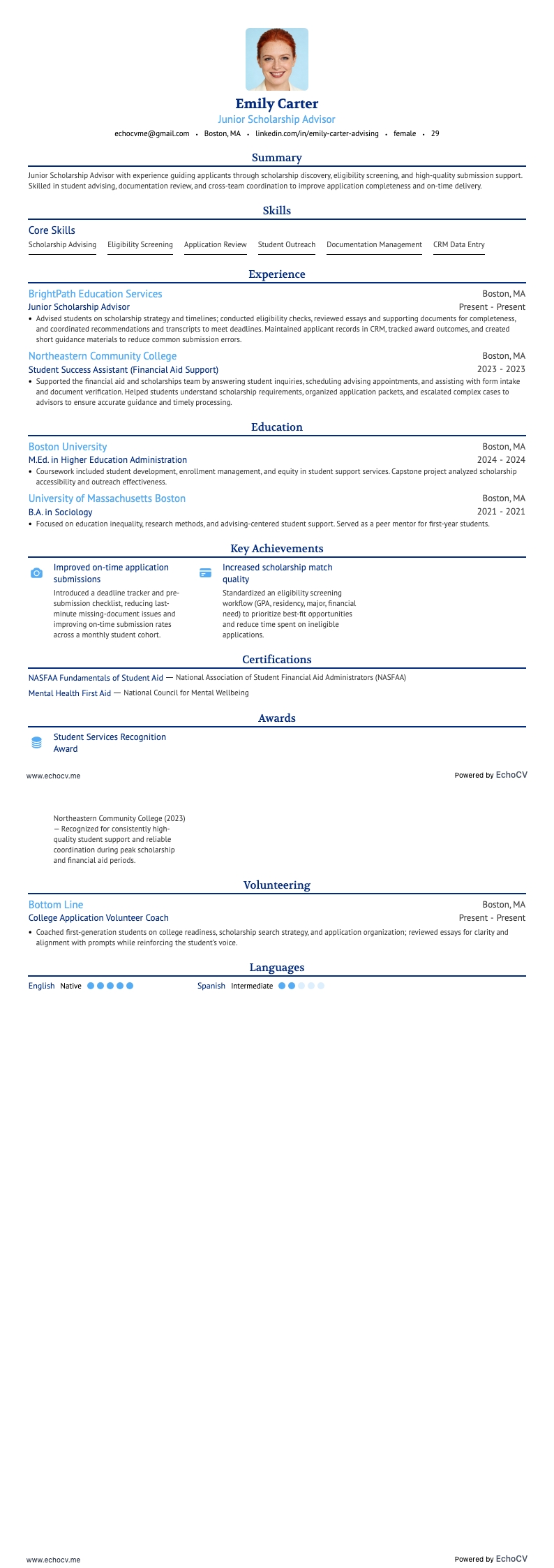
Điều phối viên học bổng mới vào nghề

Cố vấn học bổng junior example resume
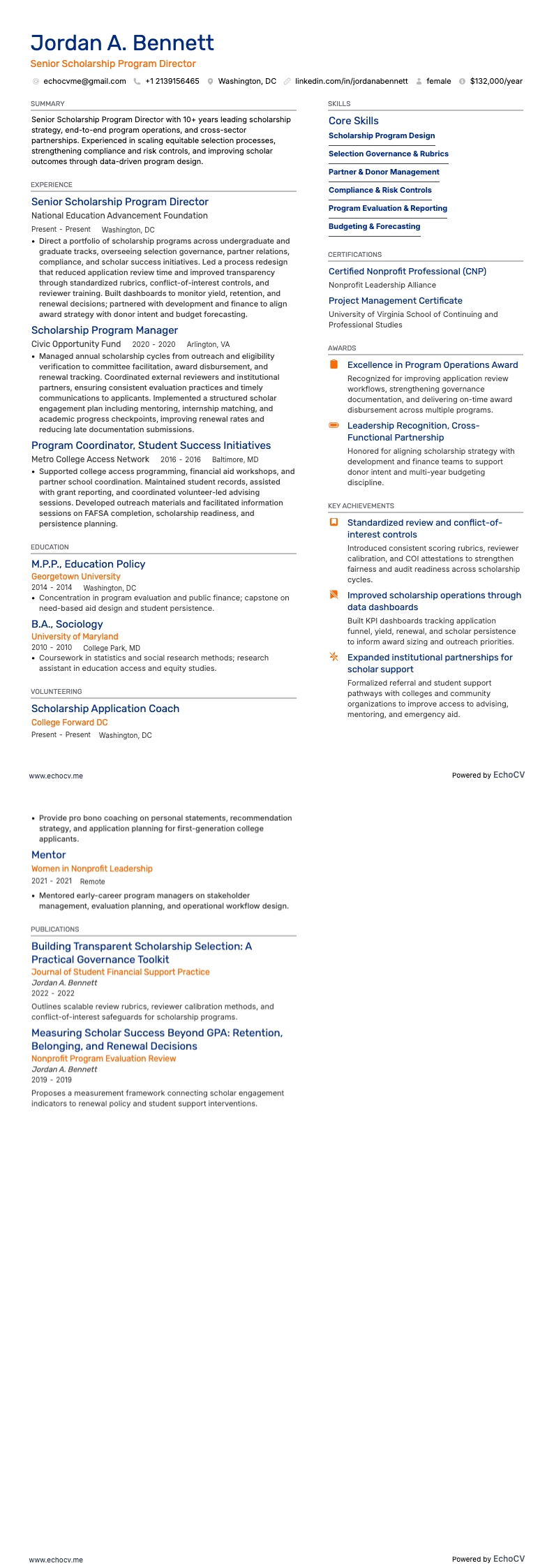
Cố vấn học bổng junior

Giám đốc cấp cao chương trình học bổng example resume
Giám đốc cấp cao chương trình học bổng

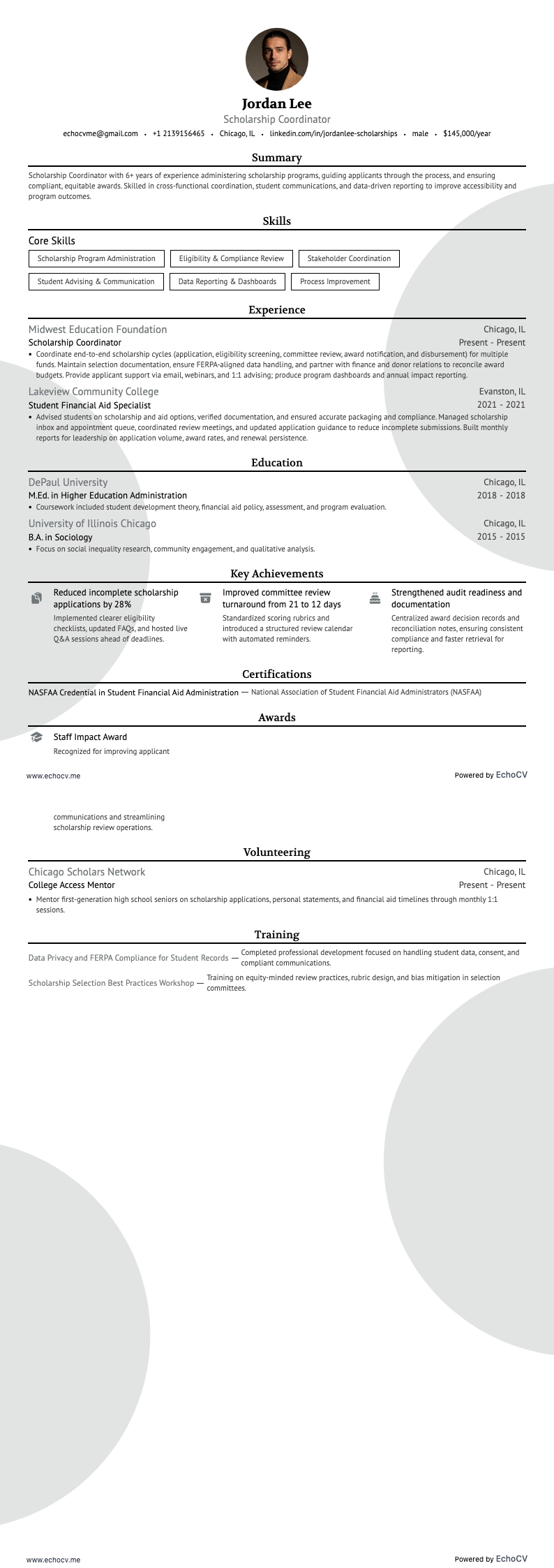
Điều phối viên học bổng example resume
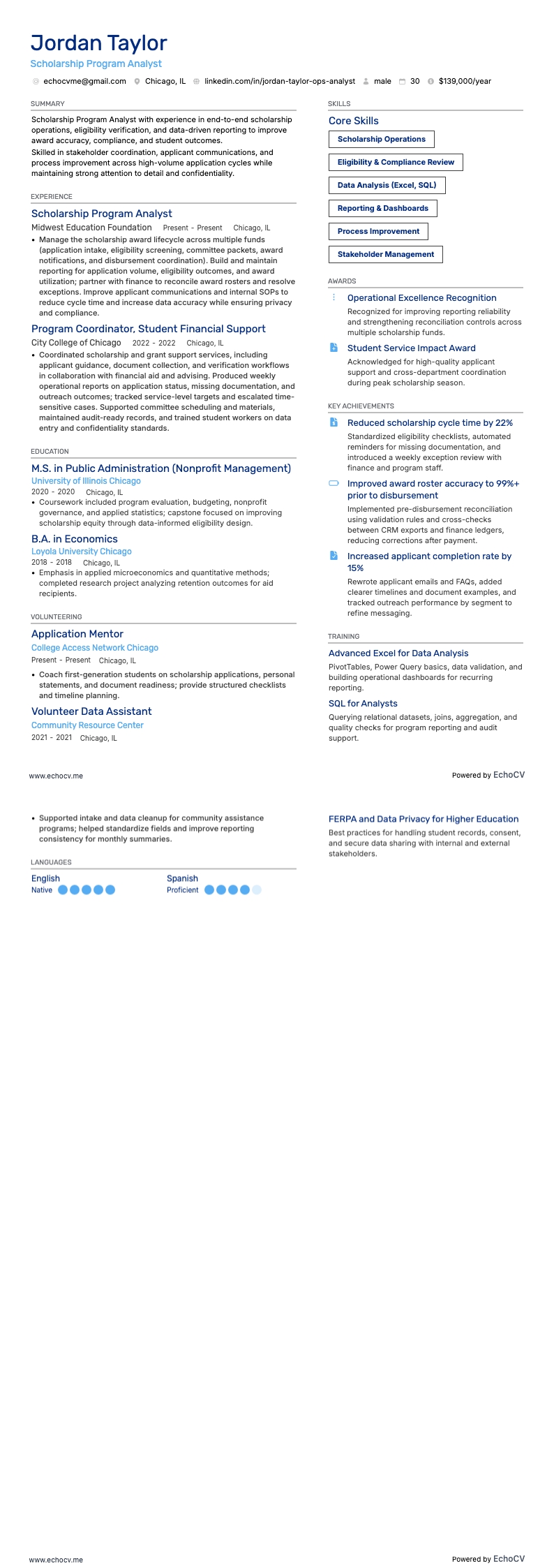
Điều phối viên học bổng

Chuyên viên phân tích chương trình học bổng example resume
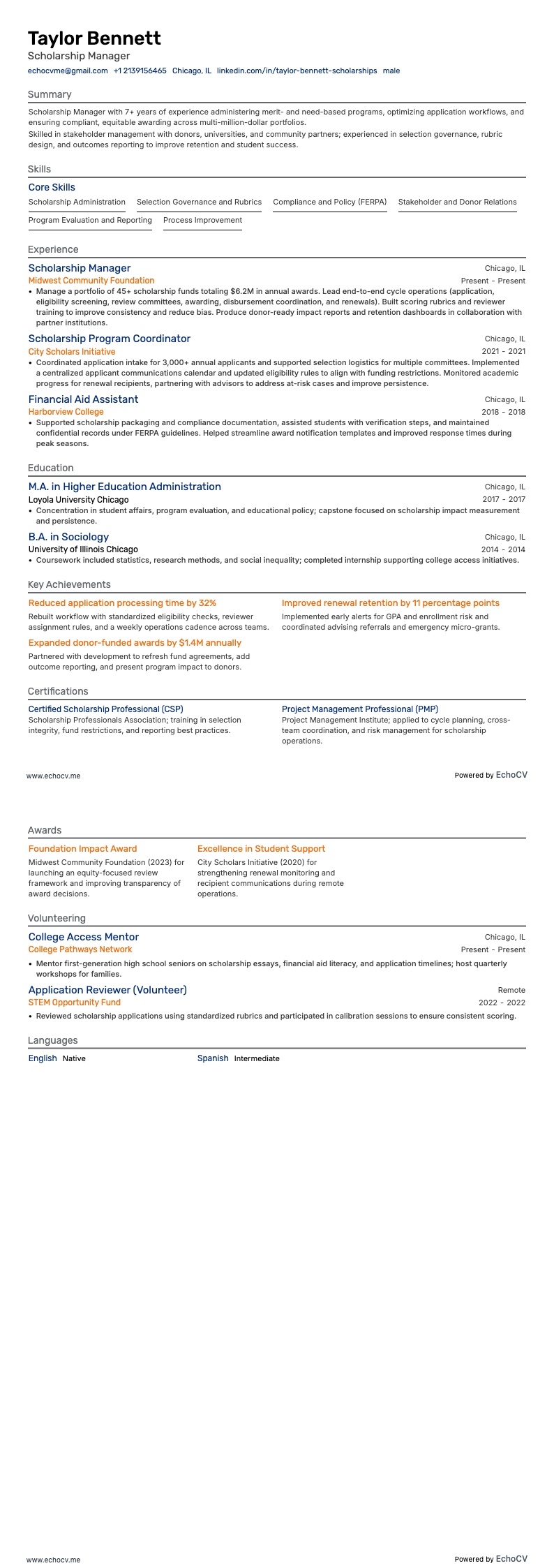
Chuyên viên phân tích chương trình học bổng

Quản lý học bổng example resume
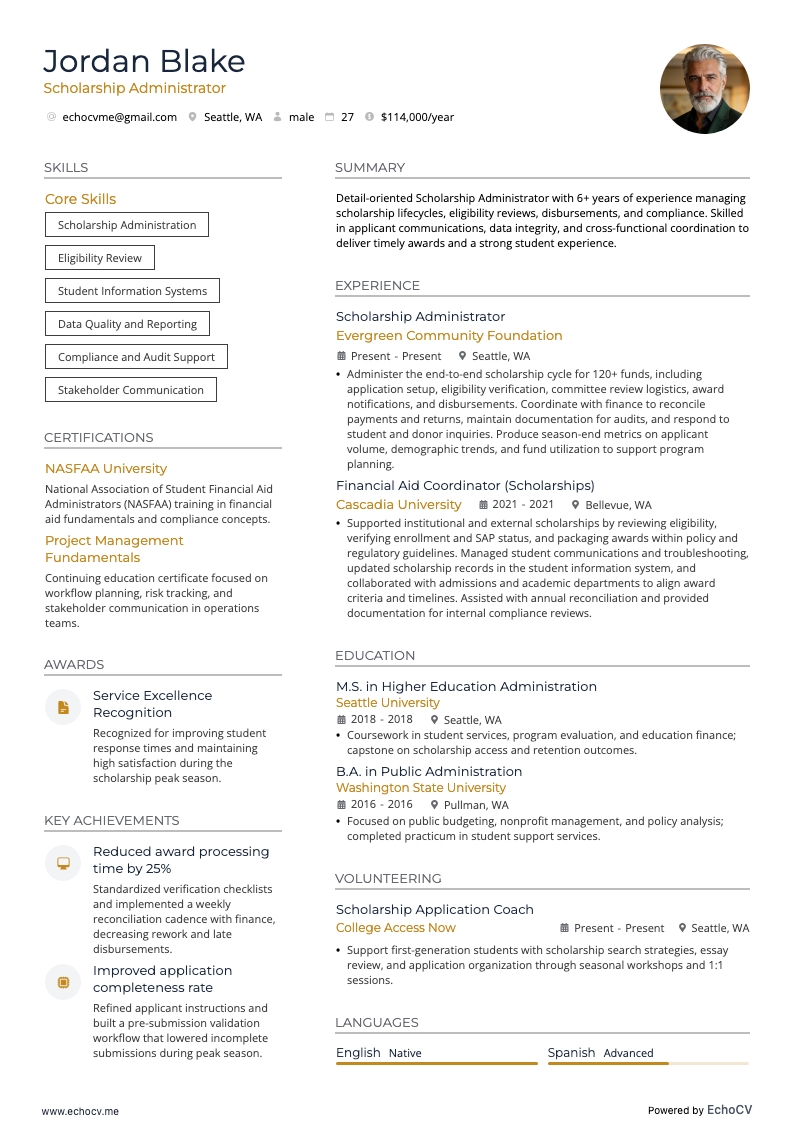
Quản lý học bổng

Quản trị viên học bổng example resume
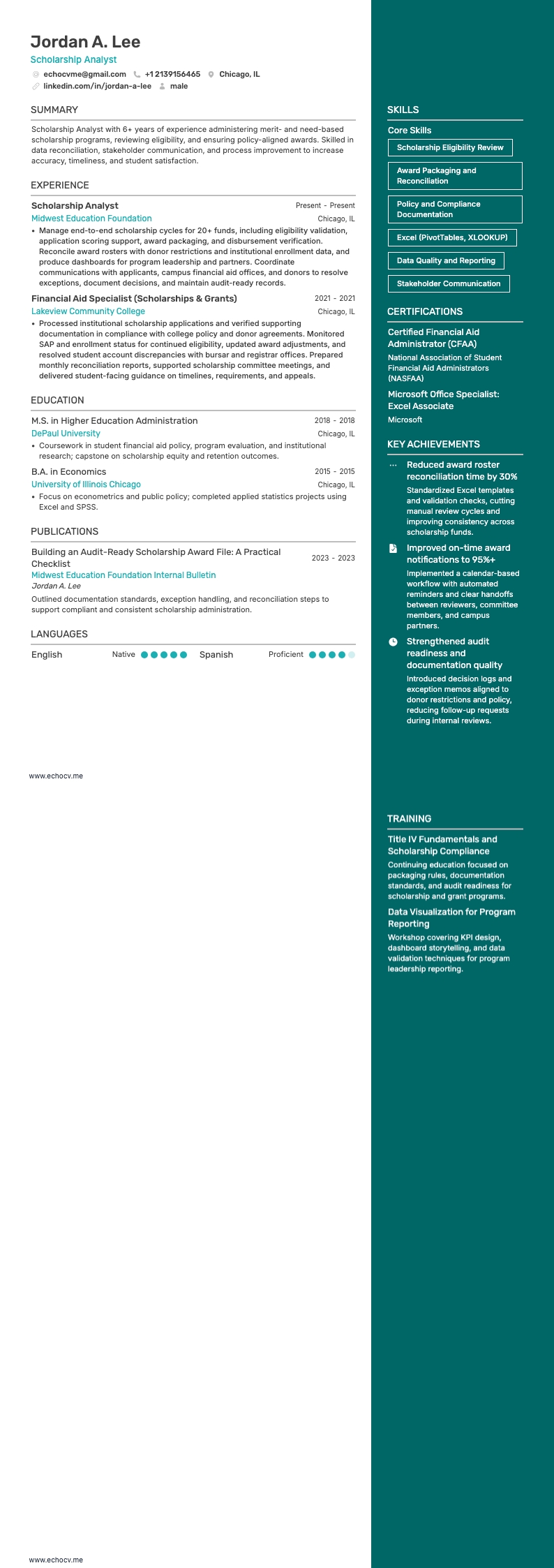
Quản trị viên học bổng

Chuyên viên phân tích học bổng example resume
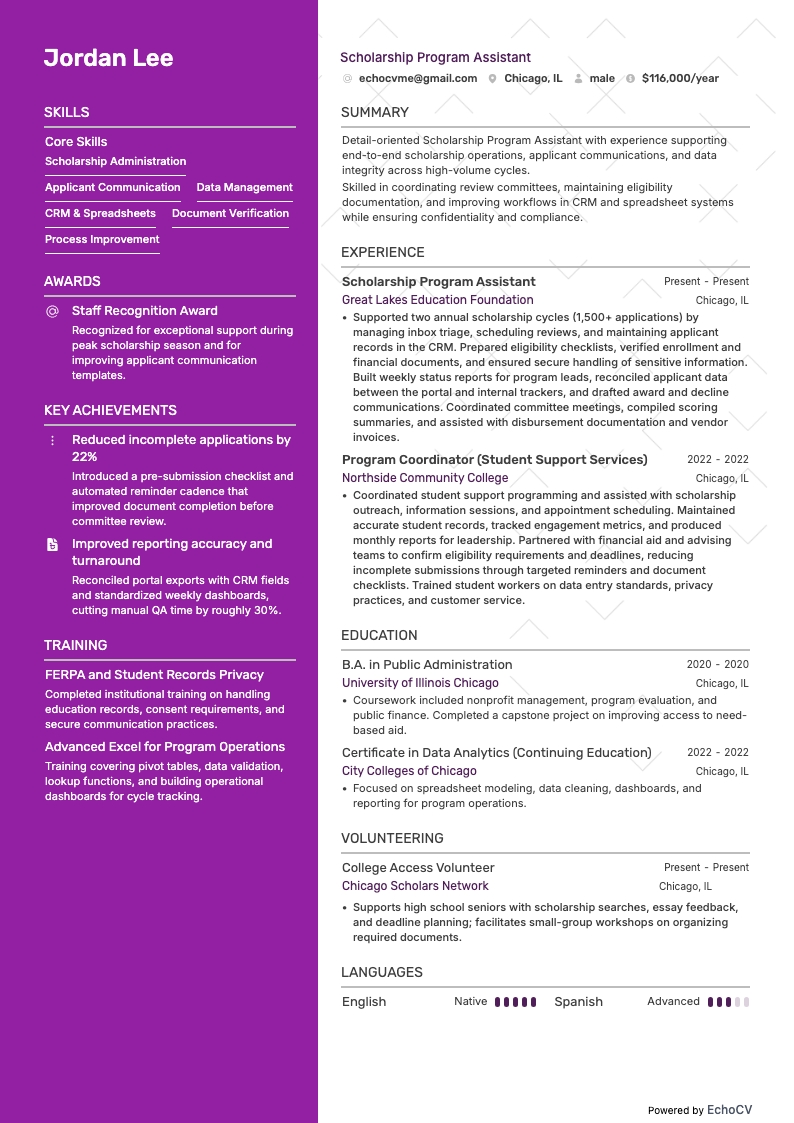
Chuyên viên phân tích học bổng

Trợ lý Chương trình Học bổng example resume
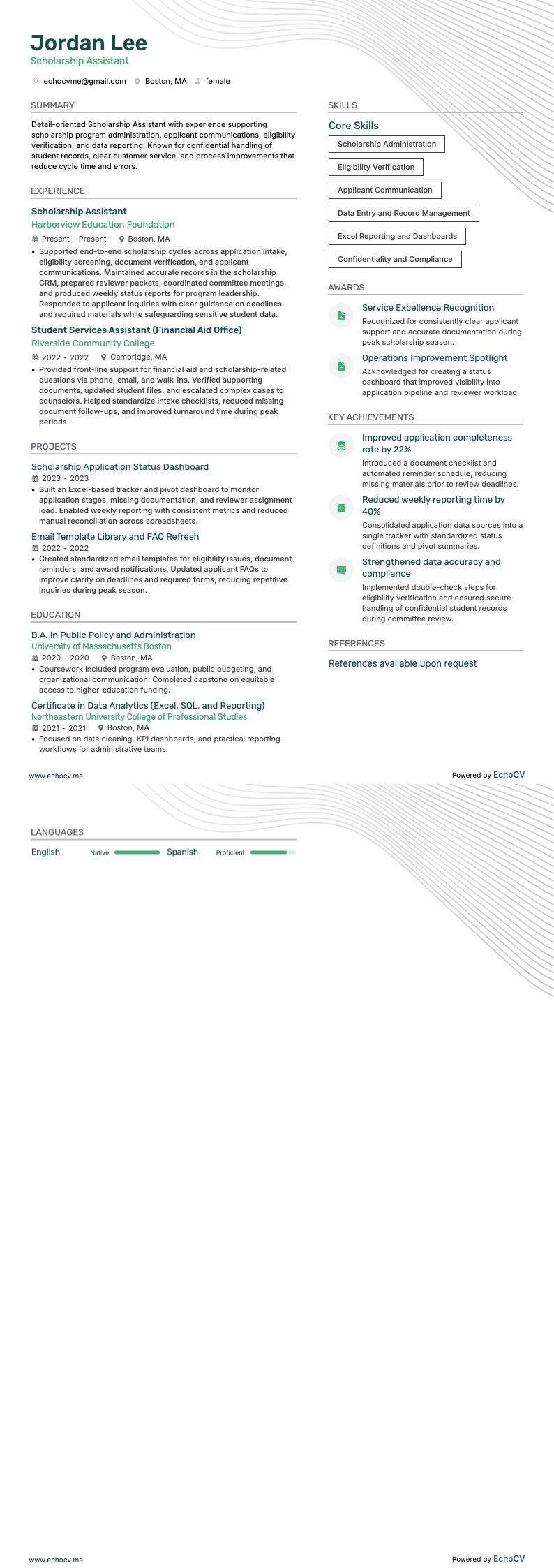
Trợ lý Chương trình Học bổng

Trợ lý học bổng example resume
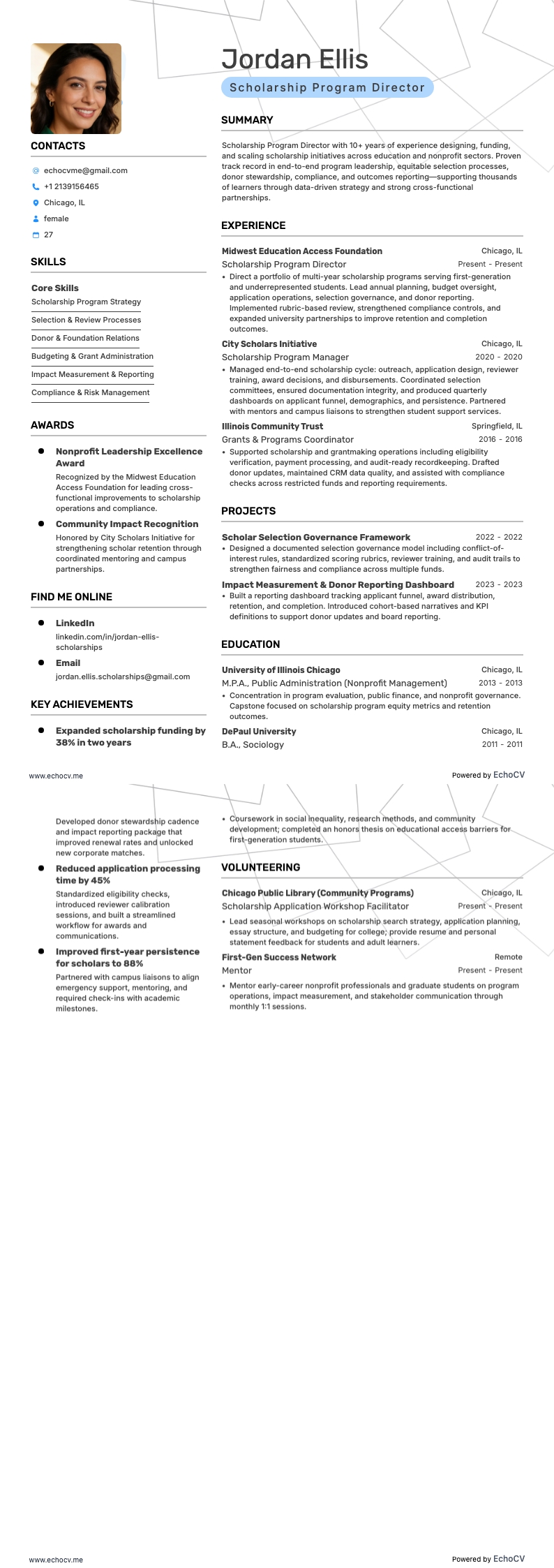
Trợ lý học bổng

Giám đốc Chương trình Học bổng example resume
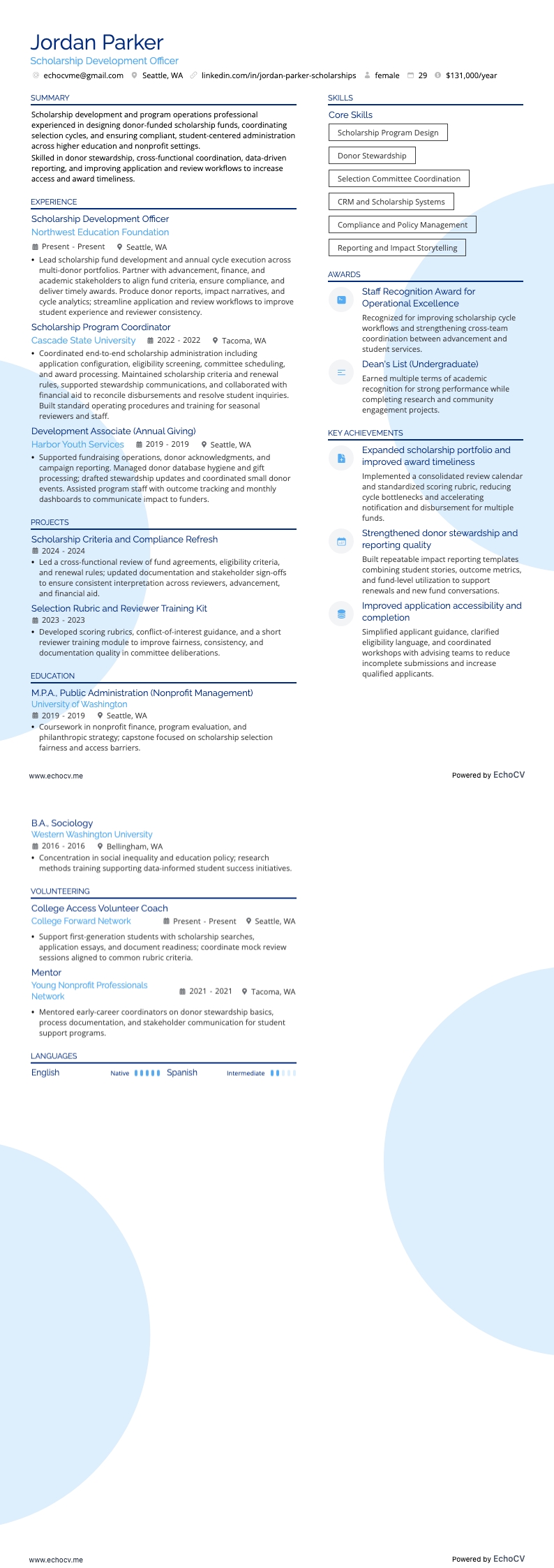
Giám đốc Chương trình Học bổng

Chuyên viên phát triển học bổng example resume
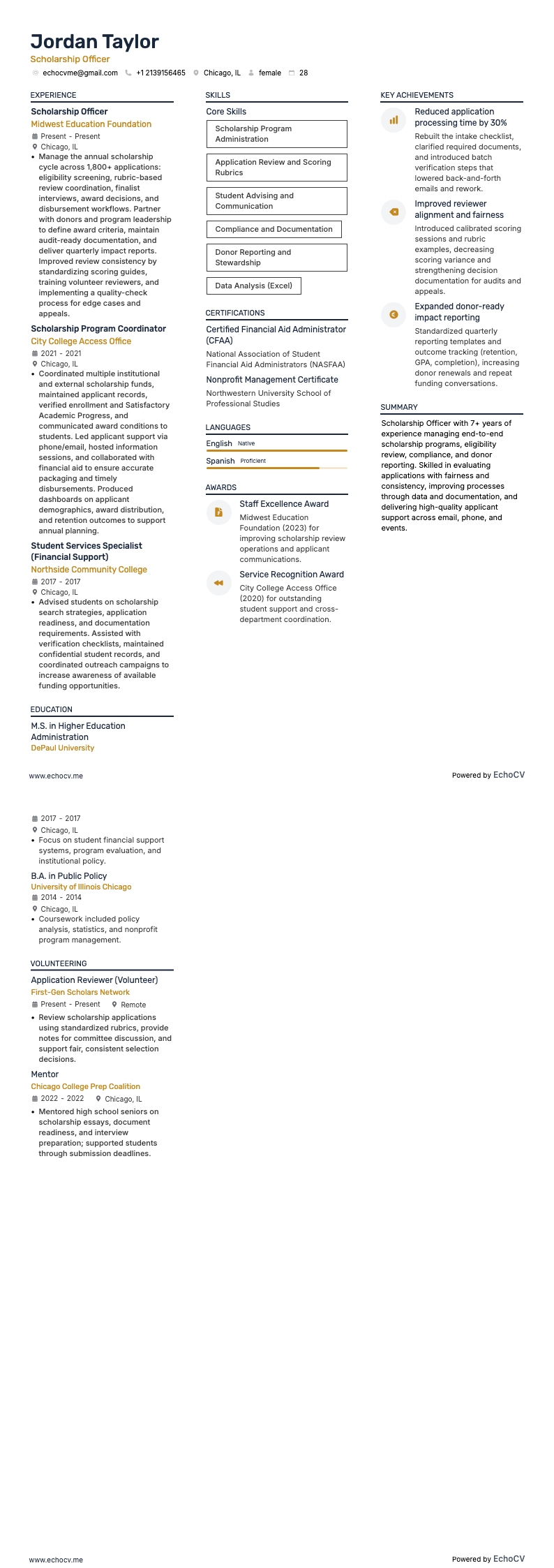
Chuyên viên phát triển học bổng

Chuyên viên học bổng example resume
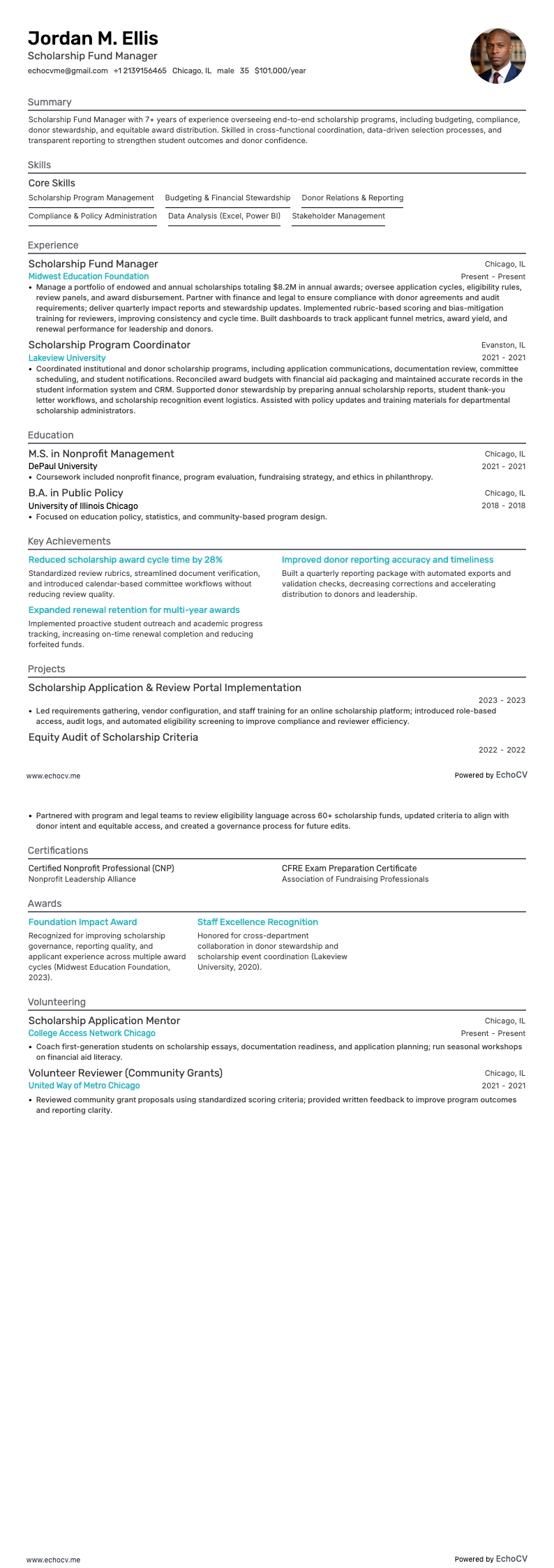
Chuyên viên học bổng

Quản lý quỹ học bổng example resume
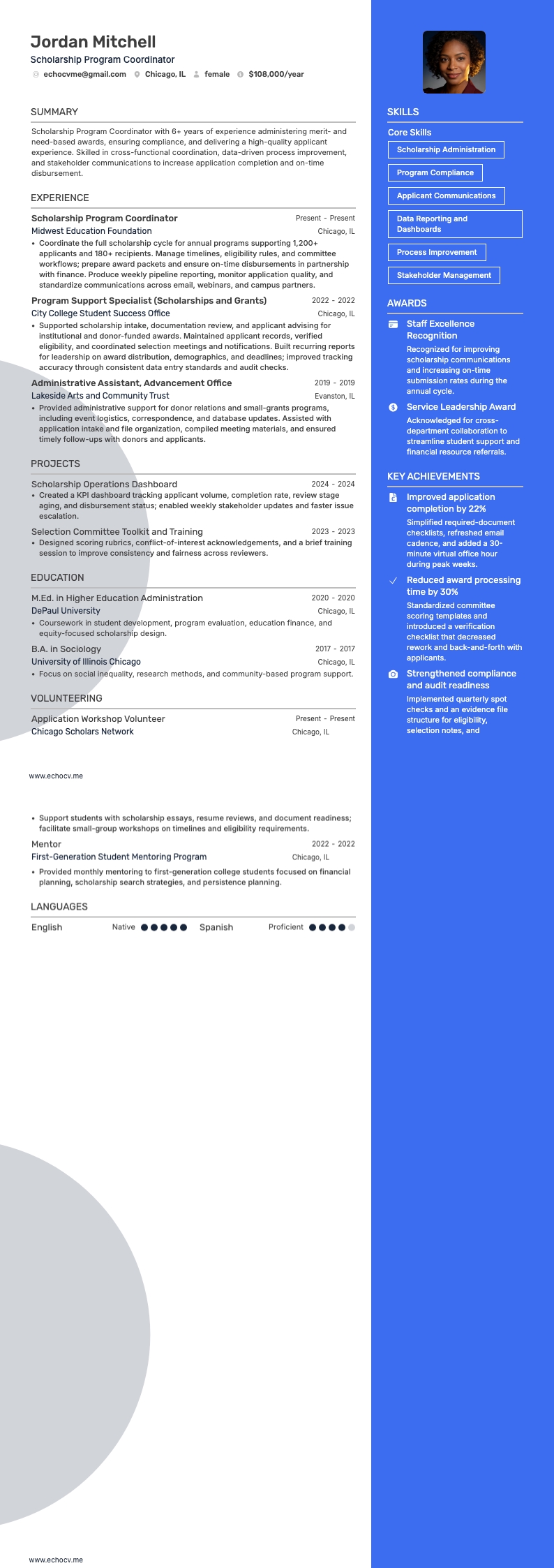
Quản lý quỹ học bổng

Điều phối viên chương trình học bổng example resume
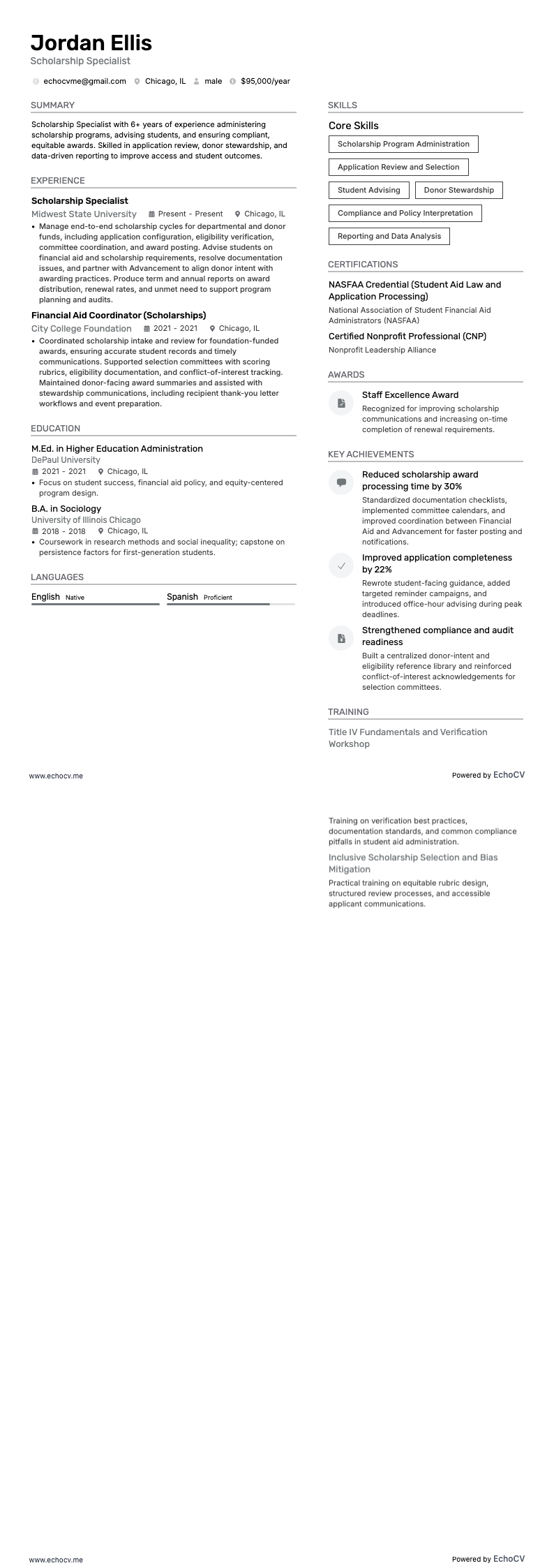
Điều phối viên chương trình học bổng

Chuyên viên học bổng example resume
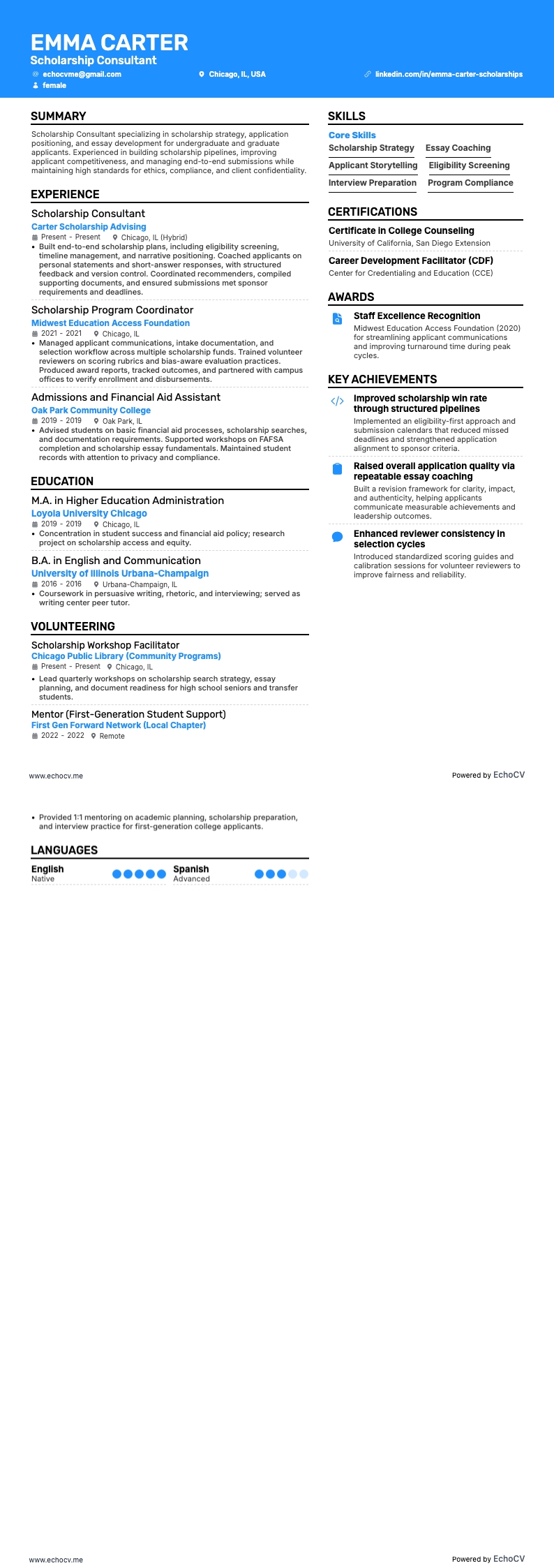
Chuyên viên học bổng

Chuyên viên tư vấn học bổng example resume
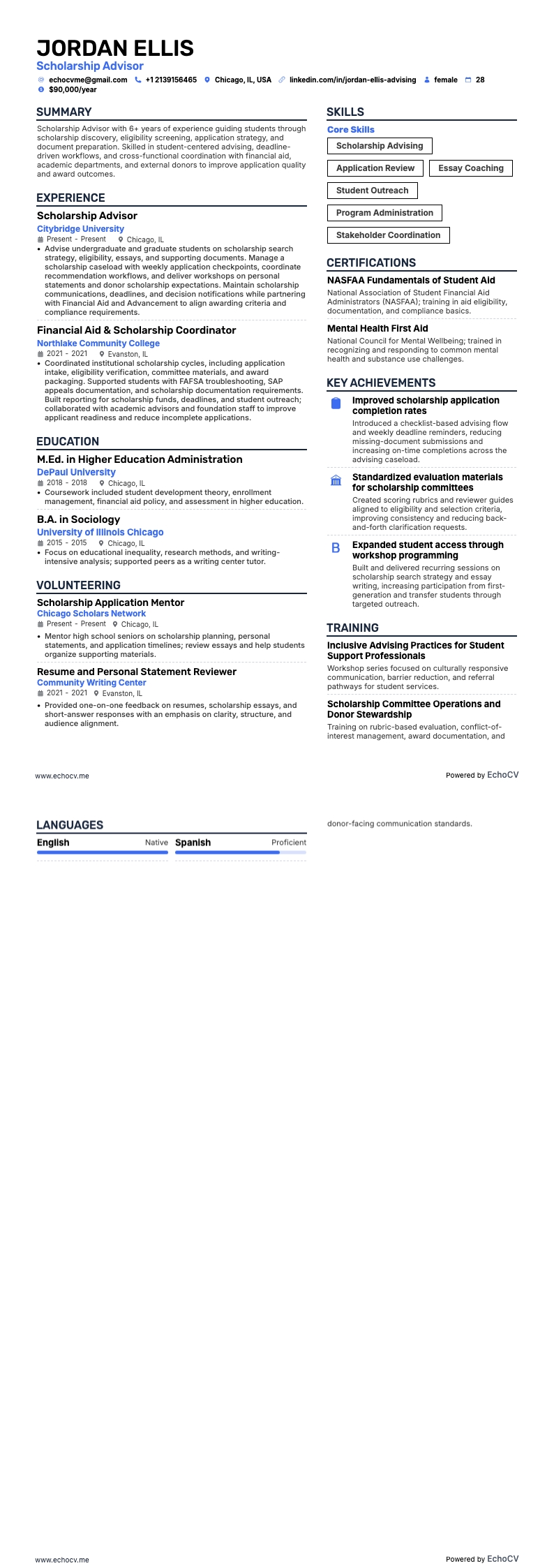
Chuyên viên tư vấn học bổng

Cố vấn học bổng example resume

Cố vấn học bổng

Even in her wildest fantasies, Abby never dreamed she could study on a fully-funded scholarship at Yale.

Yet, a real later, she's halfway into completing her master's in economics, receiving funding of +$50 000 per year.

An integral role in Abby's strategy for success was played by her scholarship resume.

In the highly competitive application process, only the best candidates win scholarships.

So how do you go about making a good first impression on the scholarship committee, responsible for your future?

Step into the shoes of a lawyer.

You'd use all of your professional, personal, and academic choices to argue your case. And prove that you're the best - no, not just the best - but the only candidate worthy of this scholarship.

Your resume is your statement of truth, highlighting all key evidence of

  • who you are
  • how you present yourself
  • the horizons you can reach if you secure the tuition.

What is more, scholarship resumes allow you to narrate your visions and goals for the future.

At the same time, the professional story you tell should meet the scholarship requirements and expectations.

Find Out Best Practices for Your Scholarship Resume in Our Guide, Which Will Show You:

  • What scholarship committees expect to see on your resume upon assessment?
  • Where to start writing your scholarship resume?
  • How to balance your experience and knowledge with vision in various resume sections?
  • Best go-to guide in substituting lack of professional experience on your scholarship resume.
  • How to include expected graduation dates to highlight your ambitions for the future?

Looking for Related Entry-level Academic Resumes? Check Out Our 32 Examples:

What is a Scholarship Resume?

Scholarship resumes outline why your experience cross-aligns with the funding profile.

Scholarship resumes have the following characteristics; they are

Most often, applicants list their experience in reverse chronological order, starting with the most recent/ senior ones.

Discover the top 5 scholarship resume sections.

  • Header - listing all relevant contact details
  • Education - including all university degrees or high school diplomas (relevant only for bachelor scholarships)
  • Experience - both professional, academic, and personal
  • Awards - to showcase your merit
  • Personal Skills - soft skills and achievements, defining your character

You may not have realized it, but scholarship resumes are living (breathing) documents reflecting your growth.

That's why there's no "one size fits all approach" to how you'd go about defining your experience.

This very often puzzles most students due to their lack of real-world, professional experience.

Your resume can be more functional based, substituting professional experience with:

  • hard skills: obtained during courses, certifications, and training
  • soft skills: developed during various extracurricular opportunities (volunteer, student organizations, clubs, etc.)
  • portfolio of work: including college or high school and personal projects

While on the topic, let’s look at:

Academic commissions' framework to analyzing your resume:

  • How your experience meets scholarship criteria?
  • Would winning this scholarship make sense in your career progression?
  • What is your objective or dream for the future? Also, would this specific funding help you achieve your vision?
  • If you win the scholarship, what impact would you make on the scientific/ academic communities or the world?
  • What sets you apart from all the other applicants?

Where to start writing your scholarship resume?

Leaving nothing to chance, when writing your scholarship resume with the 20/40/40 principal.

The principal could help you better frame your time by spending:

  • 20% on editing and formatting your resume
  • 40% to draft and write
  • 40% on research and assessment

That final 40 % actually plays a crucial role in your success. You should focus your efforts to find resources detailing:

  • Who the scholarship is meant for?
  • What sort of profile is wanted (e.g. research, leadership, community initiative)?
  • Analyzing past years' scholarship students' success.

Thus, you'd better be able to make the case of how your experience would match the scholarship profile.

MẸO CHUYÊN GIA

Take the time to create one very detailed resume for personal use that lists all your previous roles and achievements.

This long-formed resume backed up in your cloud would help you easily shorten and customize your experience when applying for scholarships and future roles.

How to Write a Professional Header for Your Scholarship Resume

Raise your hand if this has happened to you before.

You've set out to write your resume with all the hope, inspiration, and ambition you can muster. But suddenly you hit a full stop with your header.

  • Which contact detail should you include?
  • What about your 1K+ Instagram profile - with photos from your nights out and family vacations?
  • And what is it with that horrible headline - you haven't yet entered the job market, yet it's asking you to define a title or role.

Huh?!

Take a few steps back and think about the functions of the resume header.

The assessment committee most often uses it to get your contact details and preview your previous projects/work (or LinkedIn presence).

So, make sure you include a link to your:

  • relevant telephone number
  • professional email address
  • address: city, state/ country
  • LinkedIn/ GitHub/ or personal blog link.

Demystifying the resume headline is what we'll get into next.

If you have some really noteworthy role or achievement, that aligns with the scholarship requirements, you could use the header to highlight this.

Alternatively, your header could be used to showcase your vision for the future. Answering what you would like to achieve in the big picture of things.

Not sure what we mean by this?

Check out the section of this guide to get a better understanding.

2 scholarship Resume Header Examples

There are three main elements that could be improved in the above example.

The header could be less vague. Doesn’t it sound a bit desperate? Our advice is to substitute the demand (or what you want) with what you can actually achieve.

It’s not a good idea to use your university email account, as, after graduation, most accounts get “retired”. And you may want to reference back to your applications in a couple of years.

Finally, Instagram may not be the best place to showcase the portfolio of work of a Computer Science graduate.

This header works as it:

  • Includes all the relevant contact details
  • Showcases a portfolio of work
  • Highlights knowledge (programming languages and current degree) with goals

Aligning Vision and Scholarship Requirements in the Objective Resume Section

While curating your scholarship resume, do you feel too busy fighting alligators to drain the swamp? Put simply, while noting major experience points or skills, do you tend to forget about your objective?

The big WHY. Purpose. Intent. Drive.

Use this section to show the assessment committee why you're the best choice and deserve to win the scholarship.

A strong objective is between three and five sentences and is a declaration of

  • your long-term goals
  • the position you seek to acquire in the future
  • how you'd achieve change with the help of the scholarship.

And to enhance the quality of your vision, it's best to build on your achievement, strengths, and skill set.

Don't just use empty words (e.g "ambitious", "passionate", "caring"), but qualify each.

Thus, you'd be aligning your bigger purposes (and interests) so they stay relevant to the scholarship you're applying for.

2 scholarship Resume Objective Examples

Summary
Senior high school student with the ambition to continue education with the 16th District PTA Scholarship. GPA 4.0 with high academic achievements. Participating in community service. Passionate about healthcare and innovation.
SAI

This objective just lists scholarship requirements. It doesn’t even remotely answer why this student deserves the funding.

The only “character points” are the passions, but these aren’t mapped within any experience or achievements.

Summary
Senior-year high school student with a vision to integrate big data and cybersecurity best practices to create a multinational healthcare system, accessible to anyone in need. Received the President's Award for Educational Excellence, 8 years in a row, and was elected senior class president. Volunteering at all Red Cross Blood Drives (+50 / year) and at 30+ charity drives to collect new clothes for 5+ local orphanages. Community service helped me better understand the importance of integrated healthcare solutions for all.
ĐÚNG

This objective section is excellent as

  • Its first sentence meets eligibility criteria while showing an aim for the vision.
  • Academic excellence is defined by awards.
  • Class President title showcases student communication skills and popularity.
  • Charity work to show not only community service, but an understanding of why better healthcare is needed by all.

What Do Scholarship Committees Expect to See in Your Experience Section: Both Academic and Professional?

Think outside the box when writing your resume experience section. Make sure to include relevant professional, academic, and extracurricular activities.

MẸO CHUYÊN GIA

The scholarship resume experience section allows you to use your tangible achievements (and results) to hint at what:

  • areas you excel in
  • professional interests are (e.g. research area, etc.)
  • skills or values you could bring about.

While curating this section, consider choosing your best (and most relevant) professional roles. List those reverse chronologically, starting with the most recent roles. You can sort these by seniority and relevance to the scholarship.

The resume experience section could include internships, part-time experience, or lecturing/ teaching opportunities.

In some cases, you may not have much professional experience. Academic committees don't expect you to maintain a 4.0 GPA while managing a team of 12+ junior software engineers.

Showing that you have a healthy study-life-work balance can always be an asset.

So, instead, focus on your academic career.

You can include research, projects, editorial/ contributor, and teaching/tutoring experience.

High school students, applying for a bachelor's scholarship, here's what you can do. Leverage all extracurricular associations (or clubs), sports, and activities you've participated in.

Remember to select all that are relevant to the scholarship. This would highlight your academic contribution and the footprint you've left in the community.

Last, but not least, comes one of the most important areas of your experience.

Community involvement or volunteer positions show a sense of altruism and seeing beyond your own needs.

If the hours you've volunteered are impressive, you can also include those. Don't forget to note what you've achieved in that time frame.

Scholarship resume experience examples

Experience
Volunteer
Helping Animals
Hunstville, AL
Local organization, aiming to provide free healthcare to 500+ animals/year in Huntsville.
  • Did 800 hours of volunteering/year
  • Helped senior veterinarians with operations
  • Collected animals that were malnutrition and had bad living conditions
  • Applied some B.Sc. Veterinary degree knowledge in the workplace
SAI

The experience section above goes so far as to list what the student did, without second thoughts to skills obtained.

What is more, you have to be specific in all areas of your experience section, and that includes the role title.

Here’s how this can be improved.

Experience
Animal Shelter and Veterinary Volunteer
Helping Animals
Huntsville, AL
Local organization, aiming to provide free healthcare to 500+ animals/year in Huntsville.
  • Completed 800+ hours of volunteering per year to embody my lifelong passion for helping animals in need
  • Helped 5 senior veterinarians during 100+ operations by sanitizing areas, preparing all surgery instruments in advance, and taking care of hospitalized animals before and after the medical procedures
  • Answered 120+ signals from the community about animals, whose living conditions were bad, and coordinated deportation of these animals with the local police force
  • Applied knowledge from B.Sc. Veterinary degree in the field to enhance patient care quality by 45%
ĐÚNG

Reading up the above experience section would show committees the students’:

  • Passion and interests
  • Technical capabilities in the field
  • Communication skills
  • Ability to put theoretical knowledge into practice

And as a bonus, those hours of community service are pretty impressive.

A cheat sheet on writing your scholarship resume experience section

While each experience may have helped you grow - both personally and professionally - it's important to remember that your resume offers limited space.

On the way to presenting your best qualities, skills, and achievements, keep in mind the following:

  • Always portray the actual work you did

Don't end the bullet point with just the action or the indecisive verb, but include what you achieved.

Substitute: "I was responsible for 5 people"

With: "I oversaw the work 5 interns did in research for client briefs, creating a solid basis for implementing 16+ communication strategies"

  • It's in the details

The more precise you can be about your experience, the more helpful you'd be to committees to better understand what you actually did.

Substitute: "Did research in a lab"

With: "Conducted lab research and 20+ experiments to discover how diets, healthy in nutrition, versus lacking nutrition could impact the human organism in a 30-day-timeframe"

  • Relevance is key

Think about how strong your experience is in the frame of the scholarship.

Sometimes spending every day, after school, in the debate society could be a better item to add to your resume than working four-hour shifts at McDonald's.

  • Live for the moment

Remember how in elementary school you received that teacher's choice award for your painting of a field?

Well, if you're applying for a bachelor's scholarship, this accreditation of your excellence may not be your strongest asset.

Leave the past be in the past and focus on your most recent, noteworthy achievements.

45+ Skills to Add to Your Scholarship Resume

At the core of most scholarship eligibility requirements, you'd find three main elements.

  • Academic excellence
  • Community involvement
  • Purpose.

If we're to further break down these three segments, you'd find two types of skills at their cores. Ones that you may have gained through your academic, professional, or personal experience/ growth.

Hard or technical skills are the first type.

These are directly correlated to the field or niche you're specializing in (or looking to specialize in).

It's a good idea to include in your resume the technology, instruments, or tools you've learned to use as a result of your training.

Below, you'd find a list of some of the most popular technical skills for your scholarship resume.

23 technical skills you may want to add:

  • Adobe Products
  • AutoCAD
  • 3dsMax
  • Figma
  • Robotics
  • Prototyping
  • Engineering
  • Hardware Maintenance
  • Mathematics
  • C++
  • Python
  • Ruby
  • HTML
  • CSS
  • CRM
  • Machine Learning
  • IoT
  • AI
  • MSO
  • Jira
  • Medical Software
  • Phlebotomy / Administering Injections
  • Safe Use and Disposal of Chemicals
  • Reporting/ Writing Articles
  • CRM

How to describe academic, professional, and personal soft skills

Your resume is expected to balance technologies with personal skills.

As cliché as it may sound, having "ambition", "purpose", and "communication" pop up from your resume at a first glance is a good thing.

Those buzzwords hint that you are aware of the requirements of the scholarship.

Want to take your soft skills section to the next level?

Dedicate a strengths or achievements section in your resume for three specific skills. And highlight those with your achievements.

This would help you build further the case of why you're the perfect applicant for the scholarship.

Here’s how:

Strengths
Results-Driven
Setting up all 200+ lab tests and experiments with the end-goal in mind: always driven to achieve tangible outcomes.
Balance
Maintaining a 4.0 GPA, while participating in the nursing practitioners club and volunteering at the Red Cross on weekends, has taught me the subtle art of the work-life balance.
Community Care
Set yup 25+ campaigns to inform local communities about the best healthcare practices, including diets, flu shots, and keeping an active life. This has enhanced the quality of the community life by 45%.
ĐÚNG

Now that you’ve some inspiration from the resume strengths section, let’s find out some of the most popular soft skills you can include on your scholarship resume.

Don't forget about these 20+ soft skills:

How Much of Your Education Should You Include in Your Resume?"?

Scholarship committee members actually consider your academic excellence when making their choice.

Make sure that the education section of your resume is recent, relevant, and meets expectations. That means…

  • …if you're a high school graduate, who has recently been accepted to a university

You could include information about the university you've chosen to attend, with expected starting and graduation dates. Within the education description, remember to note that you are to attend this university if you can secure a scholarship.

The next item on your scholarship resume should be your high school diploma with your GPA. The description section could be used to highlight your interests or extracurricular activities.

  • …if you're a bachelor's/ master's/ doctoral student or graduate, applying for funding

Include all higher education diplomas you have (listed in reverse chronological order) with your GPA and extra details to define your niche.

If you've secured scholarships in the past, you could also list those in the description area. Just make sure that they're relevant to the scholarship you're applying for (e.g. leadership or nationally recognized scholarships, like Rhodes).

Don't list your high school education as it's from another era.

Certificates to Show Your Investment in the Niche

Certification would definitely win you a few brownie points during the assessment stage.

They hint that you're serious about the area you'd like to specialize in and that you're willing to go the extra mile.

By investing some of your own personal resources, you showcase that you're serious about the niche and that it's not just a hobby.

Did you know that in most cases, relevant certification could give you that extra competitive edge?

Being recognized as an accredited professional adds more weight to your resume. Transforming your bid from that "guy or gal who does science experiments in their free time, in the school lab," to a certified professional.

And there are so many opportunities out there to get relevant certification for your industry - just check Coursera's endless list of courses.

There are also free opportunities out there that could help you stand apart from other candidates.

Below, we've prepared 21 of the most popular certificates that could serve as a good starting point to show your career interests.

Top 21 certificates to highlight your niche:

  • University of Michigan: Programming for Everybody (Getting Started with Python)
  • CompTIA Certification
  • Entry-Level Cisco Certified Technician
  • AWS Certified Cloud Practitioner
  • Google IT Support Professional Certificate
  • App DoJo: iOS App Development
  • IBM Full Stack Cloud Developer Professional Certificate
  • HubSpot Content Marketing
  • Google Digital Garage: Digital Marketing
  • Google Analytics for Beginners
  • Hootsuite Platform Certification
  • Facebook Blueprint Certification
  • IBM Data Science Professional Certificate
  • University of Washington: Machine Learning Specialization Certification
  • Columbia University: Fundamentals of Virology
  • Yale University: Financial Markets
  • Adobe Certified Expert (Photoshop, Illustrator, etc.)
  • Avid Courses
  • Unity 3D Certifications
  • Google UX Design Professional Certificate
  • Microsoft Office Certification

Don’t Forget About Your Awards and Honors

  • Your scholarship resume formatting should highlight why you're the most deserving candidate to win this scholarship.

  • Use your headline and objective sections to talk about your achievements, strengths, and goals (or vision) for the future.

  • Make sure to include professional, academic, and community involvement in your experience section. The last two are especially important if you don't have a lot of full-time roles.

  • Don't forget to list your relevant higher education with your GPA, and expected graduation dates. The better your academic track record is, the more likely you'll win the scholarship.

  • Curate your awards, honors, and certificates to highlight your academic merit and interest within the field.

Ví dụ CV Học bổng

Khám phá thêm các ví dụ và hướng dẫn CV Học bổng để xem điều gì phù hợp với cấp độ kinh nghiệm hoặc vai trò của bạn.

Theo kinh nghiệm

Điều phối viên học bổng mới vào nghề

Xem trước CV Điều phối viên học bổng mới vào nghề

Cố vấn học bổng junior

Xem trước CV Cố vấn học bổng junior

Giám đốc cấp cao chương trình học bổng

Xem trước CV Giám đốc cấp cao chương trình học bổng

Ví dụ CV Học bổng

Khám phá thêm các ví dụ và hướng dẫn CV Học bổng để xem điều gì phù hợp với cấp độ kinh nghiệm hoặc vai trò của bạn.

Theo vai trò

Điều phối viên học bổng

Xem trước CV Điều phối viên học bổng

Chuyên viên phân tích chương trình học bổng

Xem trước CV Chuyên viên phân tích chương trình học bổng

Quản lý học bổng

Xem trước CV Quản lý học bổng

Quản trị viên học bổng

Xem trước CV Quản trị viên học bổng

Chuyên viên phân tích học bổng

Xem trước CV Chuyên viên phân tích học bổng

Trợ lý Chương trình Học bổng

Xem trước CV Trợ lý Chương trình Học bổng

Trợ lý học bổng

Xem trước CV Trợ lý học bổng

Giám đốc Chương trình Học bổng

Xem trước CV Giám đốc Chương trình Học bổng

Chuyên viên phát triển học bổng

Xem trước CV Chuyên viên phát triển học bổng

Chuyên viên học bổng

Xem trước CV Chuyên viên học bổng

Quản lý quỹ học bổng

Xem trước CV Quản lý quỹ học bổng

Điều phối viên chương trình học bổng

Xem trước CV Điều phối viên chương trình học bổng

Chuyên viên học bổng

Xem trước CV Chuyên viên học bổng

Chuyên viên tư vấn học bổng

Xem trước CV Chuyên viên tư vấn học bổng

Cố vấn học bổng

Xem trước CV Cố vấn học bổng