重症监护室护士经理 完整预览

22个ICU护士简历范例

EchoCV

由 EchoCV 团队撰写

更新: 3/15/20238 min read

查看本指南中的全部简历示例,或根据你的个性化提示生成专属简历示例

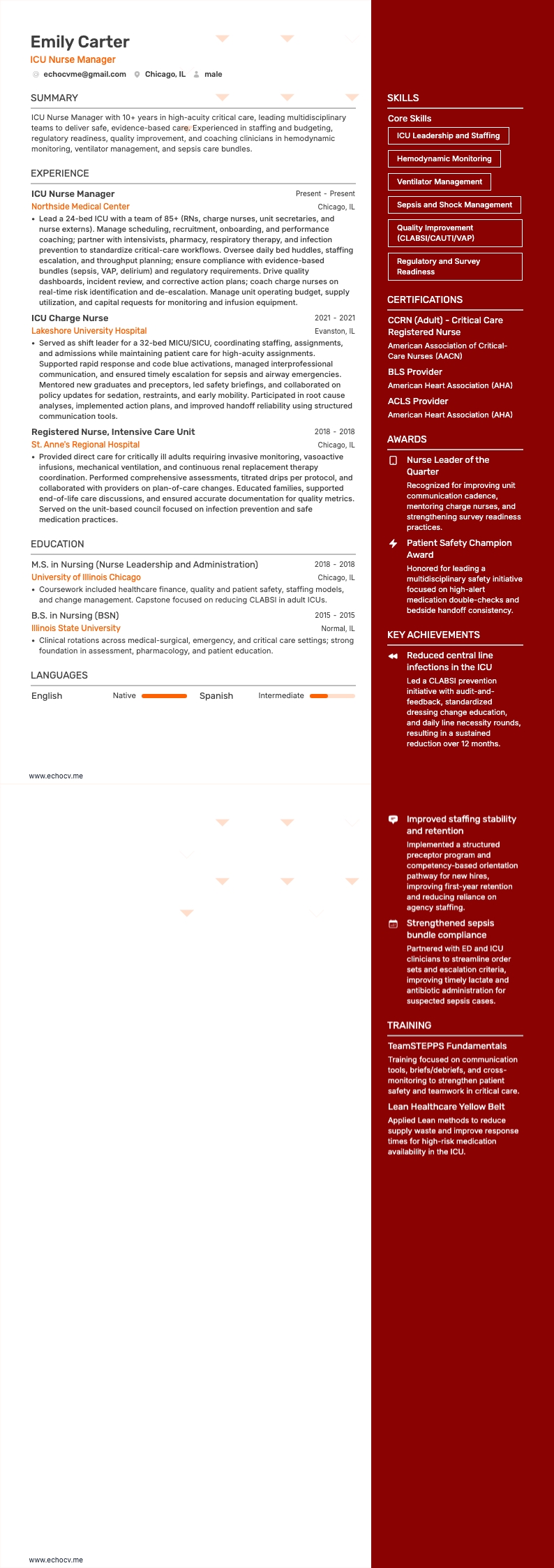
重症监护室护士经理 example resume
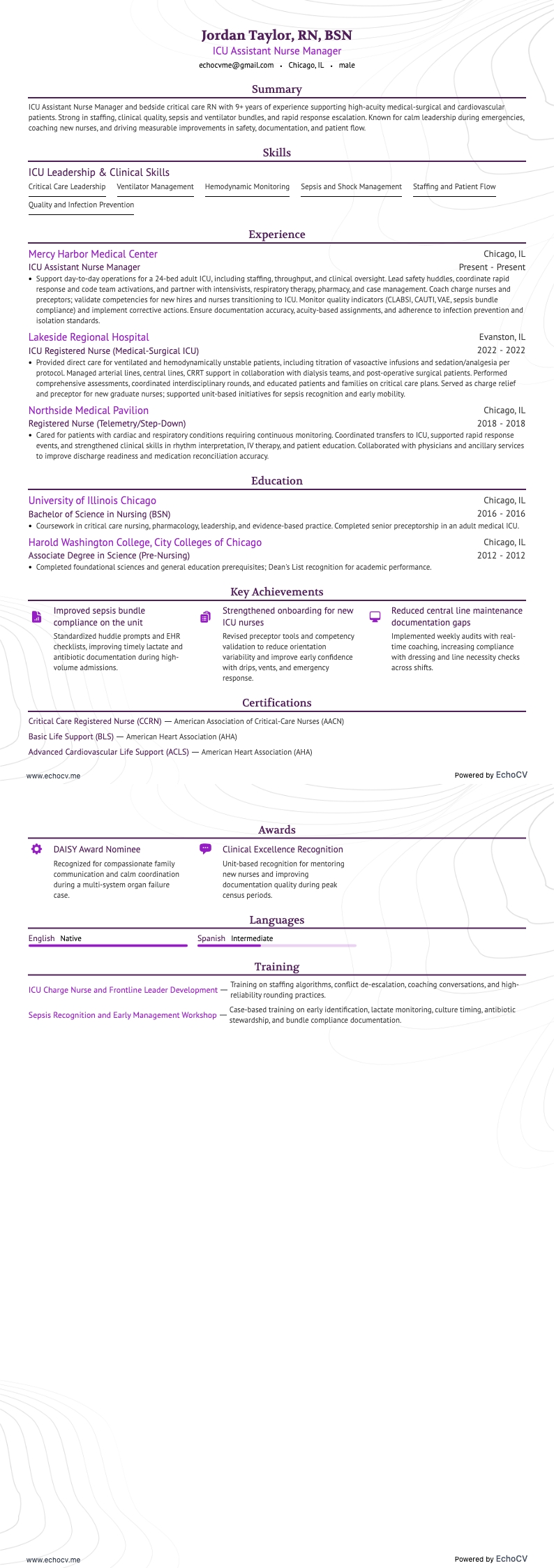
重症监护室护士经理

ICU护士副经理 example resume

ICU护士副经理

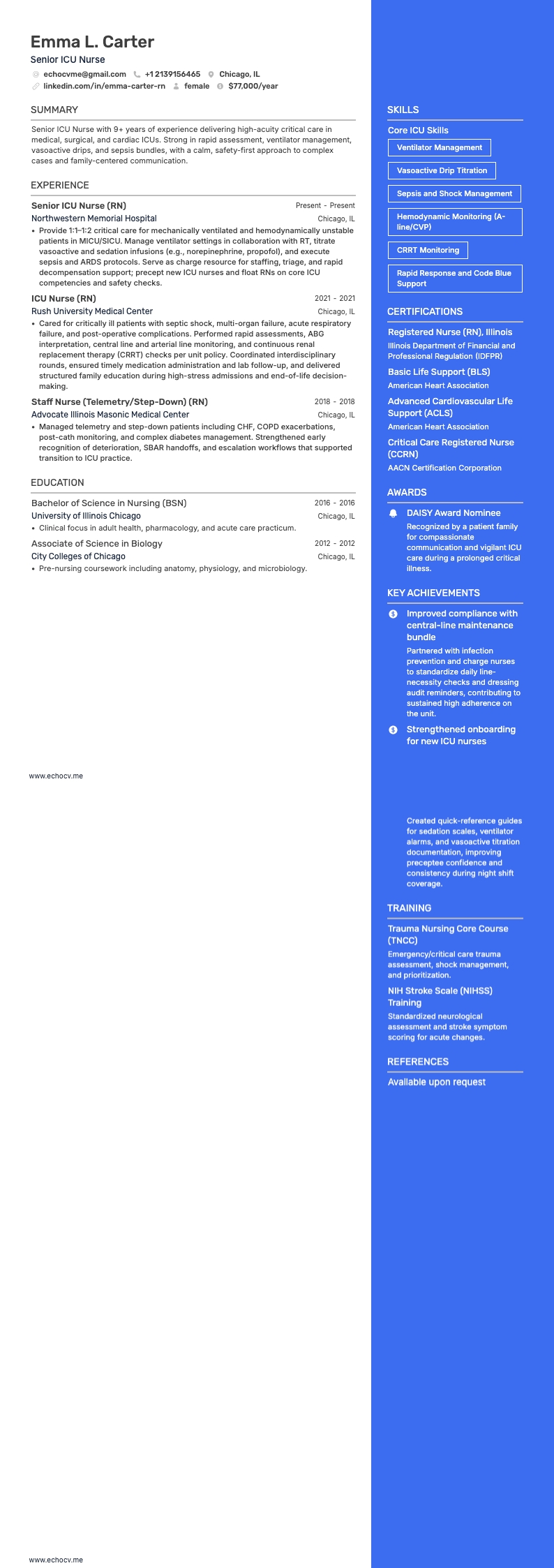
高级重症监护护士 example resume

高级重症监护护士

应届ICU护士 example resume

应届ICU护士

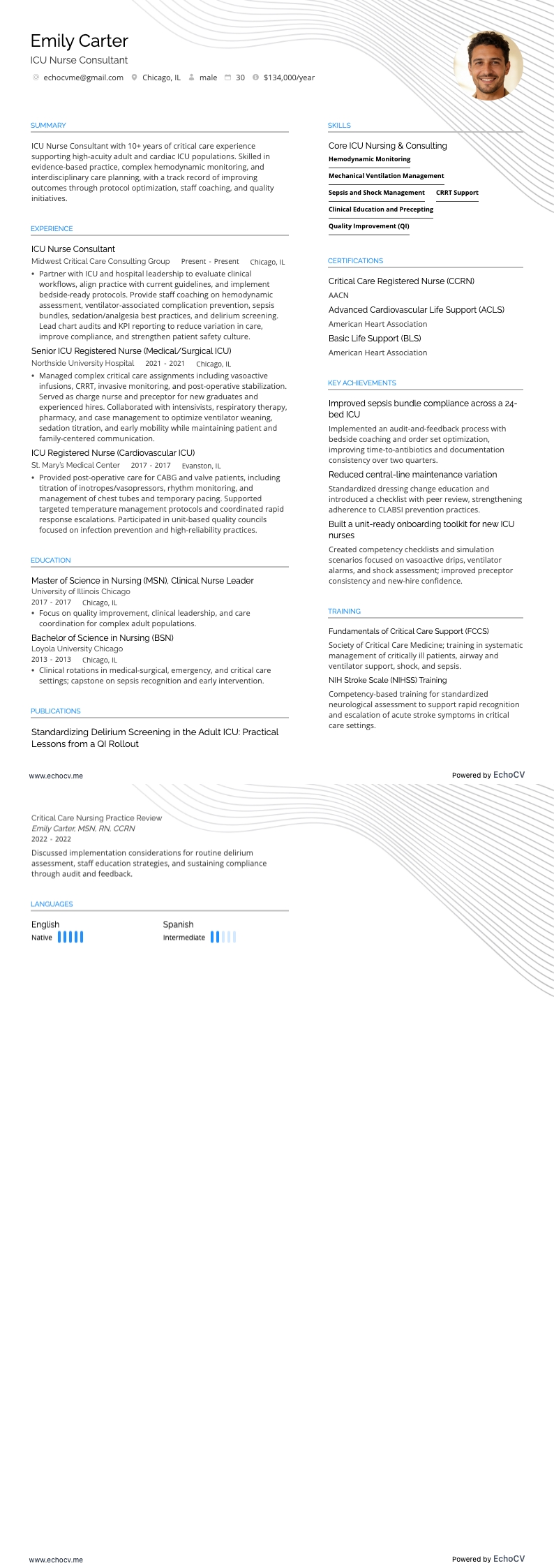
重症监护护士顾问 example resume

重症监护护士顾问

内科重症监护室护理经理 - MICU example resume

内科重症监护室护理经理 - MICU

ICU护士协调员 example resume

ICU护士协调员

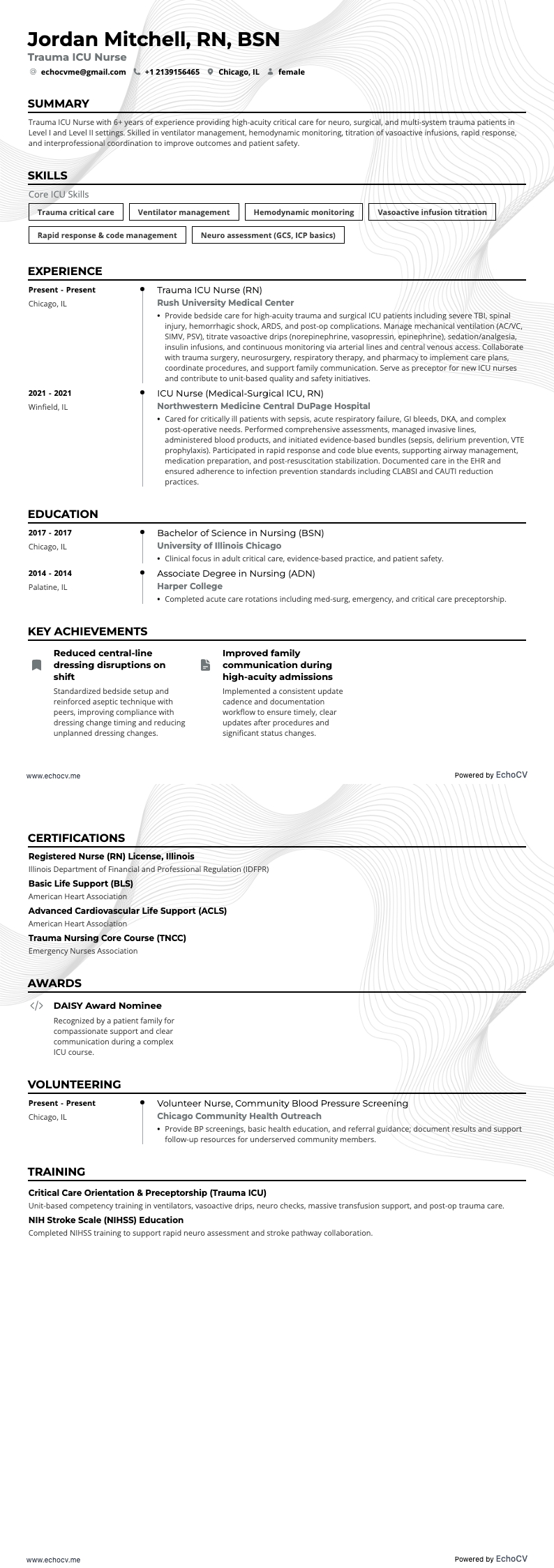
创伤重症监护护士 example resume

创伤重症监护护士

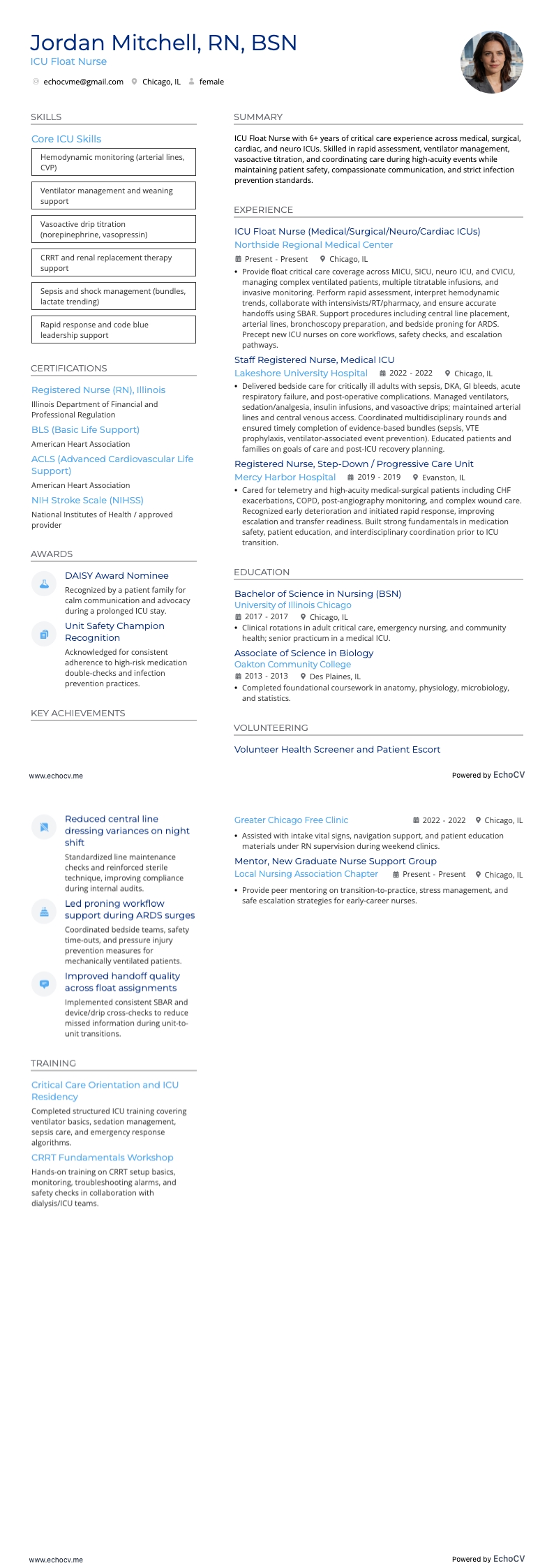
ICU机动护士 example resume

ICU机动护士

神经重症监护护士 example resume

神经重症监护护士

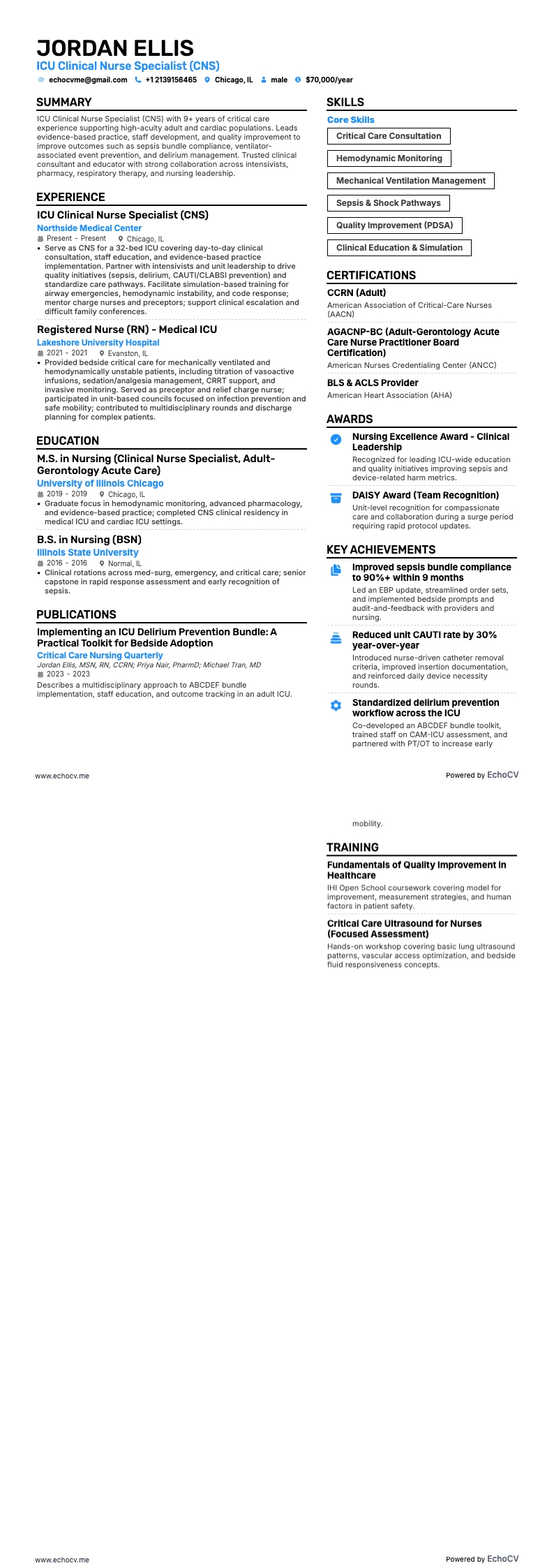
重症监护病房临床护理专家 - CNS example resume

重症监护病房临床护理专家 - CNS

重症监护室执业护师 example resume

重症监护室执业护师

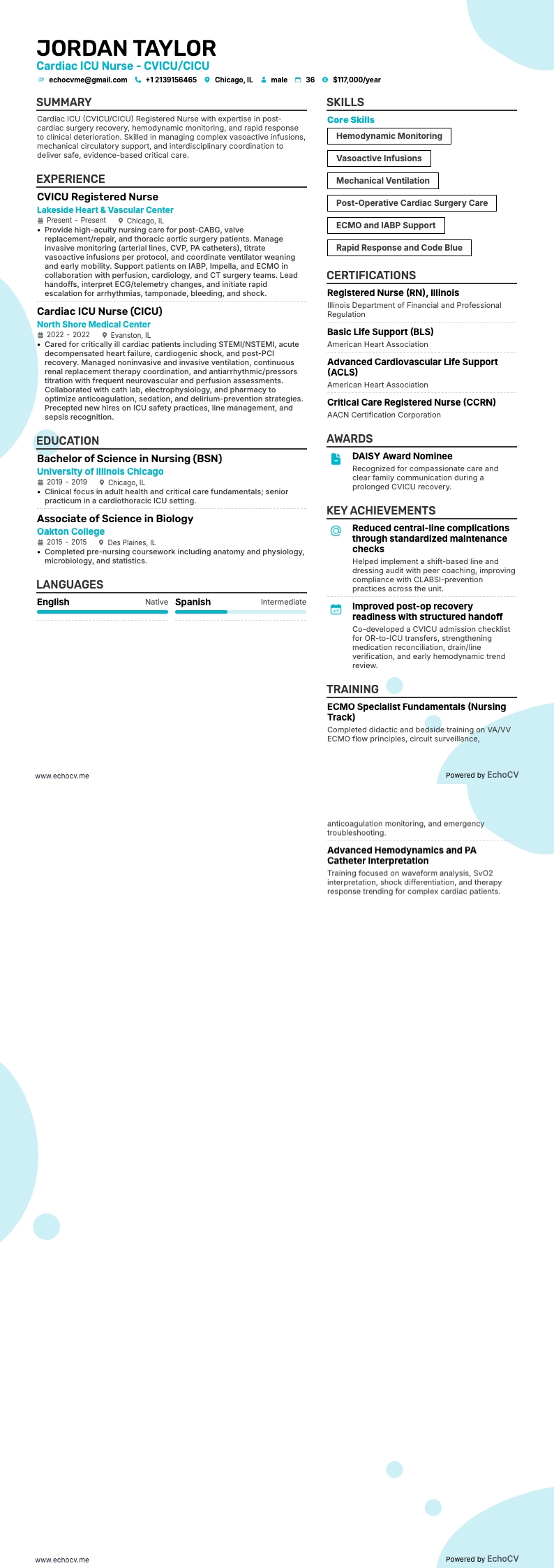
心脏重症监护护士 - CVICU/CICU example resume

心脏重症监护护士 - CVICU/CICU

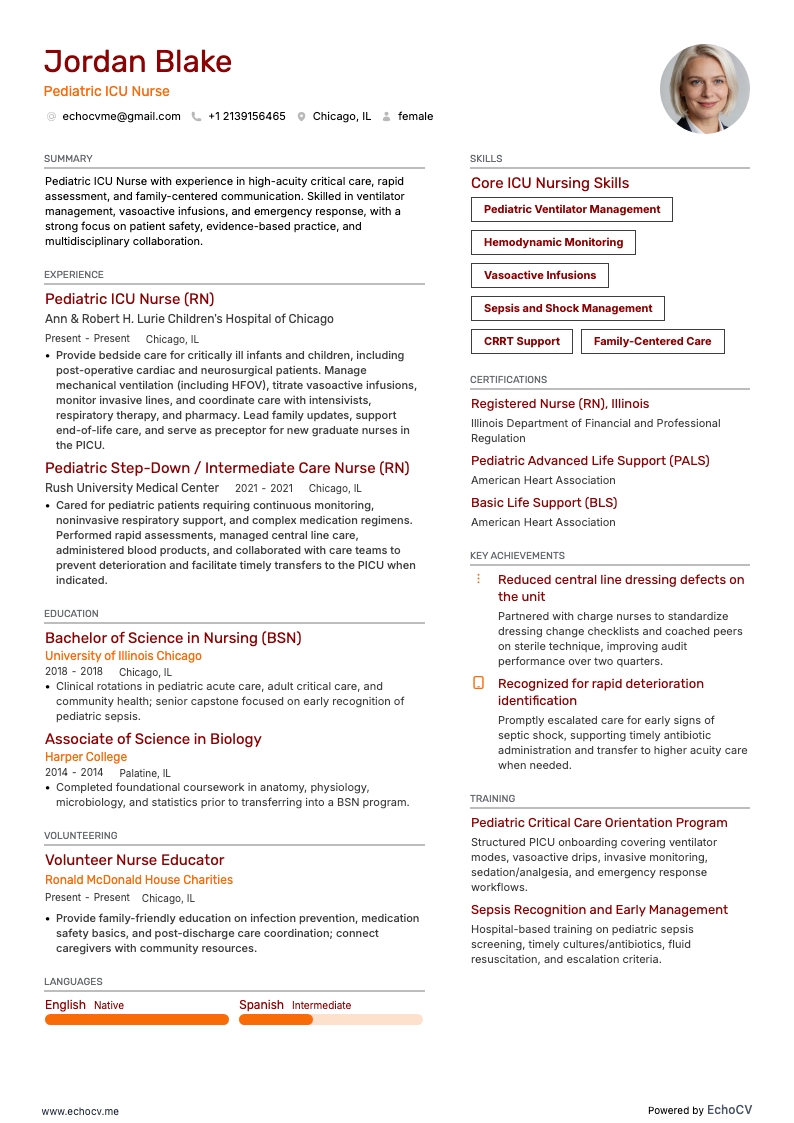
儿科重症监护护士 example resume

儿科重症监护护士

新生儿重症监护护士 - NICU example resume

新生儿重症监护护士 - NICU

重症监护室护士长 example resume

重症监护室护士长

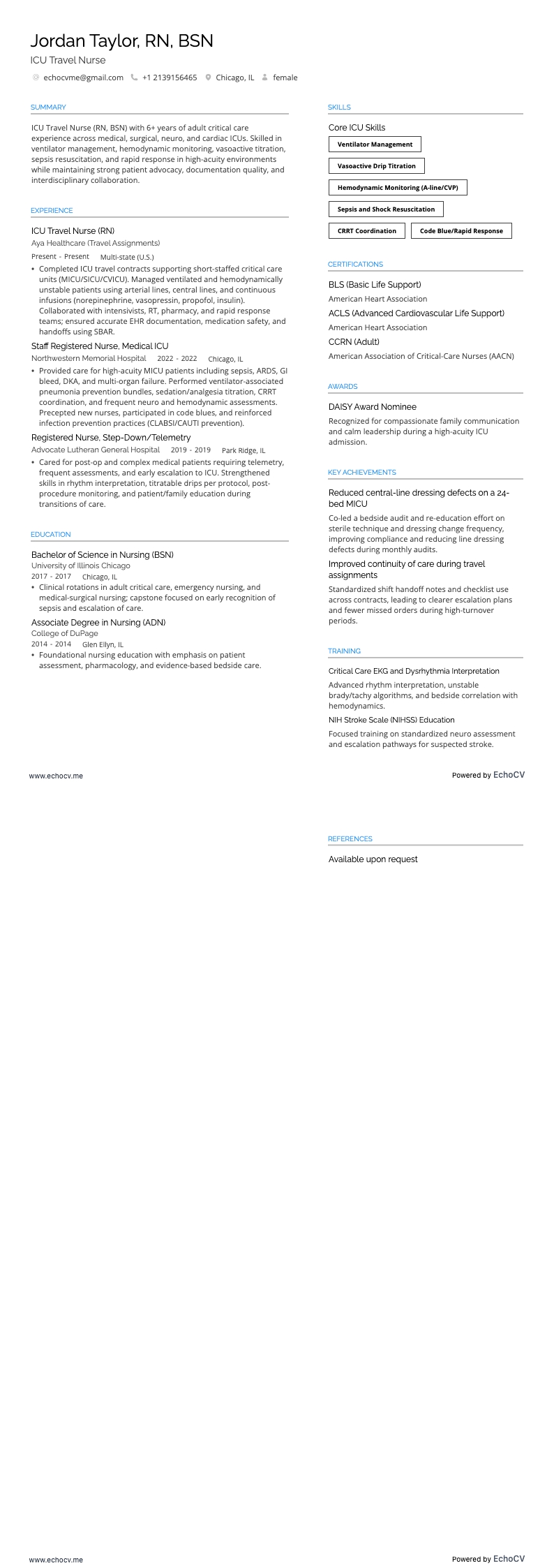
重症监护旅行护士 example resume

重症监护旅行护士

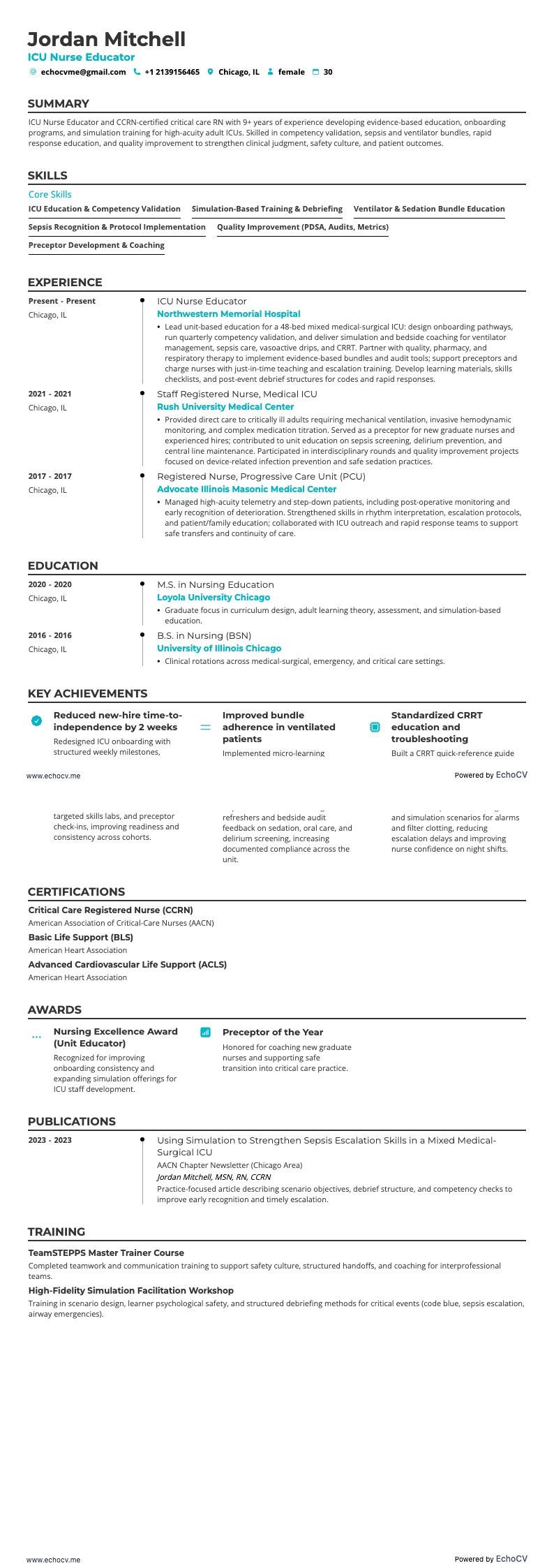
重症监护护士教育者 example resume

重症监护护士教育者

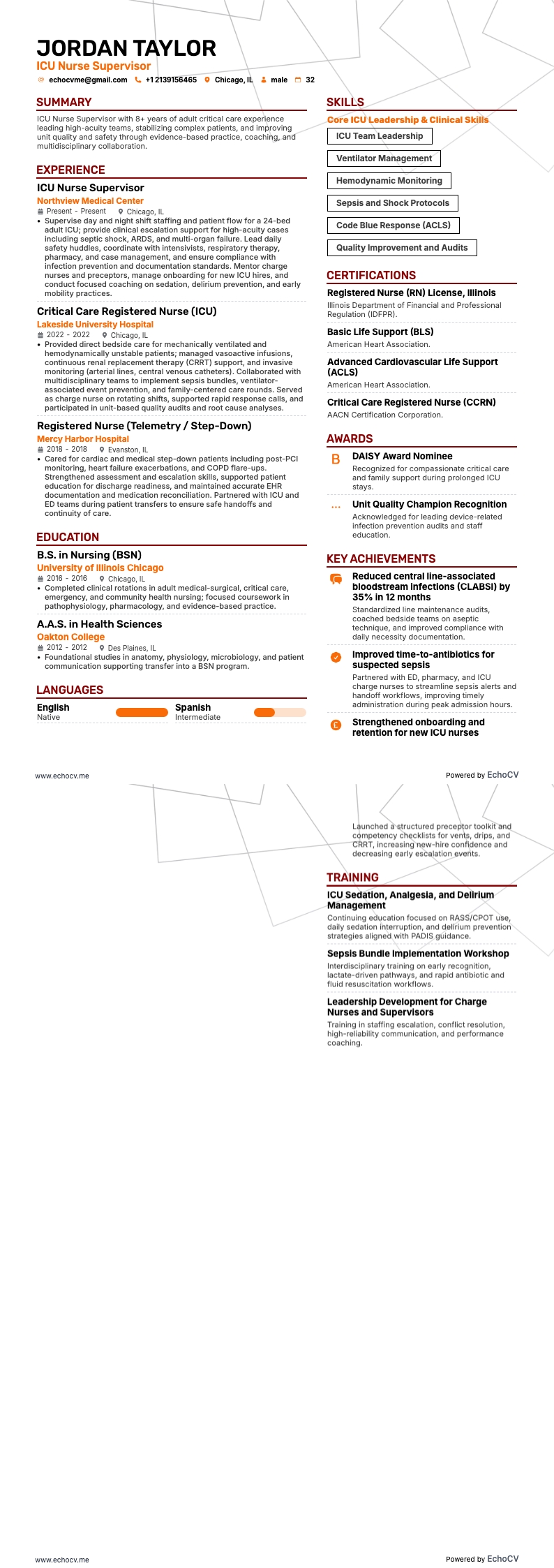
重症监护室护士主管 example resume

重症监护室护士主管

外科重症监护室护士 - SICU example resume

外科重症监护室护士 - SICU

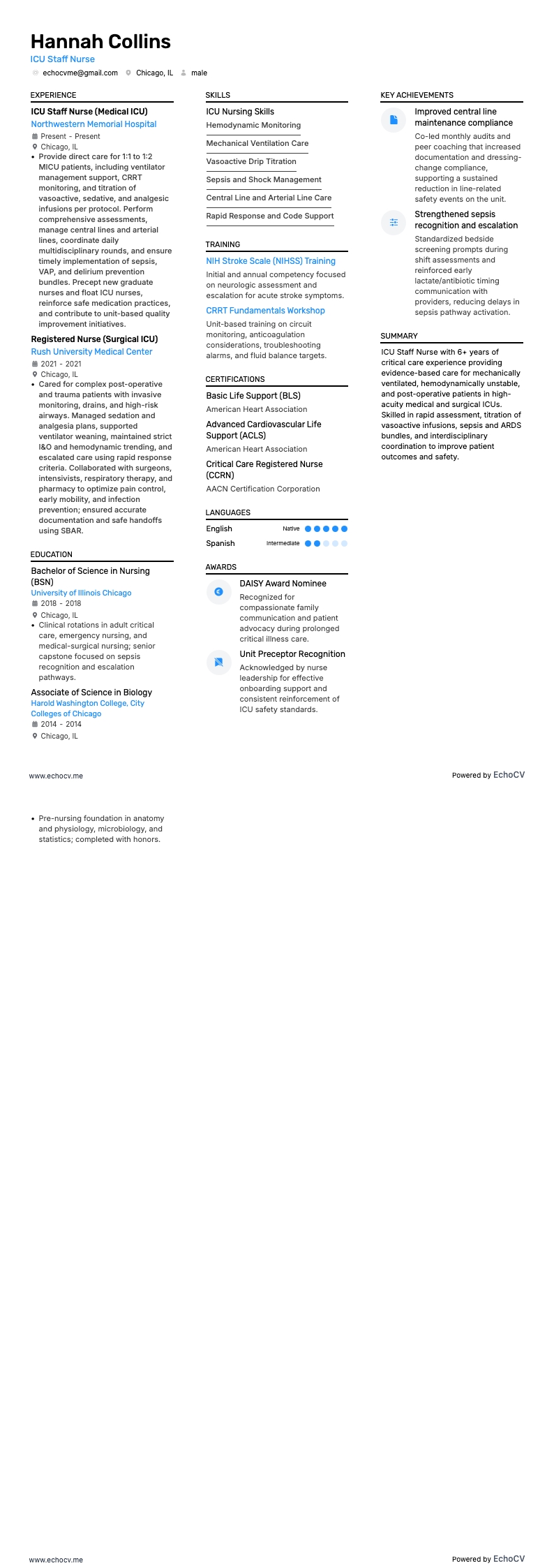
重症监护室护士 example resume

重症监护室护士

Intensive care demands precision, sound clinical judgment, and emotional resilience that most people never witness up close.

At the same time, competition for the best ICU nurse roles can still feel intense and frustrating. The U.S. Bureau of Labor Statistics projects about 190,000 registered nurse (RN) openings each year, yet many skilled ICU nurses feel overlooked.

The issue usually isn’t ability. It’s turning life-or-death work into clear, measurable resume achievements. Most documentation is written for charts and audits, not for recruiters scanning dozens of ICU applications in minutes.

This guide is built with Certified Professional Résumé Writer (CPRW) principles and real ICU experience. We’ll show you how to move beyond duty lists to structure, format, and language that highlight your impact at the bedside.

By the end, your resume will mirror what you deliver on every shift: calm, competent critical care when it matters most.

Key takeaways

  • Transform ICU duties into quantifiable achievements that demonstrate scope, scale, and clinical outcomes.

  • The reverse-chronological format is the gold standard for ICU nurses, ensuring ATS and recruiters quickly find your most recent, relevant critical care experience.

  • Place your licensure and certifications high on the resume, near the summary, as they are mandatory keyword filters for medical committees and ATS.

  • Don’t use a separate soft skills section. Instead, weave traits like crisis management into your experience bullets, backed by quantifiable actions.

  • Use Echocv’s tailoring tool or AI prompts (like the one provided) to match your resume language precisely to the job description's keywords.

Your time is critical. Skip the guesswork and find comprehensive resume examples tailored for your specific ICU specialty below.

How to choose the best ICU nurse resume format

For nearly all ICU nurses, the reverse-chronological format is the correct choice.

This structure immediately highlights your most current experience, which is exactly what clinical recruiters look for first. It’s also the format that applicant tracking systems (ATS) process the most easily. By placing your latest accomplishments at the top, you demonstrate a clear, continuous progression in your specialized nursing career.

Who it’s best for:

  • ICU and NICU nurses with 3–5+ years in continuous critical care roles
  • ICU nurses applying for a similar ICU or step-down role
  • ICU nurses showing clear progression from staff nurse to charge/preceptor
  • ICU nurses without significant employment gaps or career breaks
  • Travel ICU nurses with a manageable number of recent assignments
  • ICU nurses staying within one or two related specialties (e.g., CVICU, Neuro ICU)

Now, when should you deviate from this?

You should only consider a functional (skills-based) format if you’re attempting a significant career pivot—perhaps moving completely out of direct patient care and into non-clinical areas like health IT or nurse education.

In virtually every other case, keep your focus on the reverse-chronological order. It’s the most reliable way to clearly present your clinical history and critical care expertise to hiring managers.

What sections should go on an ICU nurse's resume?

Your ICU resume needs to work like you do on admission: fast, focused, and crystal clear under pressure. When a patient rolls in, you scan essentials first—status, vitals, airway, lines, and key history.

A recruiter does the same with your resume. So, think of each section like a structured report that guides their decisions at a glance.

Include:

  • Contact Information: Always start here—just your name, phone, email, and LinkedIn URL—to make it effortless for recruiters to schedule the interview.
  • Professional Summary: Three to four lines highlighting your years of experience, top certifications (like CCRN), and your most impressive quantifiable clinical achievement.
  • Core Competencies: A quick-scan list of high-acuity skills (CRRT, IABP, ECHMO, specialized drips, etc.) that the ATS will flag immediately.
  • Clinical Experience: Your detailed work history, using achievement-focused bullets that quantify patient outcomes or process improvements you drove on the unit.
  • Education and Certifications: List your academic degrees, required nursing licenses, and critical life support certifications (ACLS, PALS) to prove you meet all mandated requirements.

Before you put your final document into rotation, run it through Echocv’s Resume Checker to catch weak spots, keyword gaps, and formatting issues.

How to write your ICU nurse resume experience

For an ICU nurse, your experience section should prove clinical excellence, steady judgment, and the difference you make for patients and the team.

Recruitment screens move fast, so every bullet needs to earn its place and say something clear about your impact.

Where numbers fit naturally, use them. Where they don’t, you can still show outcomes through safety, teamwork, and calm handling of unstable situations.

What to include in every bullet:

  • Action verbs:Start strong with verbs that show high responsibility and clinical leadership, such as managed, stabilized, coordinated, led, implemented, or escalated appropriately.
  • Specialized focus: Name the high-acuity patients you care for and the interventions you handle, like trauma, cardiac, neuro, post-op, CRRT, or advanced drips.
  • Clinical context: Add brief context so someone outside the unit understands the challenge: bed capacity, typical nurse-to-patient ratios, or common devices on your shift.
  • Impact, not just numbers: If you can’t measure it, describe the impact: protected patient safety, supported families in crisis, or helped newer nurses manage high-acuity assignments.

Aim for a mix of quantified and descriptive bullets so your resume feels honest, grounded, and still clearly results-focused.

Like so:

Good example of an ICU nurse experience section

CLINICAL EXPERIENCE

Critical Care Registered Nurse (CCRN)
Massachusetts General Hospital (Mass General Brigham) | Boston, MA
2018–Present

Function as a Charge Nurse on rotation, overseeing staffing, bed placement, and resource allocation for a 16-bed surgical/cardiac ICU.

  • Manage a complex patient assignment of 1:1 or 1:2 critically ill patients, specializing in post-cardiac surgery, advanced heart failure, and multi-system organ failure.
  • Expertly operate and manage life-sustaining equipment, including Impella, Intra-Aortic Balloon Pumps (IABP), CRRT, and continuous invasive hemodynamic monitoring systems.
  • Co-developed and implemented a new central line bundle protocol that decreased the unit's infection rate by approximately 12% over nine months.
  • Mentor and precept new RN hires and clinical affiliates, focusing on rapid recognition of patient deterioration and appropriate escalation of care.
  • Lead rapid response and code teams for patients experiencing acute decompensation, demonstrating decisive clinical judgment under high pressure to initiate life-saving interventions.

To make your resume easy to scan for both ATS and humans, you need to master basic resume tailoring.

Can you use AI to tailor your medical ICU nurse resume?

Tailoring your resume for every single job posting is crucial—and exhausting—which is why AI tailoring tools are beneficial.

Recruiters and ATS essentially compare your skills and experience against the requirements in the job description (JD). When your language and patient focus align with the JD, you look like an immediate fit, and interviews become more likely.

The most effective resume tailoring always starts with the job description.

Author’s take

How AI maximizes your time and efficiency:

  • Instantly identify keywords: AI can scan the job description and highlight the exact technical terms (e.g., Sepsis Protocols, CRRT, Cerner) the ATS is searching for.
  • Generate tailored wording: Instead of rewriting bullets manually, AI can take your base experience and instantly adjust the language to match the job's required tone and focus.
  • Ensure concise formatting: It checks for compliance with professional formatting rules, allowing you to focus purely on the clinical content.

Here are several ways to tailor an ICU nurse’s experience section to align with the job description:

  • Match specific patient populations: If the posting asks for a Neuro ICU, swap mentions of "Cardiac Surgery" for "complex neurological conditions (e.g., SAH, stroke)."
  • Align technology and equipment: Use the exact names of the EHR systems (e.g., Epic, Cerner) or specialized equipment (e.g., Rotational Beds, ECMO) listed in the posting.
  • Emphasize unit initiatives: Highlight process improvements that align with the hospital’s stated mission or core values.
  • Duplicate certification keywords: Ensure your bullet points reinforce the need for certain certifications (e.g., "Maintained PALS certification to manage critically ill pediatric patients").

Below are examples of how ICU nurses turn vague statements into tailored, high-impact achievements that match the job description.

Resume tailoring examples for intensive care unit nurses

Job description excerptUntailored bulletTailored bullet
...experience with continuous renal replacement therapy (CRRT) and cardiac patient management is highly valued.Provided care for patients with kidney failure and managed cardiac equipment.Managed continuous renal replacement therapy (CRRT) for unstable septic patients; stabilized hemodynamics through expert management of vasoactive infusions.
...must demonstrate strong leadership in new staff mentoring and adherence to unit protocols.Trained new nurses and followed all established guidelines.Mentored 4 new ICU staff members through a 12-week critical care residency program, resulting in a 95% first-year retention rate.
...required to manage Epic EHR workflows and participate in quality improvement committees.Used Epic to chart and was part of a committee.Volunteered for the Quality Improvement Committee, utilizing Epic data analytics to identify and reduce charting errors by 20% unit-wide.

You can't afford to waste hours tailoring every application, yet skipping this step often means your resume gets filtered out by ATS. Leverage the power of the Echocv One-Click Job Tailoring Tool to instantly match your resume to the job description’s exact demands.

The next critical step is ensuring your nursing experience is as impactful as possible.

How to quantify your ICU experience on a resume

Quantifying your experience transforms vague statements of duty into measurable achievements. Hiring managers want to know the scale, scope, and impact of your actions.

Use numbers and data points to demonstrate competence, efficiency, and real-world results and to make your contributions concrete and memorable.

Quantified ICU nurse achievements

How to quantifyExample bullet point
Time efficiency and staffing"Reduced the average patient transfer time from the Emergency Department (ED) to the ICU by 25% (from 60 minutes to 45 minutes)."
Resource management and cost savings“Decreased wastage of arterial line and central venous catheter (CVC) insertion kits by 15% over six months by supply optimization, resulting in an estimated departmental cost savings of $8,000.”
Quality improvement and patient outcomes“Contributed to a 40% reduction in Ventilator-Associated Pneumonia (VAP) cases in a six-month period by championing compliance with the VAP prevention bundle and providing real-time peer coaching to a team of 15 nurses.”

Streamline writing those key successes: Echocv’s Bullet Point Generator instantly turns your job duties into impactful, success-focused statements.

Mastering the ICU nurse skills section

The skills section is your rapid-fire demonstration of competency. For an ICU role, recruiters prioritize verifiable hard skills over generic soft ones, as they immediately signal your readiness for critical care environments.

Here’s a simple process you can use to build an effective skills section:

Step 1: Prioritize practical, hard skills

Let the job description guide you in picking the right abilities and tools for your resume.

  • What to choose: Focus exclusively on procedures, equipment, and advanced clinical knowledge unique to the ICU setting.
  • What to prioritize: List the most complex and critical skills first. If you are proficient in a highly specialized skill (like ECMO or IABP), lead with it.

Step 2: Place them strategically

For an experienced ICU nurse, place skills high on the resume—after your professional profile and before work history—so core competencies are seen immediately. This placement is crucial as the section often acts as a primary keyword filter for recruiters.

Step 3: List them clearly and concisely

Use distinct groups where skills are clearly separated by commas. This formatting is the best option for optimal ATS parsing and human readability.

Use the categories below to organize your expertise, including only the skills you are proficient in.

Starting with the most sought-after hard skills found in ICU job descriptions:

Advanced procedures & monitoring

  • Hemodynamic monitoring: Arterial line insertion/management, CVP, PA catheter monitoring (Swan-Ganz).
  • Airway management: Endotracheal intubation assistance, ventilator management (all modes), tracheostomy care.
  • Vascular access: Central Line (CVC) insertion/management, PICC line care, difficult peripheral IV access.
  • Renal support: Continuous Renal Replacement Therapy (CRRT), hemodialysis.
  • Neurological: ICP monitoring, EVD management.

Critical care equipment

  • Mechanical ventilation (e.g., Dräger, Puritan Bennett)
  • IV infusion pumps (e.g., Alaris, Plum 360)
  • IABP (Intra-Aortic Balloon Pump)
  • ECMO (Extracorporeal Membrane Oxygenation)
  • Defibrillators/pacing devices

Finish up with some of the more complex medical procedures in the intensive care unit:

ICU-specific interventions

  • ACLS & PALS Certification
  • Complex titratable vasoactive/inotropic drugs (e.g., Norepinephrine, Dobutamine, Nicardipine)
  • Sepsis/shock protocol management
  • Pre/post-operative management (e.g., cardiothoracic, neuro)

Soft skills don’t belong in a separate section. They should be woven into the resume content so they become contextualized and backed by metrics.

Avoid vague terms like "Teamwork" or "Communication" unless they are integrated into your summary or experience bullets (e.g., "Coordinated care across a six-person interdisciplinary team").

Look at an example that demonstrates crisis management skills, without explicitly saying the word:

Experience bullet showcasing a soft skill:

Managed the triage, stabilization, and placement of 12 critically injured patients in a 4-hour period, during a city-wide mass casualty incident (MCI).

Now that your skills are streamlined, we move to your education and training—a critical section that must be impeccably organized for both medical committees and ATS/AI scrutiny.

How to list licensure and education on an ICU nurse resume

Nursing resumes have specific requirements because hospitals, licensing boards, and ATS need to quickly verify credentials and specific clinical competency.

Mandatory credentials section

  • Highest Degree (e.g., MSN, BSN)
  • Licensure (e.g., RN)
  • National certifications (e.g., CCRN, NEA-BC)

List your abbreviated credentials after your name in the resume header. Then, create a separate section to fully detail each credential. This practice ensures both human and machine readers can quickly verify your qualifications.

Include:

  • Full certification name (put the standard abbreviation in brackets): e.g., Critical Care Registered Nurse (CCRN)
  • Issuing organization: e.g., American Nurses Credentialing Center (ANCC)
  • Expiration Date: (crucial for hospital credential tracking)

With your key credentials established, you can now structure the education section itself. This is where you quickly and formally document your academic foundation.

Here’s what to write:

  • Highest relevant degree (e.g., BSN, ADN, MSN, DNP).
  • Institution name and location
  • Graduation year
  • Key distinctions: (e.g., Summa Cum Laude, Dean's List).
  • Note: Only the highest degree is necessary—omit high school details.

Look at a clear example of how all this works in practice:

Education entry sample

LICENSURE & CERTIFICATIONS

  • RN Licensure: New York State Board of Nursing, License ID 785934
  • Critical Care Registered Nurse (CCRN): American Association of Critical-Care Nurses (AACN, Expires 06/2028
  • Advanced Cardiovascular Life Support (ACLS): American Heart Association, Expires 11/2026
  • Basic Life Support: American Heart Association, Expires 11/2027

EDUCATION

Bachelor of Science in Nursing (BSN)
Columbia University School of Nursing | New York, NY

May 2018

How to write your ICU nurse resume summary

Yourresume summary should be three to four lines maximum and should not be a rambling list of duties. It must instantly answer the recruiter's question: "Why is this nurse uniquely qualified for our ICU?"

Here’s what to include:

  • Job title and key credentials: Start by immediately defining yourself with your title and highest credentials.
  • Years of experience and unit type: State your tenure and specific area of expertise.
  • Core skills: Highlight two or three of your most complex, in-demand technical skills.
  • Quantified impact: Conclude with one high-level metric that proves your value.

This ensures the summary acts as a keyword-rich filter that the ATS and hiring managers will prioritize.

Example summary

CCRN-certified ICU Nurse with 7+ years of progressive experience managing diverse patient populations in a 32-bed Surgical and Neuro ICU. Highly proficient in advanced hemodynamic monitoring, CRRT setup, and complex vasoactive drug titration. Proven expertise in rapid patient stabilization and leading unit-wide initiatives that resulted in a 15% reduction in central line-associated bloodstream infections (CLABSI).

How do I write an ICU nurse resume with no experience?

Applying for a highly competitive ICU role straight out of school or from a non-critical care unit requires a strategic pivot. Since you can't rely on critical care work history, you must focus on demonstrating your potential, foundational knowledge, and commitment.

1. Shift the focus: Experience is transferable

Don’t skip your experience (whether clinical rotations, a med/surg job, or even a nurse externship).

Instead, reframe it:

  • Clinical rotations: List the highest acuity tasks and skills you performed, even if they were just observation. Mention time spent in critical care units.
  • Existing job: Focus your bullet points on skills that mirror ICU demands: rapid assessment, handling acute changes in patient status, using complex equipment, and time management with heavy patient loads.
2. Prioritize formal education (move it up!)

For the novice ICU nurse, your education and certifications sections are your strongest assets. Move them to the top half of the resume, right after your professional summary.

  • Certifications: BLS and ACLS are non-negotiable and must be current. If you’re applying to PICU, pursue PALS certification. You can also take an entry-level course like Essentials of Critical Care Orientation (ECCO).
  • Education: Highlight relevant coursework, GPA (if above 3.5), and any capstone projects or honors related to acute care or pathophysiology.
3. Create a targeted professional profile

Your objective statementmust quickly convince the reader that you are prepared to learn and excel in critical care.

  • Focus on traits: Use terms that highlight ICU-ready traits: clinical judgment, rapid assessment, and high-acuity exposure.
  • Show commitment: Mention your specific goal (e.g., "Highly motivated Registered Nurse seeking an entry-level position within a Level I Trauma ICU residency program").
4. Build a dedicated Relevant Skills section

Since your work history is limited, you must clearly spell out your hard clinical skills from school and prior jobs.

  • List procedures/equipment: Include skills like EKG interpretation, IV Insertion, Foley/NGT insertion, and any monitoring or ventilator exposure you have.
  • EHR proficiency: Always list the EHR systems you have used ( Epic, Cerner, etc.).
5. Add an Additional Experience section

Use this to list any shadowing, volunteer work, or residency/fellowship program applications that show your commitment to critical care. This demonstrates you took the "extra mile" to prepare yourself for the intensity of the ICU.

For entry-level nurses, a traditional single-column template is best because it provides a clean, highly readable structure. It also allows you to distribute even scarce content evenly on a single page while maintaining a professional, modern design.

Here’s an entry-level ICU nurse resume example. Feel free to copy and paste it to a doc or customize directly using Echocv.

SARAH MILLER

BSN, RN, BLS

(123) 456-7890 | [email protected] | LinkedIn | City, State |


Summary

Highly motivated New Graduate Registered Nurse seeking an entry-level position within a Level I Trauma ICU Residency Program. Demonstrated excellence in rapid patient assessment and clinical judgment during high-acuity rotations. Proficient in EKG interpretation and utilizing advanced EHR systems. Eager to leverage foundational knowledge and commitment to continuous learning to excel in a critical care environment.


Certifications
  • Licensure: RN (Registered Nurse)
  • National Certifications: CCRN (Critical Care Registered Nurse), NEA-BC (Nurse Executive Advanced-Board Certified)

Education

Bachelor of Science in Nursing (BSN)
Columbia University School of Nursing | New York, NY
Graduated: May 2025

  • Honors:Summa Cum Laude (GPA: 3.8/4.0)
  • Relevant Coursework: Advanced Pathophysiology, Critical Care Nursing Theory

Clinical Experience

Student Registered Nurse (Total Clinical Hours: 600+)
New York Presbyterian Hospital | New York, NY
09/2024 – 05/2025

  • Completed intensive clinical rotations, including 120 hours dedicated to the Medical ICU and Emergency Department.
  • Consistently managed patient loads of up to 4:1 while in the Med/Surg unit, prioritizing medication administration and treatments with 100% timeliness.
  • Collaborated with a six-person interdisciplinary team, presenting detailed patient status updates and care plans during daily rounds to ensure continuity of care.
  • Assisted RNs with procedures, including central line dressing changes, blood product administration, and basic ventilator checks.

Technical Proficiencies
  • Clinical: EKG interpretation, Arterial blood gas (ABG) analysis, IV Insertion, Wound care, NGT insertion, Foley catheterization, Medication Titration observation.
  • Equipment: Automated External Defibrillator (AED), IV pumps (Alaris), Telemetry monitoring.
  • EHR Systems: Epic, Cerner (Proficient in charting, order entry, and documentation).

Additional Experience

Nurse Extern (Part-Time)
Mount Sinai Health System | New York, NY
06/2024 – 08/2024

  • Supported staff RNs in Med/Surg by performing vital sign monitoring, patient hygiene, and documenting input/output for a 15-patient cohort.
  • Demonstrated strong time management by proactively completing all delegated tasks for 5-6 patients per shift, improving RN efficiency.

Frequently asked questions about ICU nurse resumes and job applications

Here, we answer a few more common questions that will help you perfect your nursing resume.

What should I include in my ICU nurse resume header?

The header must prioritize immediate verification of credentials. It should feature your name, full contact information (phone, email, LinkedIn), your current city and state, and all abbreviated credentials as a headline (MSN, RN, CCRN).

What design rules should I follow?

Stick to a traditional, single- or double-column template. Both layouts are ATS-readable and allow for clear, scannable organization of technical skills and licensure.

How technical should an ICU nurse's resume be?

Extremely technical. Your resume must clearly list specific hard skills (e.g., CRRT management, IABP care, EKG interpretation) and the EHR systems you have used. Use Echocv’s Bullet Point Generator to ensure your achievements are quantified, not just descriptive.

What should I include in a nursing cover letter?

The cover letter should directly address the specific unit and hospital, highlighting two or three key skills from the job posting. Use it to connect your previous experience to the hospital's mission or the unit's needs, showing you did your research.

Don’t simply regurgitate facts from your resume. Use the cover letter to provide context for the soft skills (empathy, resilience, critical thinking) that make you a prepared candidate. This allows the reader to understand your personality and fit beyond the clinical data.

I’ve sent hundreds of applications, but still can’t land an ICU interview. Why?

The primary reason is a lack of tailoring. Mass-applying with one generic resume often gets filtered out by ATS keyword matching.

If tailoring manually feels overwhelming, consider using LLMs like ChatGPT or Gemini to get started. Another quick solution is direct tailoring with a resume builder. Check out Echocv’s One-Click Job Tailoring Tool to instantly adjust your bullet points and skills to match the job description's exact language and requirements.

What’s a good AI prompt to tailor my ICU nurse resume?

A strong prompt provides the AI with the target job ad and your existing resume content. The AI can then act as a specialized editor.

Use a prompt structure like this:

Act as a specialist ICU Nurse Recruiter. I am applying for the ICU position described in the [JOB DESCRIPTION]. Review my existing resume [PASTE RESUME BULLETS HERE]. Revise the top five most relevant bullet points from my experience section to maximize keyword matching and relevance for this specific job description, and ensure all revisions remain quantified.

Where do ICU nurses earn the most in the United States?

  • New York: $133,481
  • Vermont: $131,307
  • Maine: $125,716
  • Pennsylvania: $122,244
  • Washington: $121,507

Final thoughts

A successful ICU nurse resume isn’t just a document of duties, but a structured clinical report demonstrating mastery under pressure.

Lead with quantified achievements, verified credentials, and strategic keywords to help your resume clear ATS filters and reach the recruiter’s desk. Leverage professional tools like Echocv to streamline this process, allowing your resume to reflect the calm, competent critical care you deliver on every shift.

重症监护护士 简历示例

探索更多 重症监护护士 简历示例与指南,看看什么更适合你的经验水平或岗位方向。

按经验

重症监护室护士经理

重症监护室护士经理 简历预览

ICU护士副经理

ICU护士副经理 简历预览

高级重症监护护士

高级重症监护护士 简历预览

应届ICU护士

应届ICU护士 简历预览

重症监护护士 简历示例

探索更多 重症监护护士 简历示例与指南,看看什么更适合你的经验水平或岗位方向。

按职位

重症监护护士顾问

重症监护护士顾问 简历预览

内科重症监护室护理经理 - MICU

内科重症监护室护理经理 - MICU 简历预览

ICU护士协调员

ICU护士协调员 简历预览

创伤重症监护护士

创伤重症监护护士 简历预览

ICU机动护士

ICU机动护士 简历预览

神经重症监护护士

神经重症监护护士 简历预览

重症监护病房临床护理专家 - CNS

重症监护病房临床护理专家 - CNS 简历预览

重症监护室执业护师

重症监护室执业护师 简历预览

心脏重症监护护士 - CVICU/CICU

心脏重症监护护士 - CVICU/CICU 简历预览

儿科重症监护护士

儿科重症监护护士 简历预览

新生儿重症监护护士 - NICU

新生儿重症监护护士 - NICU 简历预览

重症监护室护士长

重症监护室护士长 简历预览

重症监护旅行护士

重症监护旅行护士 简历预览

重症监护护士教育者

重症监护护士教育者 简历预览

重症监护室护士主管

重症监护室护士主管 简历预览

外科重症监护室护士 - SICU

外科重症监护室护士 - SICU 简历预览

重症监护室护士

重症监护室护士 简历预览