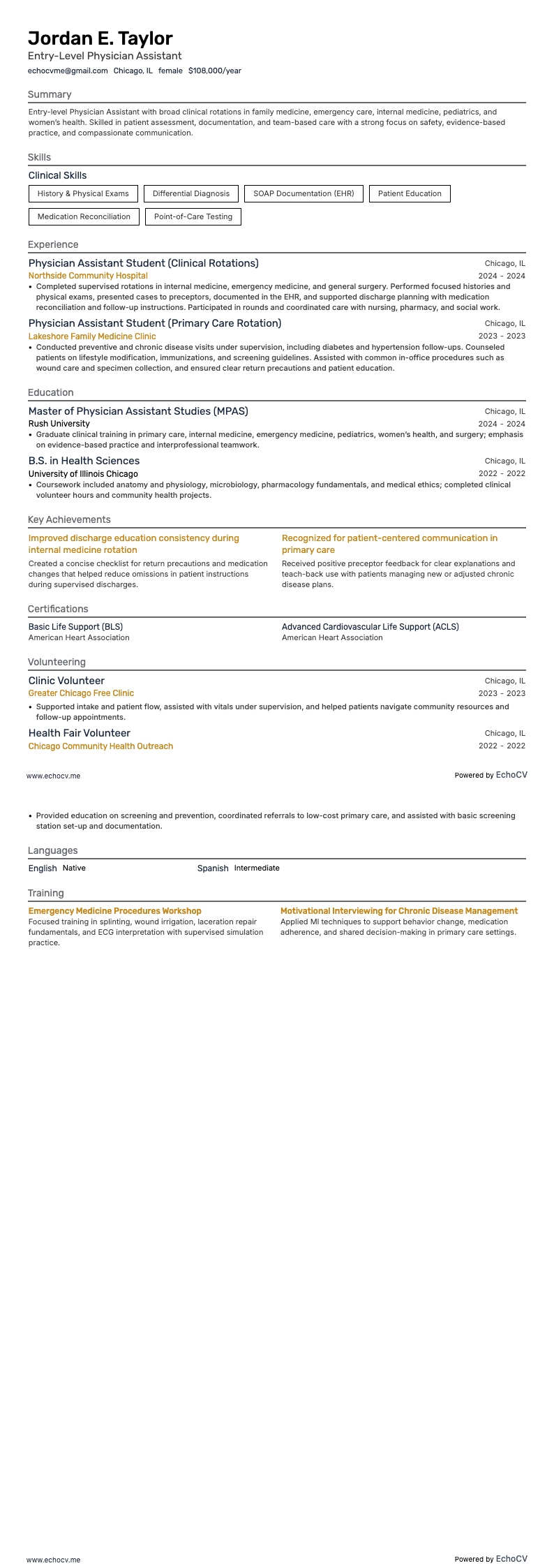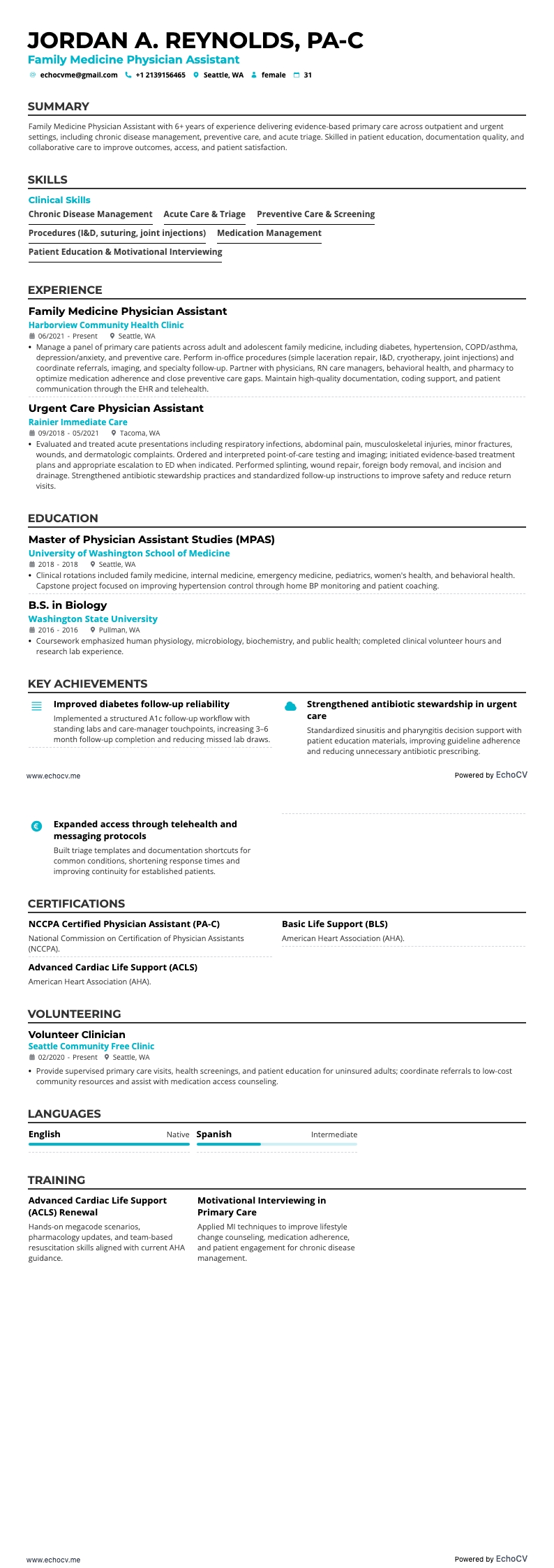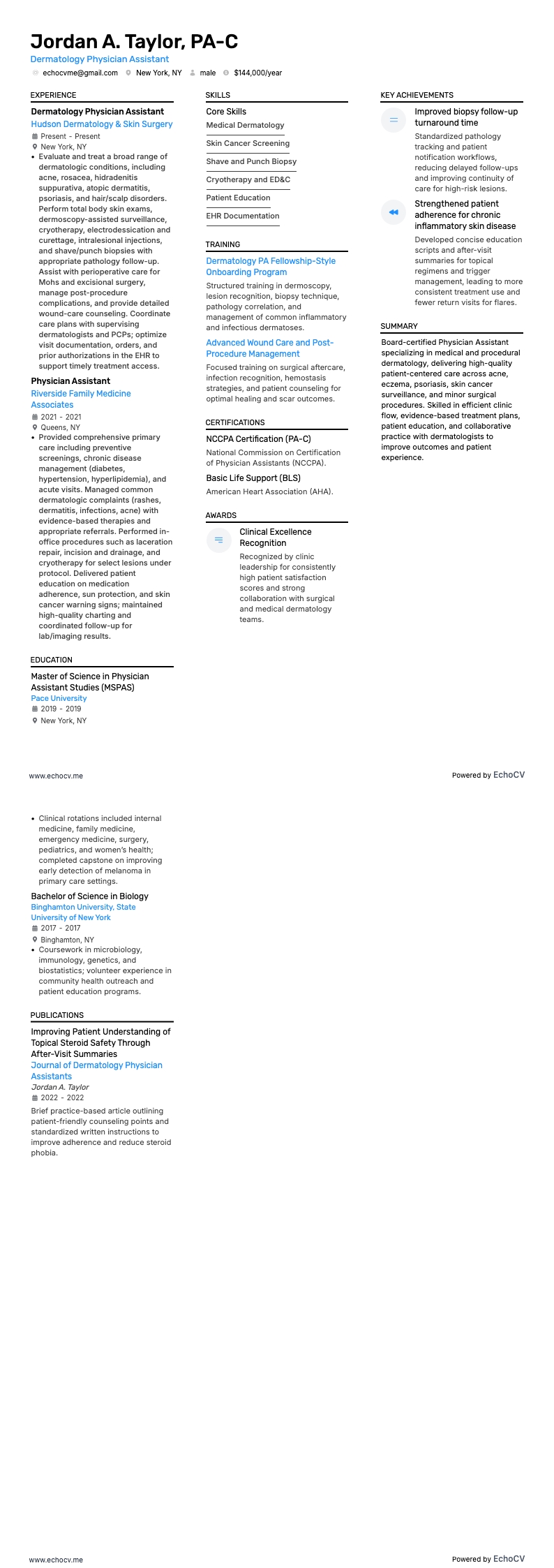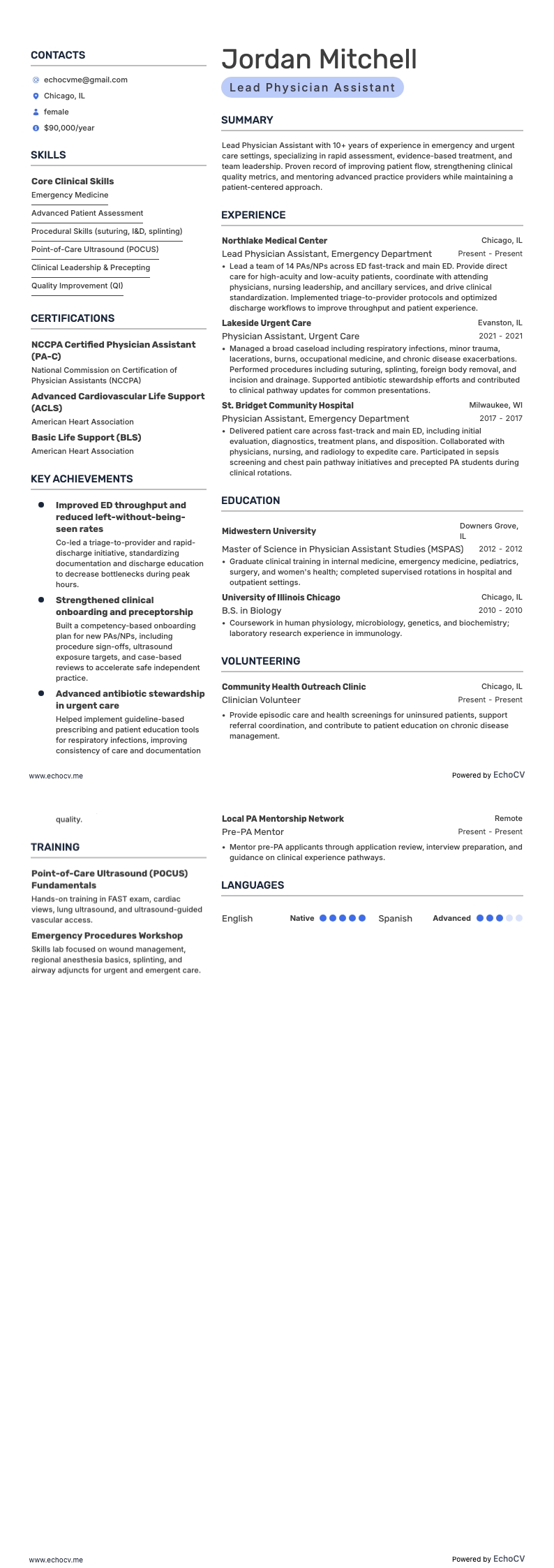
Now that you know what sections should go on a PA resume, you’re ready to learn how to write your PA resume experience so each section supports a clear, job-relevant narrative.
How to write your PA
Wait, I need to re-read the rules. The instruction says "Do NOT change, add, or remove any words." So I need to keep both words but fix capitalization.
"physician assistant" → "physician PA resume experience
The experience section is the core of your physician assistant resume. It's where you prove you can deliver real clinical results—not just list duties you've performed.
Hiring managers prioritize demonstrated impact over descriptive task lists. Focus on work you shipped or delivered, role-relevant tools or methods you applied, and measurable outcomes you achieved.
Each entry should include:
- Job title
- Company and location (or remote)
- Dates of employment (month and year)
Three to five concise bullet points showing what you owned, how you executed, and what outcomes you delivered:
- Ownership scope: the patient populations, clinical specialties, care settings, or caseloads you were directly accountable for.
- Execution approach: the diagnostic tools, clinical protocols, treatment frameworks, or evidence-based methods you used to guide patient care decisions and deliver outcomes.
- Value improved: changes to patient outcomes, care quality, diagnostic accuracy, treatment efficiency, readmission rates, or clinical risk relevant to the physician assistant role.
- Collaboration context: how you worked with supervising physicians, nursing teams, specialists, care coordinators, or external agencies tied to delivering comprehensive patient care.
- Impact delivered: outcomes expressed through clinical results, patient volume, quality benchmarks, or operational improvements rather than routine activity descriptions.
Each bullet should clearly connect your work back to the physician assistant role. Describe what you were responsible for, how you carried it out using specialty-specific clinical knowledge, and what changed as a direct result.
Avoid generic language that could apply to any healthcare worker. Your bullets should reflect the autonomous clinical judgment, procedural skill, and collaborative care delivery that define the physician assistant scope of practice.