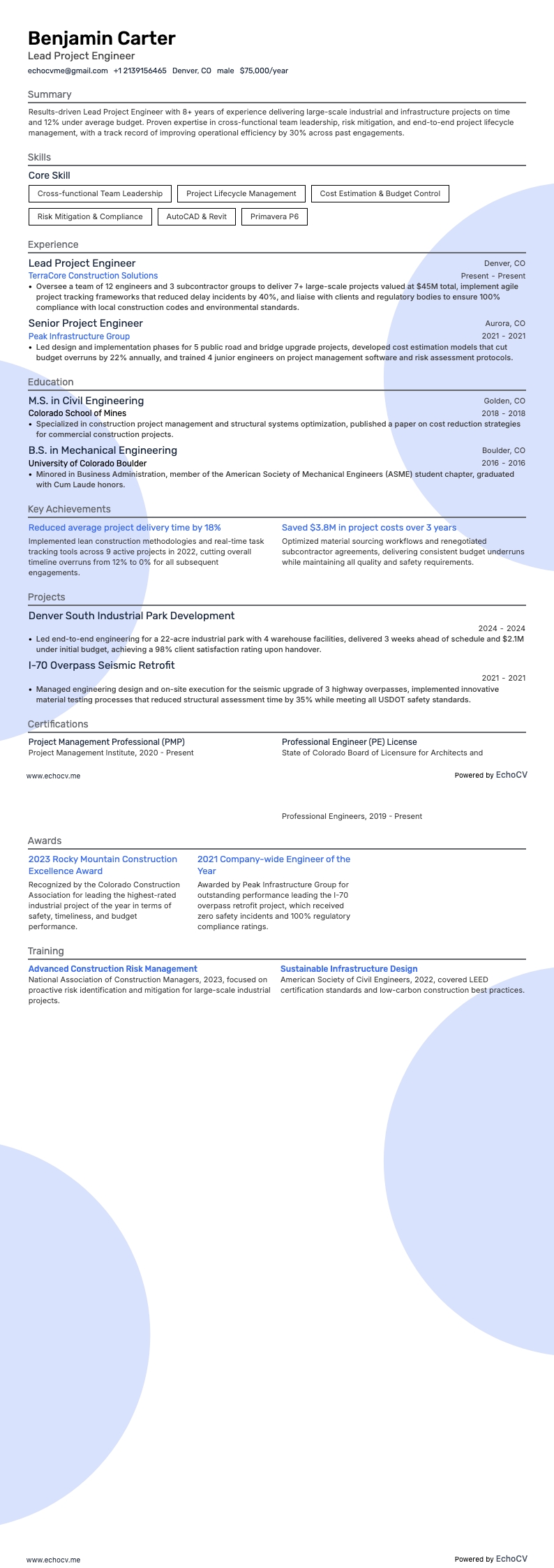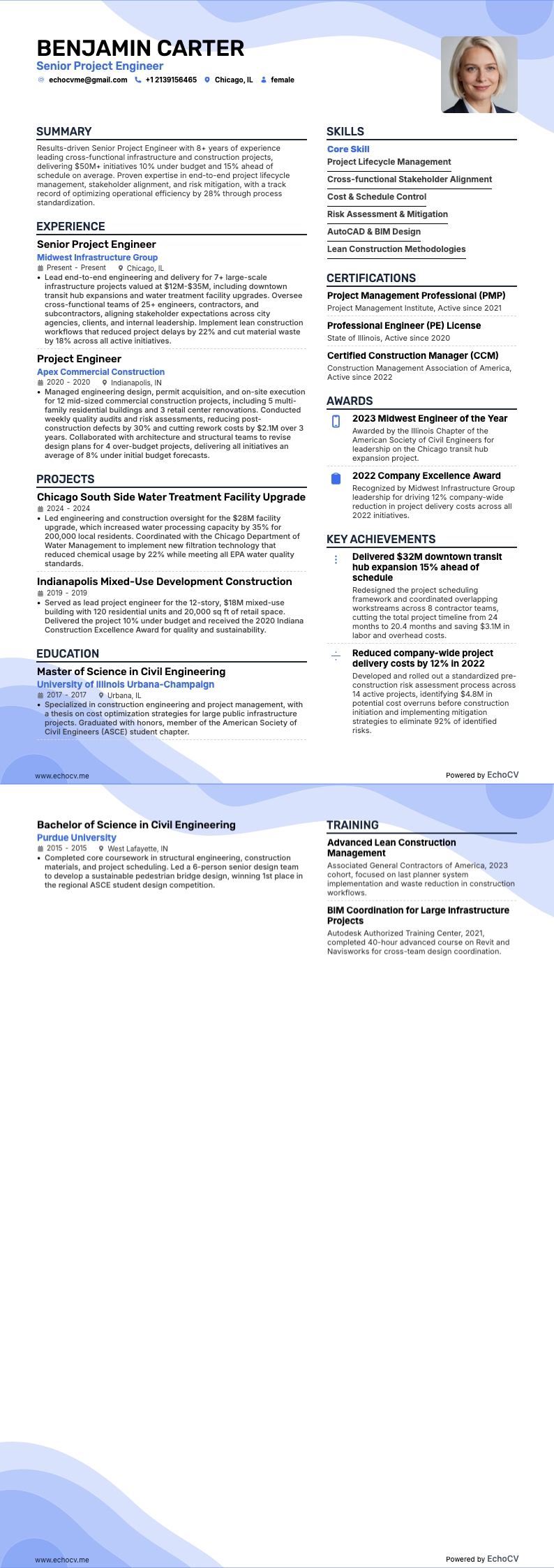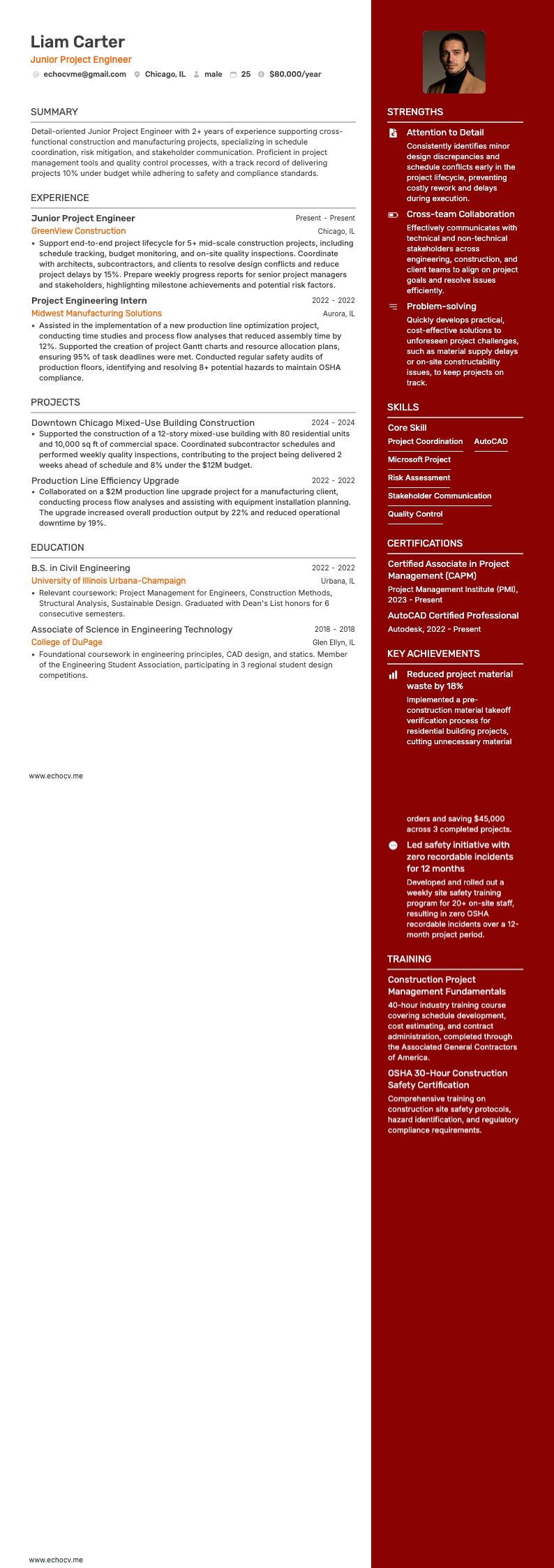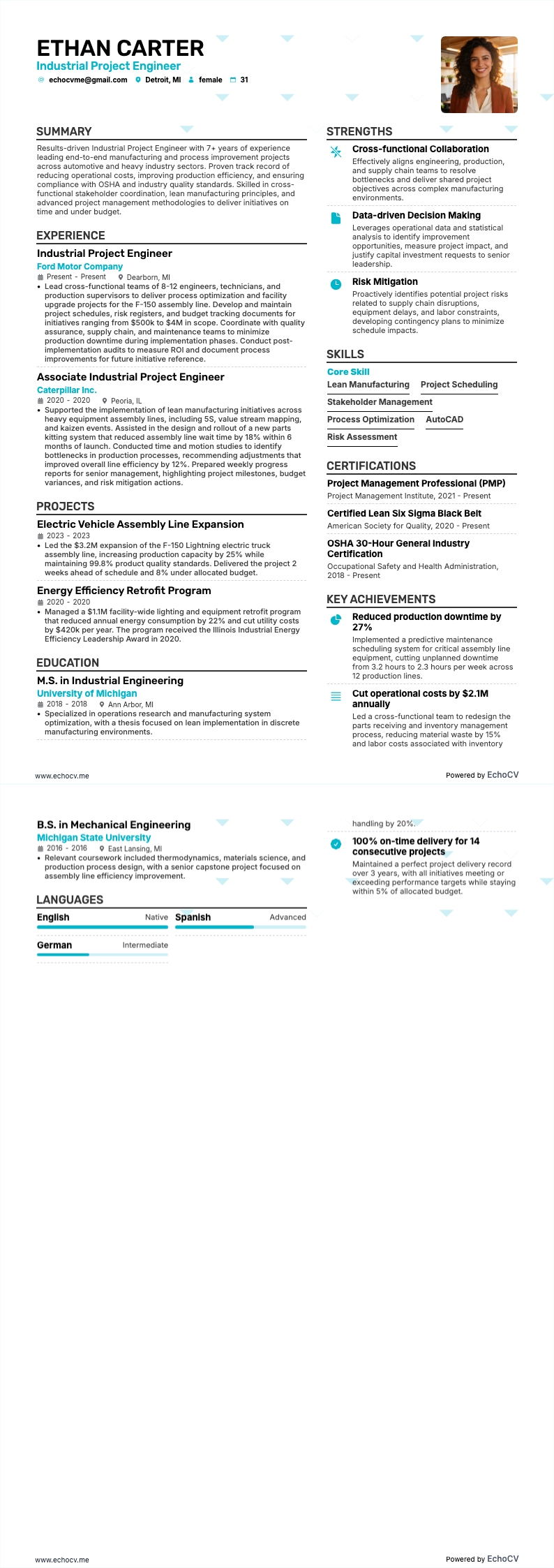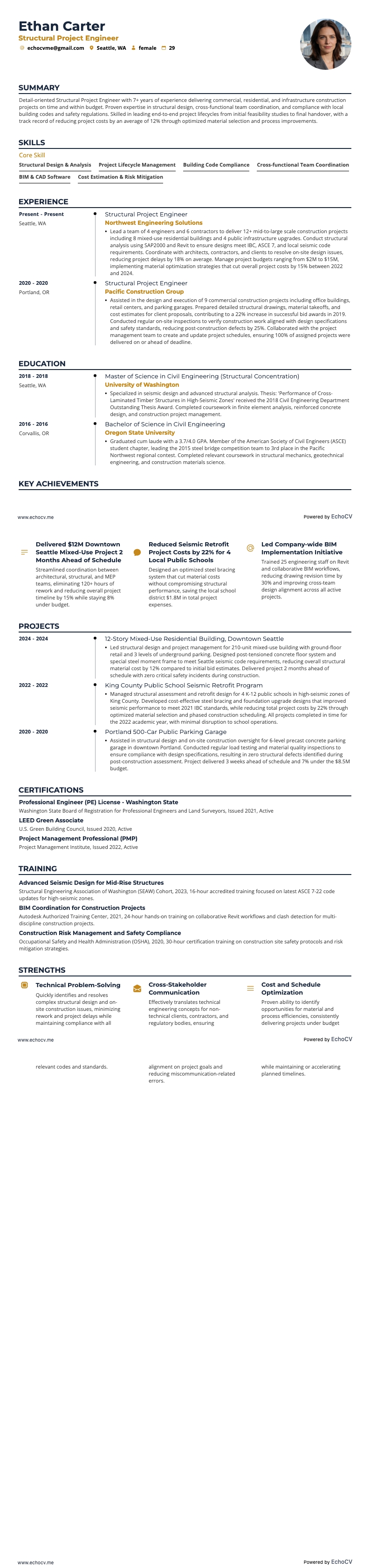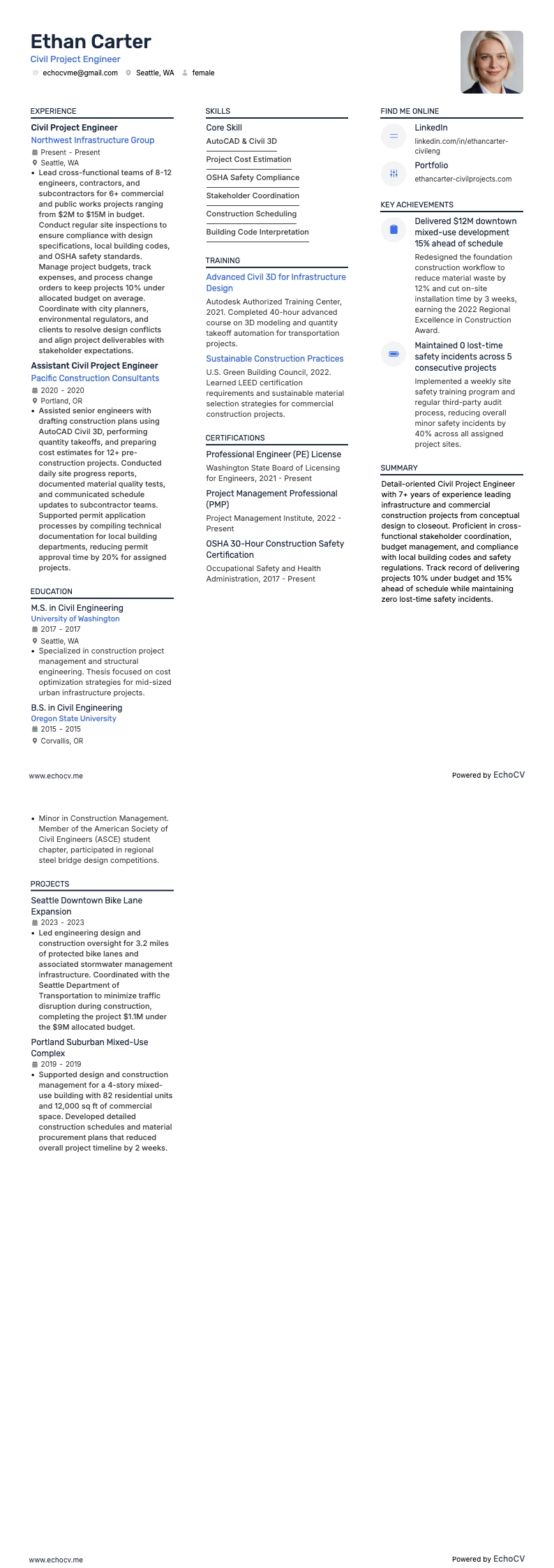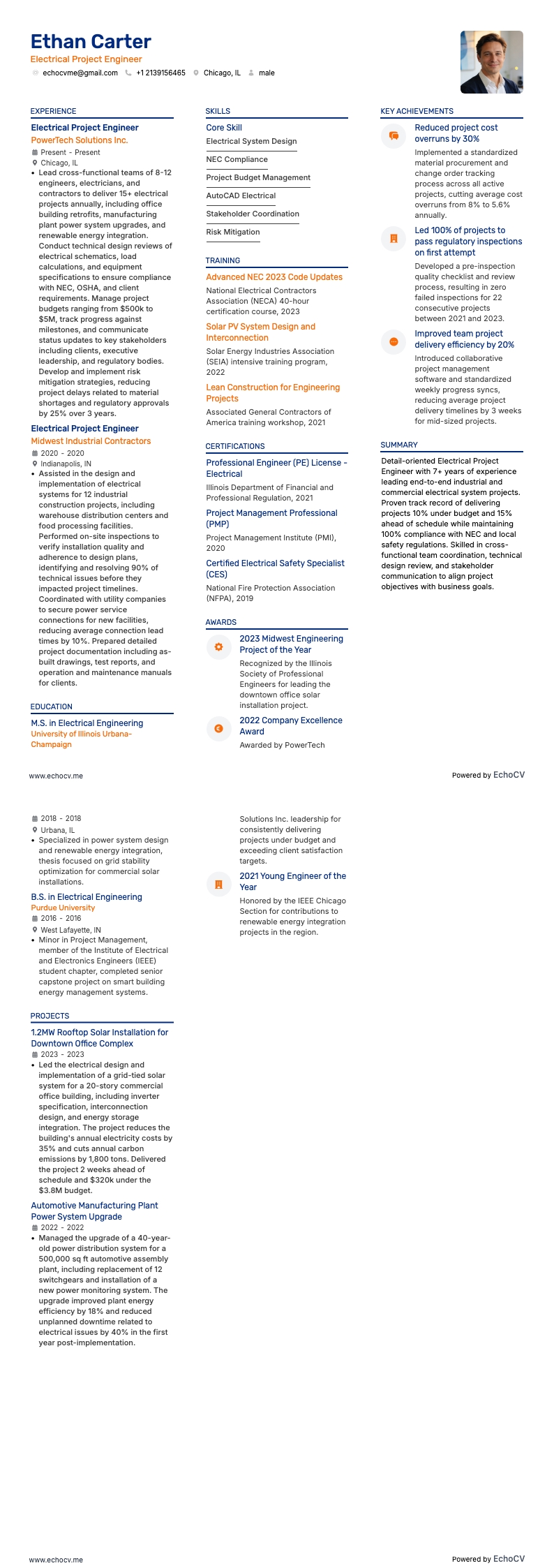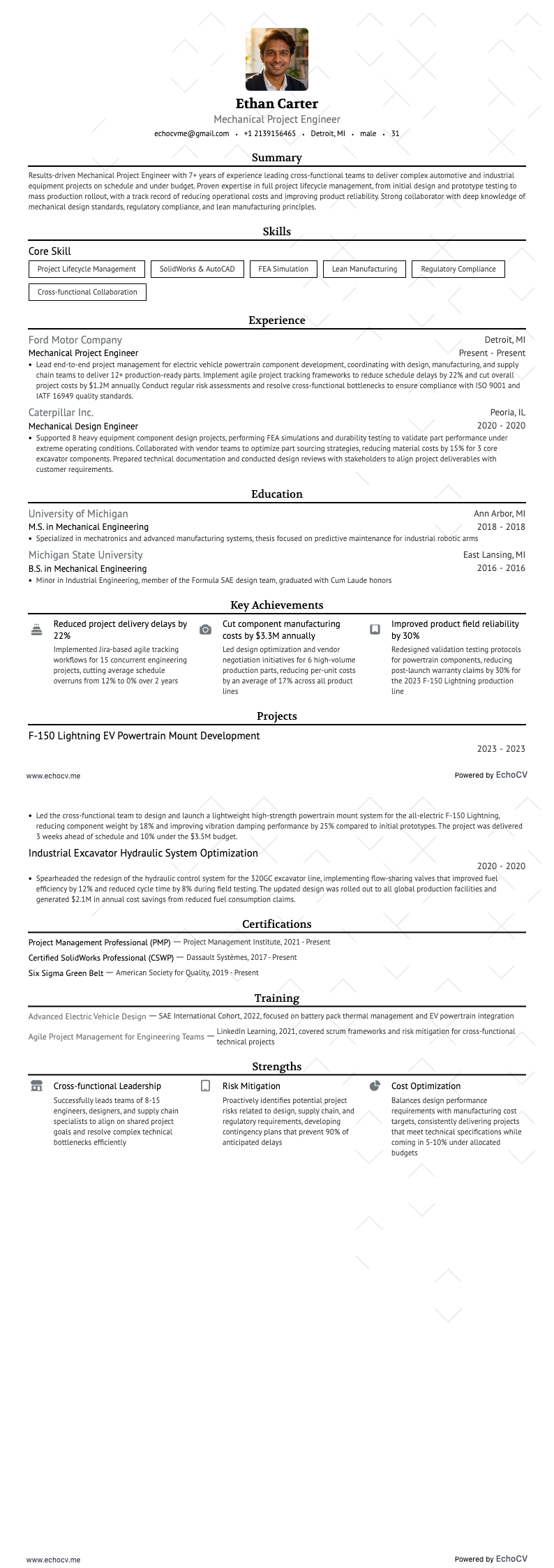
Here’s what’s right in this example:
- The example candidate lists their job title as Senior project engineer, signifying that they held a high-level role, meaning richer experience and more responsibilities. This is especially relevant when applying for another senior-level role.
- The applicant has the same experience as shown in the wrong example, but they’re describing it in the context of their top achievements and contributions. This helps them stand out and seem twice as skilled and qualified as their wrong-example counterpart.
- They’re using specific examples and metrics to add weight to their achievements: “$8M project”, “Lean Six Sigma”, “improving customer satisfaction rates by 115%”, and “lowering costs across all company projects by up to 25%”.
How to quantify the impact on your resume
Speaking of your achievements throughout your career, the best way to showcase them is to quantify them.
Show the hiring manager how you made an impact at each of your previous project engineer jobs by using “evidence”. Anything that points out exactly how or how much you made a positive difference.
Usually, that means using clear and exact metrics - percentages, numbers, and any such measures relevant to your contributions to your employer’s success.
For example…
- Include the budget size of projects managed to demonstrate financial responsibility and capability.
- Mention the number of team members led to showcase leadership and team management skills.
- State the percentage of projects completed on time to highlight efficiency and time management.
- Quantify the cost savings achieved in projects to show your impact on profitability.
- Specify the scale of projects in terms of square footage or other units to indicate experience with large-scale projects.
- Report the number of successful project bids won to reflect competitive and persuasive skills.
- Detail the percentage increase in efficiency or productivity from your initiatives to show measurable improvements.
- Note the number of cross-functional teams you collaborated with to demonstrate versatility and teamwork.
How do I write a project engineer resume with no experience
Sure, writing a project engineer resume with no such previous experience can be tricky, but there is a right way of going about it that will get you an interview.
Emphasize other achievements and non-work experience, such as:
Education
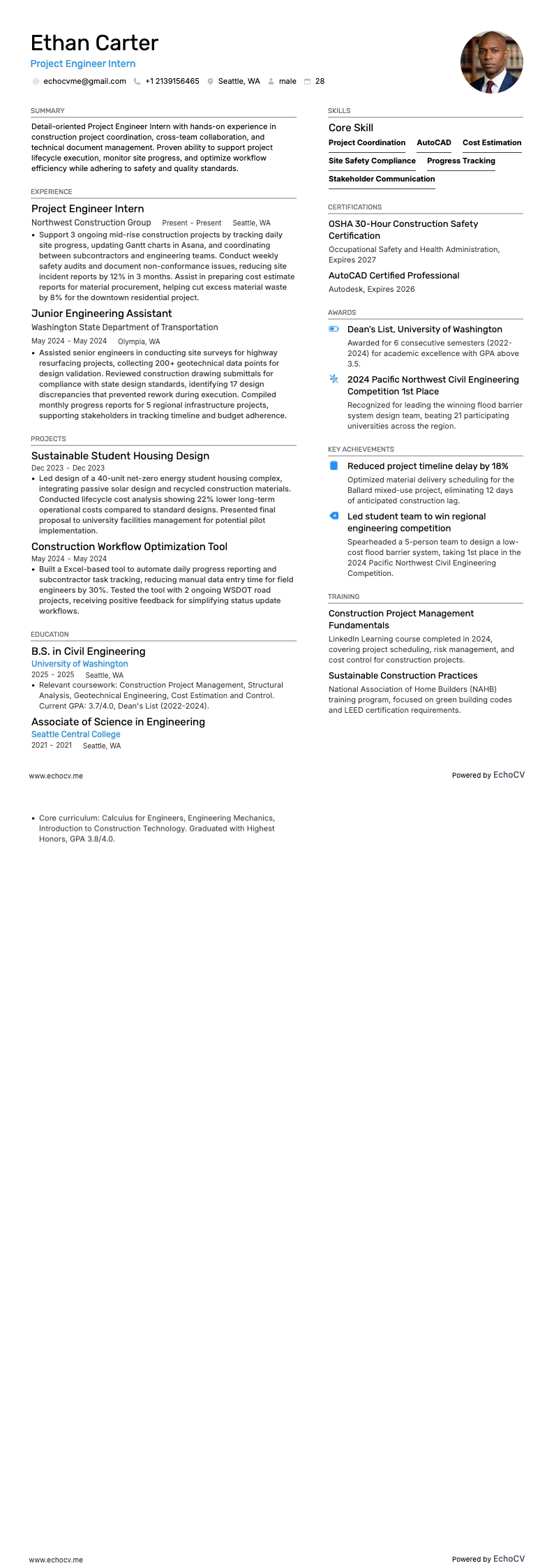
When your relevant job experience is lacking, it’s important to show you’ve put effort into learning about the intricacies of becoming a project engineer.
Highlight whichever level of formal education you’ve achieved. Focus especially on degrees and classes relevant to your desired project engineer role. Ideally, you’ll have a diploma in Engineering, Construction, or Computer Science to display. Expand on your major classes, relevant papers, projects, and all relevant awards, acknowledgments, and extracurricular studies.
You can also include your GPA, but generally, as a rule of thumb, it’s only best to do so if it’s higher than 3.5 on a 4.0 scale.
Specialized classes, courses, training, etc.
Have any non-formal education relevant to project engineering? Add them to your Education section, or if they’re more prominent than your formal education, create a new section labeled “Additional Studies” or “Courses”. List any engineering classes, project management courses, or training in computer science or construction, etc.
Internships
Make sure to list any internship you've done or are doing at the moment (this goes in your Experience section). Ideally, you've done an apprenticeship with a Site Engineer, Engineering Technician, or Technical Officer, but anything that is even remotely relevant to project engineering will do. After all, recruiters want to see eager and initiative-taking candidates.
Volunteer work
Have you taken part in any volunteer work? Maybe you spent a summer building houses in Ghana, or you volunteered to teach a class in STEM for kids.
Add them to your Experience section, name the organization you worked with, and list some main responsibilities if they're relevant to project engineering.
Projects
You may not have had any professional experience as a project engineer yet, but you will have taken part in or even headed a project at one point or another.
This includes projects you've done in school, university, apprenticeships, as part of a coursework or certification exam, etc. It also includes projects you've done in your free time as long as they're at all relevant professionally. Maybe you developed an app that helps local sustainability NGOs, or you wrote a research paper on power plants.
Whatever it is, include it. With no experience, your various projects will help you stand out significantly.
Skills
Do list all your skills relevant to project engineering. These go in a separate Skills section. You may have acquired them during your education, or while working on personal projects, it doesn't matter - emphasize them! Let the recruiter know you have the skills it takes to start working as a project engineer.
Speaking of skills…
Focus on your transferable skills
If you have some previous work experience, other than as a project engineer, listing that can help too!
In reverse chronological order (starting with the latest) list your work experience. Under each entry include three to four bullet points of:
- Any responsibilities you've had at that job that can be related to project engineering.
- Any impressive achievements you've had, such as exceeding KPIs, being promoted to team lead, being put in charge of budget management, or anything else similar that would be beneficial experience for a project engineer.
These are your transferable skills. It's things you've worked on at jobs that weren't in project engineering, and the skills you’ve acquired along the way that, however, are very much sought after in a project engineer.
How to list your hard skills and soft skills on your resume
There are two types of professional skills you need to include in your resume - hard skills and soft skills.
Hard skills are tangible, specific skills usually gained through a course, a form of education, training, etc. These are your proficiencies in certain software, mechanics, engineering tools, etc.
Your soft skills are more people-focused and are usually personality traits like your communication skills, leadership, conflict resolution, task assignment, etc.
Here’s how to list your skills on your project engineer resume:
- Create a Skills section in your resume.
- Add your skills one by one.
- Make them as concise as possible. They’re supposed to be easy to spot and digest, not something that needs elaboration.
- Separate the hard skills from the soft ones for a more organized look.
- Focus on the skills relevant to project engineering. For example AutoCAD and Project Management. Even if you’re amazing at it, leave Video Editing out.
- List the skills you’re best at. If relevant, or if you’re barely starting in your career, you can also add skills you’re intermediate in. However, don’t add anything you’ve only heard of in passing. Employers will expect you to use the skills listed.
- Tailor your Skills section to the job ad you’re applying to.
Check out the requirements listed and add the same skills (that you possess of course) word for word. If the company is using ATS (applicant tracking software), it will match keywords from the job ad with your resume. You want to make your resume light up like a Christmas tree.
Not to mention that, much like ATS, recruiters are also used to quickly skimming resumes for the relevant keywords, and you want to stand out as a suitable candidate as quickly as possible.
This is a good rule of thumb to follow in general when writing your resume. If the job ad has phrased it as “project management” instead of “project managing”, then you should also use the same wording.