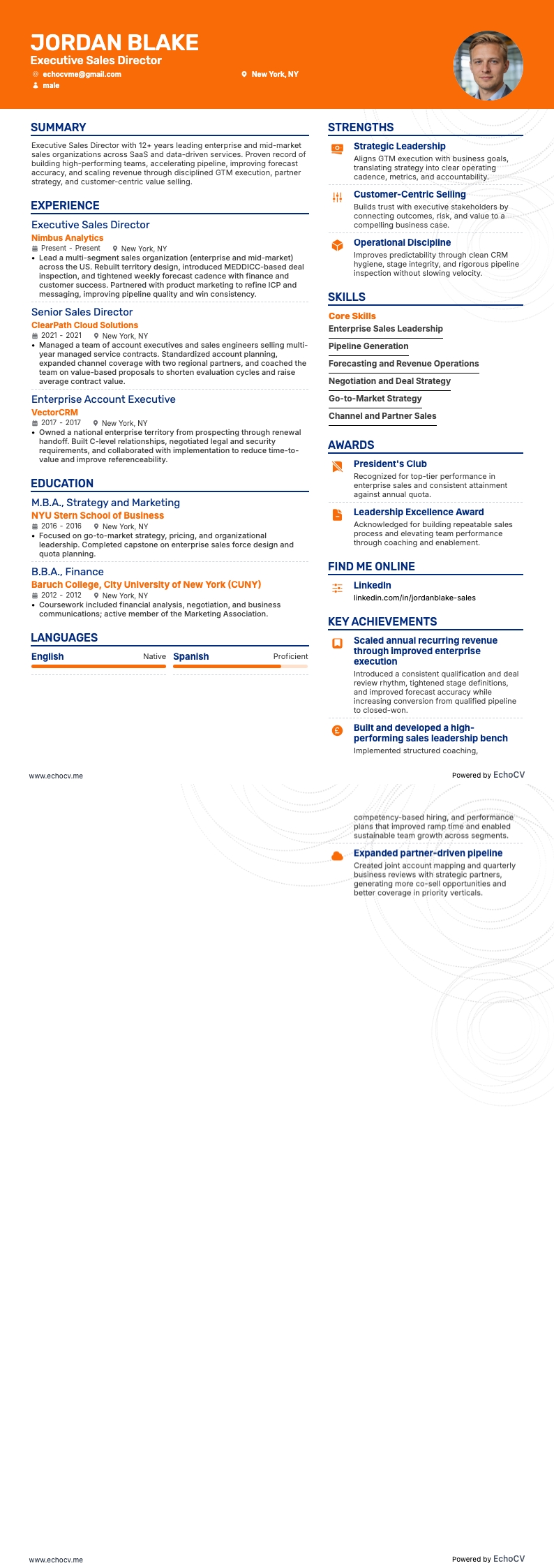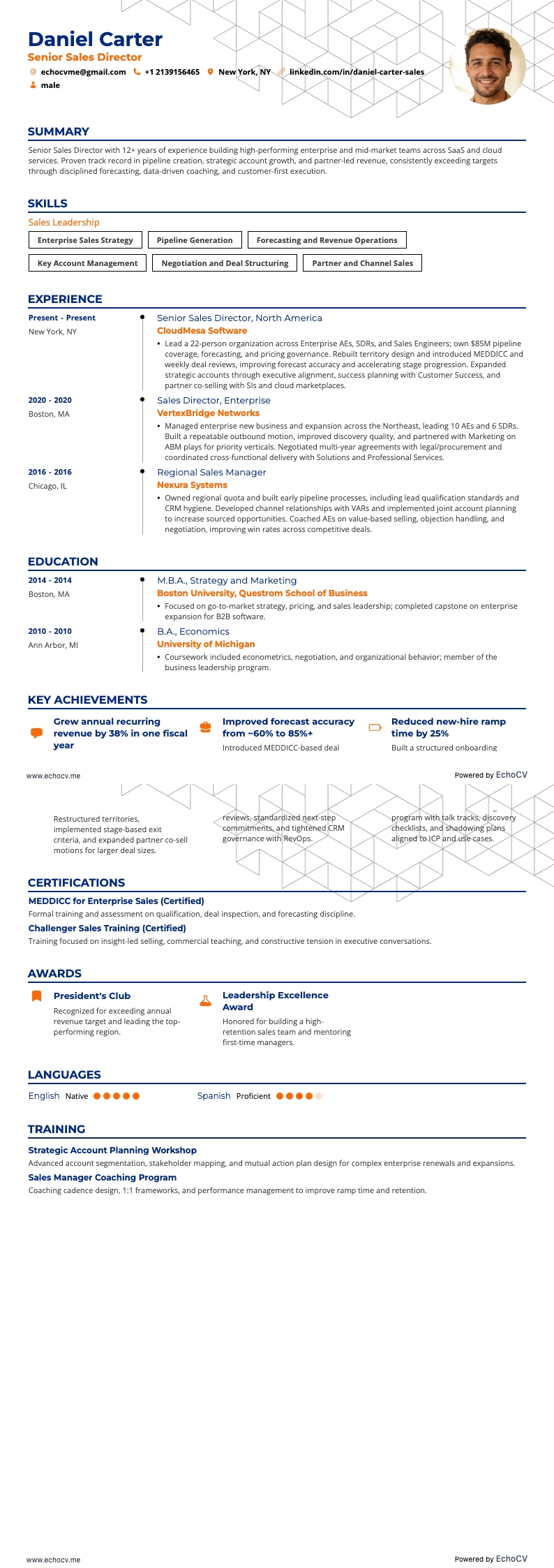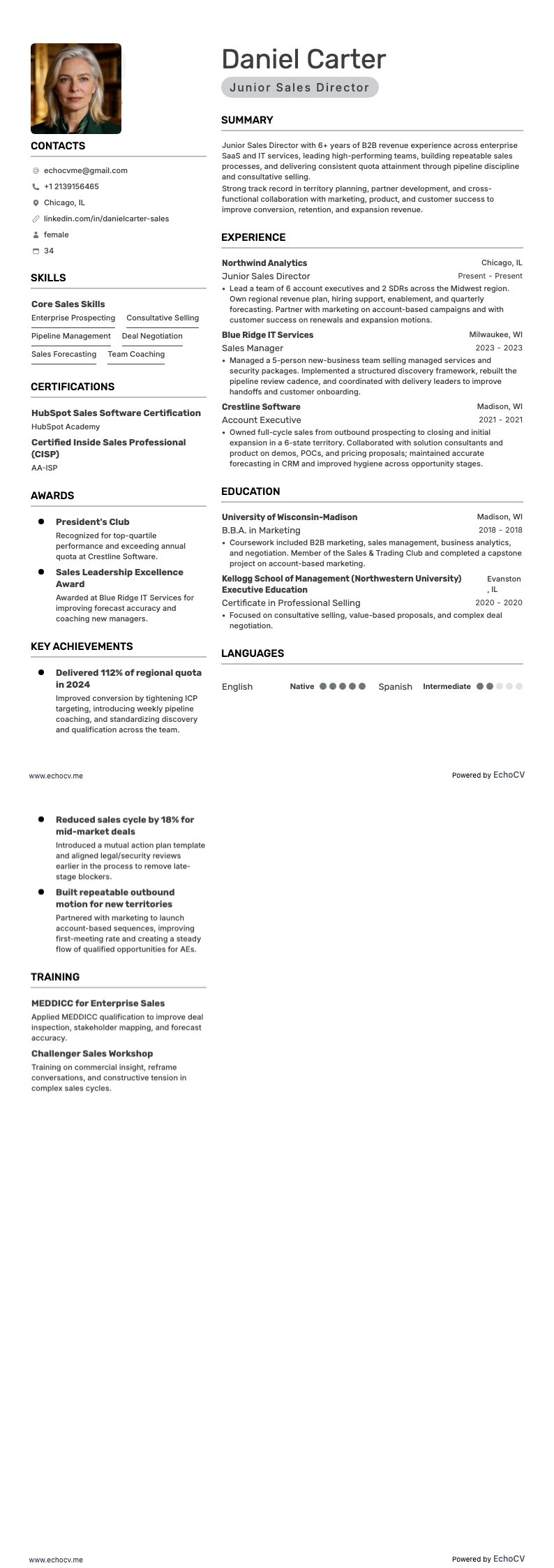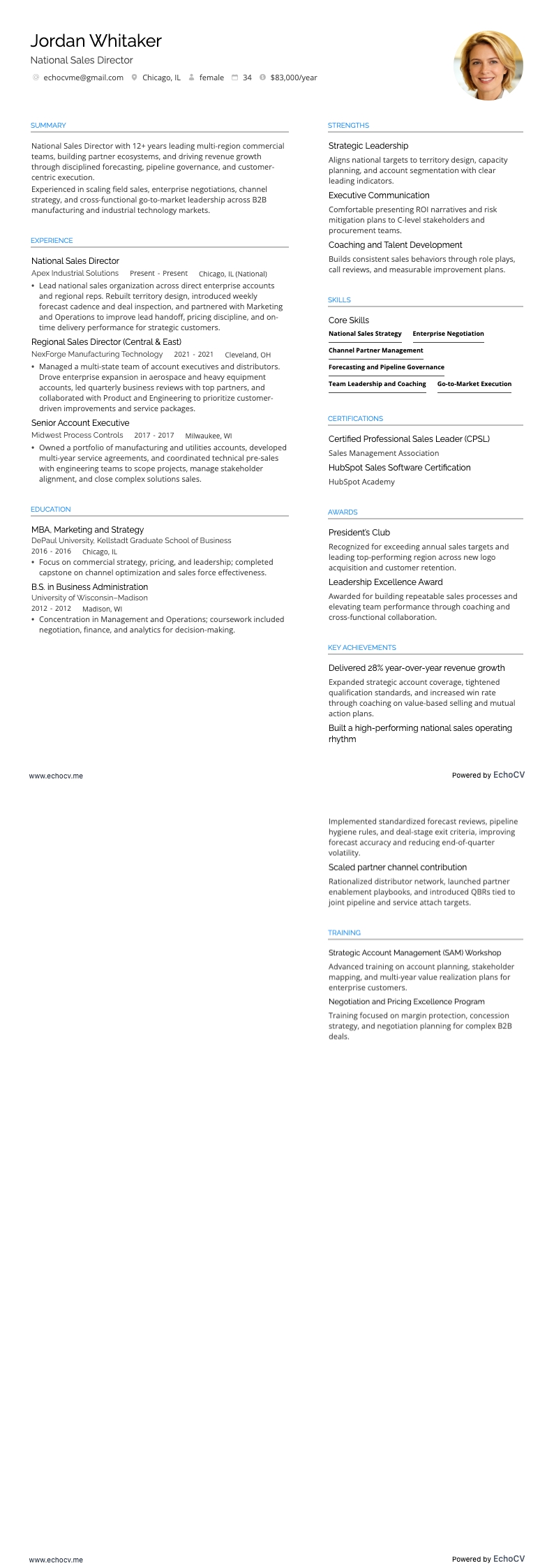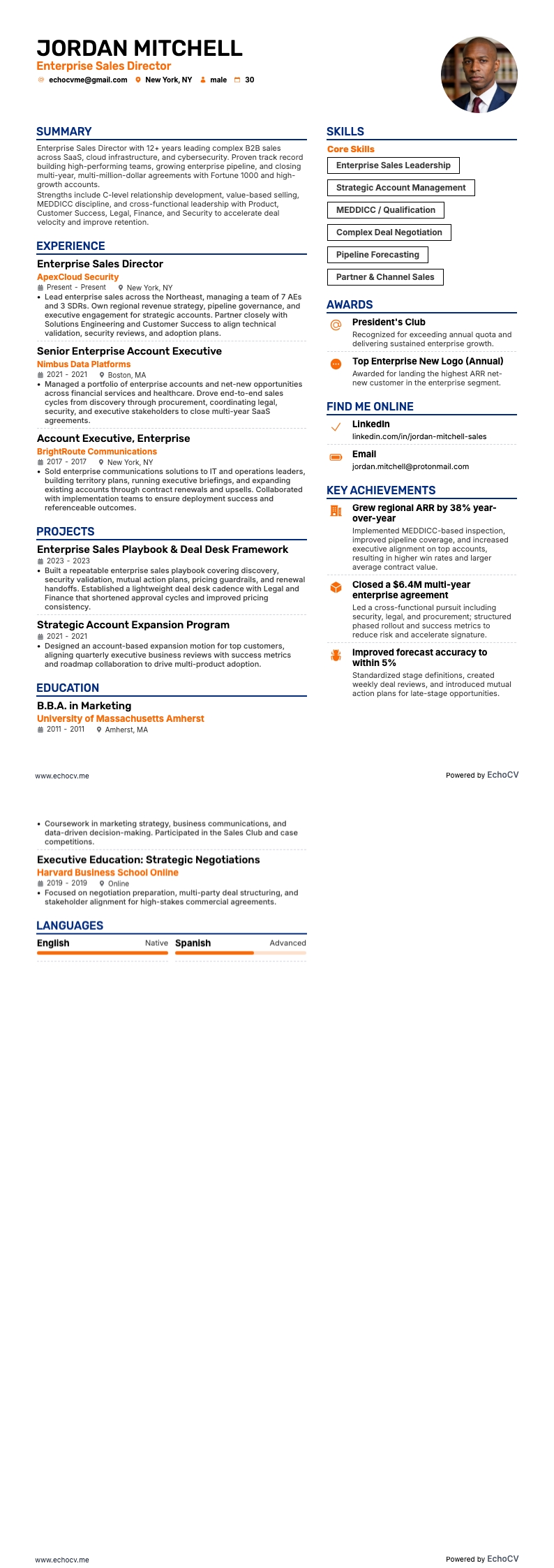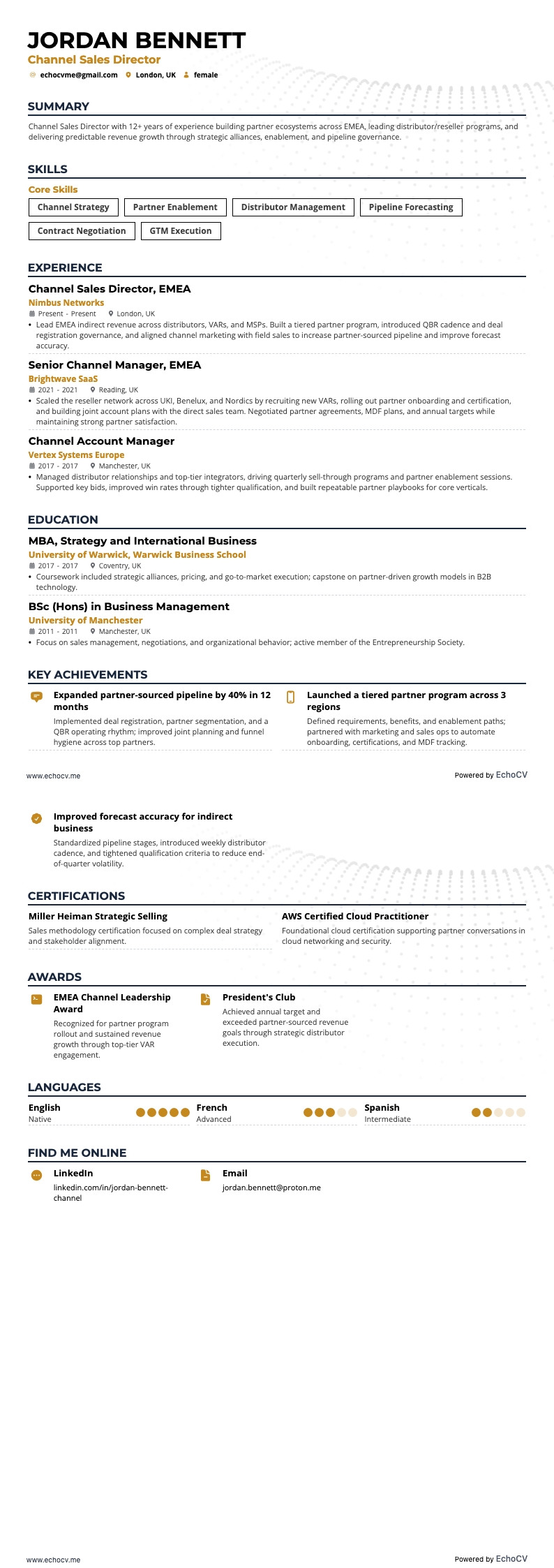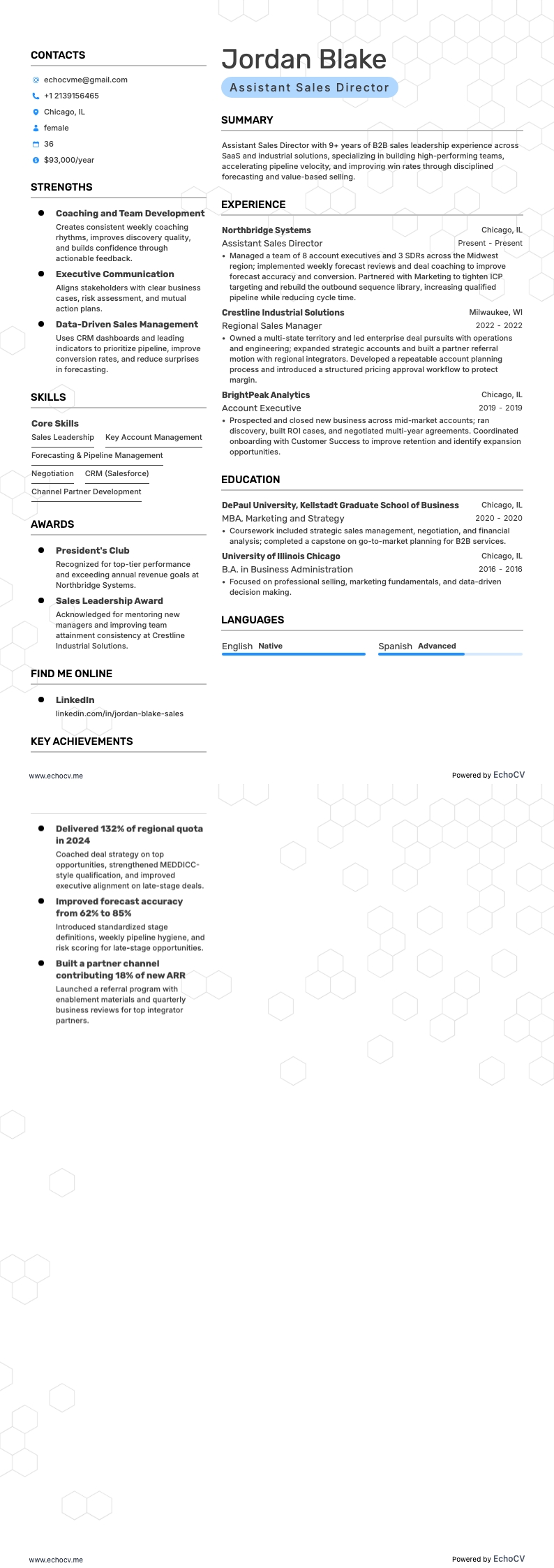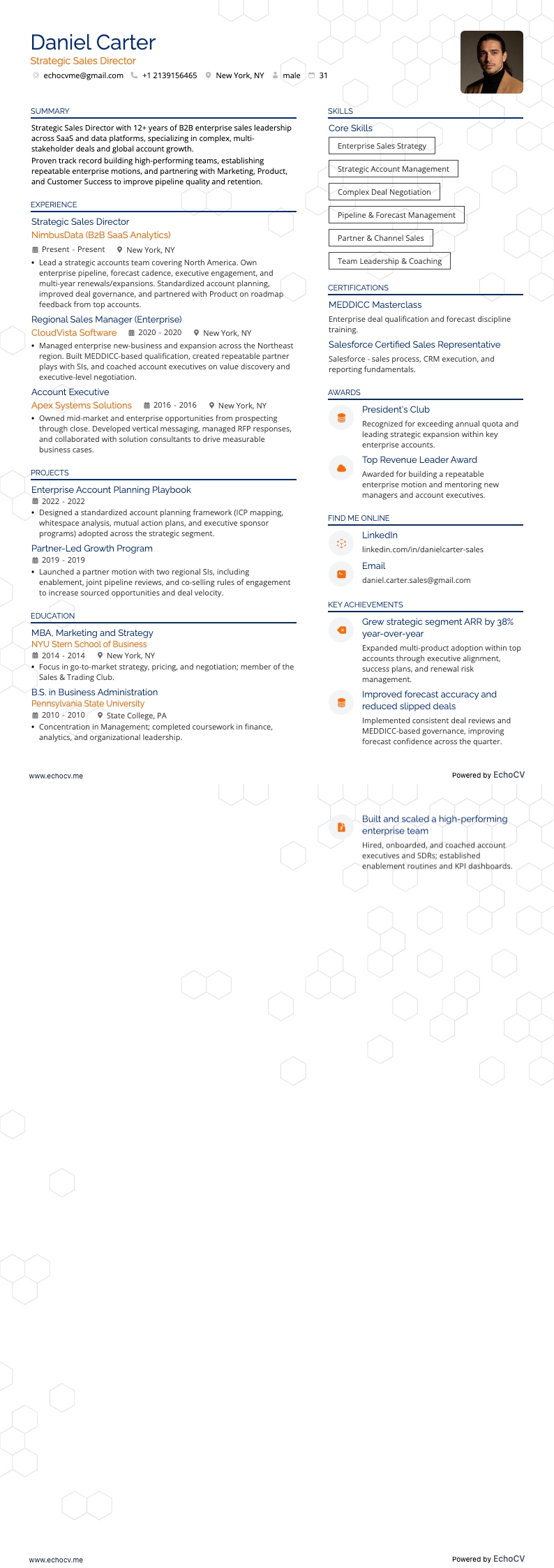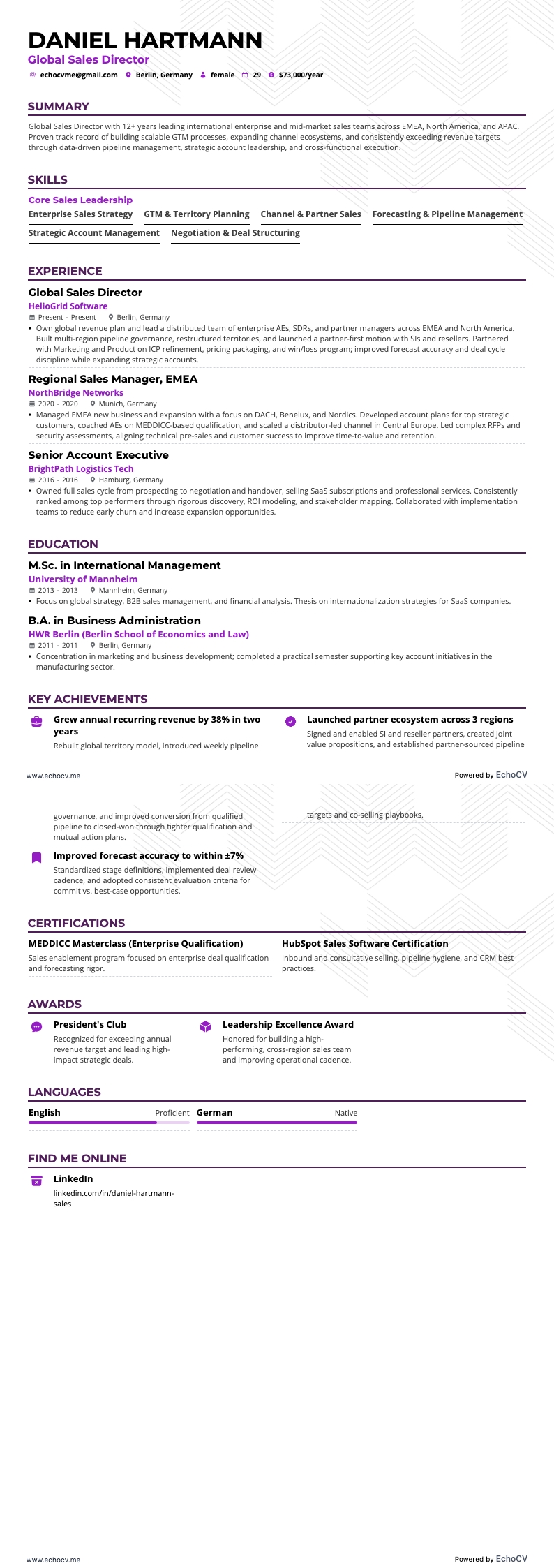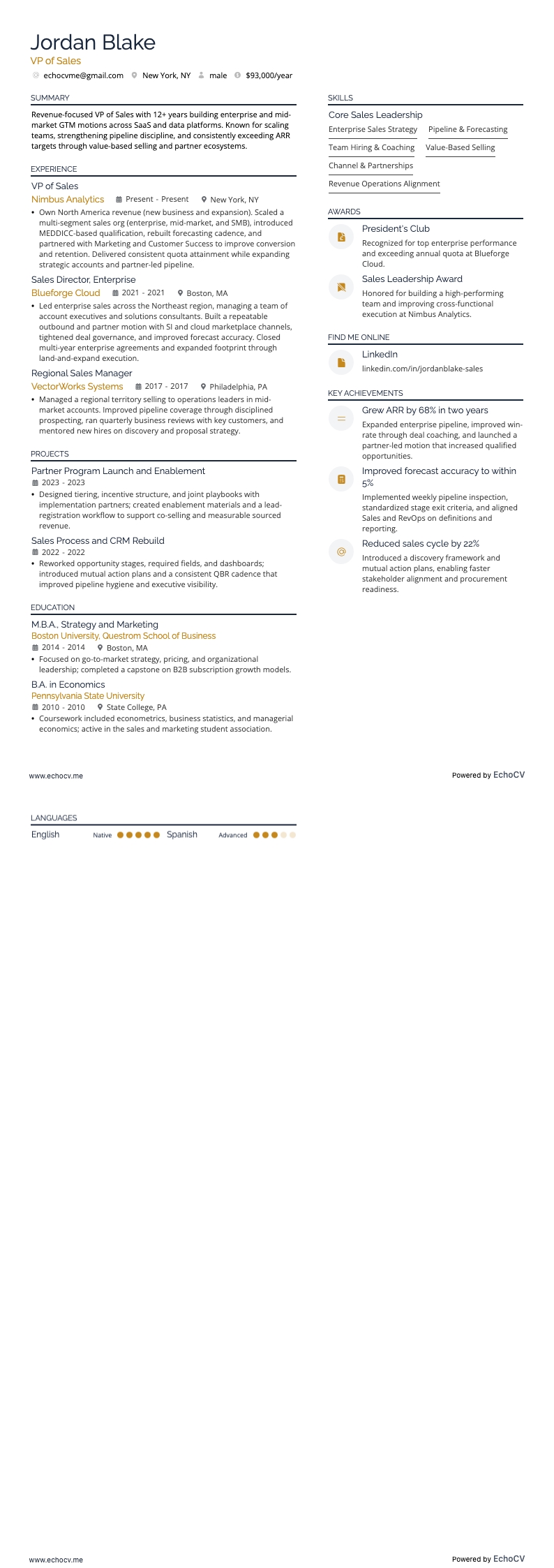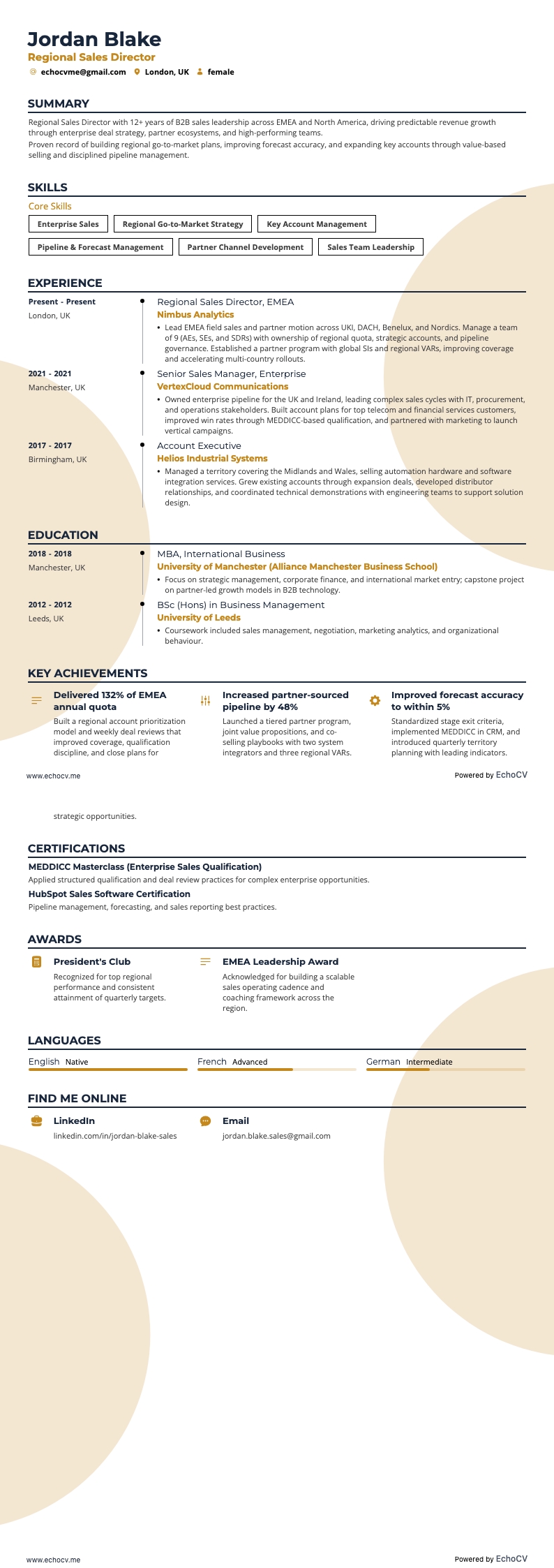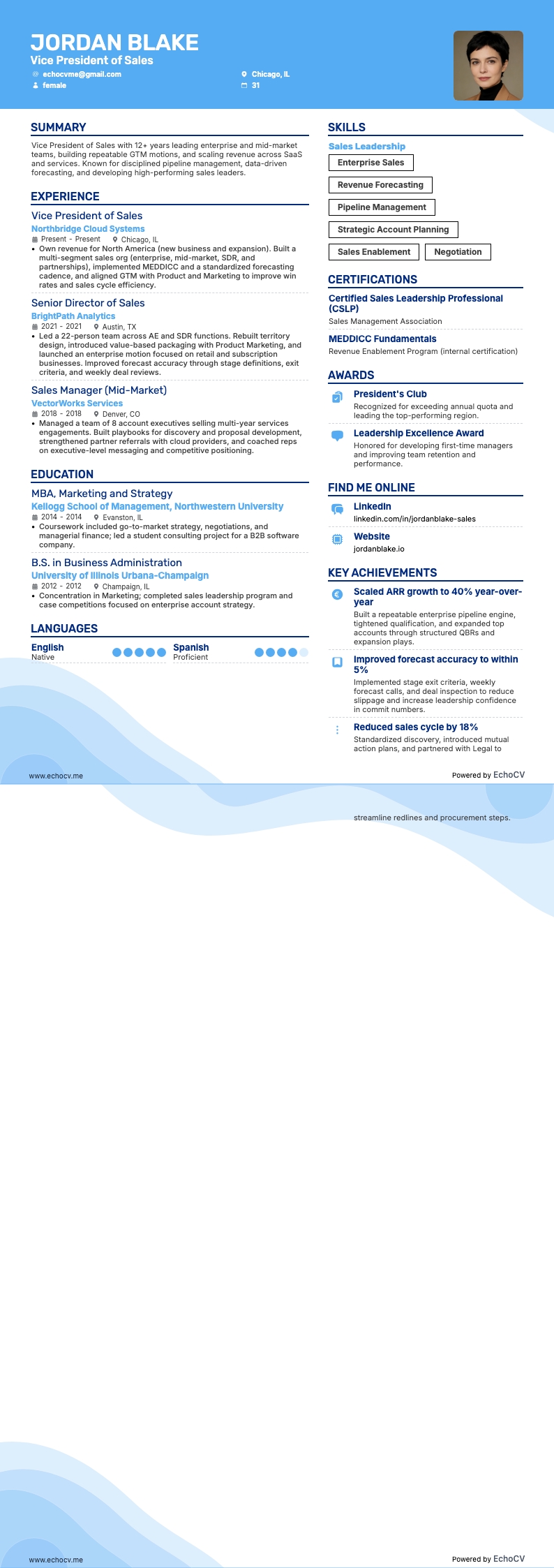
The second example reads so much better. Here’s why:
- Each bullet conveys one leadership responsibility and the ROI of said responsibility.
- Every point includes quantifiable metrics so hiring managers don’t have to second guess how great the applicant is when it comes to leading a team or improving sales processes.
- It shows proof of their soft skills — collaboration and communication skills — that helped the applicant work with interdepartmental teams and get budget approval from senior management.
How to quantify the impact on your resume
Sales professionals are a numbers-oriented bunch. At the most junior level, you’re taught that the number of leads you contact affects the number of meetings you make, and therefore your monthly sales.
The love for quantifiable metrics goes all the way to the top, except in this case your achievements aren’t centered on sales quotas but on high-level gains like reducing the sales cycle, and increasing market shares.
You know the hiring committee, many of which are VPs and C-execs, will zoom in on your numbers. So how can you include metrics on your resume?
Let’s start with the quantifiable achievements you can include on your resume:
- New revenue
- Revenue increase
- Number of clients or deals closed
- Cost savings in streamlining the sales process
- Team growth, especially if you’ve scaled the sales team
- Performance improvement after the initial product launch, or a successful product launch
- Increase in market share for existing offers
- Performance improvement when entering a new market
- Ranking in the national or global sales team
- New sales channels opened, such as online shopping websites, trade shows, etc.
After that, you can either follow the Challenge - Action - Result (CAR) or Situation - Task - Action - Result (STAR) format in writing the bullet points. You don’t always have to write the bullet points as is, you can mix up the order of each element, as in Action - Result - Challenge.
ARC Example:
Secured 5 new accounts with a total revenue of $3.5M for a new health supplement launched in July 2025.
The action is securing the accounts, the result was the $3.5M revenue and the challenge was that it was a new health supplement brand. This short bullet point tells a powerful story but it doesn’t go into the long and technical details of how you made it happen. Best leave that for the interview.
Check out this guide on how to write story bullet points.
How do I write a sales director resume with no experience?
You need a proven track record and about 7 to ten years of experience in a sales role or related management position to get a job as a sales director. But what if you don’t have any experience in a director-level role?
There’s no single correct path that leads to a sales director job. While many sales directors started as sales managers or regional sales managers, some started as marketing directors, customer service heads, and even in operations management. So as long as you’re not applying with no management experience whatsoever, there’s still hope for you.
The important thing is you know how to train and coach teams, improve systems, and prove that you have what it takes to create winning sales strategies.
Now with all that said, here’s how you can translate your previous sales or leadership experience into an attention-grabbing sales director resume.
- If you have no sales experience, focus on how your other experiences increased revenue for the company. This can come in the form of a winning marketing campaign, or an improvement in upsells from a customer service team you’re managing.
- Explain how well you coach people. List specific mentoring techniques you use, like creating incentive programs or using quarterly reviews instead of annual reviews. Don’t forget to mention how these techniques resulted in new business or increased productivity in your team.
- Highlight strategic initiatives and projects you created, and product launches you oversaw, as this is a common task for sales directors.
- List specific revenue targets met or exceeded, and new accounts you helped acquire — even if you’re not in a sales role — as long as you collaborated with the team who closed the deal.
- If you have no sales experience, emphasize other transferable skills you have from other industries like training and coaching, strategic planning, business development or networking.
How to list hard skills and soft skills on your resume
It’s tempting to just squeeze in all your sales director's hard skills and soft skills onto your resume. But that might make your application well over 3 pages long— or more! That might help you pass the ATS screening but that’s a lot of wasted real estate. Who knows if the recruiter will bother reading the rest of your application??
Besides, passing the ATS screening by blindly pasting a list of skills is a gamble. You might hit the common skills like communication, strategic planning, and forecasting, but what about specific data analysis and enterprise planning software? You won’t be able to list all of them
The best strategy is to look at the job ad — or several job ads, and pick 5 hard skills and 5 soft skills mentioned that also align with your skill set.
Hard skills, by the way, are specific to the role and can be tasks you do like sales forecasting or software you know how to use like a Customer Relationship Management (CRM) software. Soft skills aren’t limited to the job, that’s why many soft skills are transferable or applicable to different roles and industries.
The job ads you see might mention basic sales skills like pipeline management and product knowledge. Skip that, at least for this section. Remember you only have about 10 slots to fill, so focus on director-level tasks like sales team training, sales forecasting, and C-suite business development.